Futureproof Festival / 2026
Philippe Pasquier: the instrument has a person attached
The conversations worth coming back to.
Source and citation
This is an authored, illustrated recap. The session date records when the talk took place. An edited transcript and festival recording have not been released on this page.
Kris Krüg. “Philippe Pasquier: the instrument has a person attached” Futureproof Festival 2026 proceedings, Volume 01. Session: 2026-10-28. Edition updated 2026-11-06. https://www.futureproof.website/2026/proceedings/sessions/philippe-pasquier-live-set/
You can also select and copy the citation above.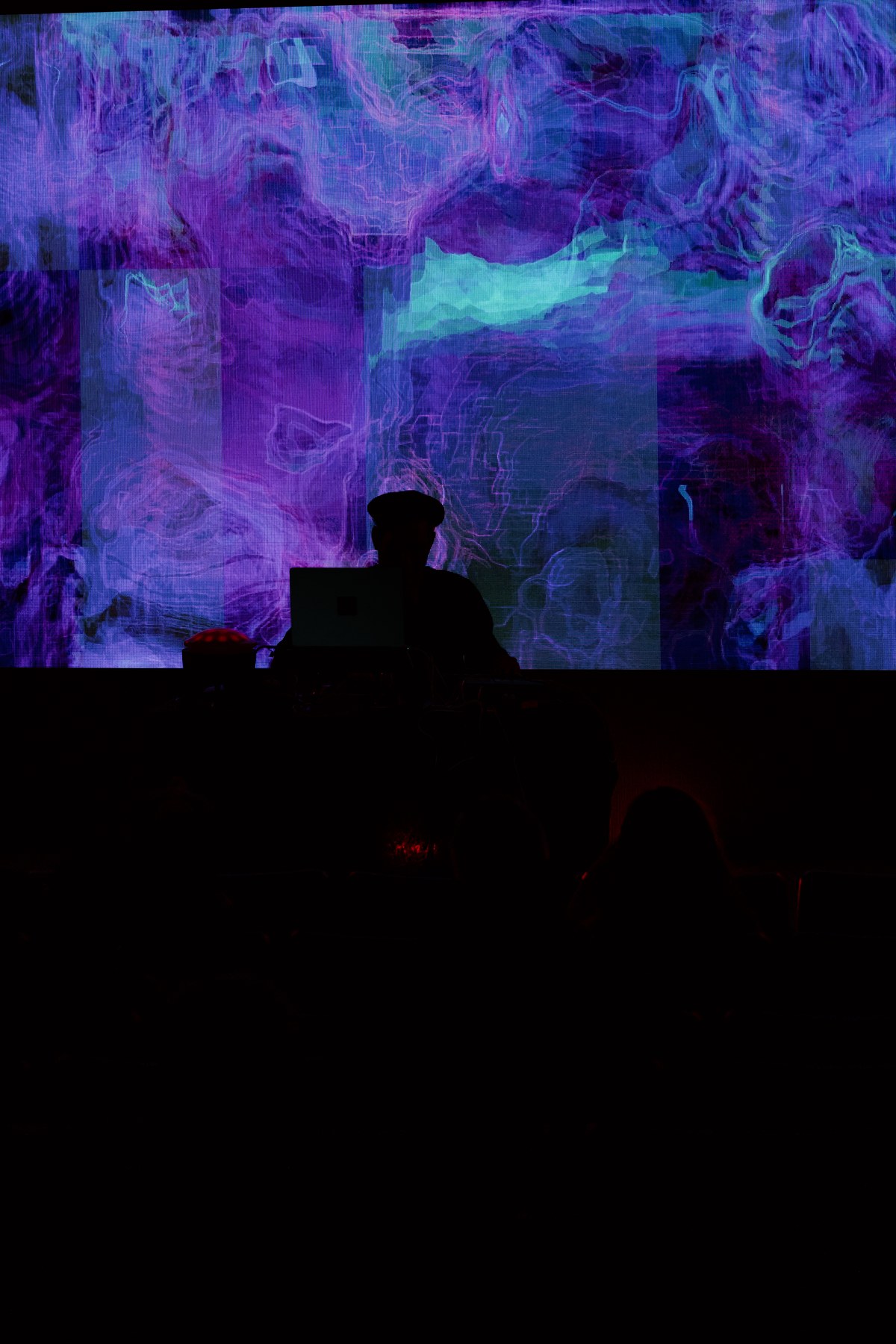
Philippe Pasquier's opening-night performance at Futureproof Festival of AI, October 28, 2026.
The projection takes up most of the picture. Purple and blue forms, with a person in silhouette underneath.
That small human shape is worth keeping in the frame.
Philippe Pasquier brought a live generative performance to the opening night of Futureproof Festival of AI, presented by BC + AI at Vancouver's H.R. MacMillan Space Centre. Michelle Diamond's photographs give us several ways to look at it: the projected work, the equipment and the person at the controls.
In my Year One account, the performance sits beside the evening's talks and working demonstrations. Different ways to get a difficult conversation out of the abstract and into something people could encounter.
Here, the images carry the story. The argument begins with the relationship they keep visible: a generative system being played by somebody.
Put the controls back in the picture
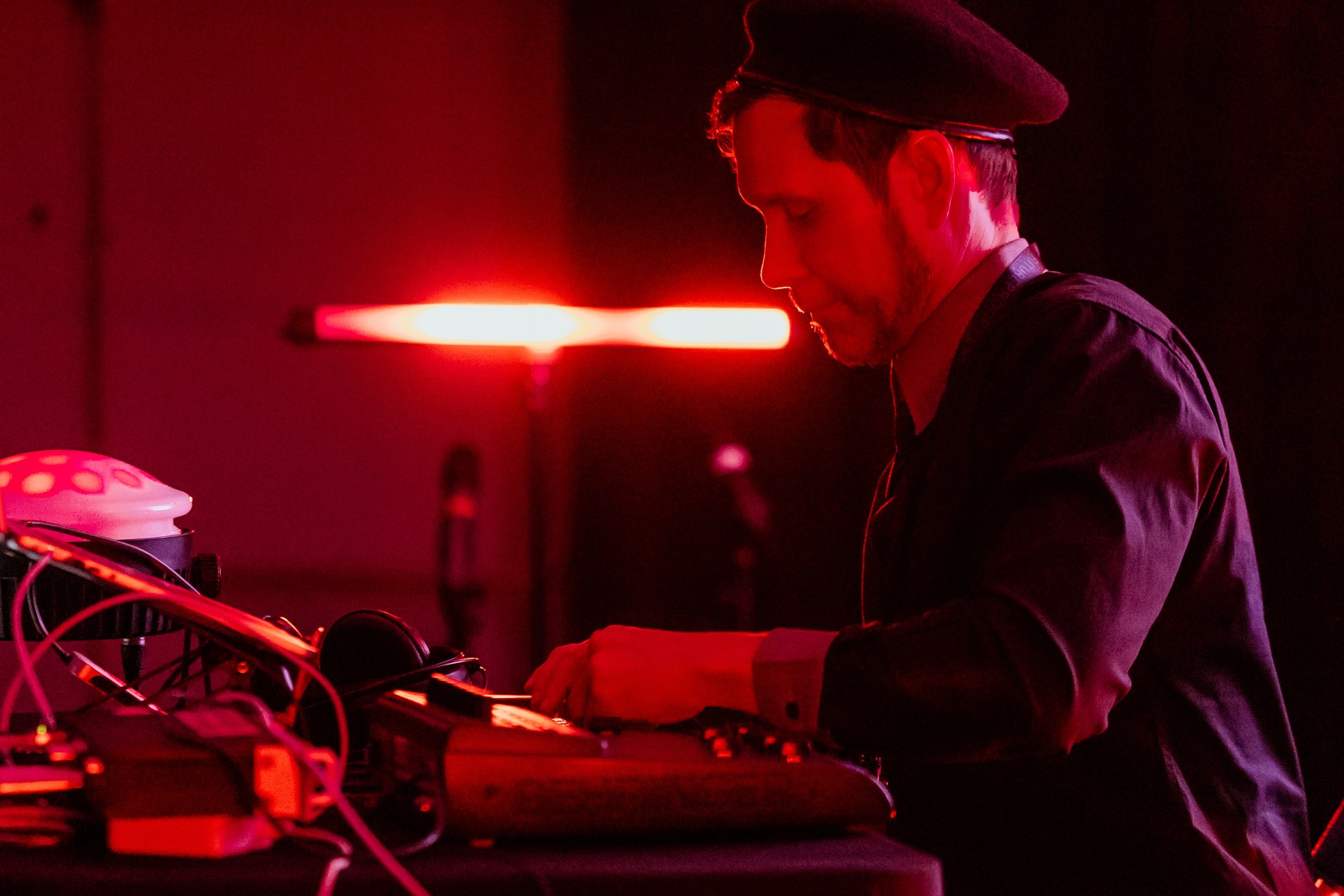
A close view of the performer at the controls during the Wednesday set.
A product gallery usually gives us the result. The interface, the awkward decisions and the person doing the work tend to disappear.
This photograph keeps the machinery and the hands together. A table, cables, a laptop and someone attending to them. The projection belongs to an activity taking place in front of people, with the work of performing still visible.
It changes what is worth asking. What can the performer steer? Which possibilities have been prepared? What can be repeated, varied or interrupted?
Those questions take a little longer than asking which model made the picture. They get us closer to the craft.
Philippe supplied one concrete connection in his Friday talk: he said he had used Autolume during the Wednesday performance. His lab describes it as a visual synthesizer, and that language gives us a useful way into the practice.
A model can become an instrument
Autolume's official project page describes a system for artists to prepare material, train or adapt models and work with their outputs in real time. Its performance documentation shows controls for moving through a model's latent space, varying image characteristics and making loops.
Think of that space as the possibilities a particular model can produce. The interface gives a person ways to move among them. Choices about the source material and model happen upstream; choices about what to do with the possibilities continue in performance.
That doesn't settle authorship, rights or artistic value. It does make the work more specific than “AI made this.” Somebody has to decide which material to begin with, which changes are interesting and what deserves another person's attention.
On Friday, Philippe compared learning a stable system with learning a violin. If the instrument keeps changing, becoming proficient carries a recurring cost. Staying with it can be an artistic decision.
There is a satisfying bit of stubbornness in that. The release calendar doesn't get to be your entire practice.
An archive brings a history of choices
My photography has its own connection to this work. The Metacreation Lab credits Alpha Prism to Kris Krüg, Lionel Ringenbach, Philippe Pasquier and Arshia Sobhan. I wrote about the earlier Wosk Centre portraiture experiment in 2024.
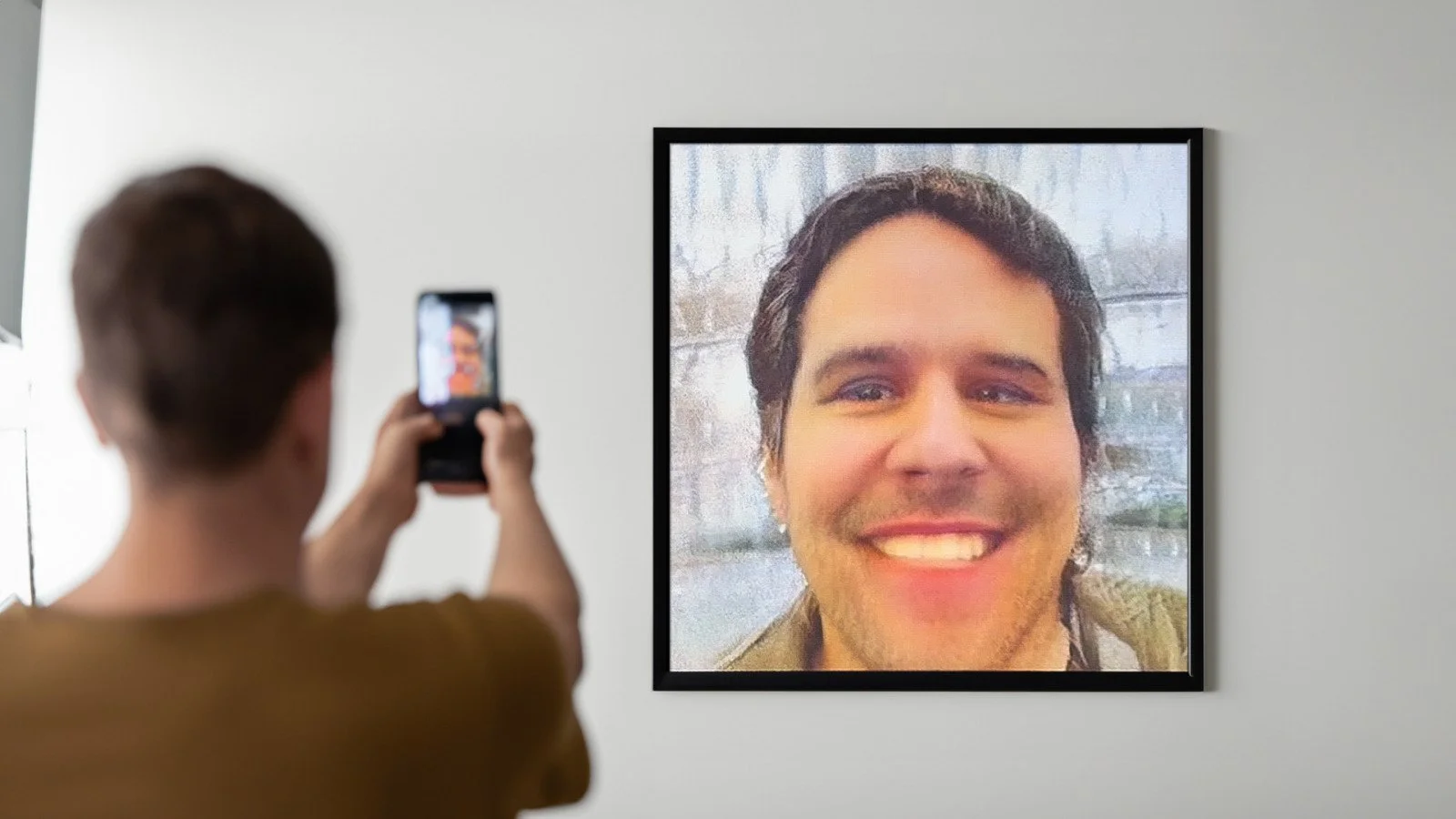
Related project context: Alpha Prism, as illustrated on the Metacreation Lab's Autolume project page. Credits: Kris Krüg, Lionel Ringenbach, Philippe Pasquier and Arshia Sobhan. This installation image is not from the Futureproof set; the portrait on the display is generated artwork.
A photographic archive contains choices made before anyone trains a model. Where to stand. When to press the shutter. Which frame to keep. What light, expression or accident feels worth returning to.
Working with that archive opens another set of choices. It also asks what persists from the original practice and what changes when photographs become material for a generative system.
Alpha Prism is a separate project, rather than a name for the Wednesday performance. The connection is the practice of treating a body of work as material an artist can return to and reshape.
An archive has a past. A performance asks what somebody can do with it now.
Give the work somewhere to happen
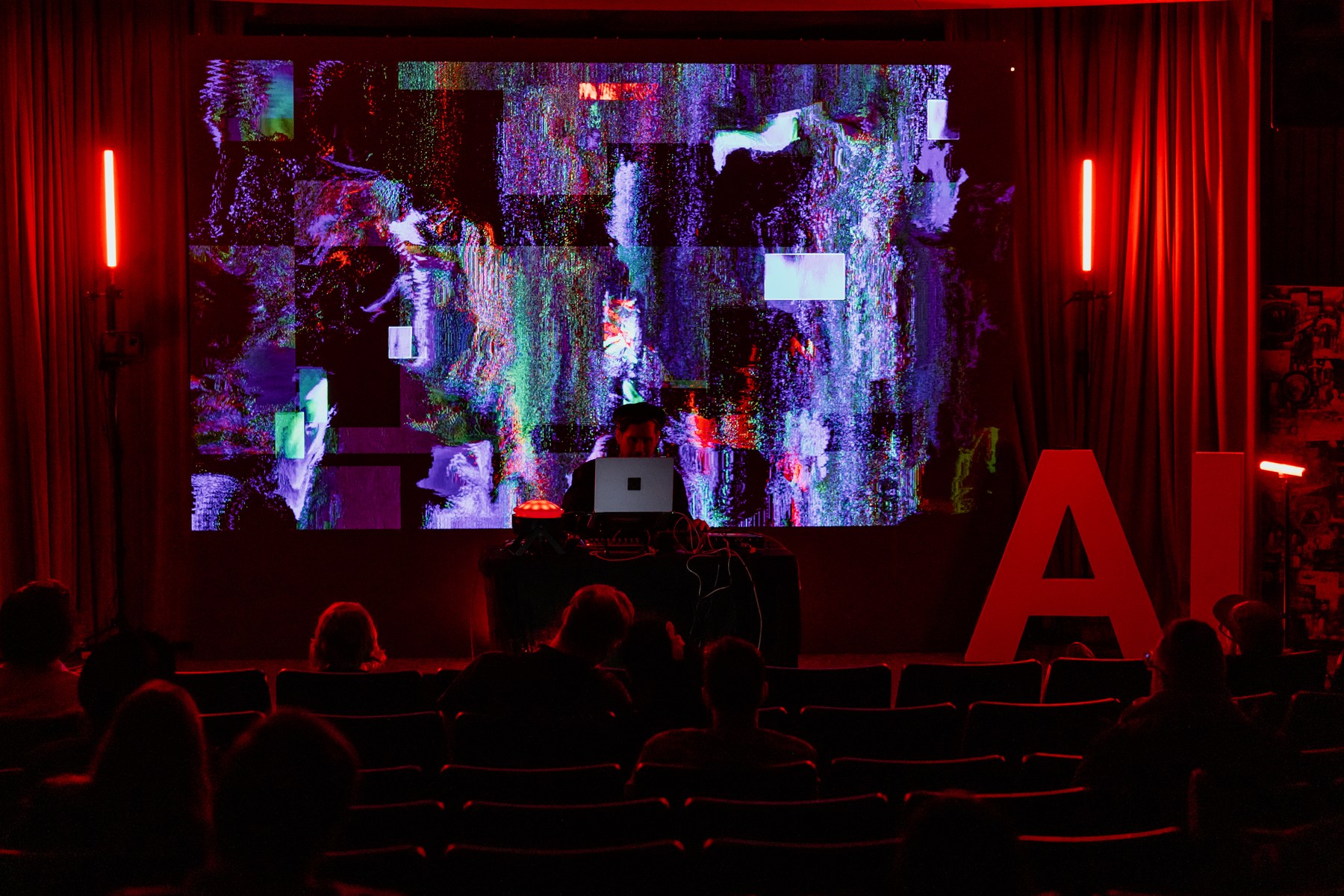
The opening-night set in the Space Centre theatre. The projected image is the performed visual work, not a presentation title card.
The wide photograph brings the audience back into the composition. People, equipment and projection occupy the same place. The image no longer floats alone in a feed.
That matters for the way we talk about creative AI. A finished output can invite a quick verdict. Showing a practice gives us more to examine: the relationship between the person and the system, the choices the work makes available, the setting in which it is encountered.
Our BC + AI Film Club carries a related habit into screenings and workflow conversations. Put the work on a screen, then ask the maker how it happened. A conversation with something specific in front of it has somewhere to go.
These photographs hold onto that specificity. An artist at a table. The work projected above him. People there to encounter it together.
Keep the person in the frame. There is still plenty to ask them.