Futureproof Festival / 2026
Dean Shev: who answers when the answer is wrong?
The conversations worth coming back to.
Source and citation
This is an authored, illustrated recap. The session date records when the talk took place. An edited transcript and festival recording have not been released on this page.
Kris Krüg. “Dean Shev: who answers when the answer is wrong?” Futureproof Festival 2026 proceedings, Volume 01. Session: 2026-10-29. Edition updated 2026-11-06. https://www.futureproof.website/2026/proceedings/sessions/dean-shev/
You can also select and copy the citation above.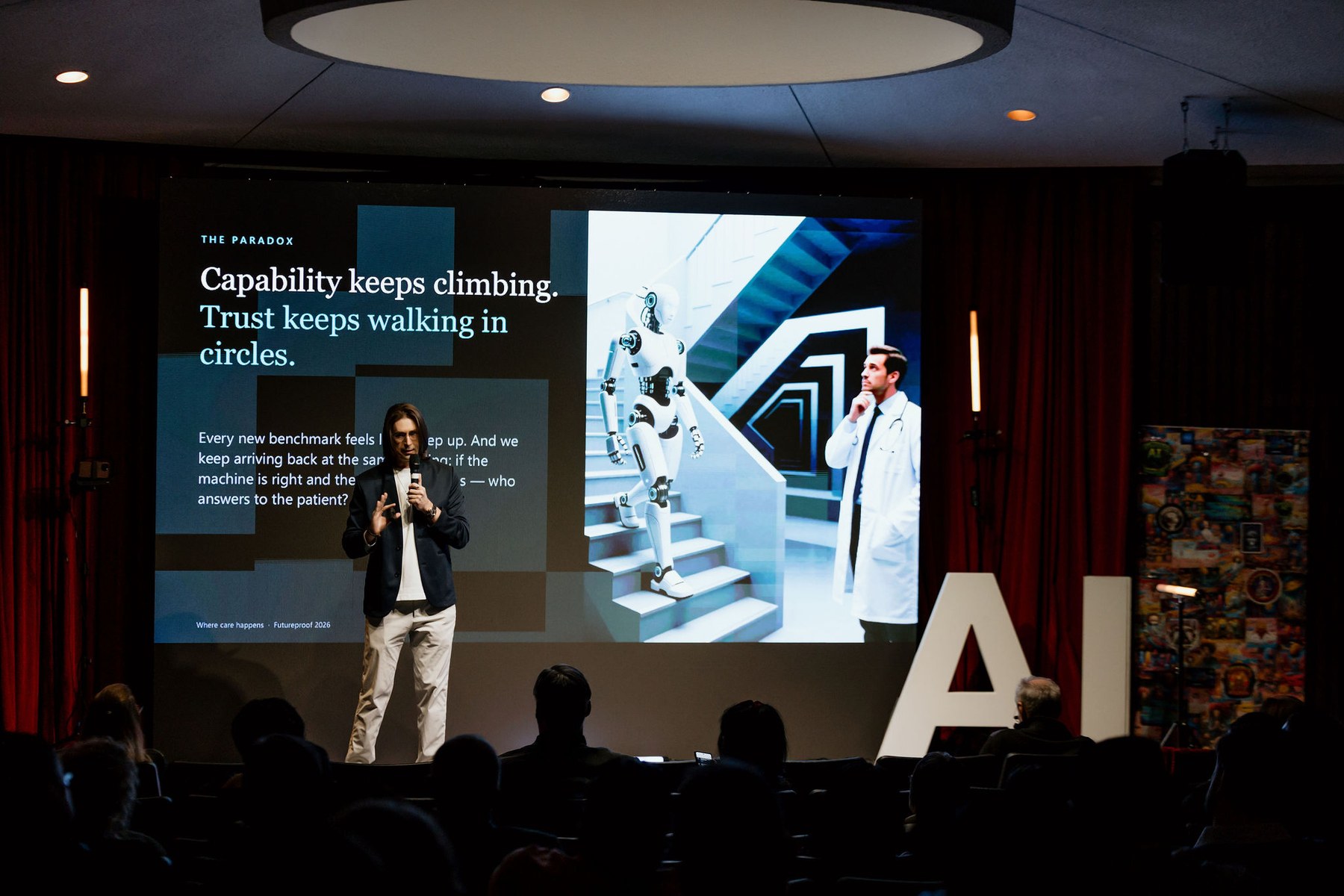
Dean Shev at Futureproof Festival of AI, October 29, 2026. The projected image is an illustration from the presentation.
The answer arrives immediately. It sounds informed. It may even perform well on the task used to test it.
Who is going to answer for what happens next?
Dean Shev brought that question to Futureproof from his work building health technology. As co-founder and CTO of VHT.ai, he described work on AI assistance for people trying to understand health information and navigate care.
The question he wanted to keep in view was the person's position in the exchange: what information the system used, what the person had agreed to, what could be checked and who could intervene.
A soothing voice doesn't fill in those blanks.
A reasoning score doesn't finish the care question
Dean discussed research comparing AI and physician performance on difficult medical cases. It was part of his argument that capability and accountability are different problems.
The Brodeur and colleagues preprint referenced in his presentation examines several medical reasoning tasks. Its December 2024 version compares model outputs with historical physician and model baselines, including a small set of patient-management vignettes graded by physicians. Its authors call for trials in clinical settings.
A score on those tasks does not mean the same percentage of patients will be diagnosed or treated correctly. The move from a bounded evaluation to care involves people, information, workflow and consequences that a headline score doesn't contain.
Dean's central concern survives that distinction. If the system and a clinician disagree, someone still has to investigate the disagreement and communicate what follows to the person affected.
Three promises, several engineering problems
He organized the talk around three patient-facing expectations: avoid harm, protect the person's data and explain the answer in a way that can be questioned.
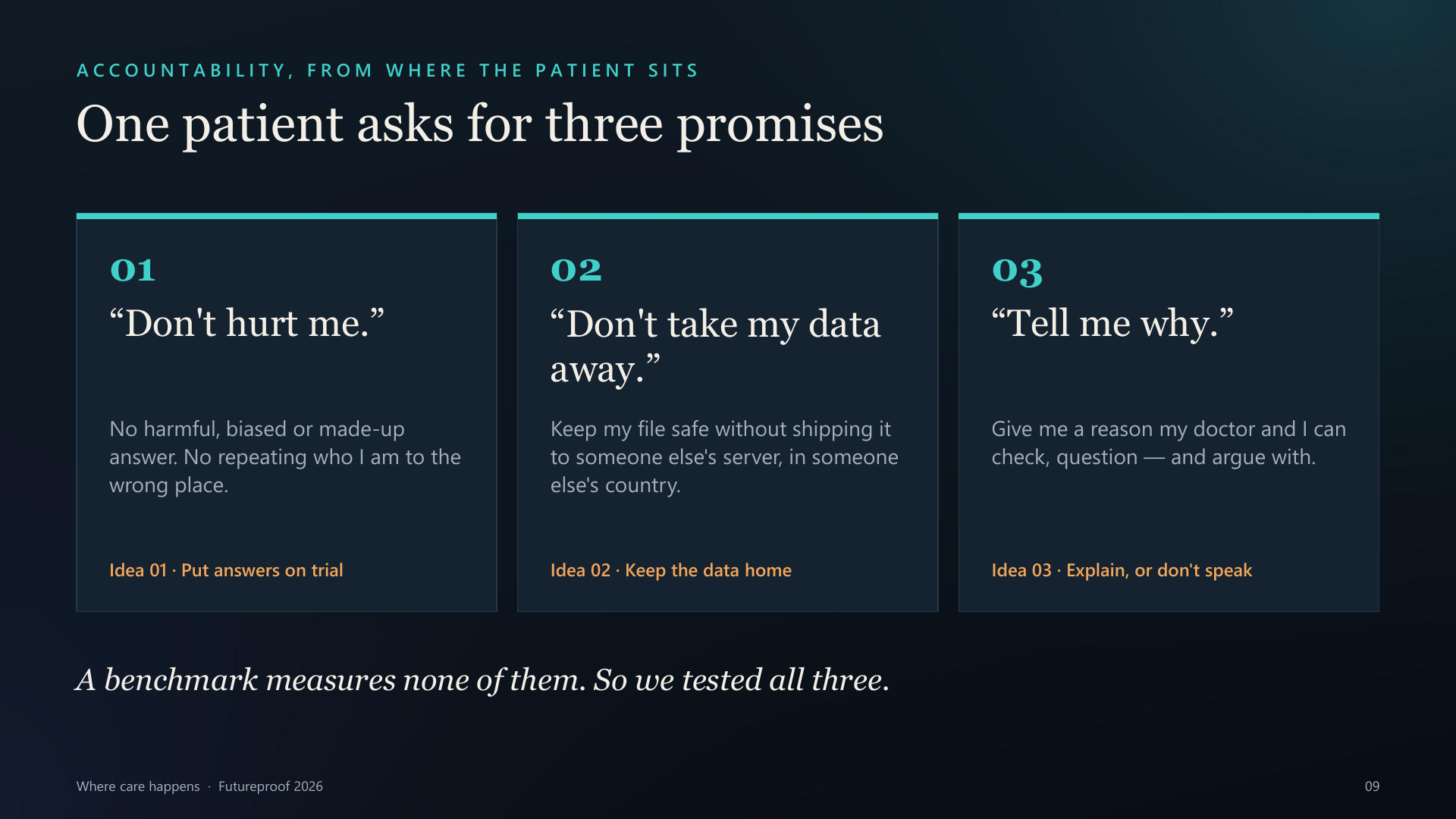
Dean's organizing framework, submitted PDF page 9. It asks what a deployment must answer beyond a capability score; it is not a claim that privacy or safety can never be evaluated. Presentation: Dean Shev / VHT.ai.
Those expectations lead to different work. Evaluating an answer's medical content doesn't establish who may read an uploaded record. Keeping a document within a chosen infrastructure boundary doesn't establish that the answer drawn from it is useful. A fluent explanation still needs checking against the evidence it cites.
The World Health Organization's guidance on ethics and governance of AI for health puts these questions in a wider frame of human rights, oversight and responsibility. It addresses the people and institutions designing and deploying systems, as well as the people affected by them.
That's a more demanding assignment than telling a user to exercise good judgment after the answer appears.
The tribunal is a checking process
The concrete example Dean brought was an LLM Tribunal research project with Northeastern University Vancouver. He described using several models to examine a draft response across accuracy, ethics, privacy and autonomy, then guide a revision.
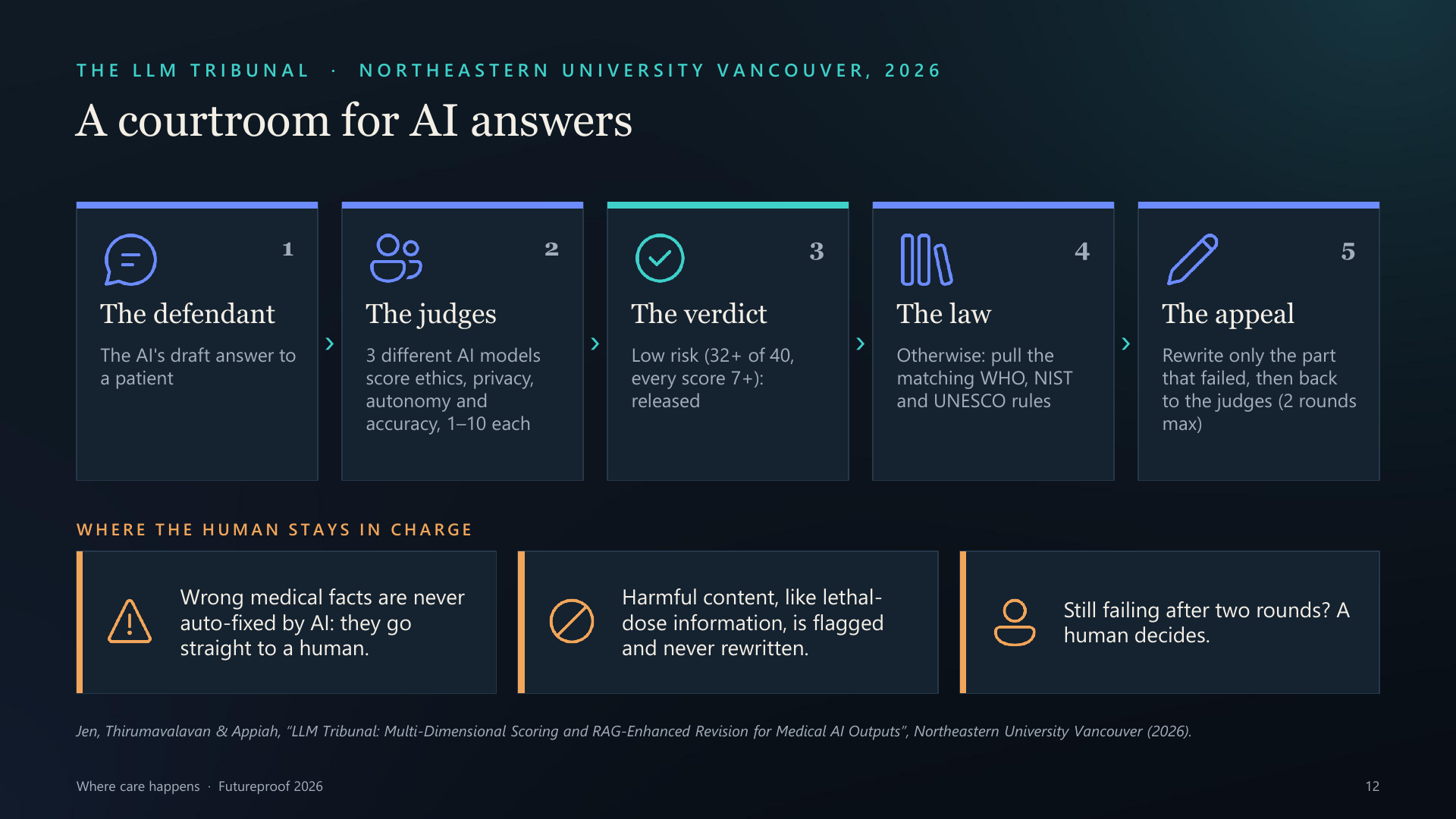
The research workflow in submitted PDF page 12. WHO, NIST and UNESCO are guidance sources for the rubric. The courtroom language is a design metaphor, not a legal proceeding or certification. Presentation: Dean Shev / VHT.ai.
The diagram makes useful details visible: what is being judged, the criteria, when the draft is revised and where the process hands something to a person. It also specifies a limit on repeated revisions instead of letting the system keep rewriting until it awards itself a satisfactory score.
VHT's public research account identifies the tribunal as a graduate capstone and distinguishes its research-prompt scores from the live service. The company's ECHNA explanation similarly describes the rubric as informing its design, rather than establishing a benchmark against other assistants.
Those limits matter. A set of model judges can help locate a weakness in another model's answer. Their agreement doesn't independently establish that the answer is medically sound or that the deployed service is safe.
The useful next question is who checks the judges, with which cases and against what external evidence. That question belongs inside the design.

During Dean's Thursday presentation.
Dean also described work on document-upload protection and explanations for predictive outputs. These have their own jobs to do before a person can rely on an answer. He was presenting components of an approach, not a single score that could settle every concern about it.
The data-sharing disagreement was the point
Simon Haworth, who had just spoken about drug discovery, challenged the emphasis on keeping data at home. His work needed data from different populations and places. He argued for the value of sharing it so other people could benefit.
Dean answered from the individual's control over the use. He described permission for a research purpose and removing identifying information. He also defended the importance of population context when interpreting data.
Another audience member challenged whether a country's border was the right way to frame that context. Location, they suggested, could itself be a variable to consider.
The exchange didn't produce a shared rule for every dataset. It exposed several decisions that need examining separately: who agrees to a use, what is shared, who receives it, how the context travels with it and what claims the resulting model can support.
You can care about research access and still owe people a specific account of what happens to their information. You can care about local control and still need to explain why a particular boundary serves the research or the person.
Our BC + AI Life Sciences group exists across precisely those disciplines. The public conversation can continue without treating private health records as discussion material.
An explanation should make a decision easier to question
Dean's third expectation was an answer whose reasoning and evidence could be examined.

The explanation principle as Dean presented it, submitted PDF page 17. Presentation: Dean Shev / VHT.ai.
The practical test is whether the explanation helps someone find the source, understand the limitation or bring a meaningful question to a qualified person. A longer answer can still conceal the important uncertainty.
In my writing about giving chatbots moral authority, I ask who is steering when the system reflects a convincing answer back to us. Dean puts that question beside a health record. The person needs something more useful than confidence to work with.
BC + AI's Responsible AI Professional programme offers a place to work through those deployment questions: purpose, evidence, consequences and the decisions someone must own. A stated principle becomes more useful when it changes the route an answer takes.
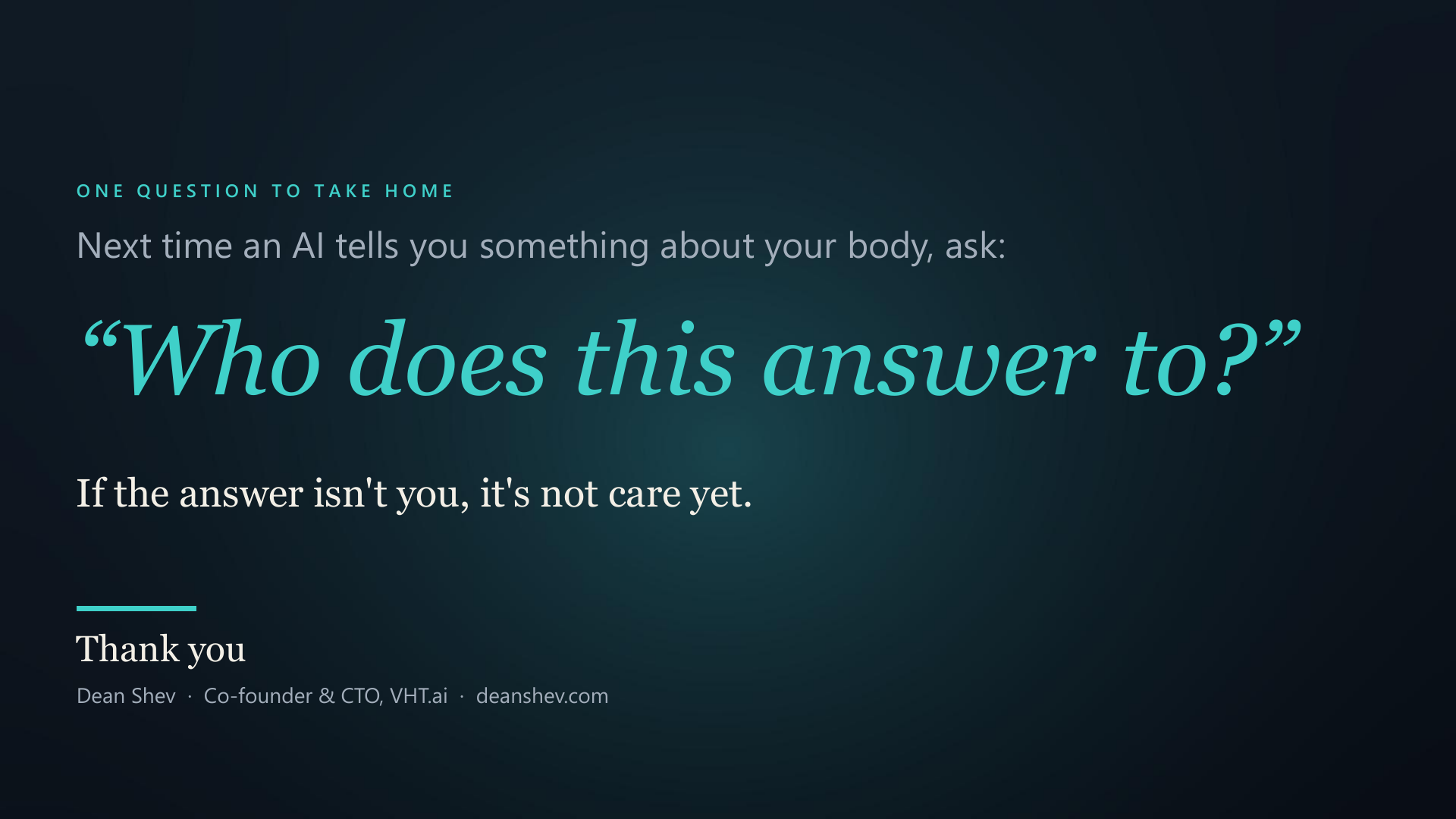
The closing question, submitted PDF page 20. Presentation: Dean Shev / VHT.ai.
For a team building a health tool, put that question beside the actual workflow. Name the person who reviews a serious disagreement. Explain what they can see, what they can change and how the user gets a response.
Then show that route to someone outside the team and let them ask where it breaks.
Accountability needs an address people can reach.