Futureproof Festival / 2026
Simon Haworth: the prediction still needs a lab
The conversations worth coming back to.
Source and citation
This is an authored, illustrated recap. The session date records when the talk took place. An edited transcript and festival recording have not been released on this page.
Kris Krüg. “Simon Haworth: the prediction still needs a lab” Futureproof Festival 2026 proceedings, Volume 01. Session: 2026-10-29. Edition updated 2026-11-06. https://www.futureproof.website/2026/proceedings/sessions/simon-haworth/
You can also select and copy the citation above.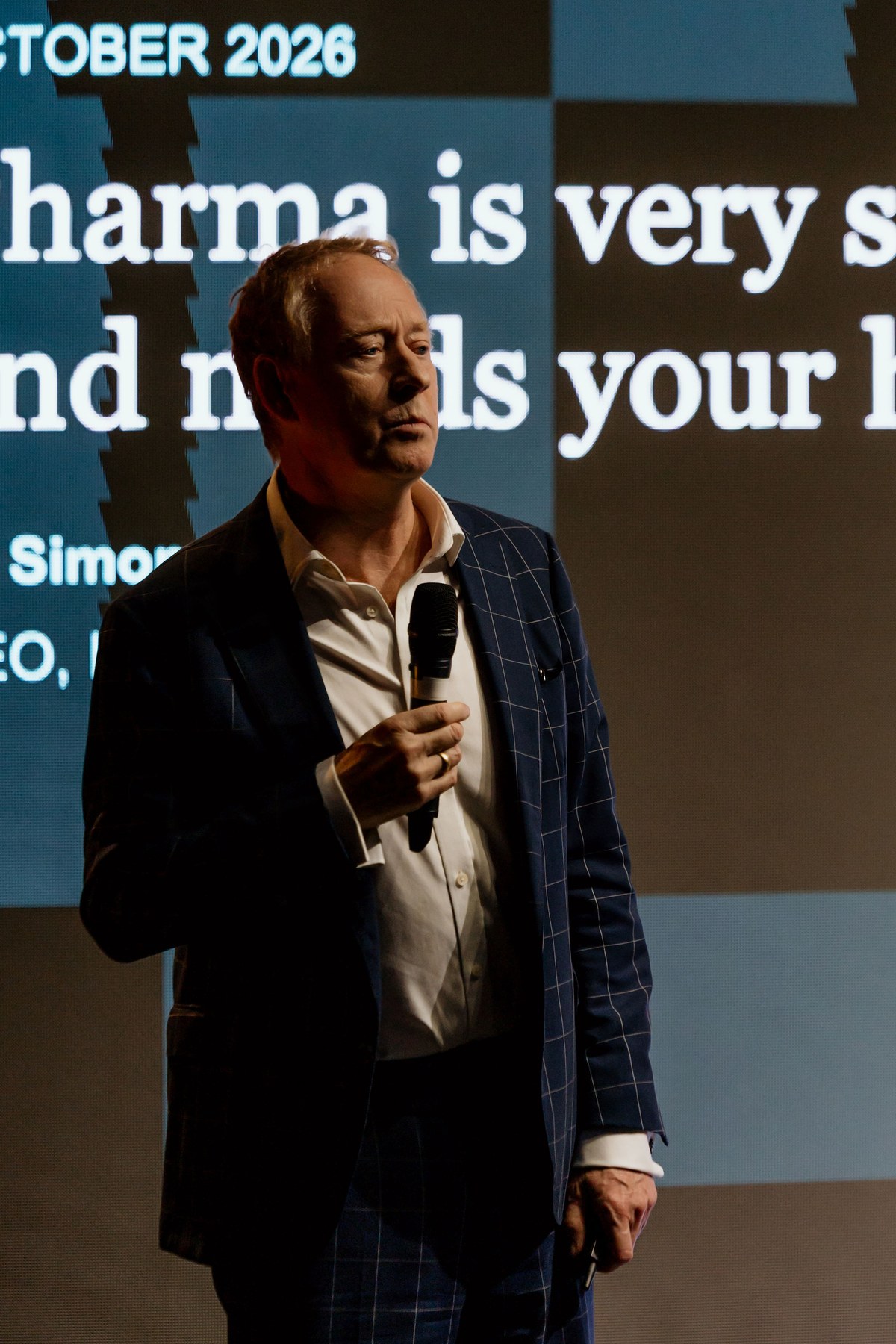
Simon Haworth at Futureproof Festival of AI, October 29, 2026.
The AI has produced a promising hypothesis. Now someone has to find out whether the biology agrees.
Simon Haworth put that obligation at the centre of his Futureproof talk. The CEO of Intellomx wanted the people building AI to look further into disease mechanisms and further into the physical work required to test them.
His provocation was that speeding up part of drug discovery could leave the underlying reasons for failure intact. You might move candidates through a process more efficiently while discovering, later and painfully, that you were pursuing the wrong thing.
Simon called that failing faster. In a setting where a failed idea can absorb years of work, the phrase deserves more scrutiny than it usually gets in a startup pitch.
The iceberg is a question about ignorance
Simon used an iceberg to distinguish what is already described in the literature from the biology researchers still need to understand.
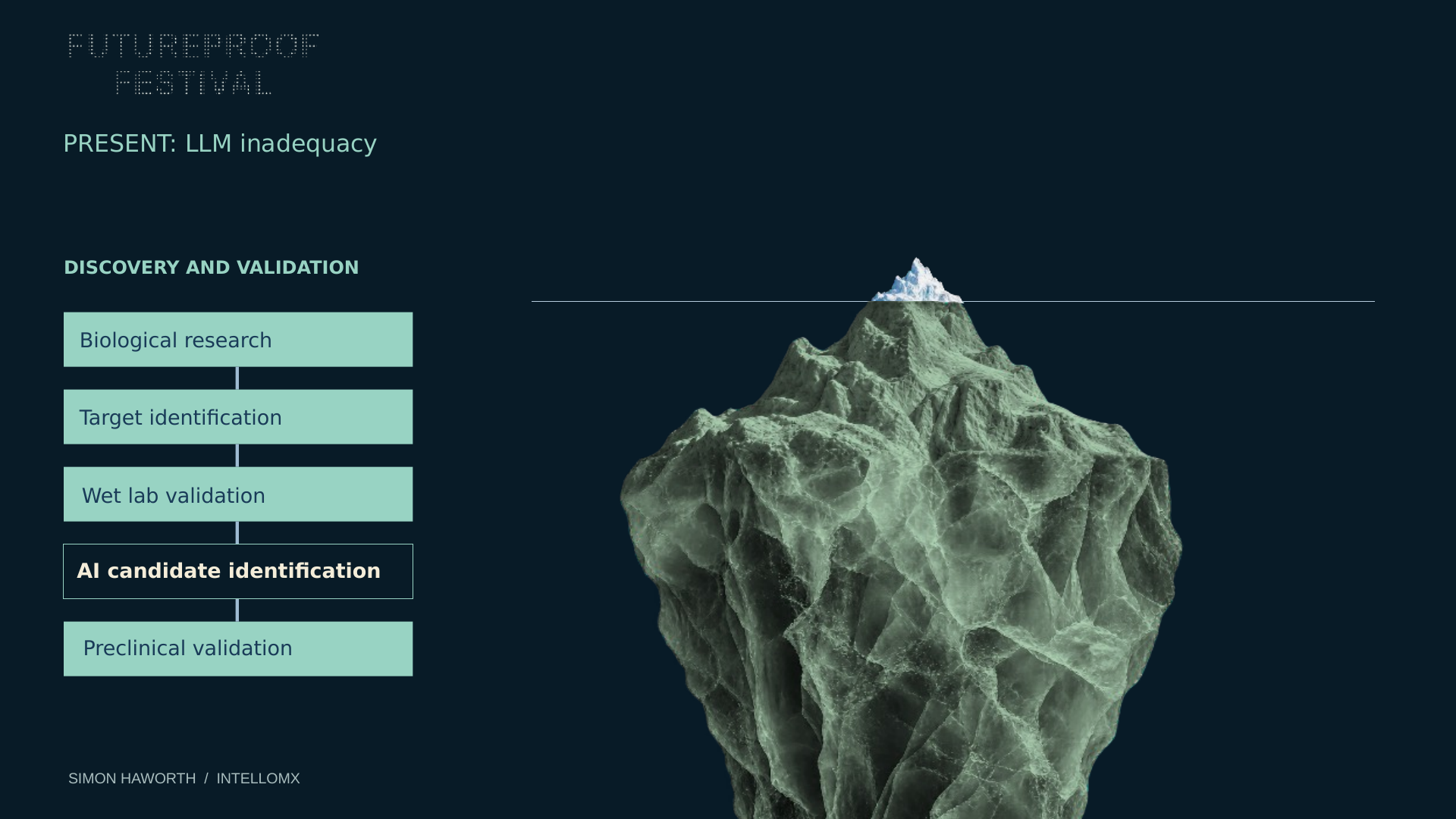
The iceberg metaphor in Simon's submitted slide 12. It illustrates his argument about unknown biology; its proportions are not a measurement of how much biology is understood. Presentation: Simon Haworth / Intellomx.
He argued that a language model working through existing knowledge doesn't, by itself, answer the questions hidden below that waterline. His interest was in applying machine learning to biological measurements and investigating the relationships they might reveal.
That is a distinction between research tasks. Summarizing papers can be useful work. Identifying a plausible disease mechanism, testing an intervention and finding out whether it helps a person involve further work with different standards of evidence.
The Q&A tested the metaphor. An audience member asked how anyone could quantify what they didn't know. Simon acknowledged how difficult that estimate was and explained that he was trying to communicate scale.
Good. An image can open an argument without turning its geometry into a statistic.
What the company says it is doing
Simon described Intellomx's work with transcriptomic data and disease models, aiming to identify targets for further investigation. The company's white paper on its biology-led approach sets out that position: start with human molecular data and use language models as supporting interfaces rather than treating literature retrieval as the discovery engine.
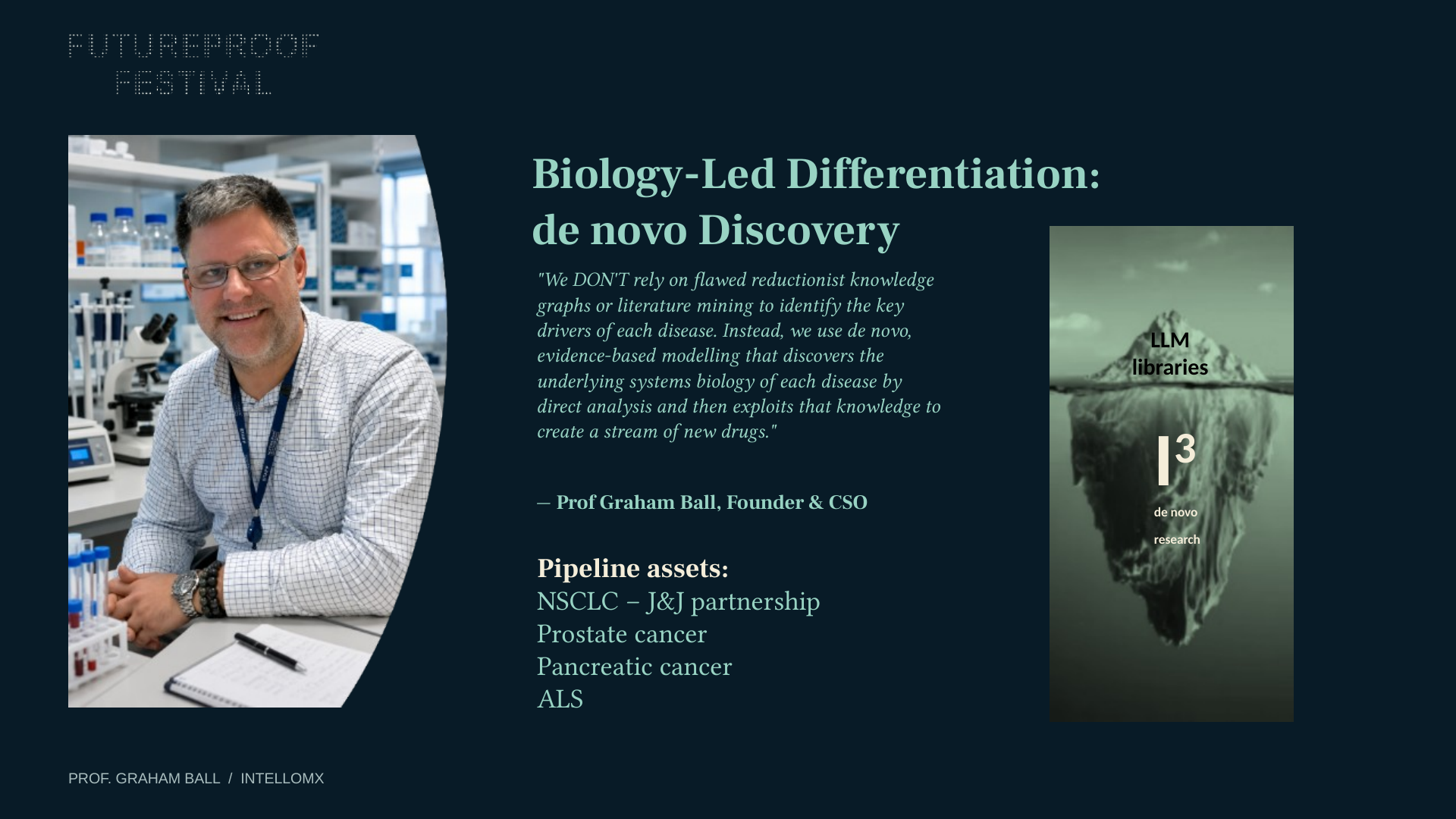
The company's approach and research pipeline as presented, submitted slide 14. These are company descriptions, not evidence that the listed research areas have produced approved treatments. Presentation: Simon Haworth / Intellomx.
There is a concrete research relationship to follow beyond the stage account. Intellomx's June 2025 announcement of a second collaboration with Johnson & Johnson describes work to identify and evaluate lung-cancer targets. A target-discovery collaboration is a particular activity. It doesn't establish that a resulting medicine has proved effective in patients.
Keeping that distinction visible makes the work easier to assess. What was measured? What did the model infer? Which experiment tests that inference? What happened in the experiment?
The interesting detail lives in the answers to those questions. A promising adjective won't do the job.
The physical work gives the idea somewhere to fail
Simon argued that wet-lab and preclinical validation were opportunities for British Columbia. He wanted facilities and people who could take a computational hypothesis into an experiment and find out whether the expected effect appeared.
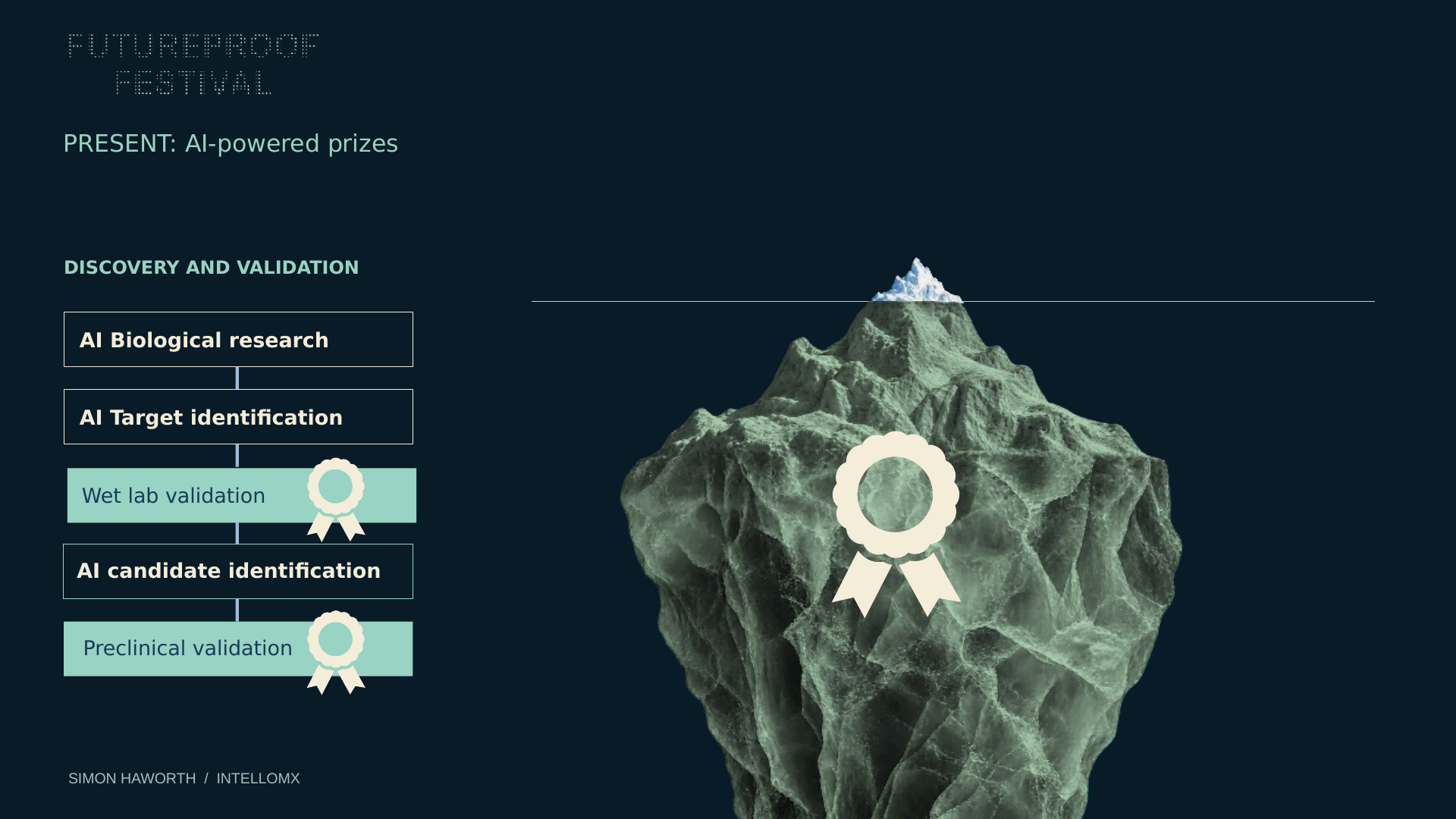
Where Simon placed physical validation in the process, submitted slide 13. The illustrated markers highlight proposed opportunities; they are not research awards or clinical results. Presentation: Simon Haworth / Intellomx.
The work can't be reduced to making an experiment run faster, either. Asked about miniaturizing labs and testing vastly more samples, he came back to the difficulty of finding models that meaningfully represent the disease being investigated.
Speed is useful after you have a reason to trust what the experiment represents. More repetitions of an inadequate model can leave the original problem beautifully automated.
And preclinical evidence has its own boundary. The FDA's explanation of clinical research distinguishes laboratory work from studies in people. Moving from a biological result toward a treatment requires further questions about safety, dosage, effects and the people being studied.
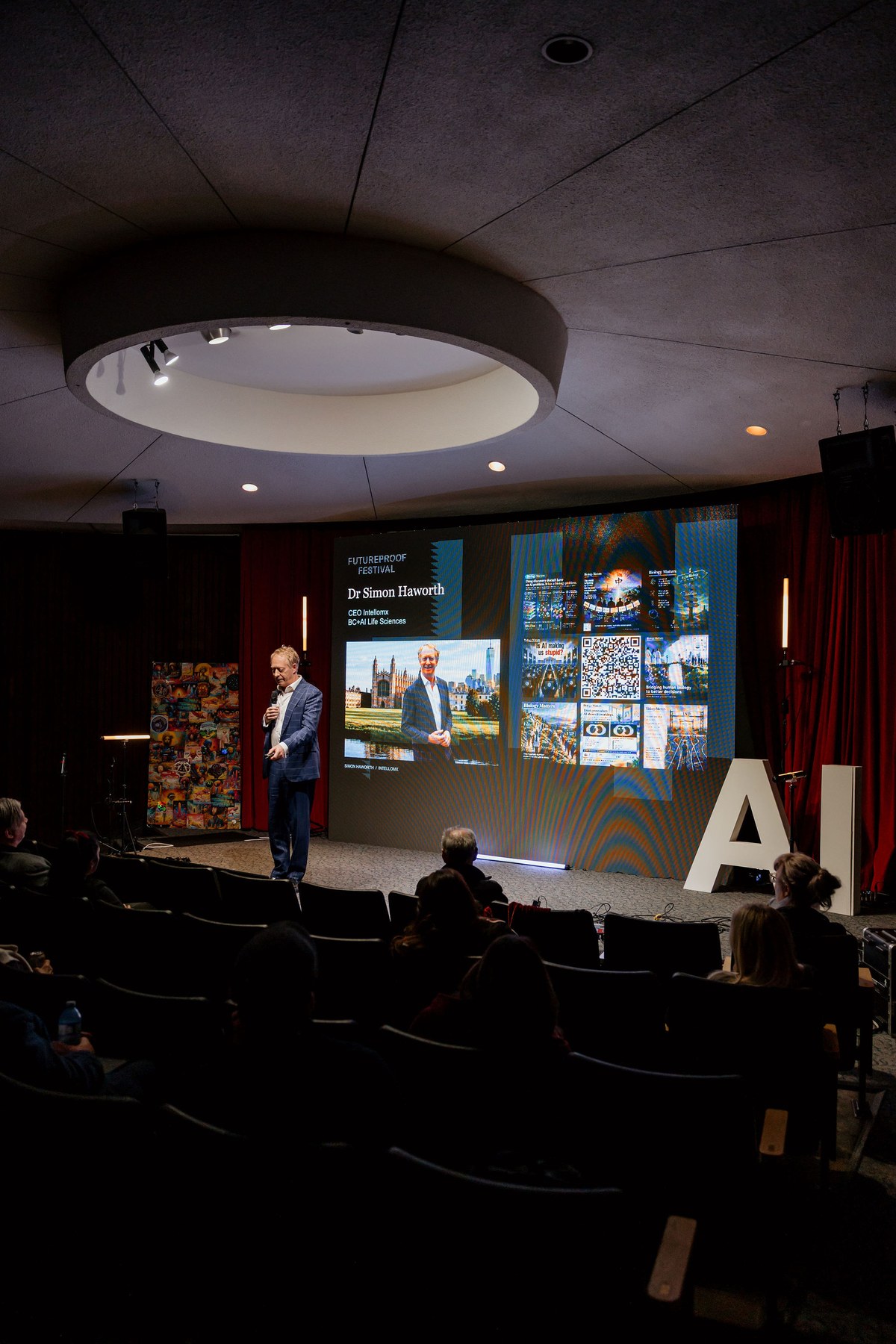
The Thursday life sciences session.
Simon also described a digital toxicity twin intended to anticipate unwanted effects beyond the target being investigated. It is an attempt to bring a wider biological system into view before committing to later stages.
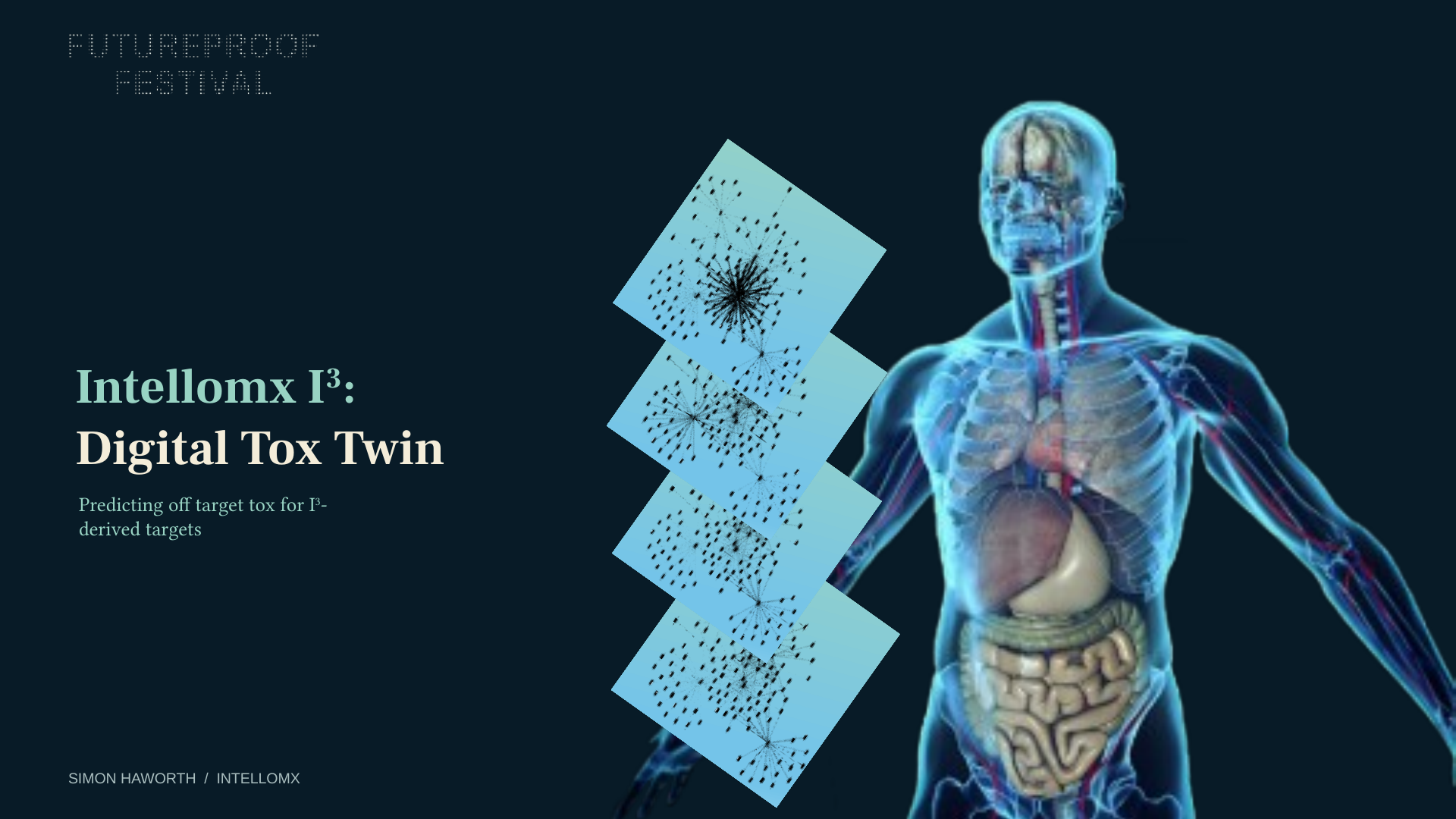
The Digital Tox Twin concept in submitted slide 15. This is a conceptual presentation graphic, not a patient's scan or proof of clinical predictive performance. Presentation: Simon Haworth / Intellomx.
That aim still leaves the essential question open: how well does the prediction hold up when it is tested? The talk introduced a research direction and the company's expectations. It didn't supply a clinical validation study for this audience to examine.
Coordination is part of the infrastructure
An audience member asked who would organize and pay for the connections between researchers, facilities and institutions. Simon described ongoing conversations with investors and government, alongside the difficulty of getting the relevant people to work together.
The distinction matters here too. An opportunity isn't a funded programme. Having facilities in a region doesn't automatically make them available to a team trying to test a particular idea.
Our BC + AI Life Sciences group brings people from discovery, clinical care, health data and other disciplines into the same conversation. Simon's related Wild Salmon proposal asks how experienced founders might build their way back to British Columbia. Both offer places to continue the questions raised on stage, with the proposal still visibly a proposal.
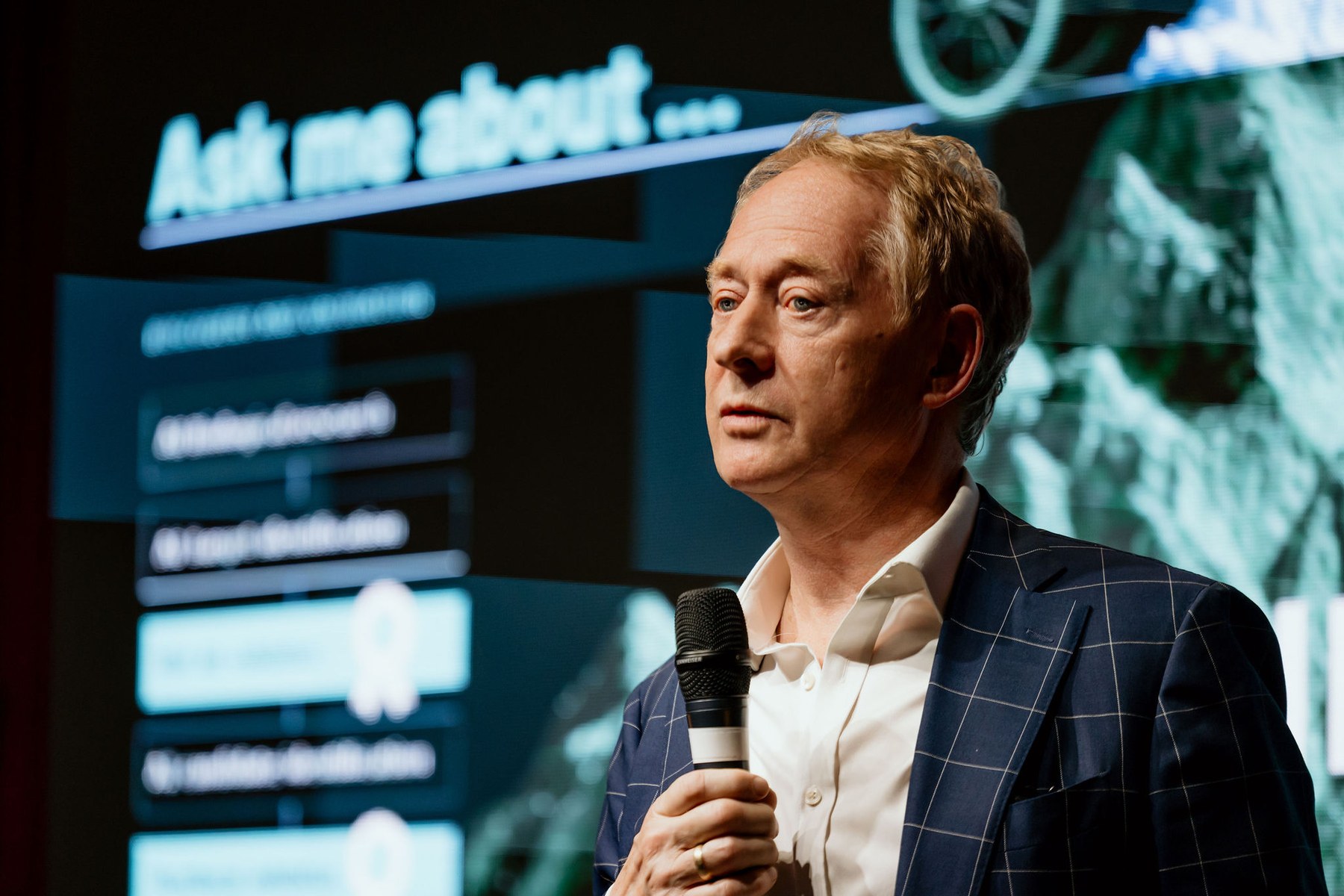
During Simon's presentation.
His exchange with Dean Shev in the following session added a real disagreement: Simon stressed the research value of sharing data across different populations; Dean stressed the person's control over its use. Neither question disappears because the other matters.
For a builder, Simon's challenge is specific enough to work on. Identify a biological question, the data that might illuminate it and the experiment that could prove your promising answer wrong. Then find the people and facilities capable of doing that experiment.
The model has made a suggestion. The interesting work is what happens next.