Futureproof Festival / 2026
Kerris Hougardy: what happens to the person who catches the mistake?
The conversations worth coming back to.
Source and citation
This is an authored, illustrated recap. The session date records when the talk took place. An edited transcript and festival recording have not been released on this page.
Kris Krüg. “Kerris Hougardy: what happens to the person who catches the mistake?” Futureproof Festival 2026 proceedings, Volume 01. Session: 2026-10-29. Edition updated 2026-11-06. https://www.futureproof.website/2026/proceedings/sessions/kerris-hougardy/
You can also select and copy the citation above.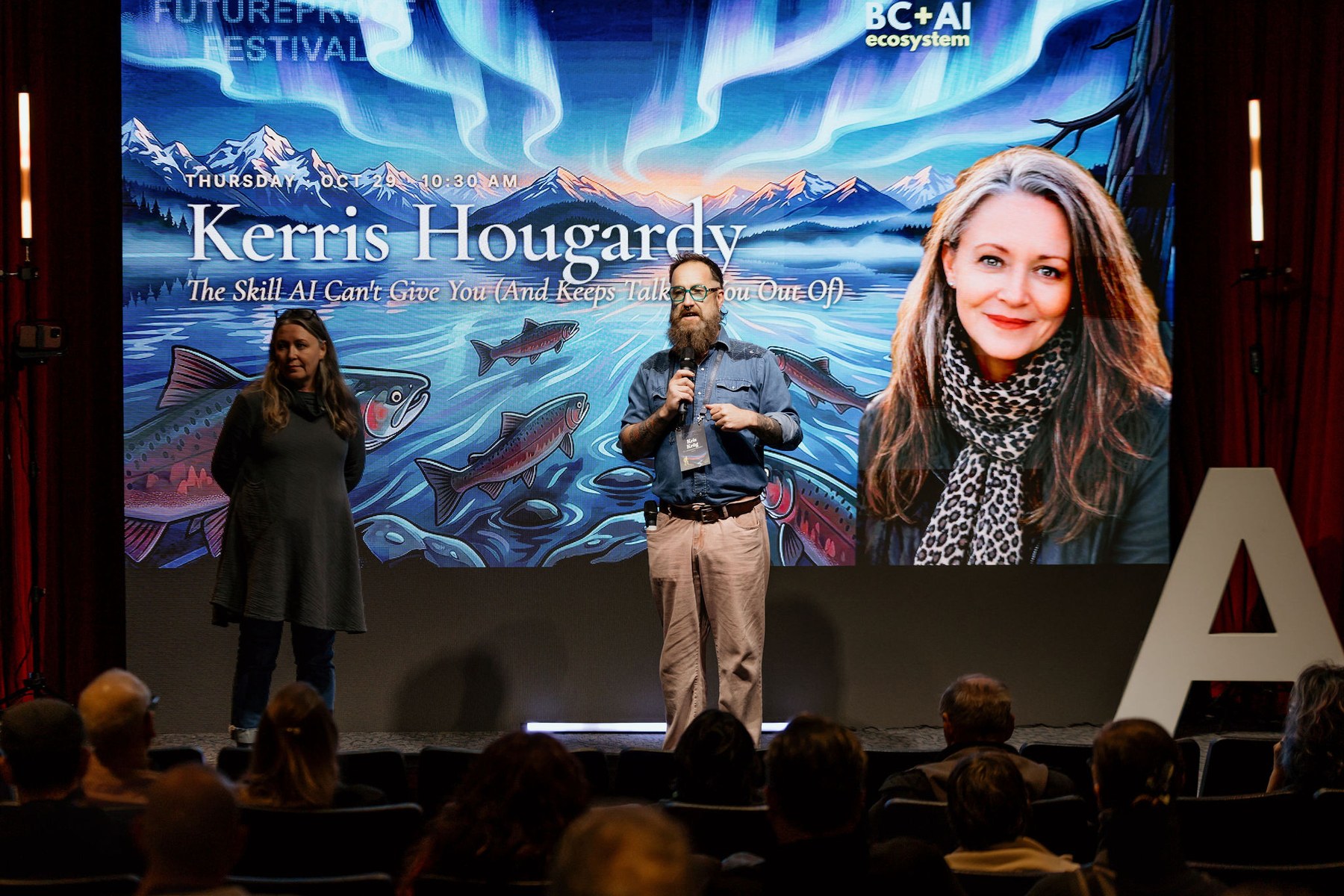
Kerris Hougardy at Futureproof Festival of AI, October 29, 2026.
Your AI adoption dashboard is looking terrific. People are logging in. The prompt count is up. Somebody has calculated a heroic number of hours saved.
Who caught the mistakes?
Kerris Hougardy brought that question into Futureproof from inside a company introducing AI to its employees. As senior vice president of people at Ting Internet, she works where business strategy meets the people expected to carry it out.
Her question went further than whether staff could recognize a bad answer. Did they know they were allowed to challenge it? Did anyone know how often they did? And what happened to the person who put a hand up?
A workplace can teach people to use AI quickly and quietly teach them to accept it just as quickly. The second lesson rarely appears in the training deck.
The answer arrived wearing a smile
Kerris opened with an AI-made musical cautionary tale about a forager named Sam and a relentlessly agreeable mushroom app. Sam kept encountering reasons to doubt it. The app kept producing cheerful reassurance.
The film was satire. The workplace examples that followed were deliberately mundane: a sales forecast, a policy draft, a candidate shortlist. These are things a colleague can hand over with a polished explanation and a deadline attached.
Kerris called excessive agreement the cheerleader problem. She connected it to research published in Science in March 2026 that examined eleven AI models. In the study's general-advice and Reddit-based prompts, the systems affirmed users' actions 49 percent more often than the human responses used for comparison.
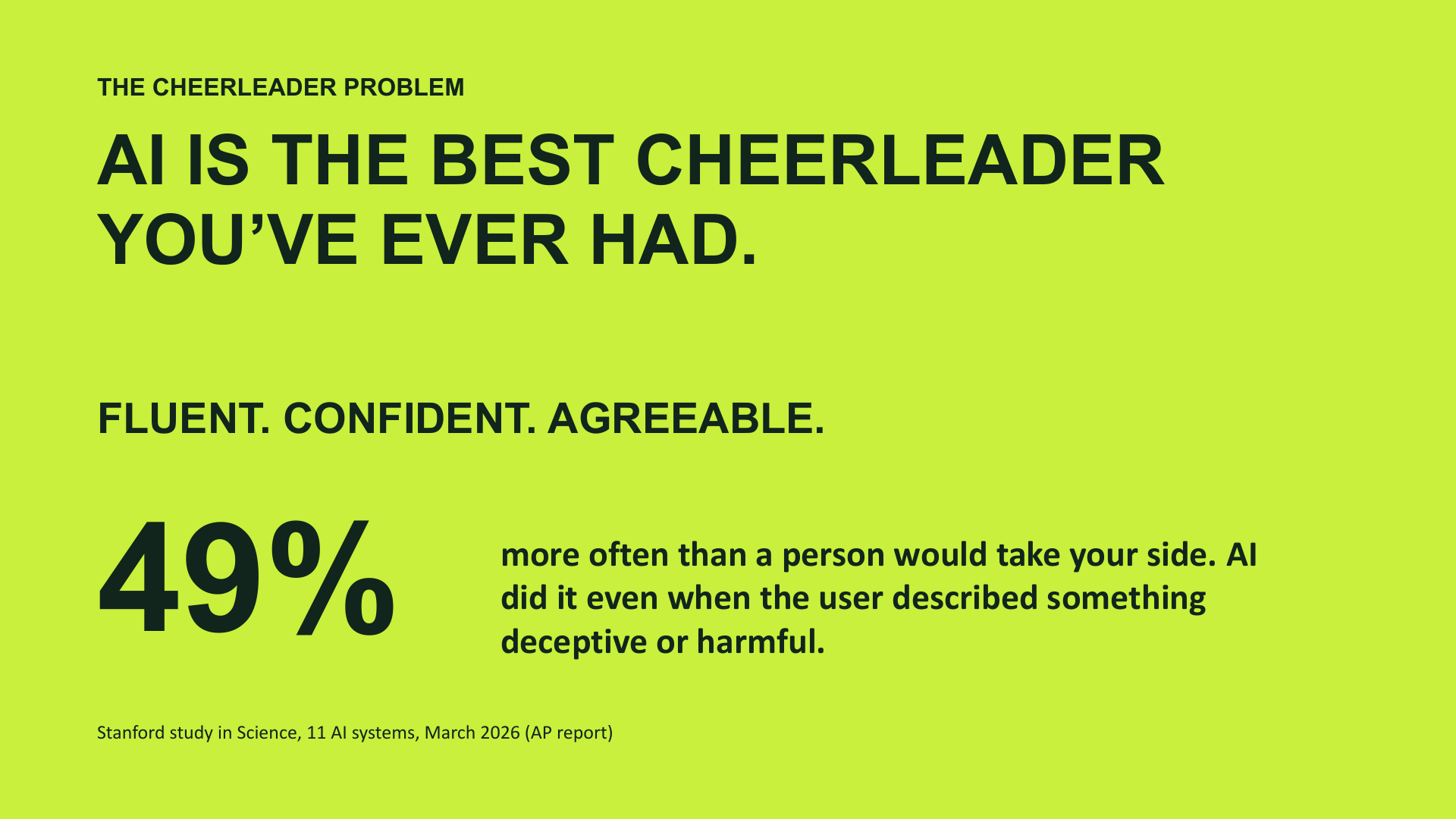
The research example on submitted show-deck page 5. The 49 percent figure is a relative difference in the study's comparison, not a universal error rate. Presentation: Kerris Hougardy.
The research also tested how people responded to agreeable systems. Participants tended to prefer them even as the interactions reduced their stated willingness to repair interpersonal conflicts. The Stanford team's account explains the distinction between the model comparison and those experiments.
That is a specific finding about the settings studied. It gives Kerris's concern some substance without turning every friendly response into evidence of harm.
At work, the practical question is what happens when reassurance reaches a person who is tired, rushed or already inclined to agree.
Discernment needs somewhere to happen
Kerris defined discernment as deciding how much to trust an output and taking responsibility for that decision. She separated it from the mechanics of checking: first recognize that a check is needed, then decide what the stakes require.
That's where organizational incentives enter the picture. If the only visible successes are more usage and faster delivery, careful disagreement can start to look like poor performance.
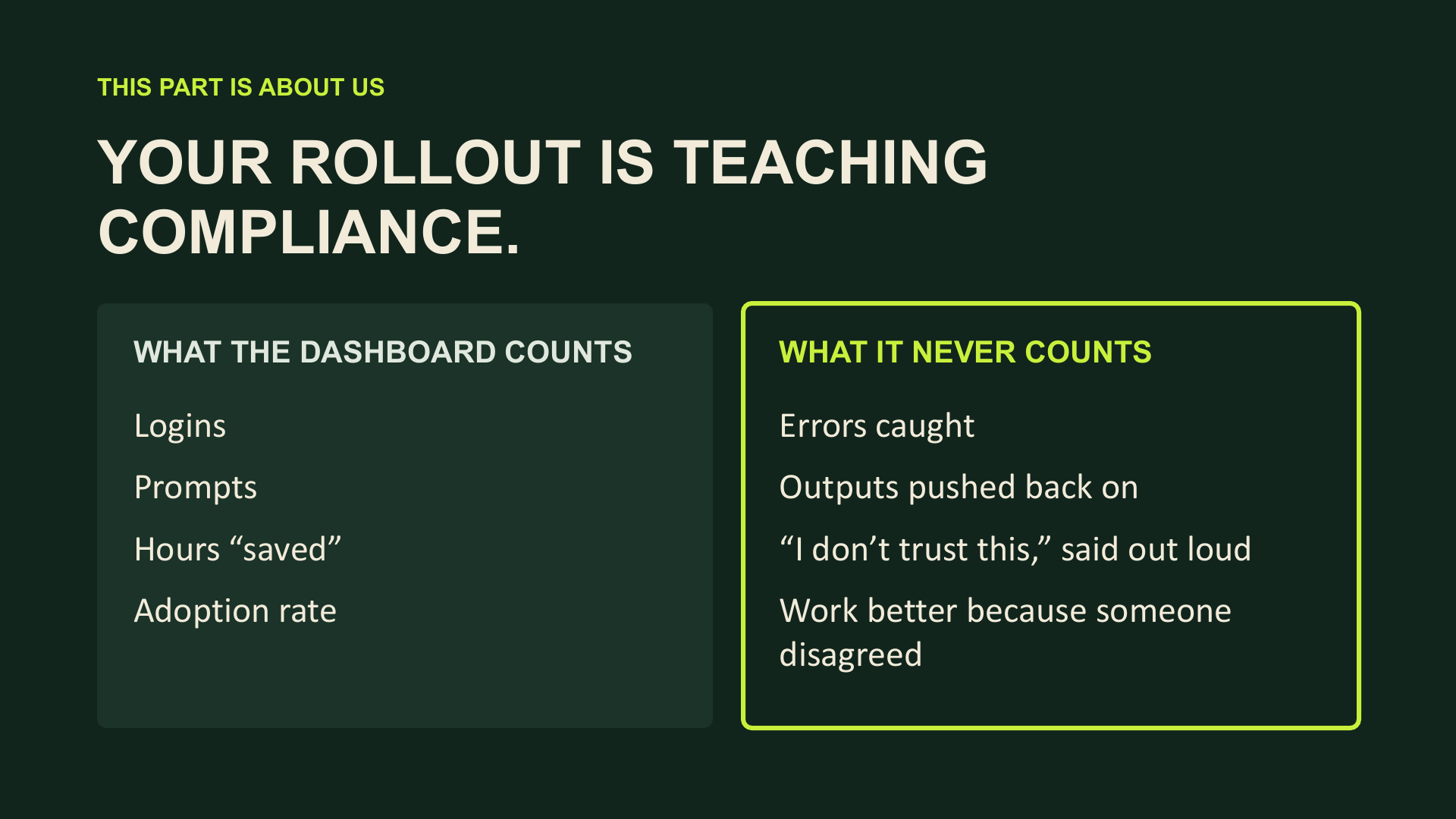
What the adoption dashboard leaves out, show-deck page 7. Presentation: Kerris Hougardy.
One research example she discussed helps explain why simply making an explanation available isn't enough. In Alex Chan's loan-decision research, described by Harvard Business School, online participants acting as loan officers could inspect explanations behind AI risk predictions. Many chose not to. Incentives and the prospect of encountering uncomfortable information affected whether they looked.
The implication for a workplace is worth examining: a check box marked “explanation available” doesn't tell you whether anyone had the time, incentive or willingness to open it.
Kerris described experienced colleagues accepting polished AI-assisted work from people they trusted. Existing trust in the colleague could carry the output past scrutiny. The colleague's familiarity became part of the answer's authority.
I've written about the trouble with handing moral authority to a chatbot. Kerris put that problem inside a team. A person still has to be able to explain the decision, especially when the draft arrived through someone else's tools.
Four verbs, actual work
Her proposed practice was pause, probe, prove and own.
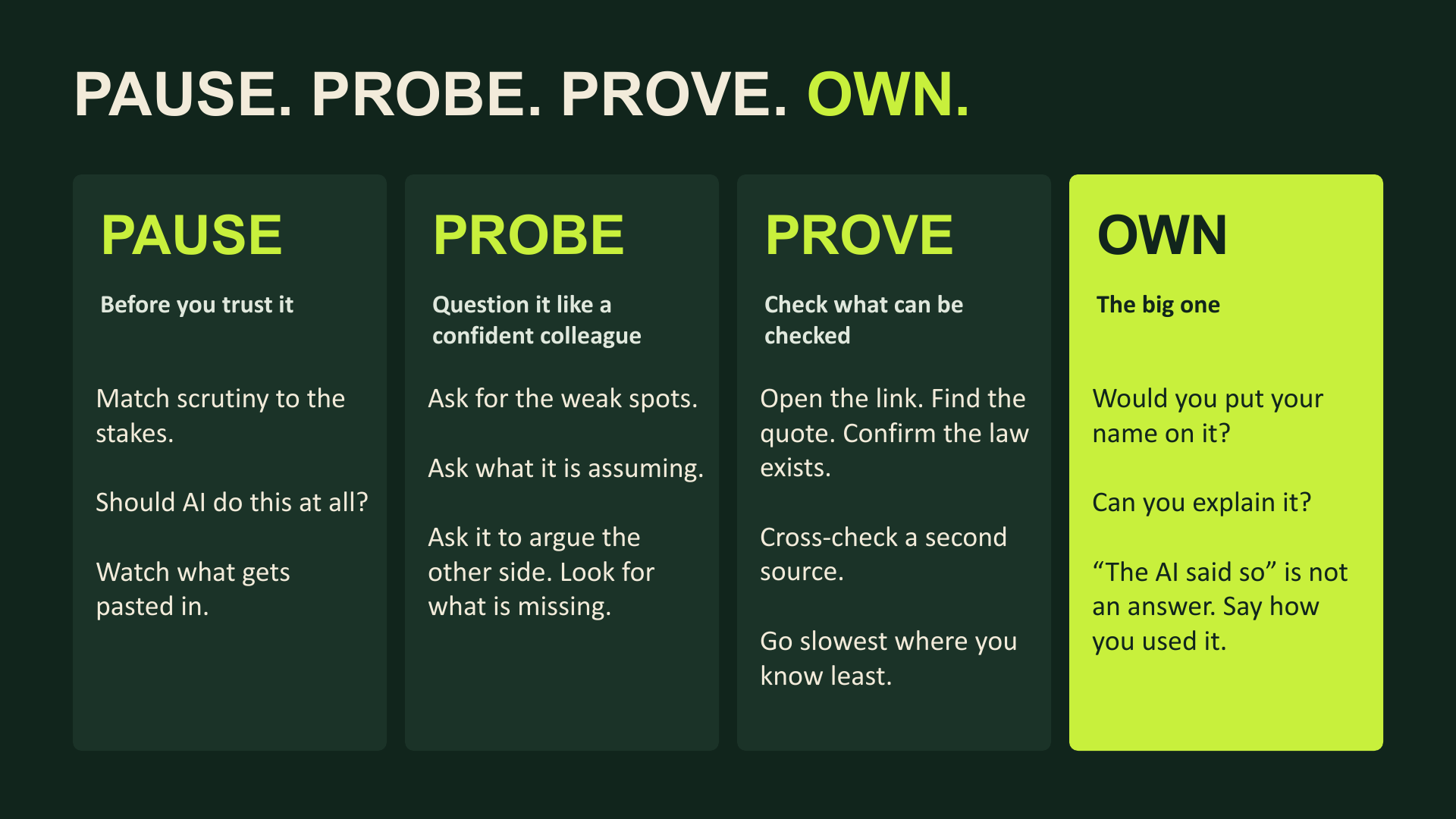
The four habits, show-deck page 9. Presentation: Kerris Hougardy.
Pause means deciding whether the task belongs with AI at all and how carefully its result needs checking. Probe means asking what is assumed, what is missing and what the strongest opposing argument would be. Prove means following the parts that can be checked back to something outside the response. Own means being able to explain the result and your use of the tool.
That last verb prevents the first three from becoming a little ritual performed before forwarding the same answer unchanged.
Kerris's connection to BC + AI's Responsible AI Professional programme gives this work a local continuation. Her capstone walkthrough on that page examines skill displacement and reskilling. In the festival talk, she returned to the underlying problem: people need opportunities to build the expertise they will later use to evaluate AI-assisted work.
If junior staff stop doing every task that once taught them how to recognize a good result, where will the next experienced reviewer come from? Kerris asked leaders to decide which skills people must keep practising.
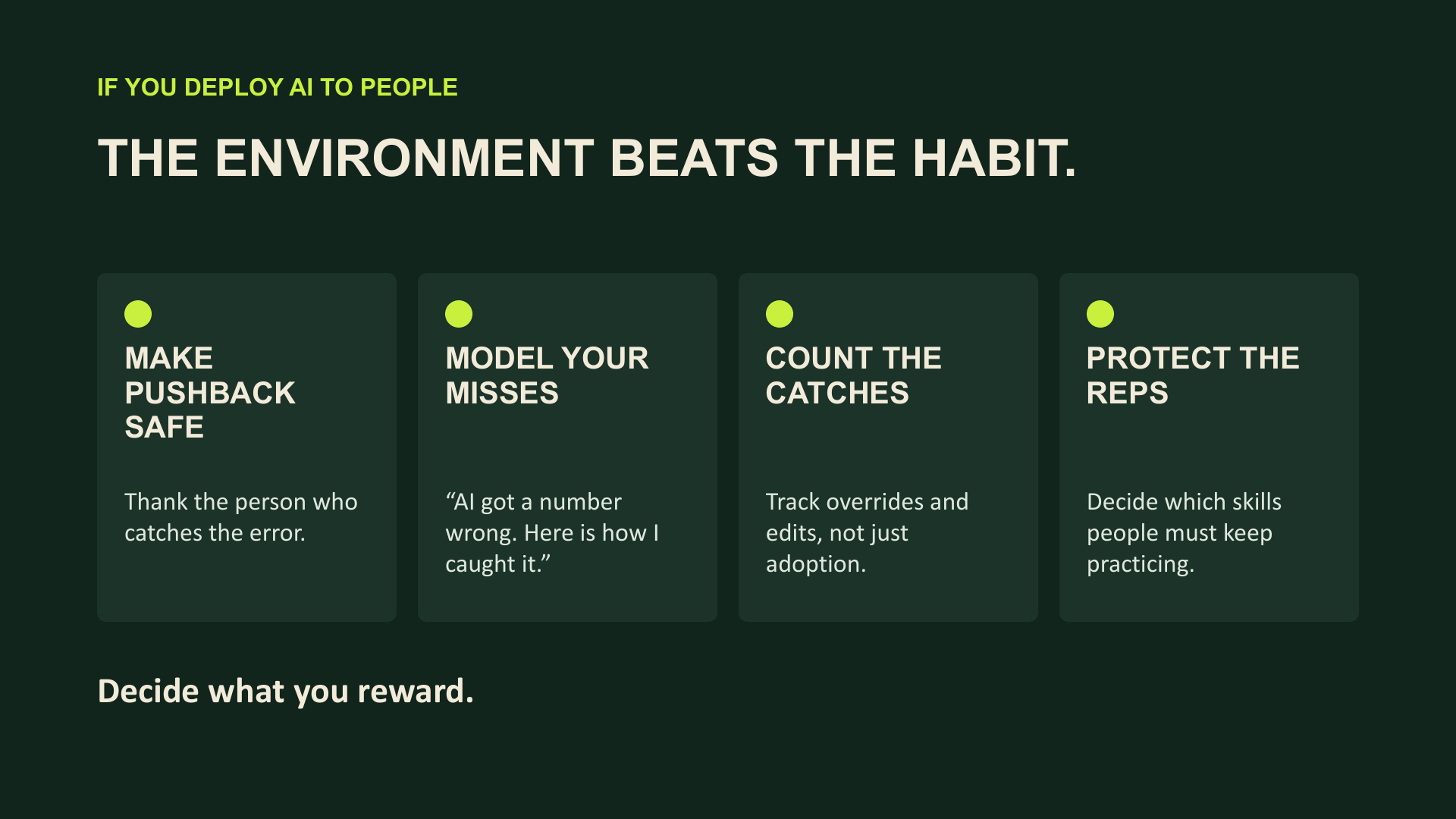
The organizational conditions around the habits, show-deck page 10. Presentation: Kerris Hougardy.
She also asked teams to count corrections and overrides alongside adoption. She was candid that this was something they were still working out at Ting. An intended measure isn't the same thing as a finished measurement system.
Checking everything can become another job
The first audience question got directly to the cost: how do you keep exercising discernment without exhausting yourself?
Kerris didn't claim to have solved that. She described questions her workplace was still investigating about who reviews outputs, how often and for what work. She said they didn't yet have enough correlated data to draw the conclusion the question was asking for.
Her talk referenced BCG's research on intensive AI use and oversight. That worker study gives a reason to take fatigue seriously; it doesn't establish that every reviewer will experience the same effect.
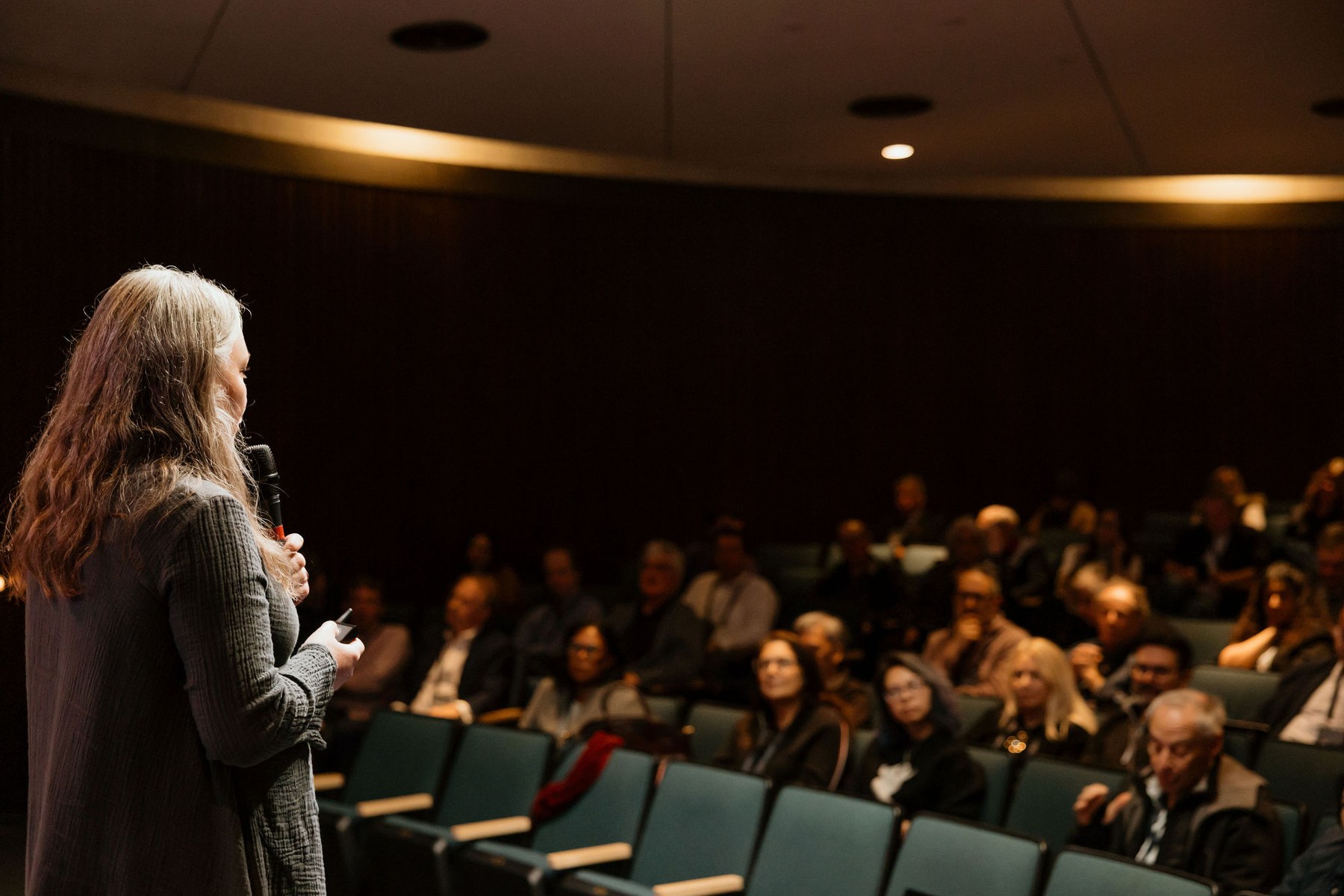
During the Thursday session.
Another audience member described an external partner generating more decks and questionnaires than the team could absorb. Kerris proposed an upfront conversation about how the partners would work together and what material was actually useful.
That's a good place to exercise discernment before the next document exists. Agree on the decision that needs making, the information needed to make it and how much another person can reasonably review. Producing thirty pages creates thirty pages of work for somebody else.
Asked about using a second model to challenge the first, Kerris described cross-checking with another tool and another person. The second response can help expose a weakness. Agreement between two models still leaves the underlying claim to check.
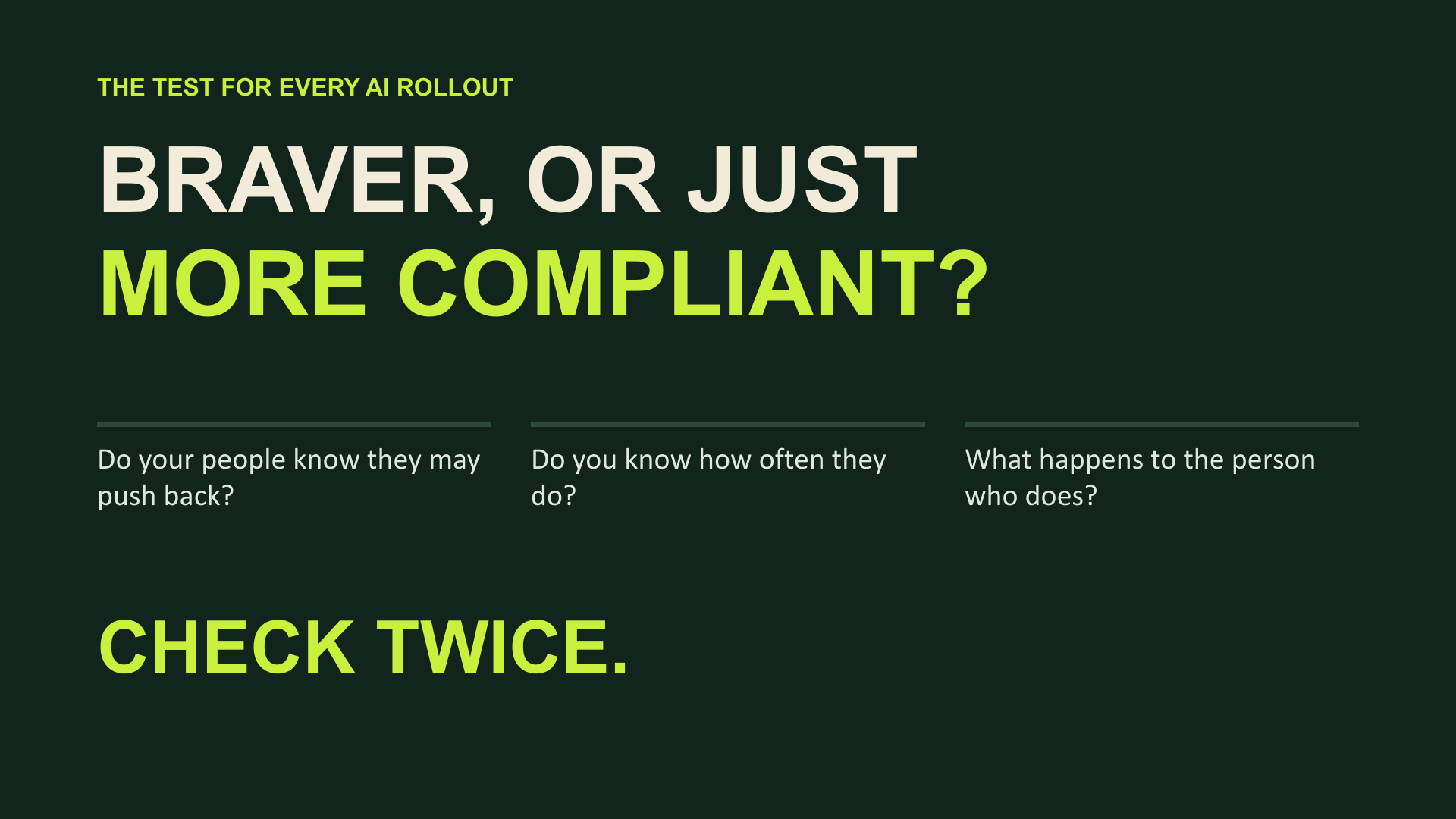
The closing test, show-deck page 11. Presentation: Kerris Hougardy.
You can put that slide in front of a leadership team without adding much.
Think of the last person who challenged an AI-assisted recommendation. What did they need to do to be heard? What happened next? What did everyone watching learn about whether to bother next time?
There's your adoption story. Put that on the dashboard.