Futureproof Festival / 2026
Andrew Zolli: a road is a warning, not a verdict
The conversations worth coming back to.
Source and citation
This is an authored, illustrated recap. The session date records when the talk took place. An edited transcript and festival recording have not been released on this page.
Kris Krüg. “Andrew Zolli: a road is a warning, not a verdict” Futureproof Festival 2026 proceedings, Volume 01. Session: 2026-10-30. Edition updated 2026-11-06. https://www.futureproof.website/2026/proceedings/sessions/andrew-zolli/
You can also select and copy the citation above.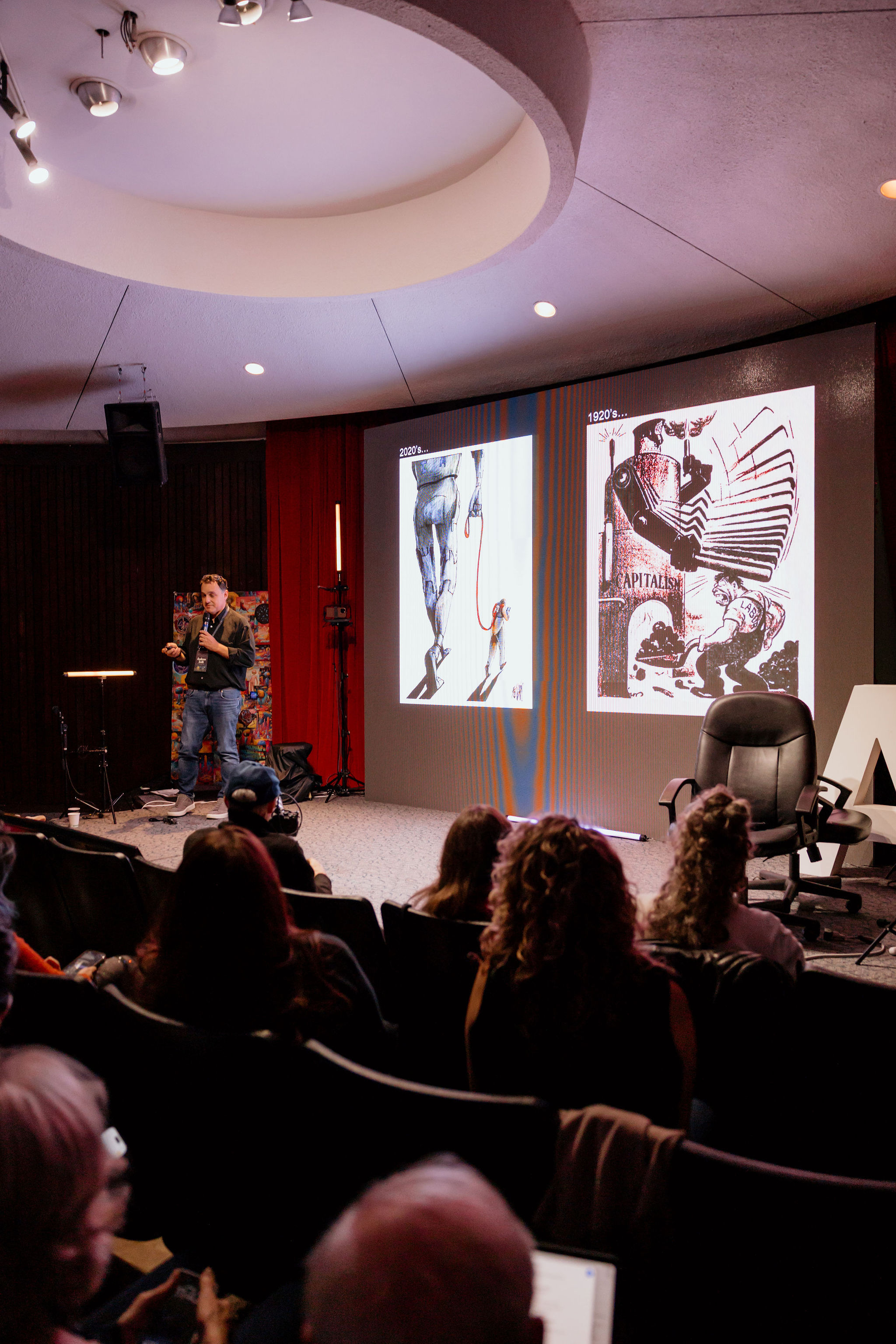
Andrew Zolli at Futureproof Festival of AI, October 30, 2026, at Vancouver's H.R. MacMillan Space Centre.
Andrew Zolli pointed to a detail in satellite imagery of the Amazon. The obvious thing was the clearing. The more useful thing was the road reaching toward what could be cleared next.
One showed damage. The other offered a chance to pay attention before more damage arrived.
That difference carried his talk at Futureproof Festival of AI, presented by BC + AI. What happens between a system noticing something and people being able to act on it?
Andrew, chief impact officer at Planet, brought the view from orbit. He also brought a warning about the view: more signals won't magically give us more time, shared purpose or authority to intervene.
The dashboard can be spectacular. The forest still needs somebody to do something.
Two satellites in the picture
Andrew began with an engineering analogy. A spacecraft needs sensors that help its operators understand the forces acting on it quickly enough to maintain control.
Then he pointed out the second satellite in the image: Earth, moving around the sun with all of us aboard.
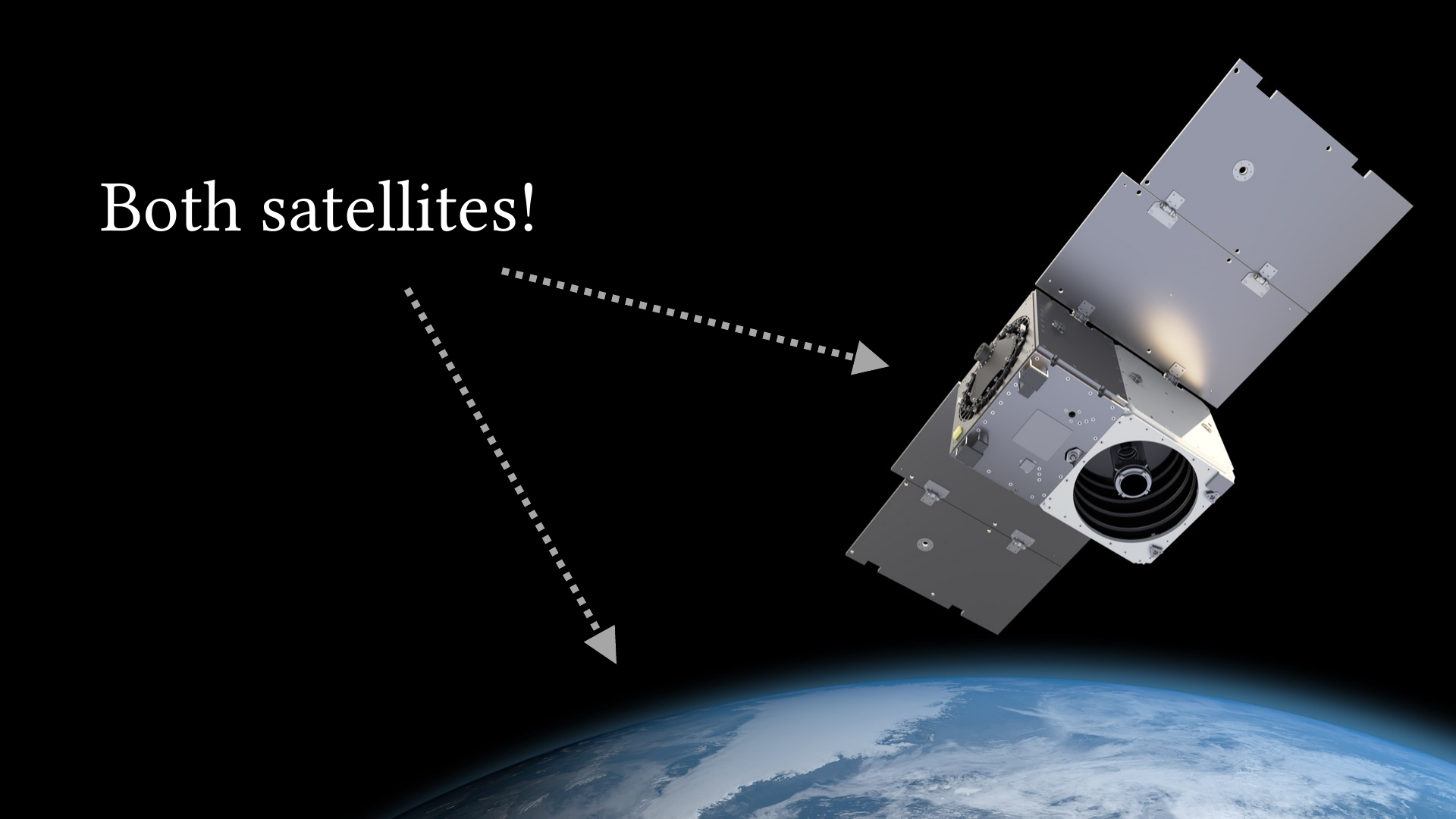
Original presentation, slide 3: the spacecraft and the world it observes. Source: Andrew Zolli / Planet Labs PBC; rendered from the revised speaker deck.
The analogy reframes observation as part of stewardship. If people are changing the systems that keep us alive, we need ways to notice those changes at a useful pace.
He connected that need to the planetary boundaries framework. The 2026 Planetary Health Check summary assesses nine Earth-system processes and reports seven boundaries transgressed. The framework describes rising systemic risk; it isn't a countdown timer attached to each place on a map.
Andrew paired environmental danger with expanding technical capacity. His challenge was to imagine what that capacity could serve, rather than treating an existing distribution of power as the only possible arrangement.
Follow the signal all the way to the person
In the forest example, he described a chain connecting repeated observations, detection of change, reports and environmental enforcement. Finding a pattern was one step in a larger institutional process.
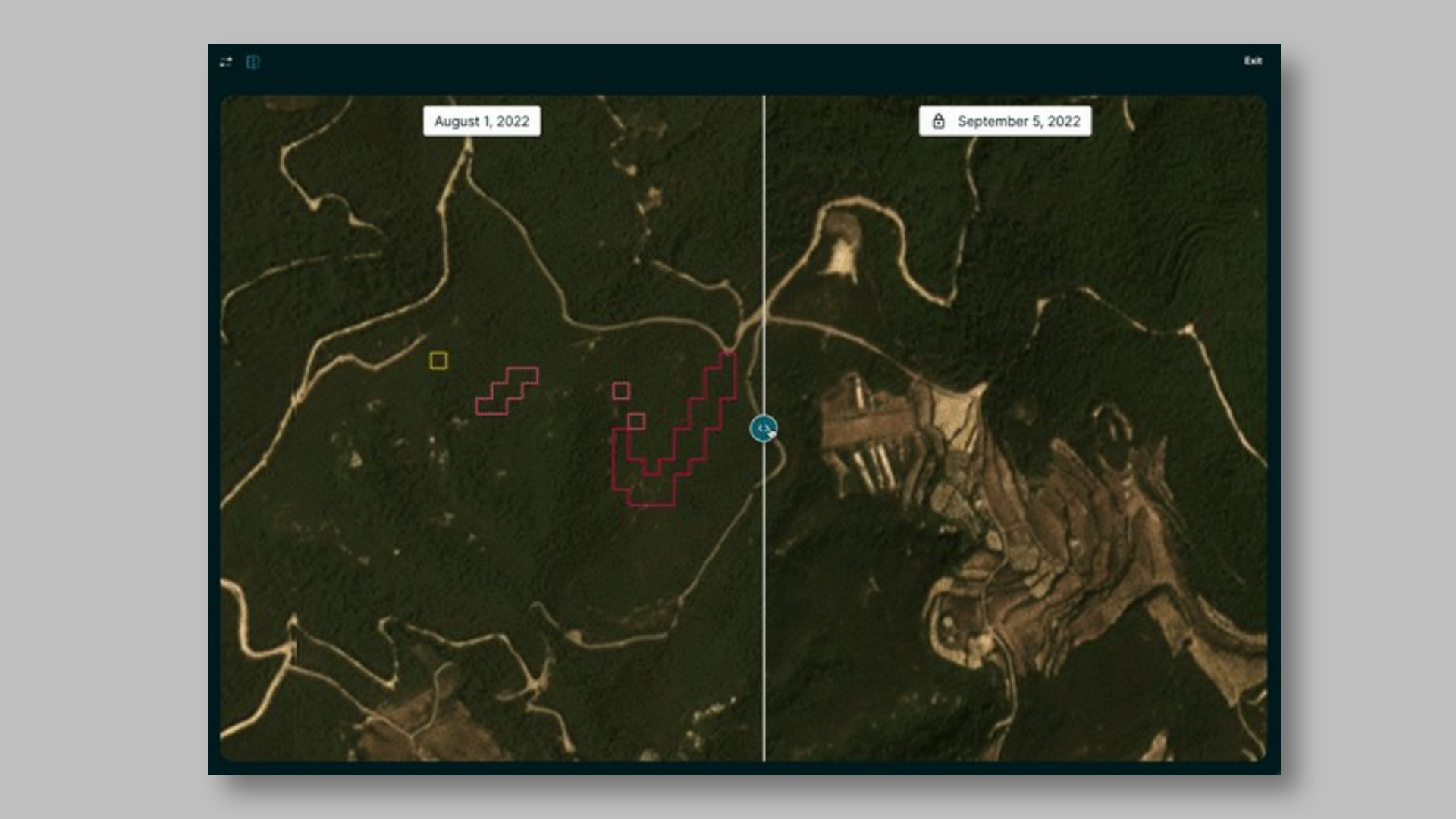
Original presentation, slide 8: a dated before-and-after comparison used in Andrew's forest-monitoring discussion. Source: Andrew Zolli / Planet Labs PBC. An image of clearing does not by itself establish its legal status.
Planet's public impact account describes partners using its imagery in environmental enforcement. It is the company's account of its work. The useful mechanism to follow is how information reaches people equipped to investigate and respond.
For a separate view of that work in Brazil, MapBiomas Alerta publishes its method: combine alerts from different systems, validate them, inspect imagery, refine boundaries, cross-reference information and publish reports. Its public platform description explicitly distinguishes detecting vegetation loss from determining legality or responsibility.
That distinction protects the argument from becoming a fantasy of automatic justice. A detected road is a reason to look closer. A model output doesn't issue its own warrant.
Ask the operational questions. Who receives the report? What do they need to verify it? Can they act while action still matters? If the answer ends at “someone should,” the system isn't finished.
An ecosystem won't fit in one sensor
Andrew moved from forest loss to biodiversity. Satellite observations can show patterns across a landscape, but understanding what lives there calls for other kinds of knowledge and measurement.
He described work linking observations from space with field research, including DNA-based species identification. The aim was to combine different signals into a more useful account of an ecosystem's condition.
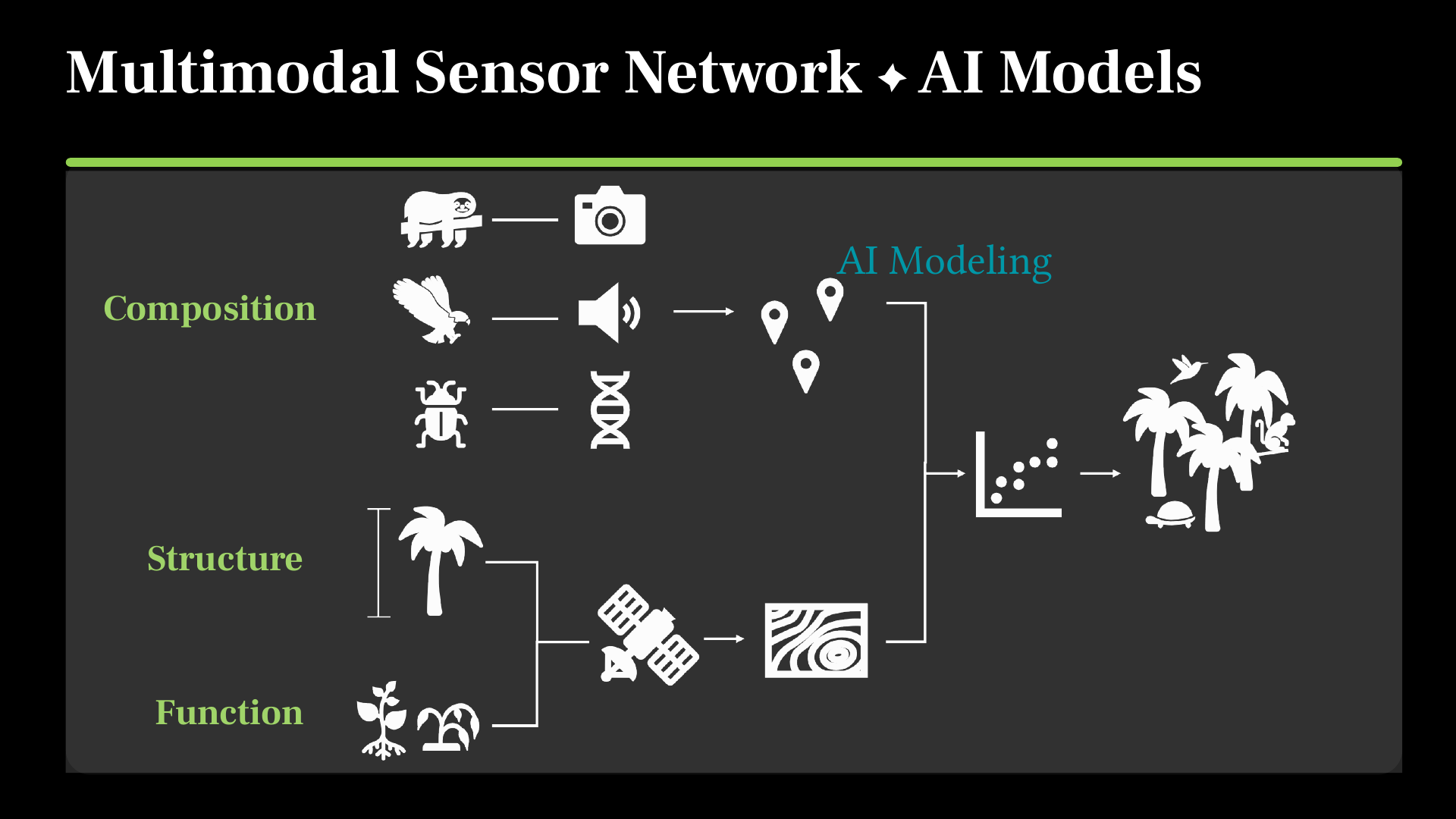
Original presentation, slide 16: the proposed combination of field and satellite observations. Source: Andrew Zolli / Planet Labs PBC. The diagram describes a modelling approach, not proof that every species or ecological relationship can be measured remotely.
The Amazon.ia initiative gives that ambition an institutional form. Its public description brings together field stations, Amazonian organizations, research institutions and technology partners. The work is developing shared infrastructure for conservation decisions, rather than offering one sensor as a complete account of the forest.
Planet's September introduction to Amazon.ia explains the combination of camera traps, acoustic observations, DNA information and satellite data. The point is the relationship among those sources. Each can make something visible that another misses.
There's a creative lesson here, too. Choosing what to combine is part of making meaning. More data can deepen an account. It can also bury the question you were trying to answer.
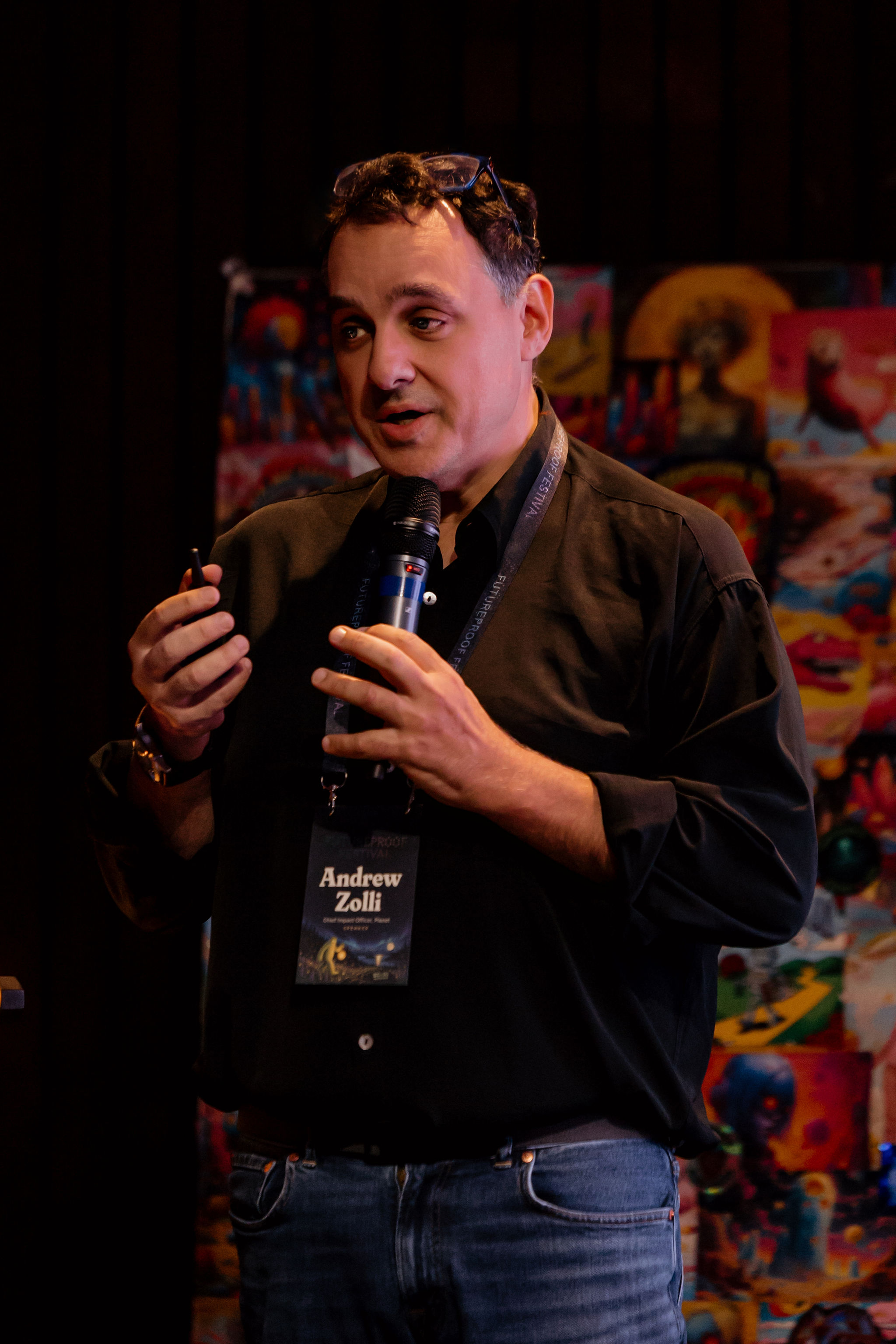
Andrew during the Friday talk on planetary observation and collective action.
A conversational interface changes the entrance
Andrew showed a recorded Planet AI example asking for recent patterns of illegal gold mining in Peru. The interface navigated to Madre de Dios and surfaced locations for inspection.
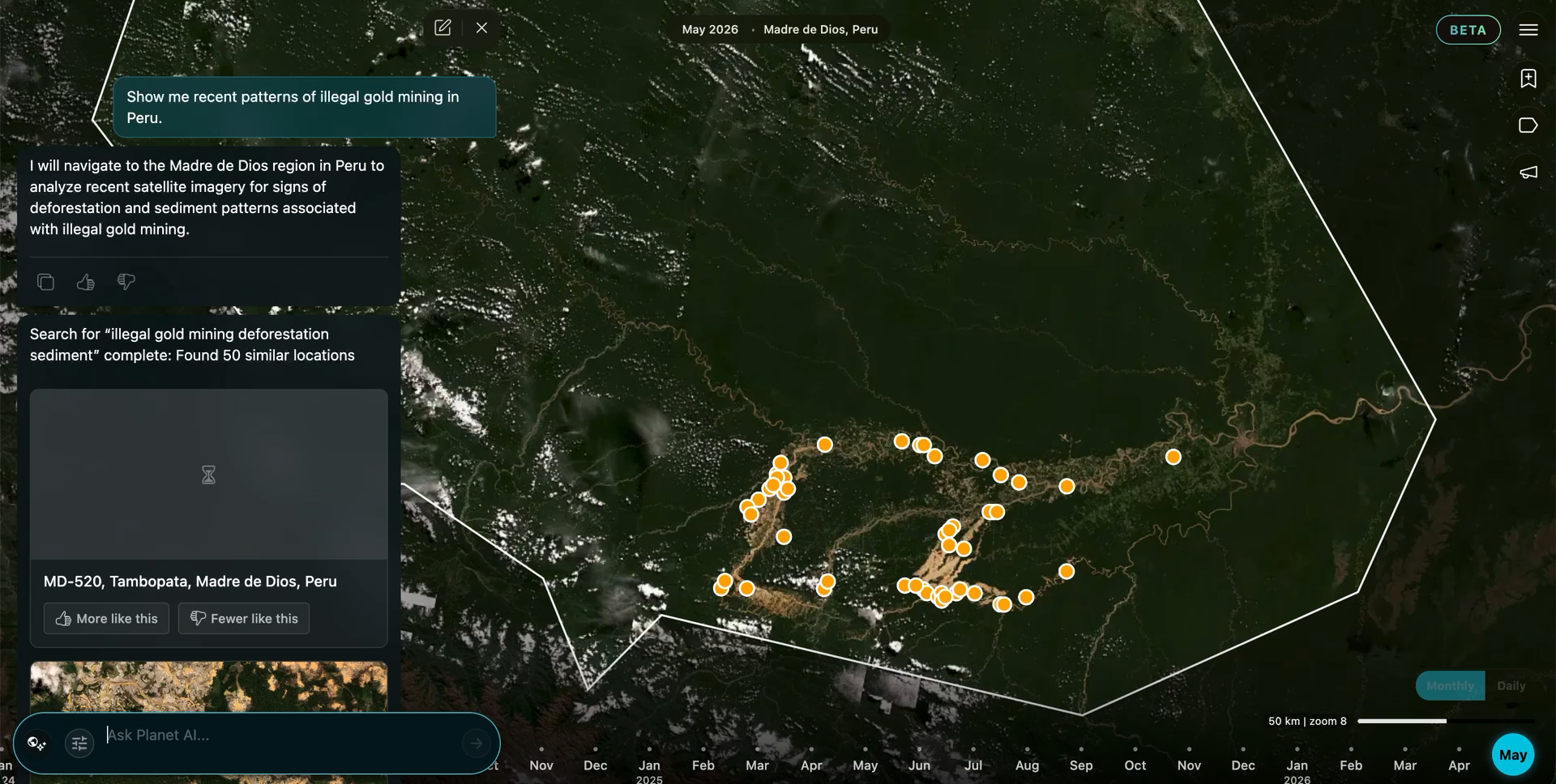
Actual demonstration frame, 35 seconds into the video embedded in original slide 17. Source: Andrew Zolli / Planet Labs PBC. This is a recorded beta example; its returned locations are search results, not independently verified legal findings.
The interface offers a different entrance into a large imagery archive. It lets a person begin with a question instead of first learning every operation of a specialist tool.
That convenience raises the stakes for what happens next. The user still needs to inspect the evidence and understand what the result can establish. Natural language makes a request easier to express. It doesn't make the underlying uncertainty disappear.
The view from above needs an answer from the ground
In the Q&A, an audience member challenged the colonial relationship that can accompany observation: outsiders arrive, collect information and decide what a place needs. What happens to knowledge held by people who live there?
Andrew acknowledged the history of broken promises and described an operating principle of building with people, sharing capacity and doing patient work in service of local needs.
That response is a commitment to test in practice. It doesn't establish consent on behalf of a community or settle who controls every dataset. A conservation purpose doesn't confer those powers by itself.
This connects directly with Sara Blenkhorn's work on ownership and institutional design. Who gets to steer the organization holding the resource? And with Sovereign AI for Whom?: who can influence the bargain beneath the useful capability?
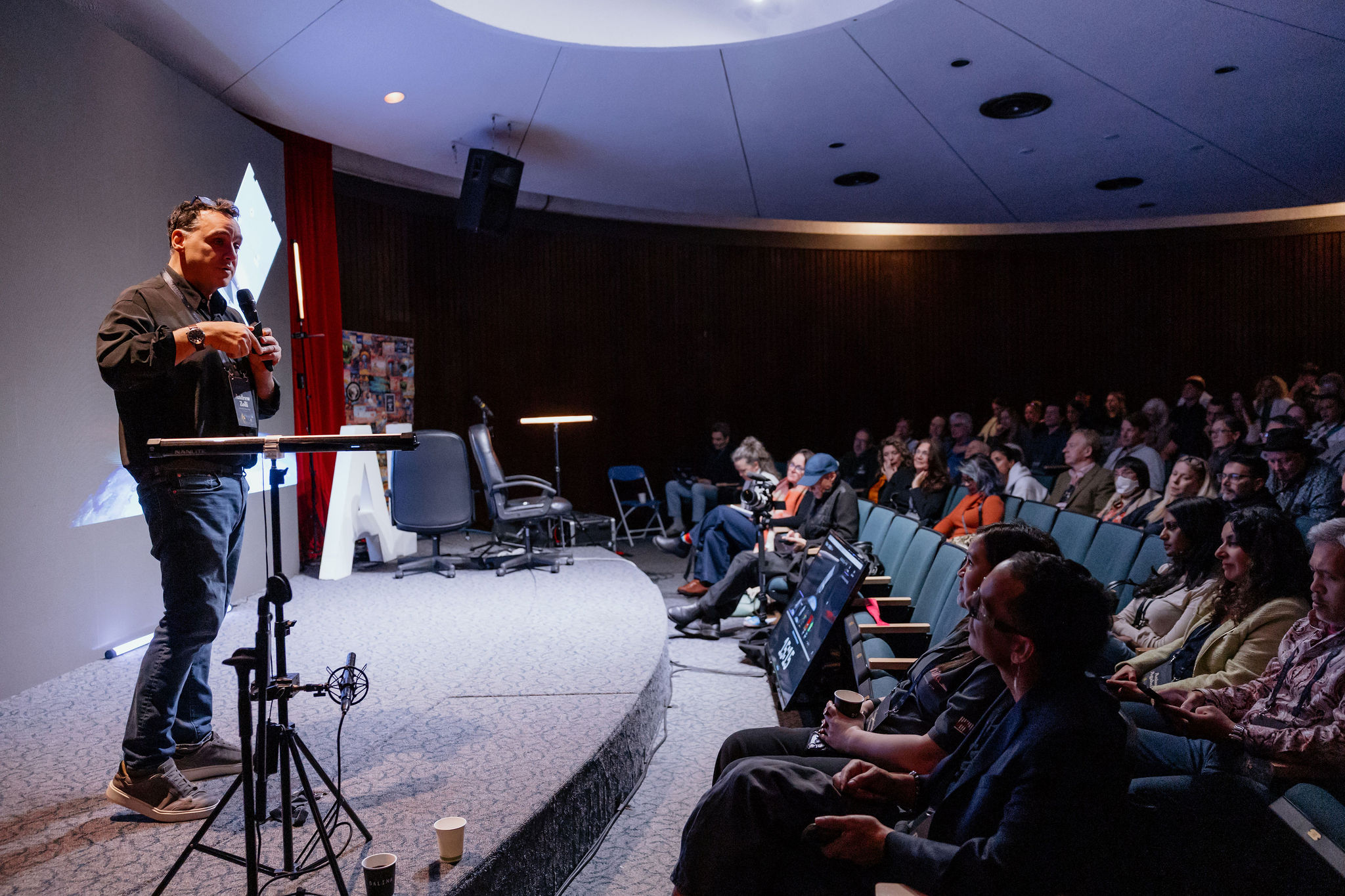
The Friday audience and speaker share the theatre floor.
Give human attention somewhere useful to go
Another question asked how private-sector capacity and public benefit could work together. Andrew emphasized shared information and learning to understand one another's language.
He returned to a constraint that no faster analysis removes: human attention. If systems generate ever more signals, collective sensemaking has to help people decide which ones deserve action.
Our AI Ethical Futures Lab works on the civic version of that problem: making information useful enough that people can question a system and influence what happens. A disclosure that nobody can act on leaves most of the job undone.
Andrew closed by asking us to value the living intelligence already here. The technical work becomes more interesting when it helps us recognize our relationships and responsibilities within it.
So follow the satellite image. Then follow the report, the permission and the person with a decision to make. Keep going until you can see what changes on the ground.