Futureproof Festival / 2026
Stephanie Dick: who decided what counts as intelligence?
The conversations worth coming back to.
Source and citation
This is an authored, illustrated recap. The session date records when the talk took place. An edited transcript and festival recording have not been released on this page.
Kris Krüg. “Stephanie Dick: who decided what counts as intelligence?” Futureproof Festival 2026 proceedings, Volume 01. Session: 2026-10-29. Edition updated 2026-11-06. https://www.futureproof.website/2026/proceedings/sessions/stephanie-dick/
You can also select and copy the citation above.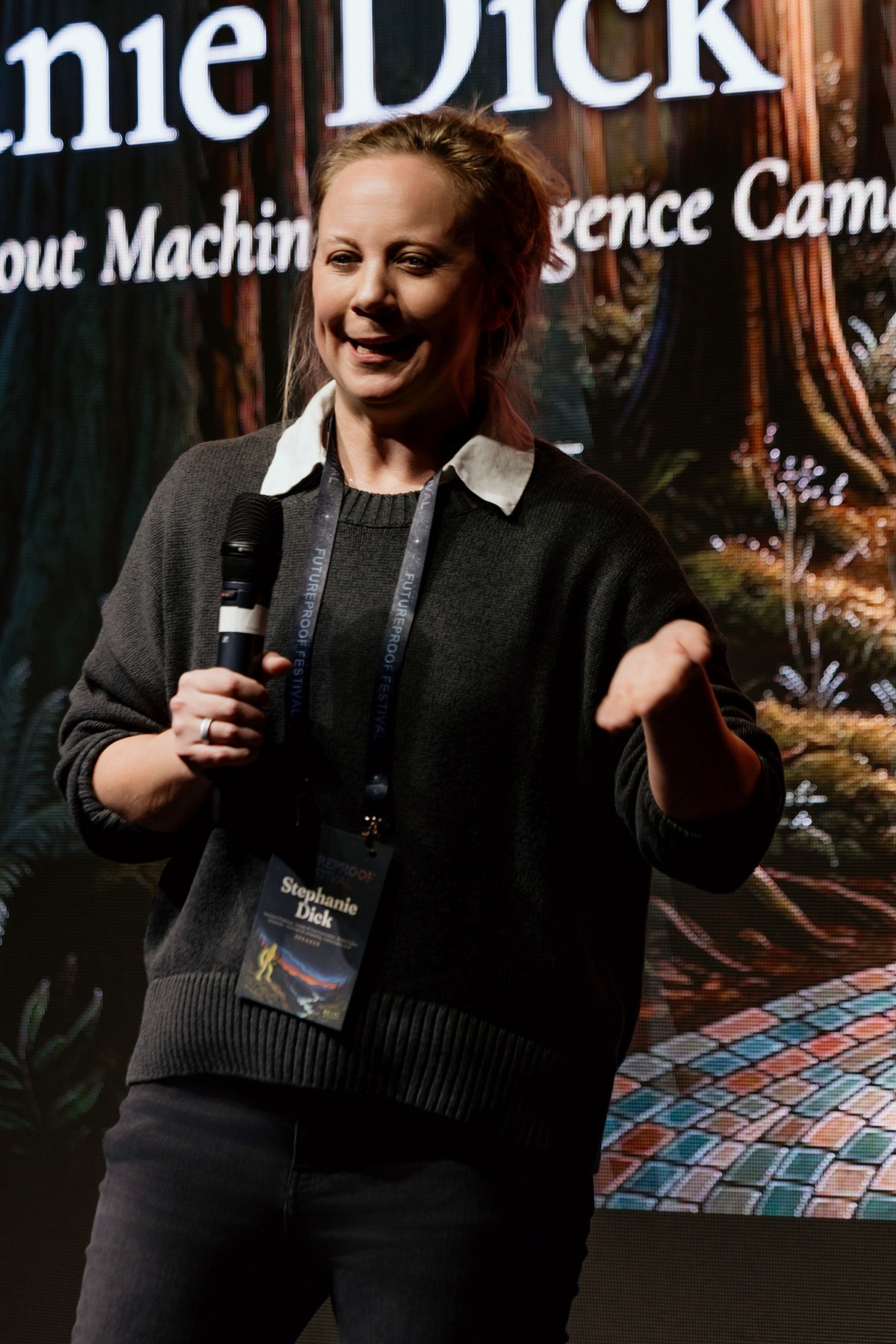
Stephanie Dick at Futureproof Festival of AI, October 29, 2026.
If you want to know where AI is taking us, spend some time with the people who study how it got here.
Stephanie Dick came to Futureproof with a historian's objection to the sales pitch. The thing being called intelligence has changed repeatedly. So have the people authorized to define it, the tasks used to demonstrate it and the human qualities treated as obstacles along the way.
Her talk asked us to look at those choices before accepting another announcement that a machine had surpassed us.
Surpassed us at what, exactly? And when did that become the whole job description for being human?
A history shaped by distrust
Stephanie placed an influential strand of early AI research within the anxieties of the Cold War. Nuclear weapons and military decision-making created pressure to process information and make consequential decisions under conditions of uncertainty.
In the account she developed, human limitations became an engineering brief. People were tired, emotional, slow or susceptible to the wrong belief. Could some of that difficult decision-making be handed to computers?
She characterized this history as a lack of faith in people. It's a forceful historical argument, and it changes the questions worth asking about a technical project. What problem were its designers trying to solve? Which human capabilities did they value? Which did they classify as interference?
The 1955 Dartmouth research proposal, by John McCarthy, Marvin Minsky, Nathaniel Rochester and Claude Shannon, makes one early ambition visible: describe aspects of intelligence precisely enough that a machine could simulate them. It was a research conjecture, with several proposed avenues of investigation. A conjecture is an invitation to do work. It doesn't settle the meaning of the thing being investigated.
Stephanie's published historical essay on artificial intelligence also resists the idea of a single inevitable path from that proposal to the present. The field has contained different ambitions and competing accounts of what intelligent behaviour requires.
First, find the rules of thinking
In the first approach she described, intelligence lay in reasoning. If people could solve a logic problem by manipulating symbols according to rules, perhaps researchers could discover those rules and make a computer follow them.
Stephanie discussed Herbert Simon and Allen Newell's work in this tradition. Mathematical proof and other formal problems gave researchers places to make the approach concrete. The question was whether the messy work of human judgment could be captured in the same way.
The research choice matters. If you decide intelligence is a certain kind of reasoning, success at a reasoning task can look like success at intelligence itself. Everything outside the task risks becoming an inconvenient footnote.
That is still worth remembering when someone waves a benchmark around. A score tells you how a system performed under the conditions of the test. Someone chose those conditions and decided which performance to reward.
Then, ask what the expert knows
The expert-systems approach shifted the emphasis. Perhaps good reasoning wasn't enough. A chemist or physician also knew things about a particular field, developed through study and experience.
Knowledge engineers tried to make that expertise explicit so a computer could use it. Stephanie described interviews, observation and attempts to catch the reasoning behind a person's decision. The ambition was to turn what the expert knew into something executable.
Her everyday illustration was tax software: questions lead to further questions and conditional branches. The example makes the structure recognizable without requiring anyone to have built a medical expert system.
But the translation raises a question for the person being observed. What happens to the knowledge that won't fit the categories? When the expert hesitates, notices an odd detail or changes their mind, is that noise, or part of the expertise?
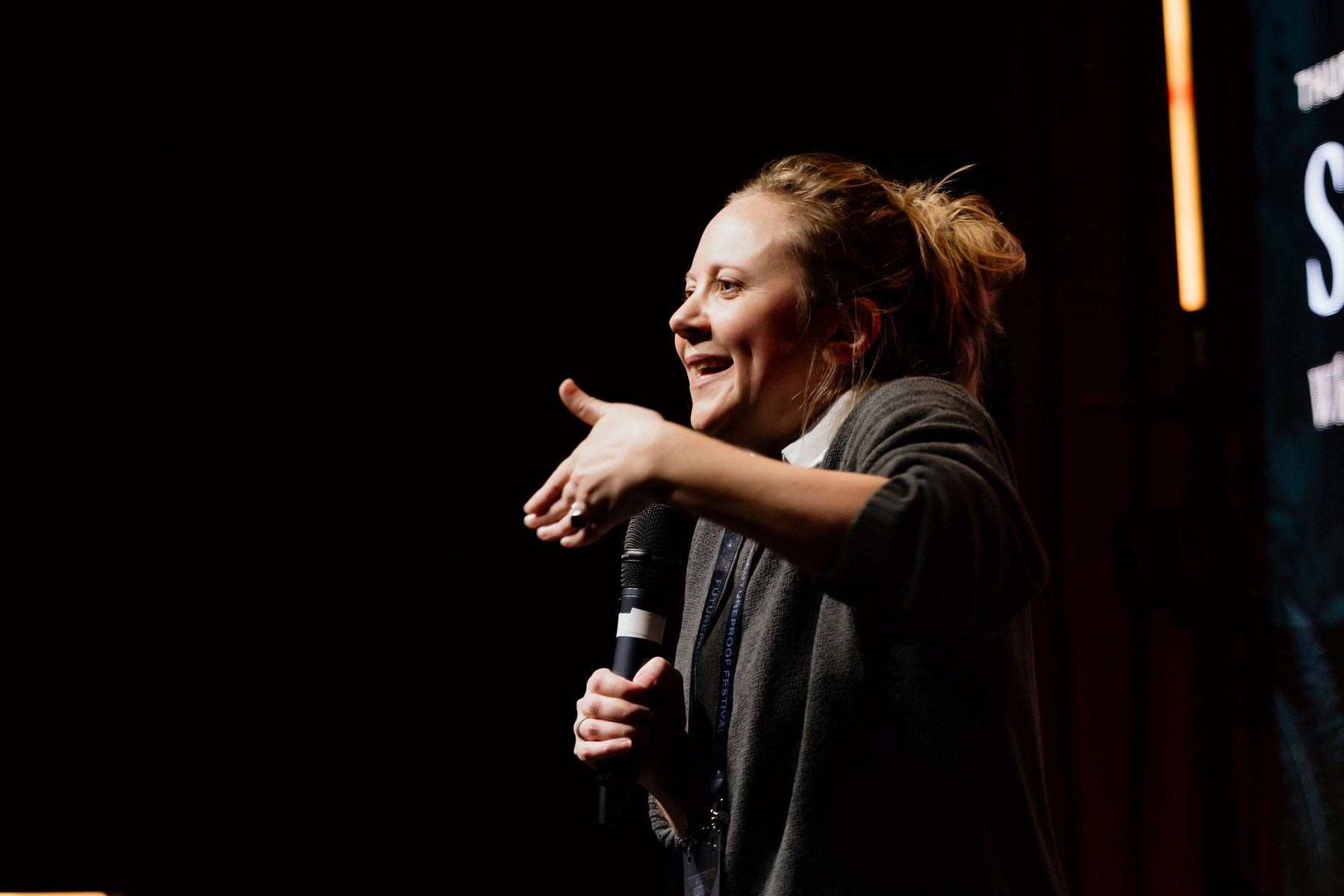
Stephanie during her discussion of human knowledge and its formalization.
The automation project contains a theory of the person. You can disagree with that theory even while finding the resulting tool useful.
Learn from the outputs instead
Stephanie then described the data-driven turn: instead of first writing down a complete account of how people think, give the system examples of what people produce and look for statistical regularities.
Language offered a concrete route into this history. She traced a shift from trying to encode language rules toward models built from patterns in text. Large language models belong to that broader history, with much more complex representations and different machinery from the early statistical systems.
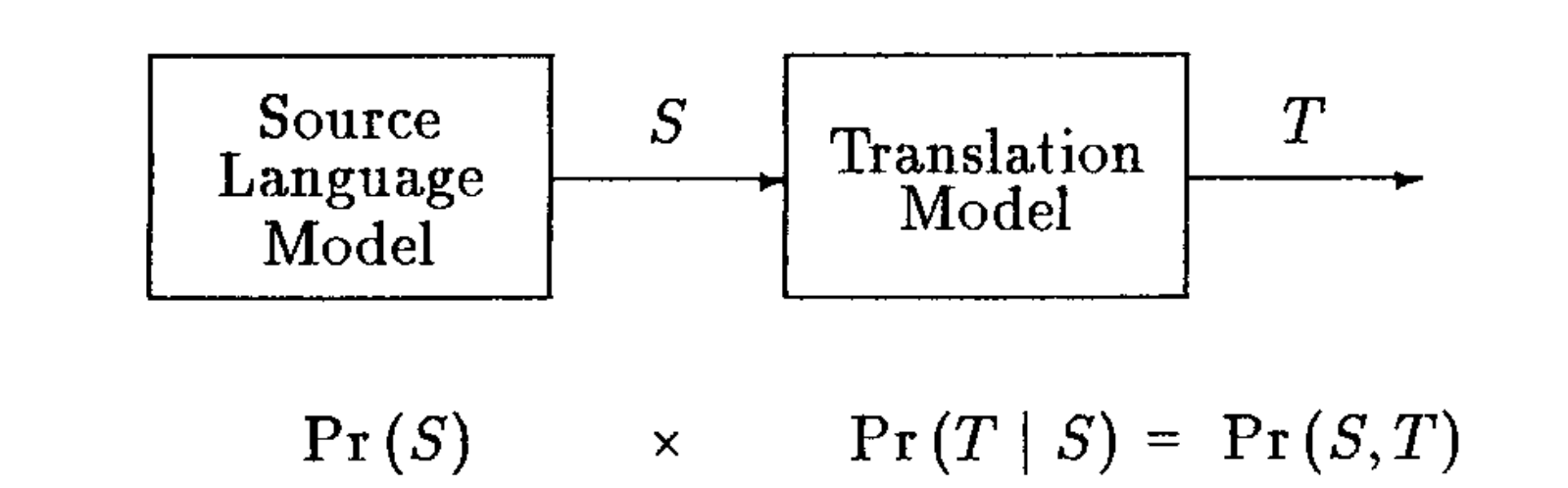
Historical context added for this article: a cropped diagram detail from Figure 1, page 80, of Brown and colleagues' A Statistical Approach to Machine Translation, 1990. Source: Computational Linguistics / ACL Anthology. Stephanie presented without content slides; this is not a festival presentation screenshot.
The 1990 paper supplies a specific example of the change she described. Its authors explain a translation system with probabilities estimated from translated sentence pairs. They also distinguish that bounded task from the wider art of translating a person's work.
That distinction is useful. A system can achieve something worth using without establishing a complete account of human understanding. The practical accomplishment and the larger philosophical claim need their own arguments.
Stephanie was asking us to stop letting one claim substitute for the other.
The human parts might be doing some of the work
Her challenge to the older models was to consider whether intelligence develops through embodied, emotional and social experience. The things classified as interference might be part of how people learn, judge and make meaning.
She borrowed a friend's joke to puncture grand claims about systems escaping their constraints: spend some time trying to keep mice out of an industrial kitchen.
A capable escape artist isn't automatically the measure of every kind of intelligence. The comparison gets a laugh because the category error is familiar. We keep taking a striking ability and asking it to carry a very heavy conclusion.
In my essay on giving chatbots moral authority, the concern is what happens when a persuasive answer starts substituting for a person's judgment. Stephanie reaches further back: what assumptions made that substitution seem desirable in the first place?
Knowledge is something people make together
Sara Blenkhorn asked about collective intelligence in the Q&A. Stephanie responded by describing scientific knowledge as an astonishing human undertaking, produced through work that is messier than a clean diagram of a method can convey.
That sits productively beside Kristen Delphos's science-storytelling session. Kristen offered a structure to help writers communicate research. Stephanie asked us to keep the real making of knowledge visible beneath the structure: disagreement, changing interpretations and people working through uncertainty.
Neither good communication nor scientific care benefits from pretending that a method diagram is the whole process.
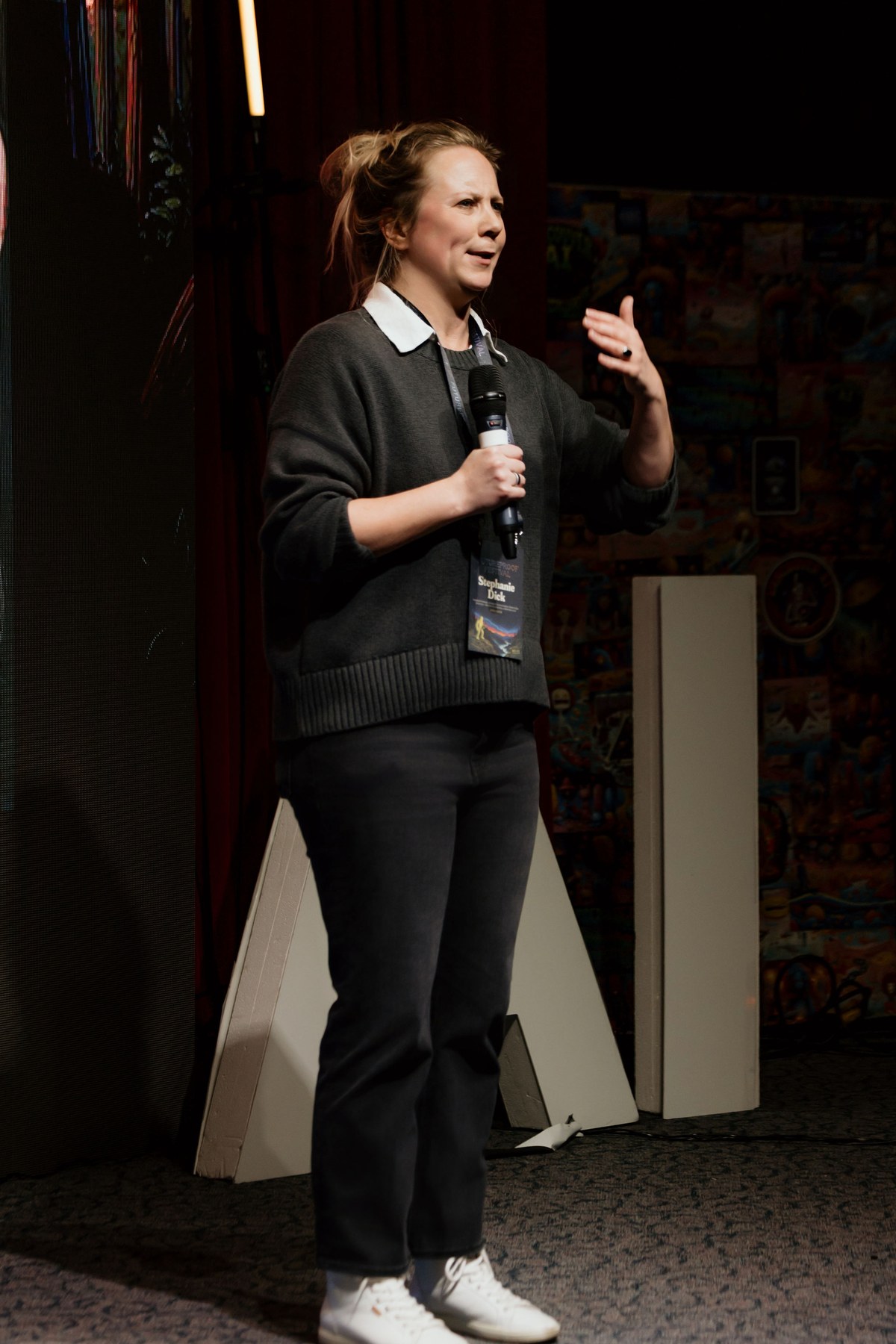
Stephanie's Thursday talk was delivered without a content deck.
An earlier question had taken her back to the politics of distrust. She described how Cold War suspicions reached into relationships and identities. Trusting one another, in her account, can itself be a political act.
That's a serious demand on the people building AI. The model's performance is one part of the work. The arrangements among the people using it also need attention: whose judgment counts, who can challenge a decision and what knowledge disappears when the system's categories take over.
Our Responsible AI Professional programme gives practitioners a place to work on deployment decisions and their consequences. Stephanie supplies a question to bring into that work before choosing a metric: what idea of intelligence are we building around, and whose capacities does it leave out?
AI didn't arrive carrying the final definition of intelligence. People have been arguing about that definition for decades. We still have a say.