Futureproof Festival / 2026
Kristen Delphos: the writers wrote the rules
The conversations worth coming back to.
Source and citation
This is an authored, illustrated recap. The session date records when the talk took place. An edited transcript and festival recording have not been released on this page.
Kris Krüg. “Kristen Delphos: the writers wrote the rules” Futureproof Festival 2026 proceedings, Volume 01. Session: 2026-10-29. Edition updated 2026-11-06. https://www.futureproof.website/2026/proceedings/sessions/kristen-delphos/
You can also select and copy the citation above.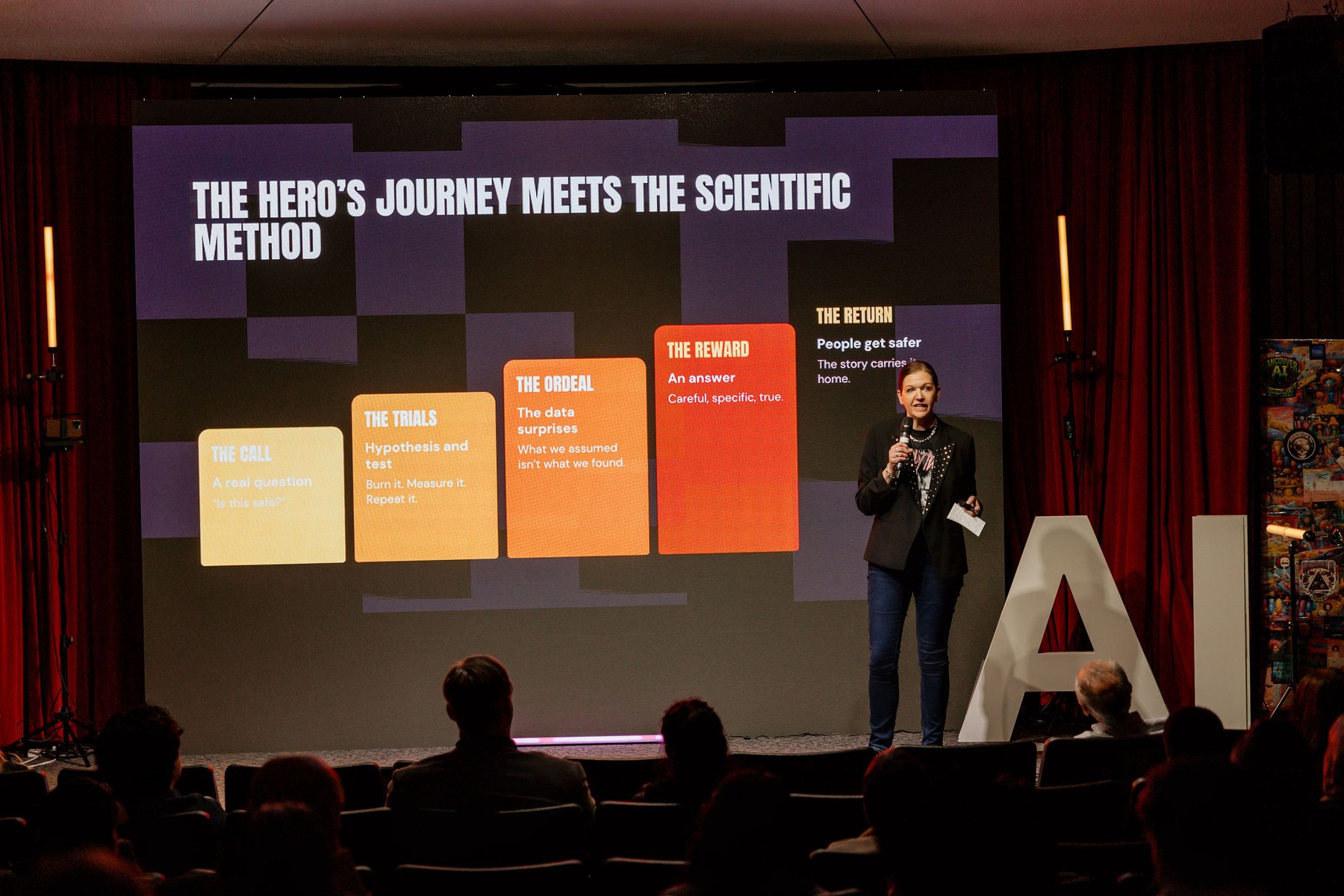
Kristen Delphos at Futureproof Festival of AI, October 29, 2026.
The writers were suspicious of AI. So Kristen Delphos put them to work designing how it would behave.
At UL Research Institutes, her team translates safety science into stories people can understand and use. A dense report can contain an important finding and still leave a reader wondering what the hell it has to do with their life.
The writer has to find the connection without making the science say something more convenient.
Kristen's Futureproof talk showed what happened when her team brought that responsibility into an AI workflow. They chose the sources it could use. They wrote the editorial rules. They made it identify the claims that needed more work.
The people worried about losing their judgment were given a practical place to exercise it.
A red crayon before a research institute
Kristen began with three words written on a windowsill when she was seven: “I am me.” A red crayon, an unauthorized surface, an early indication that the writer had opinions.
Later came a school literary magazine and a poem she and a fellow editor slipped back into the issue after being told to remove it. She recalled getting fired. Then came music reviews, screenplays and the decision to write for a living.
Her point was personal continuity. The tools and the employers changed. The impulse to see something and make another person see it remained.
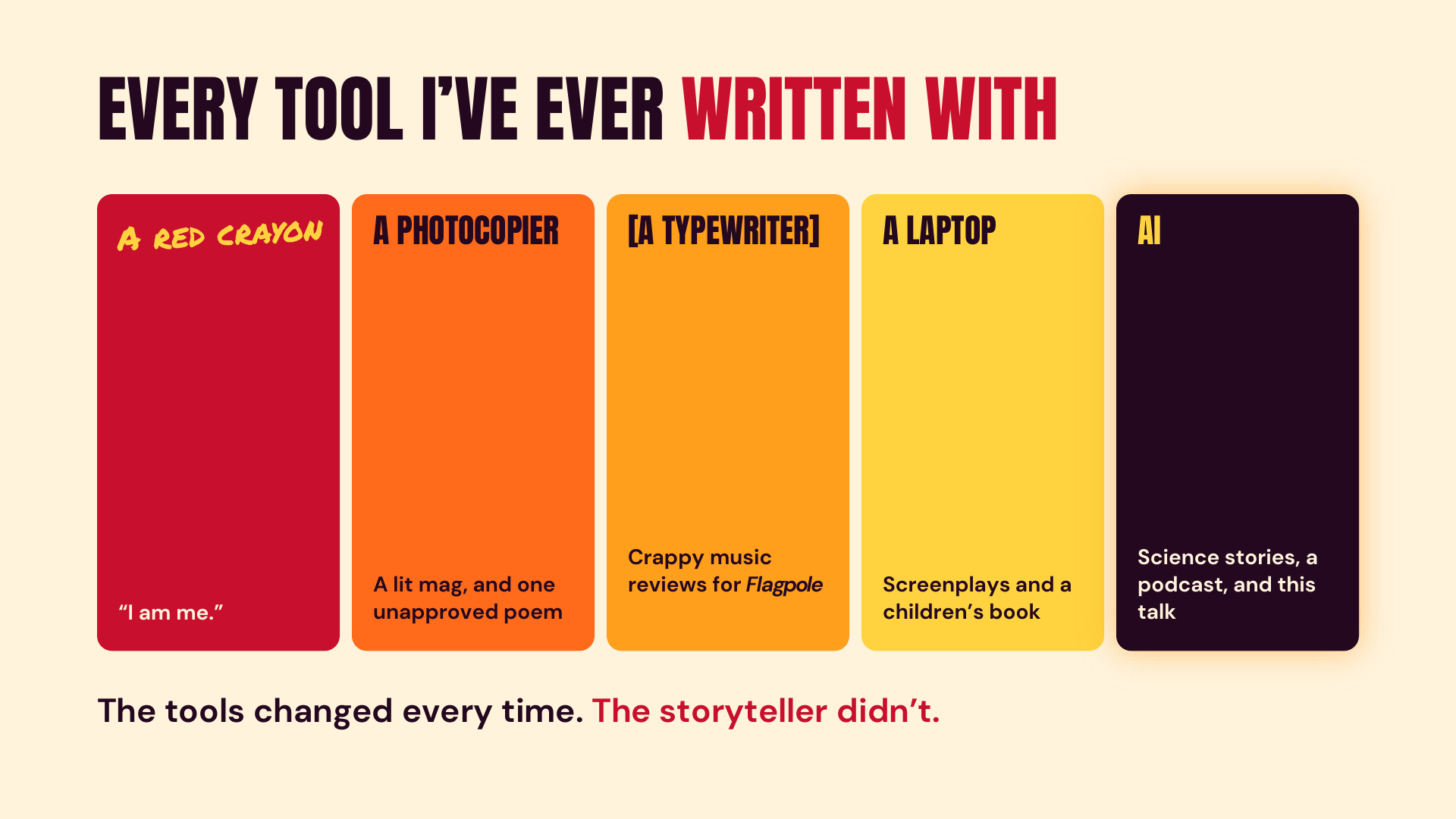
The tools changed; the author still had something to say. Submitted presentation page 16: Kristen Delphos / UL Research Institutes.
That matters in the middle of a conversation that can make every working creative feel like a function awaiting replacement. A writer brings a history of noticing, choosing and getting things wrong. There's a person behind the sentences, including the ones a tool helps produce.
Our AI Upgrade for Creative Professionals starts from that working experience: rebuild the workflow around the craft you've developed. Kristen brought an example of people doing exactly that with a demanding editorial job.
Give the science a story without giving it a costume
Kristen described the initial difficulty of talking about storytelling with scientists. Some heard “dumb it down.” Others heard “press release.” Neither captured the job she wanted her writers to do.
She used the hero's journey as a bridge: begin with a question, encounter difficulty, learn something and carry it back to other people. She placed it alongside the scientific method to make the work of research recognizable as a story.
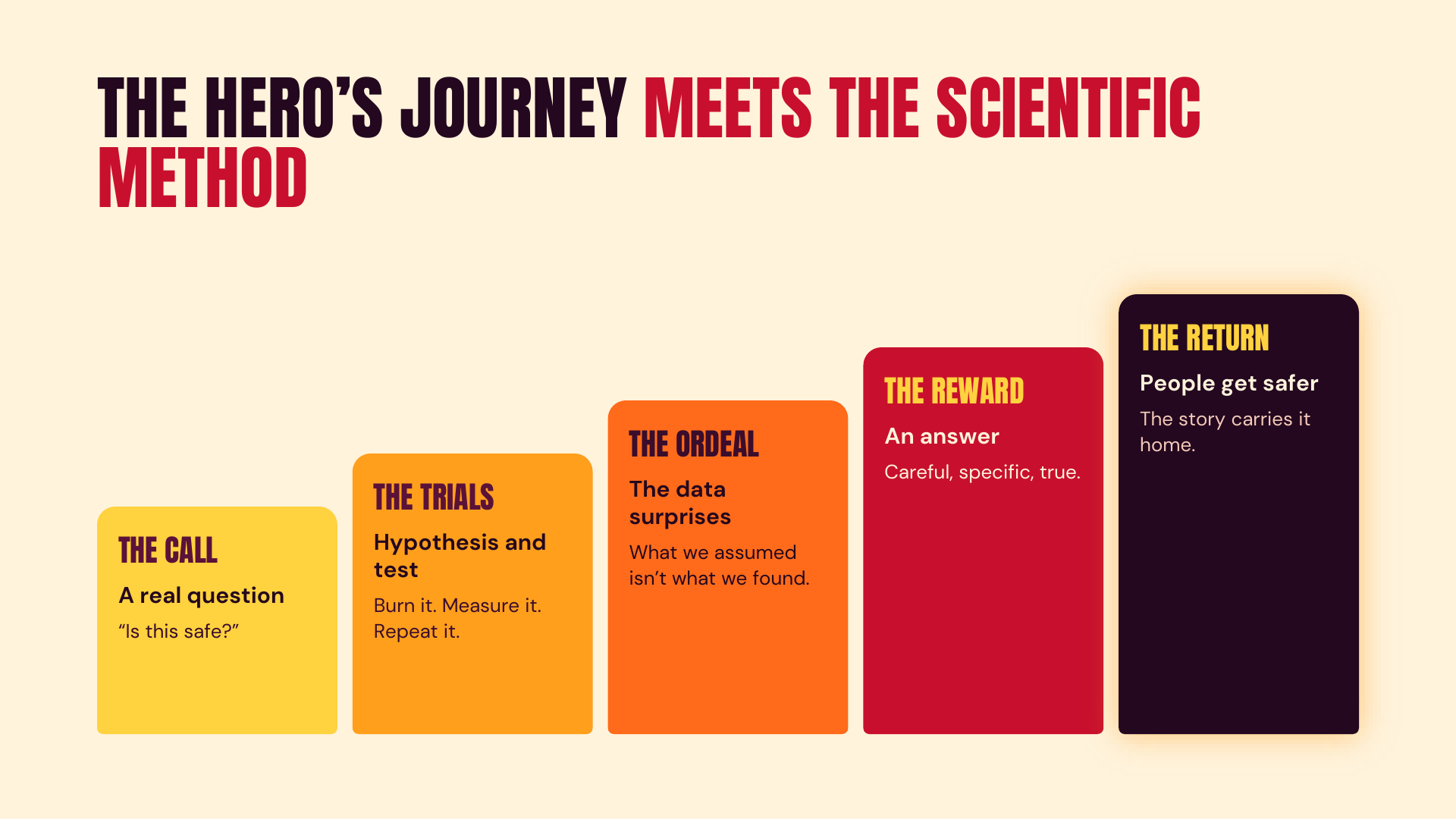
Kristen's storytelling analogy, submitted page 9. It is a way to explain the research process, not a claim that every study produces a tidy resolution. Presentation: Kristen Delphos / UL Research Institutes.
One step in her diagram deserves particular attention: the data surprises you. What you assumed isn't what you found.
That's where the writer has to resist the urge to tidy everything up. The story can't require a triumphant result before the experiment has happened. The finding might narrow the question, expose a limit or show why the first explanation doesn't hold.
An honest account can make that interesting. It doesn't need a victory costume.
The tool has homework before it gets to write
The team spent several hours experimenting together, starting with exercises outside their day job. Then they built a science-storytelling skill around the standards of their actual work.
It asks about the finding and the intended reader before producing a draft. It works from the institute's published research. It has writing rules, including an expanding list of AI habits the team wants removed.
Yes, the em dash was on the list. Working writers have eyes.
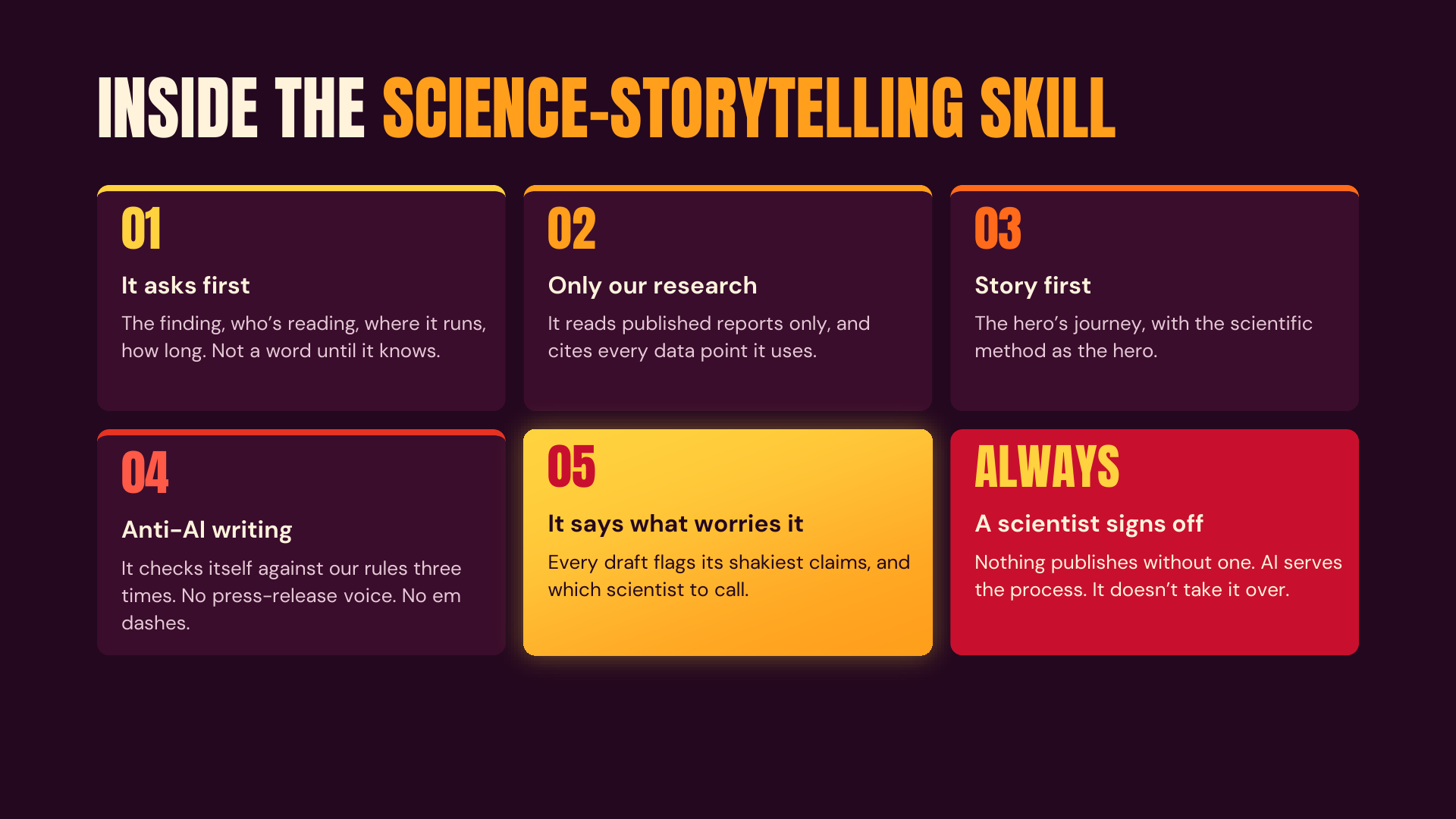
The editorial workflow, submitted page 11. These are the team's intended operating rules; the slide isn't an independent audit of model compliance. Presentation: Kristen Delphos / UL Research Institutes.
The most consequential output was the set of questions. The skill flags what it can't establish from the source and helps the writer identify what to ask the scientist.
That changes the next conversation. The writer can arrive with a possible story and specific points to investigate, instead of asking a researcher to somehow produce an accessible narrative on demand. The scientist can correct the interpretation and explain where the draft has run past the evidence.
My account of building AI workflows with founders describes a related habit: gather the project's real context and working rules in a place the tools can use. Kristen's example adds a particularly useful requirement. The workflow should help the human notice what remains unresolved.
A headline that opens a question
Her vaping example showed the editorial choice in miniature.
The easy headline was a command: don't vape. Her team's brief was to communicate the science. The question became whether the cloud was simply water vapour, and the proposed headline invited readers into what researchers had found.
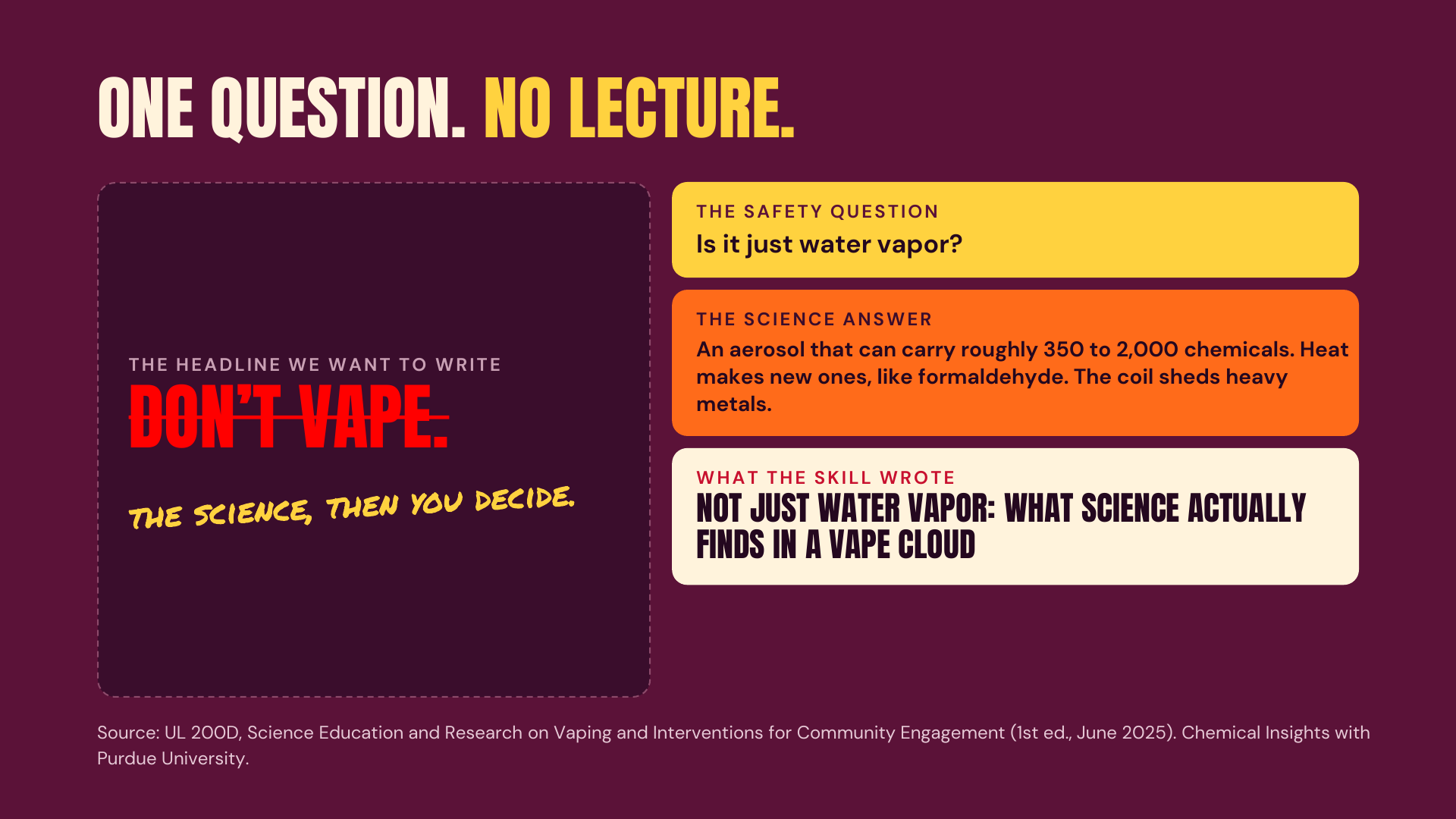
A headline example, submitted page 12. The slide cites UL 200D, the June 2025 research guidance; the institute's published explanation of vape emissions supplies the underlying context. Presentation: Kristen Delphos / UL Research Institutes.
That public explanation distinguishes vapour from aerosol and describes chemicals that can be present in emissions. The editorial task is to make the finding understandable while keeping a route back to its evidence.
A headline can respect the reader's agency and still have a point. Scientific care doesn't require prose that reads like the back of a filing cabinet.
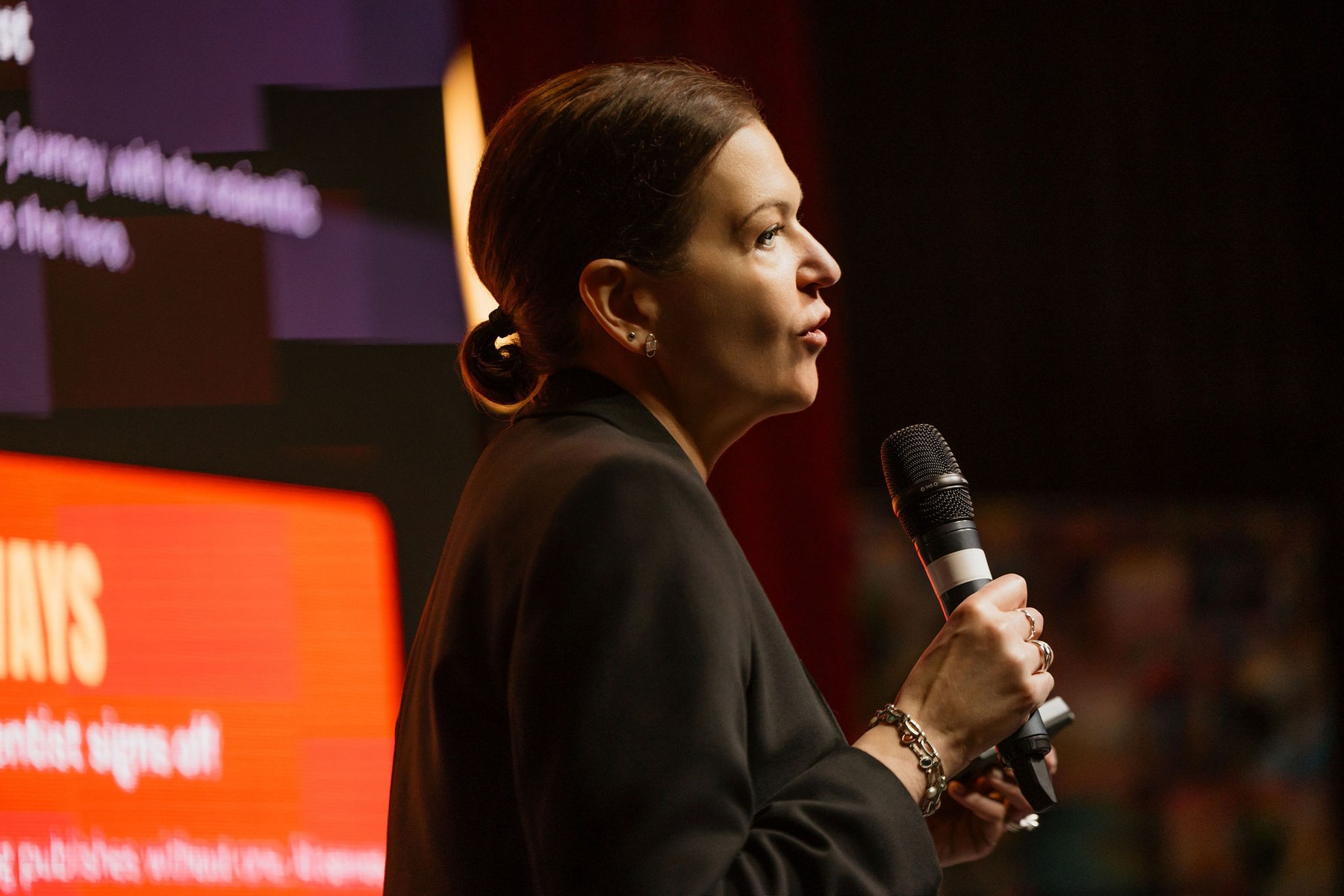
During Kristen's presentation of the writing workflow.
The new tools helped an old film find people
Then Kristen took us somewhere unexpected: a silent fire-safety drama commissioned in 1917.
An Unbeliever Convinced had been considered lost. Its rediscovery led to a restoration involving the University of Maryland Libraries, Periscope Film, USC's HMH Foundation Moving Image Archive and UL Research Institutes. Jon C. Mirsalis supplied a new, period-appropriate score.
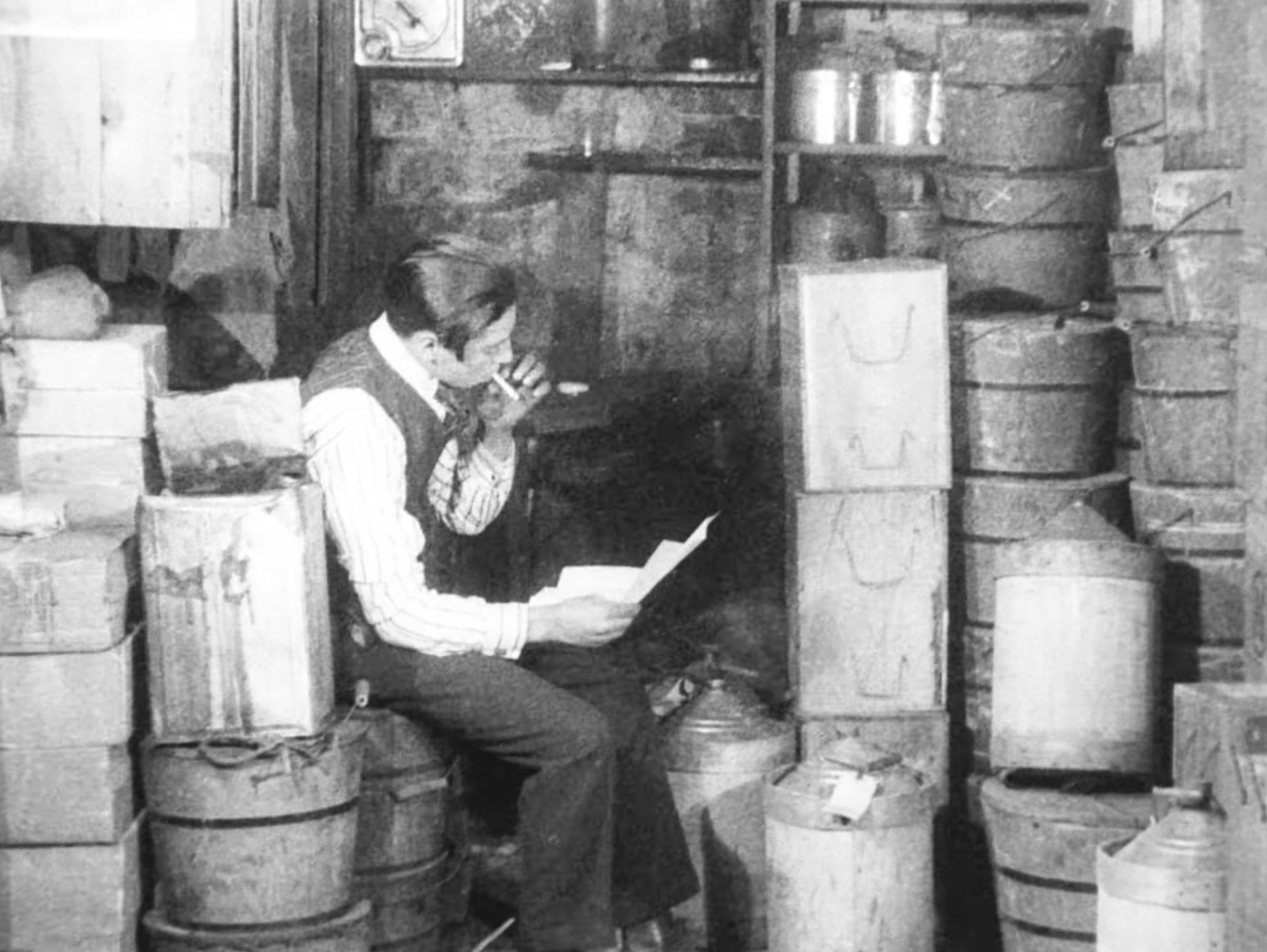
A scene from An Unbeliever Convinced (1917), from UL Research Institutes' restoration gallery. Film: Essanay Studios, commissioned by Underwriters Laboratories. This is the historical film Kristen discussed, not an AI-generated reconstruction or a festival stage capture.
The restoration was the work of archivists, preservation specialists and a musician. Kristen described using AI with her communications team to plan how to bring that work to an audience: audience research, a marketing plan and festival submissions.
She contrasted that hands-on work with an agency proposal that would have taken weeks before the team had a plan. The useful lesson wasn't a universal savings figure. Her writers could investigate an unfamiliar field and make decisions about a real project themselves.
You can watch the restored film and read the account of its rediscovery. For our BC + AI Film Club, there's a lovely practical connection: new tools can help people find and discuss existing work, as well as make new films.
Keep the makers in the workflow
The Q&A brought the employment question back into view. A communications leader asked how to defend a team's resources when the software appeared capable of doing so much.
Kristen's advice was to show the work and keep the team close to making it. That is an argument for visible contribution, not a guarantee about anyone's job. The budget question survives the clever demo.
What her example gives a team is a place to start. Take a real assignment. Let the people responsible for its quality write the rules. Inspect the failures together. Make the unresolved questions part of the output.
The writers didn't have to surrender their standards to participate. They built those standards into the work, then kept themselves responsible for whether it was any good.