Futureproof Festival / 2026
Charles Bicari: five phones, a choir and a better question
The conversations worth coming back to.
Source and citation
This is an authored, illustrated recap. The session date records when the talk took place. An edited transcript and festival recording have not been released on this page.
Kris Krüg. “Charles Bicari: five phones, a choir and a better question” Futureproof Festival 2026 proceedings, Volume 01. Session: 2026-10-29. Edition updated 2026-11-06. https://www.futureproof.website/2026/proceedings/sessions/charles-bicari/
You can also select and copy the citation above.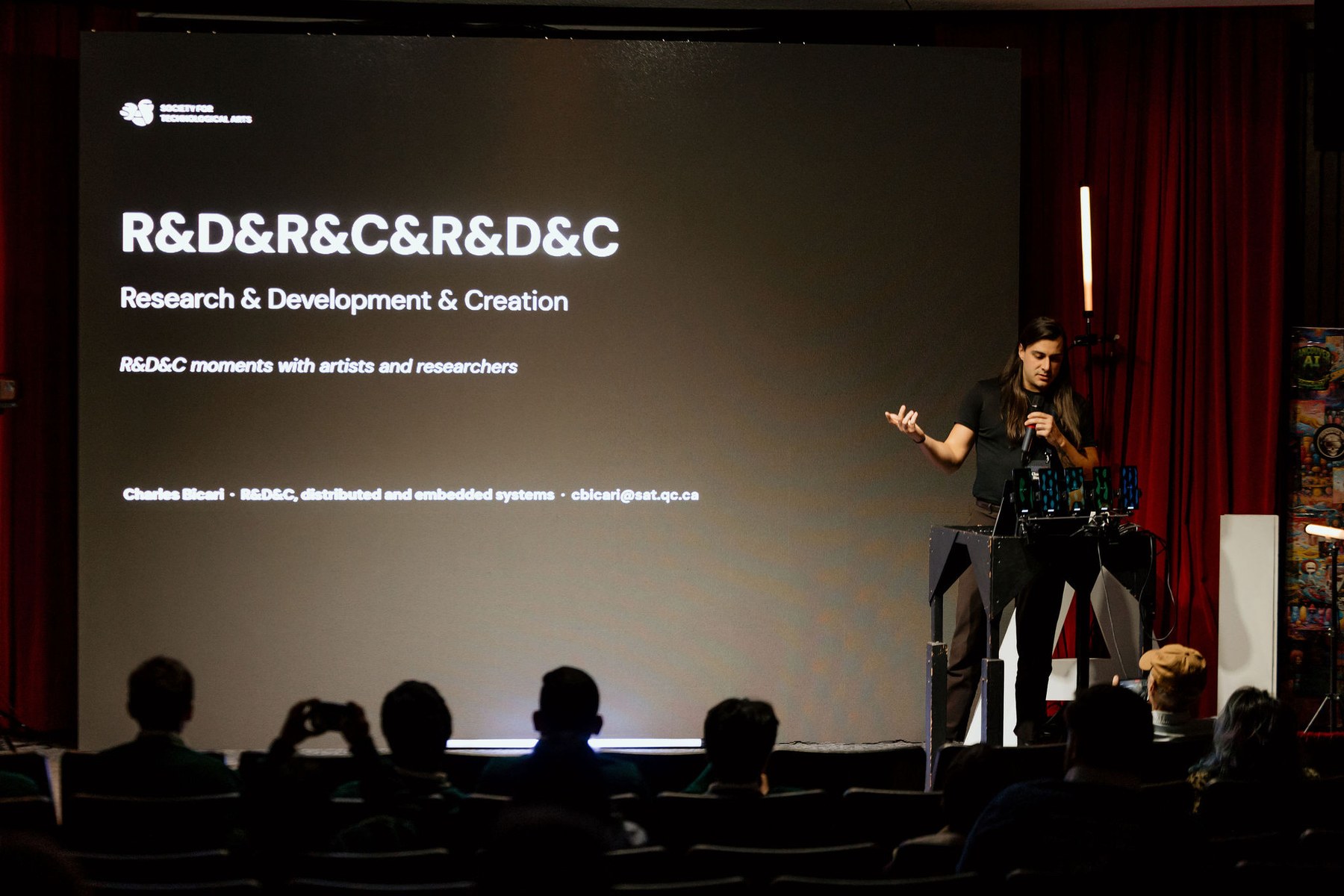
Charles Bicari at Futureproof Festival of AI, October 29, 2026.
The choir needed a moment to wake up.
Five phones stood on Charles Bicari's table. There was no big sound-system reveal. He explained that the phones themselves would play, sent the system a song and waited.
Then the little machines sang.
Charles had arrived from Montréal's Société des arts technologiques with small computers, a local network and a collection of experiments. His Thursday talk gave us a look inside the thinking behind them, including the setup he planned to take further at Friday's closing party.
He made AI feel like something an artist could put on a workbench and mess with. The interesting question became what you could make it do, and what you might discover while trying.
“You do AI” is a spectacularly vague job description
Charles described being assigned AI projects as though the phrase named one coherent skill. His comparison was electricity. Working with it doesn't tell you whether someone builds a hydro dam or a microchip.
His own interest was in small, locally run systems and their creative uses. He talked about microcontrollers and Raspberry Pis, devices with constraints you encounter quickly when you try to build something that responds in real time.
That's a good antidote to the tendency to discuss AI only through the largest model or the biggest data centre. The particular system matters. Where does it run? What input can it accept? What can you connect to it?
The SAT research lab places that practical work in a broader research-creation practice: artists, researchers and technical people experimenting together, with methods and tools that can be passed back into creative work.
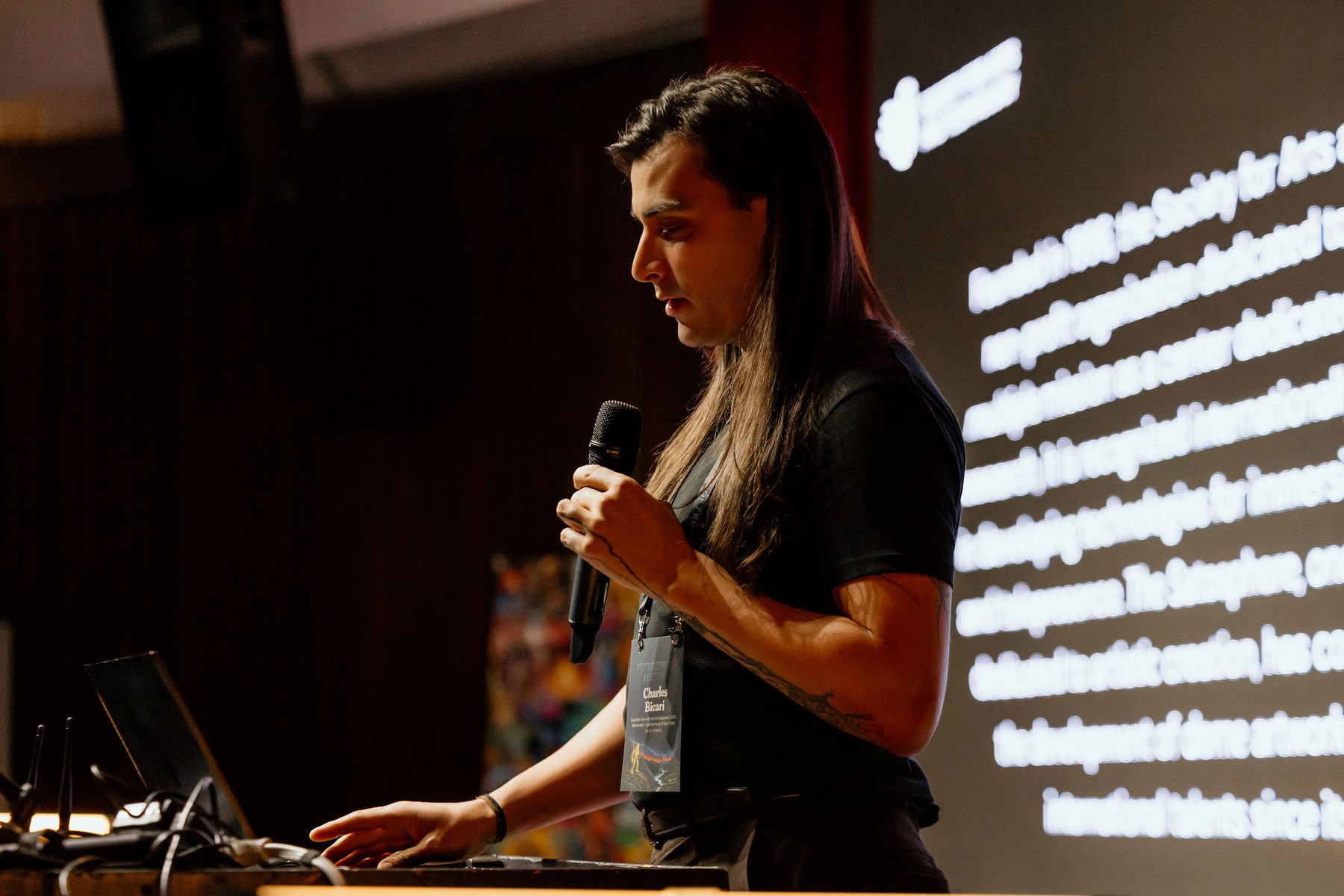
The physical setup and SAT introduction on stage.
What if the input is a knob?
One of his experiments began with a small language model on a microcontroller. Instead of approaching it through a familiar text box, Charles started thinking about a physical control: could an analog signal influence what went into the model?
That is a different starting point from asking everyone to become better at prompting. It asks what sort of interface a person could use at all.
He connected the idea to a conversation about people who cannot interact through conventional speech or keyboards. Could sensors and learned mappings offer other ways in? The talk raised that as a design direction to investigate, rather than presenting a finished accessibility product.
His related neural-synthesis architecture gives readers a concrete path into a different physical-control experiment: hand tracking, a learned mapping and a sound-producing model, with a MIDI control option too. It is a separate documented project, not a description of the five-phone choir.
The creative choice is in what gets connected. A camera, a gesture or a knob can become part of the instrument. The model is one component in the arrangement.
Give the system something to look back at
Charles described a sphere that makes room for two kinds of input. Depth cameras capture the people standing around it. A second camera watches the whole installation, and a local model describes what it sees in English and French.
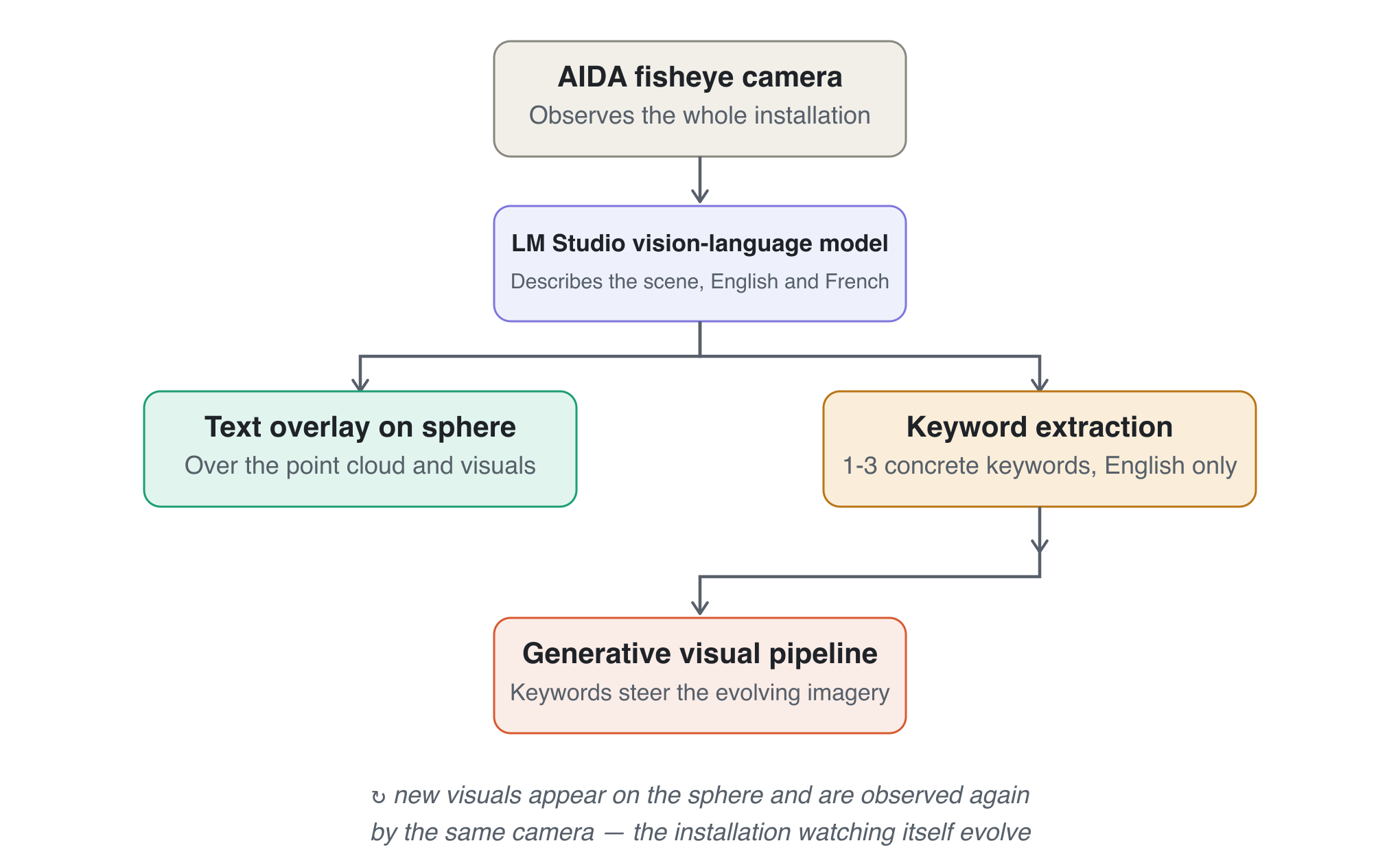
Project documentation for the installation Charles described. His original feedback diagram follows the camera’s image into a bilingual description and the keywords that shape the next projection.
In Charles’s architecture notes, the description splits in two. The words appear on the sphere. A few keywords also steer the next image, which the camera sees again. The people keep moving, and the installation keeps changing what it has to look at.
You don't need to grant it a self to find that interesting. The artist has made a loop between observation, description and generation, then given the loop time to behave.
It is a useful connection to Philippe Pasquier's creative-systems practice. An artist can compose the conditions under which work develops, including the feedback, the timing and the points where they intervene.
Can you compost the slop?
Charles recounted an artist asking what to do with a pile of generated imagery. Could it be composted?
The metaphor became a distributed process: different agents worked on parts or stages of an image, with roles inspired by decomposition. He described carrying a version into the performance setup, using ASCII imagery as an aesthetic choice.
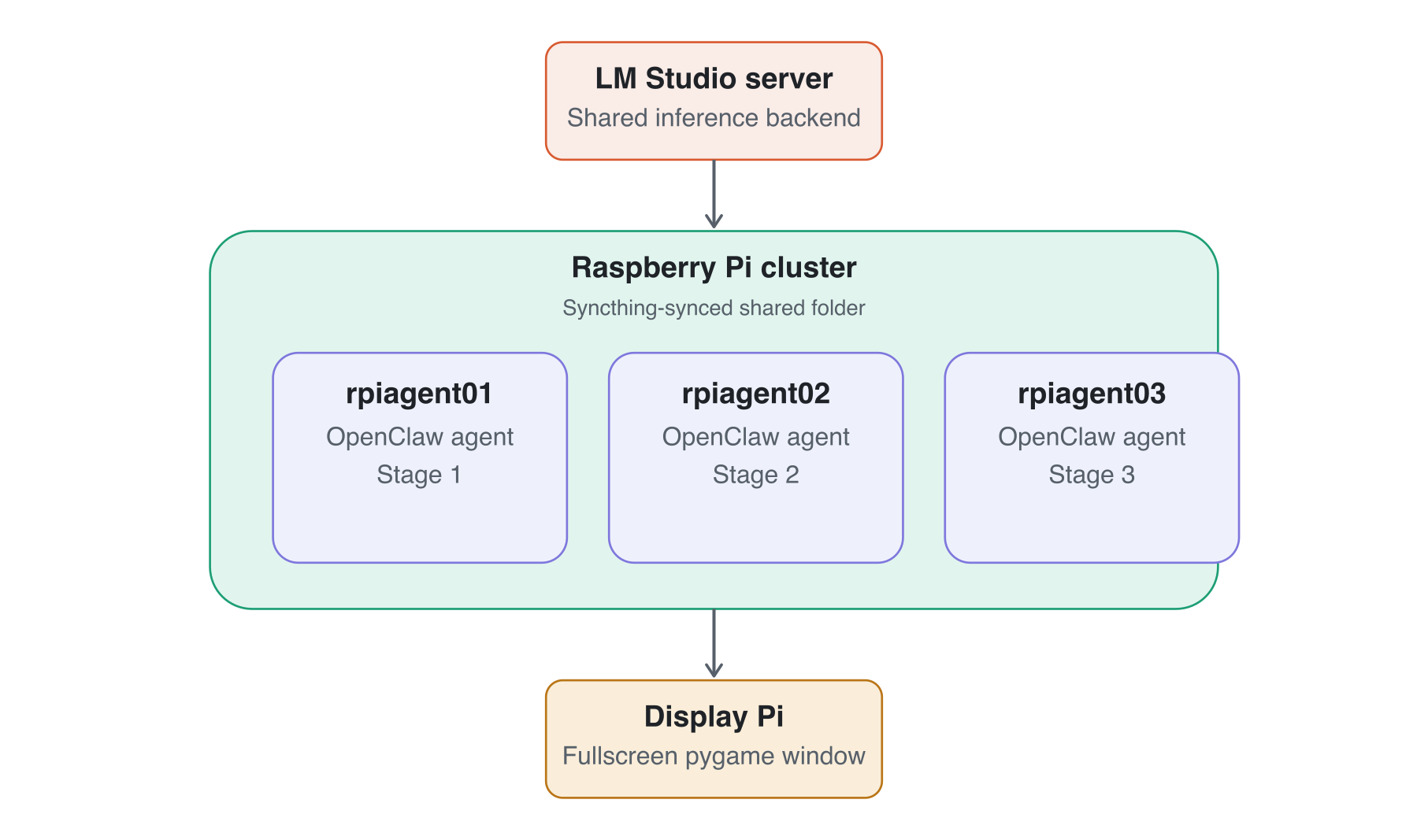
Project context from Charles's Technocompost architecture overview. The original published SVG diagram is rendered here with its labels intact. It shows a shared inference backend serving the Pi cluster, not a full language model running independently on each board. Diagram: Charles Bicari. This is not a festival slide capture or a diagram of the phone choir.
That published account distinguishes an agent-directed pipeline from a tile-processing mode that doesn't need a language-model decision for every operation. The distinction helps the reader see where the AI is doing something and where other software is doing the work.
There is creative value in making that division visible. Calling everything an agent conceals choices the artist could actually change: the transformations available, the sequence and the conditions under which a different action is selected.
Our BC + AI Film Club makes space for exactly this kind of process discussion. Show the work, then show enough of the system that another maker can ask a useful question.
A constrained agent can still surprise its maker
Charles compared his early experience of agents to a game character with a limited set of actions. It could act within that repertoire, which made the frightening abstraction more understandable to him.
His feelings changed again as he encountered systems becoming more capable of making tools. He kept the uncertainty in the story. Learning how a system works can reduce one kind of fear while giving you a more specific reason to pay attention.
My writing about who is steering an AI system asks where the person's values enter the loop. Charles puts that question in the workshop. Which actions have you made available? Who can change them? What did the system do while you were expecting something else?
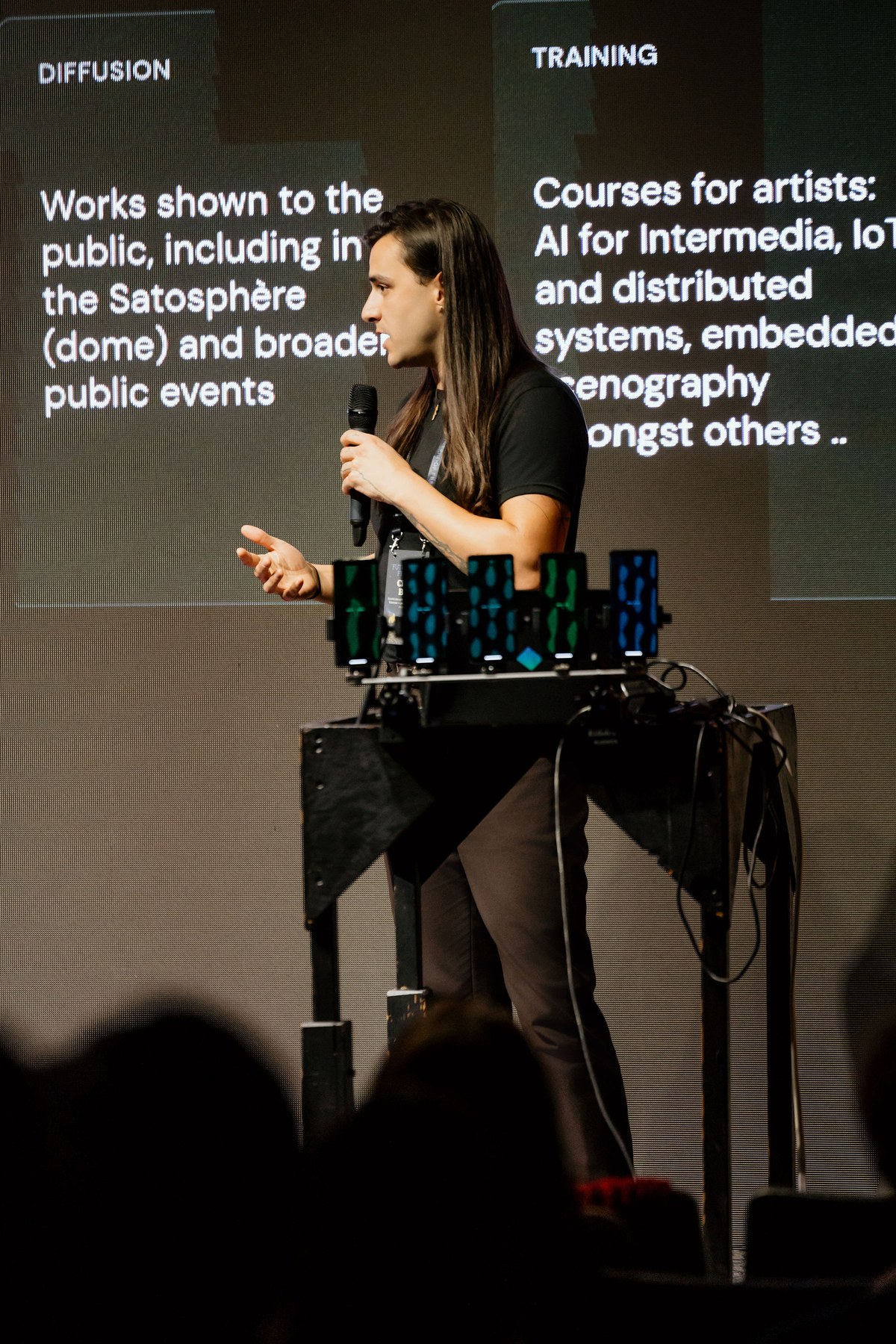
The link between experimentation, public work and teaching in the actual presentation.
Listen to the little machines
The phones brought the discussion back to something people could hear. Charles described sending instructions to the setup and having the devices interact. He identified one part of the sung output as something a particular choir agent had written.
The demonstration was modest enough to leave its machinery visible. We could see the phones, the cabling and the person trying to get the experiment started.
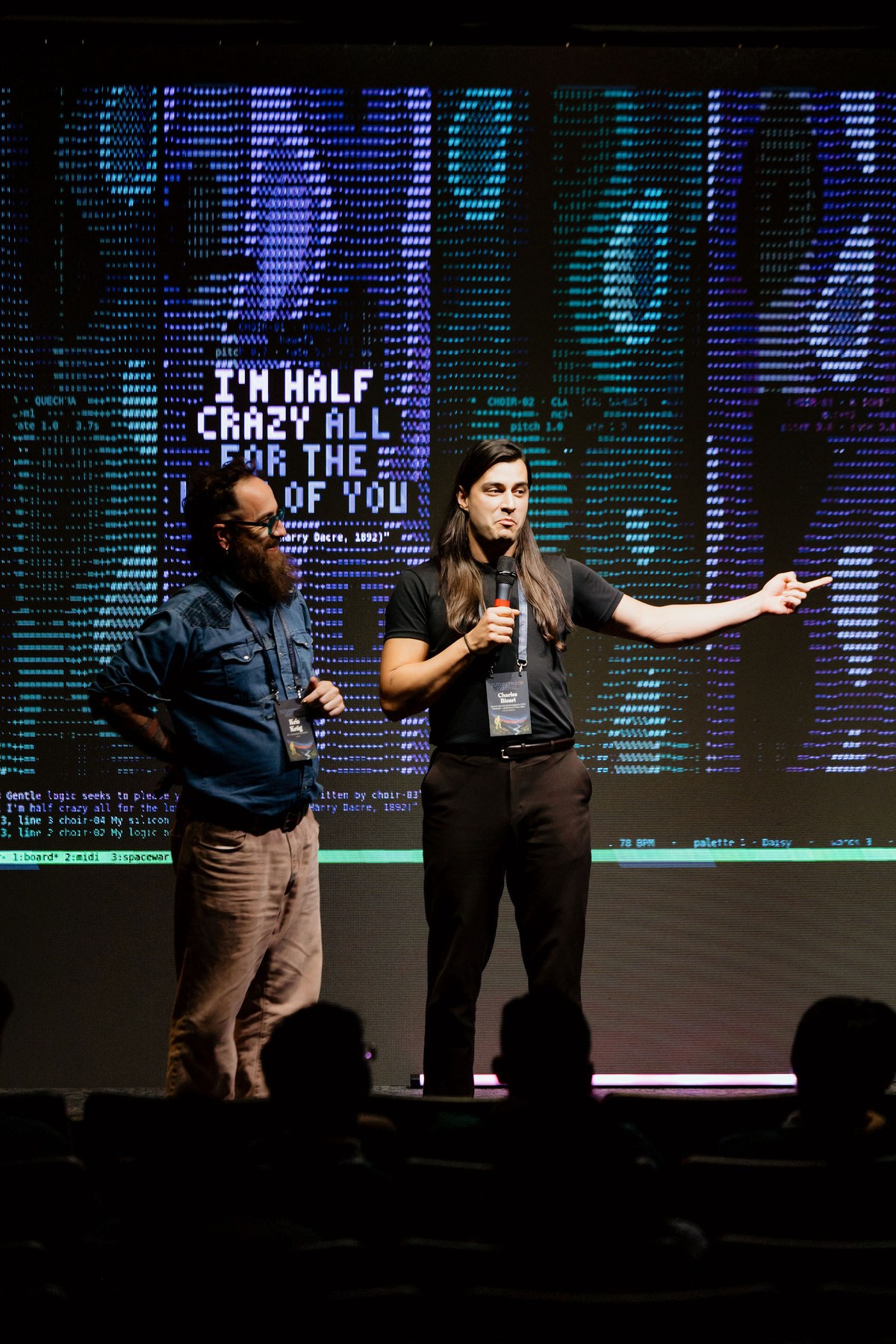
The Thursday demonstration, ahead of the separately planned Friday performance.
Charles said the setup was running locally. That's a description of this demonstration, with its own network and devices. The creative point was the relationship among those devices and the behaviour he could compose through them.
Asked about Friday, he described a broader musical setup and a moment where devices playing a game together would shape the music. That remained a preview in this talk. The Thursday demonstration gives us plenty to work with on its own.
An instrument doesn't have to explain the entire future of artificial intelligence. It has to offer a musician something worth playing, and a listener something worth hearing.
Charles brought five phones. They made a much more interesting argument together than another grand claim about AI could have made for them.