

Futureproof Festival of AI2026 / Volume 01

Proceedings

Three days in the room.

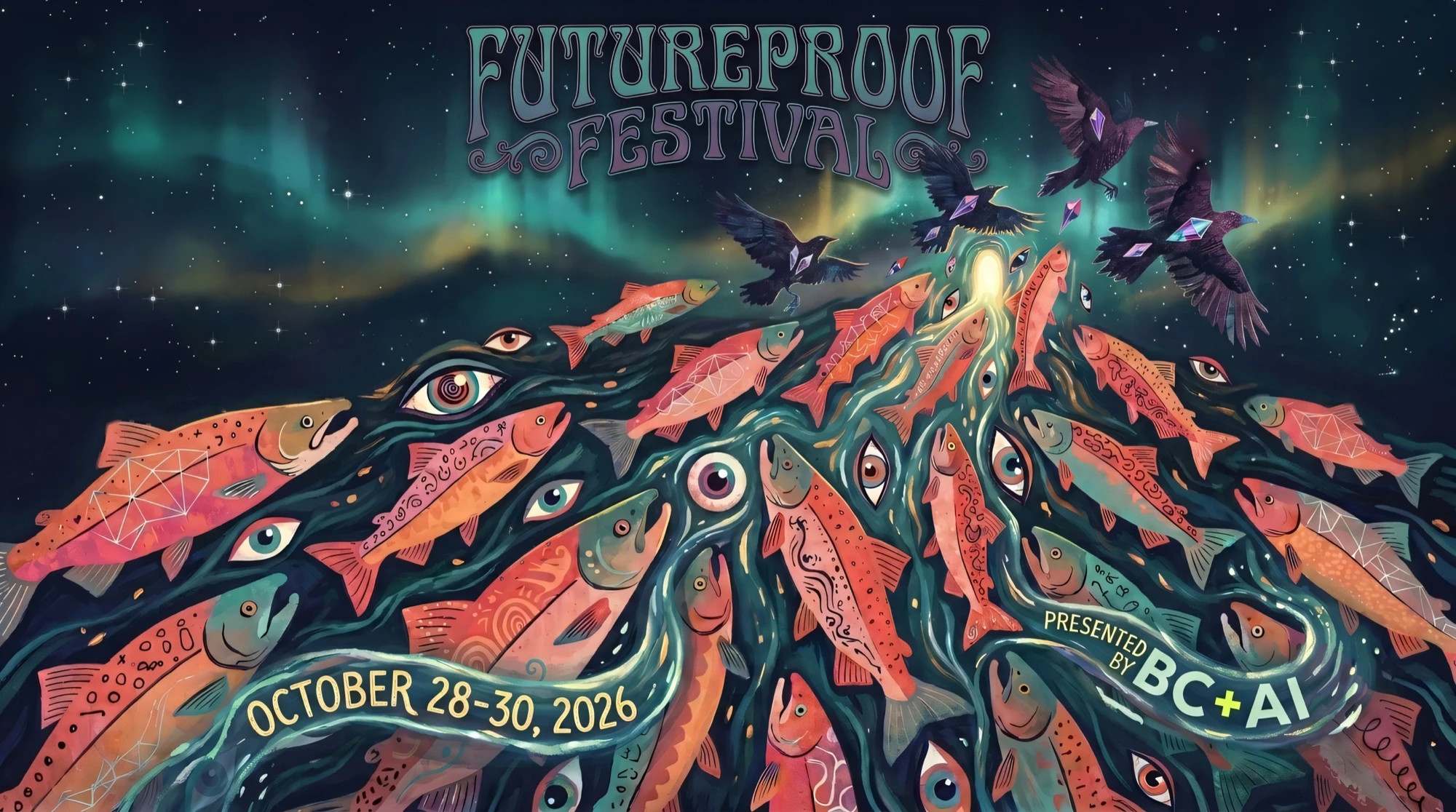
Salmon swim beneath ravens and the northern lights in the 2026 Futureproof Festival campaign painting.
Salmon Starfield · 2026 Futureproof Festival campaign artwork

October 28–30, 2026

Vancouver, BC

H.R. MacMillan Space Centre

Futureproof Proceedings / 2026 edition01

October 28–30 · Vancouver

Futureproof Festival

In this issue

The opening keynote started with a bicycle. The final talk returned to the camera. In between, people asked who gets to decide what the tools do, what they demand, and what they leave up to us.

Futureproof Proceedings / Contents02
Futureproof Proceedings / Contents03
Futureproof Proceedings / Contents04

Wednesday · October 28 / 5 recaps

01.

Tools you can feel

Attention, public memory and the work of making something people can inspect.

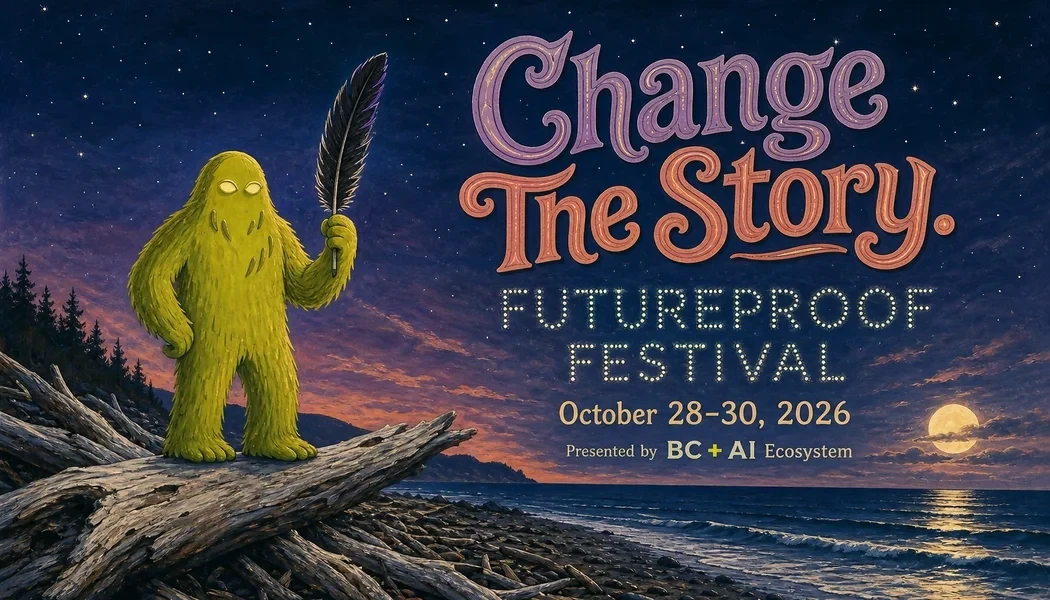
Squatchie raises a raven feather from a log at moonrise. The poster reads Change the Story.
Change the Story · 2026 Squatchie poster series
Futureproof Proceedings / Opening night05

01 Wednesday · October 28

Amber Case

your house shouldn't need a system administrator
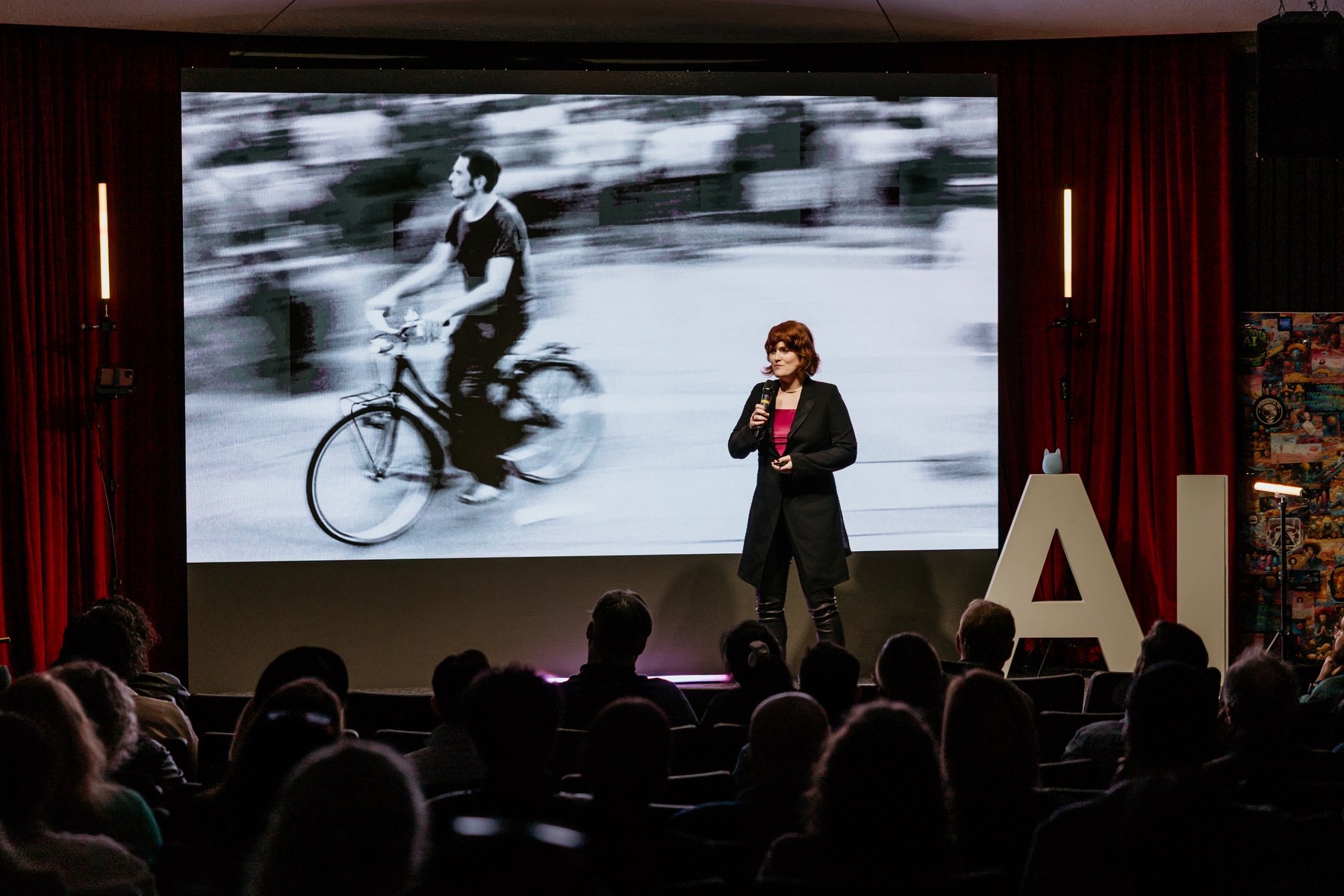
A presenter stands beside a large black-and-white photograph of someone riding a bicycle, with audience members in the foreground.

The bicycle at the centre of Amber Case's opening-night argument. Futureproof Festival of AI, October 28, 2026.

Michelle Diamond / Diamond’s Edge Photography

A bicycle doesn't ask you to phrase your request differently.

You push. You steer. The resistance in the pedals tells you something about the hill. The machine gives you information through your body while your eyes stay on where you're going.

Amber Case opened Futureproof Festival's first night with that ordinary piece of engineering and a fairly rude question for the technology industry: why do so many newer tools make us work harder to use them?

Her talk, Calm Technology in the Age of Loud Machines, examined the attention a product takes in exchange for the thing it supposedly does. A voice assistant interrupts your activity, waits for a command, makes you wait for a response and sometimes sends you back to the beginning. Try putting that interface on a bicycle. See how far the conversation gets before you hit something.

The bicycle establishes a useful standard. Once learned, a tool can become part of an activity. A product that keeps demanding an audience has a different relationship with its owner.

01 / Amber CaseOpening night

Your hands already know things

Amber compared physical car controls with flat screens. A knob has a location, an edge and resistance. You can learn where it lives. A screen can put the same function somewhere else after the next software update and leave your fingers looking for the old address.
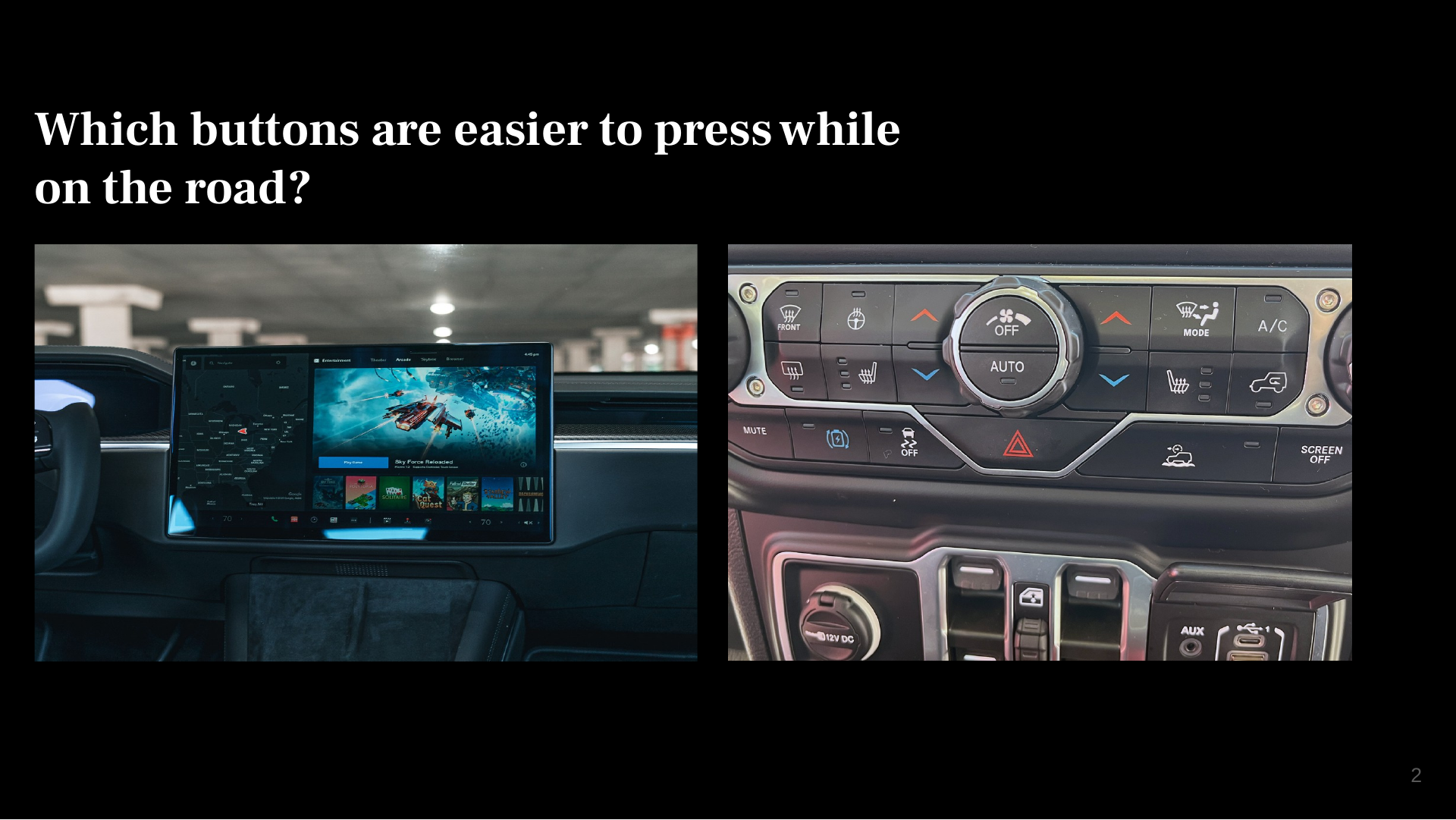
Two car dashboard designs accompany the question Which buttons are easier to press while on the road?

A comparison from Amber's submitted presentation, slide 2. Presentation: Amber Case / Calm Tech Institute. Rendered from the original PowerPoint.

Amber Case / Calm Tech Institute

She used the idea of proprioception, our sense of our bodies in space, to argue for interfaces that work with skills people have already acquired. Her distinction between something easy on the first encounter and something comfortable after years of use deserves a place in every product review.

Moving a familiar control has a cost. The company gets to announce a redesign. The person using it gets homework.
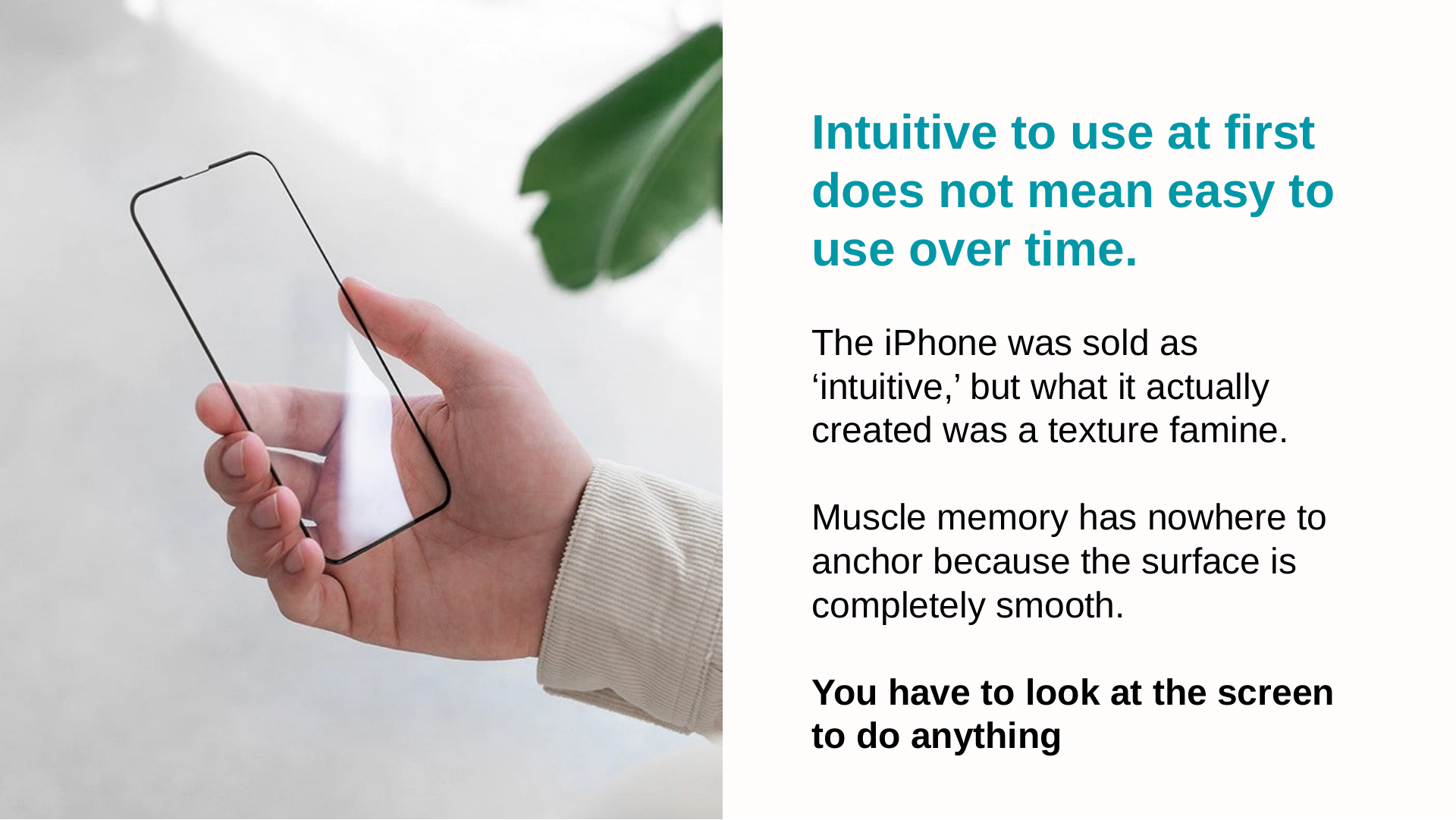
A slide explains that a smooth screen gives muscle memory nowhere to anchor and requires looking at the screen.

The texture argument, submitted slide 10. Presentation: Amber Case / Calm Tech Institute.

Amber Case / Calm Tech Institute

Amber brought up cameras as objects people become accustomed to through use. That connection is immediate in my photography practice. Knowing the controls helps keep your attention on the person, the light and the moment changing in front of you. Learning the instrument is part of making the picture.
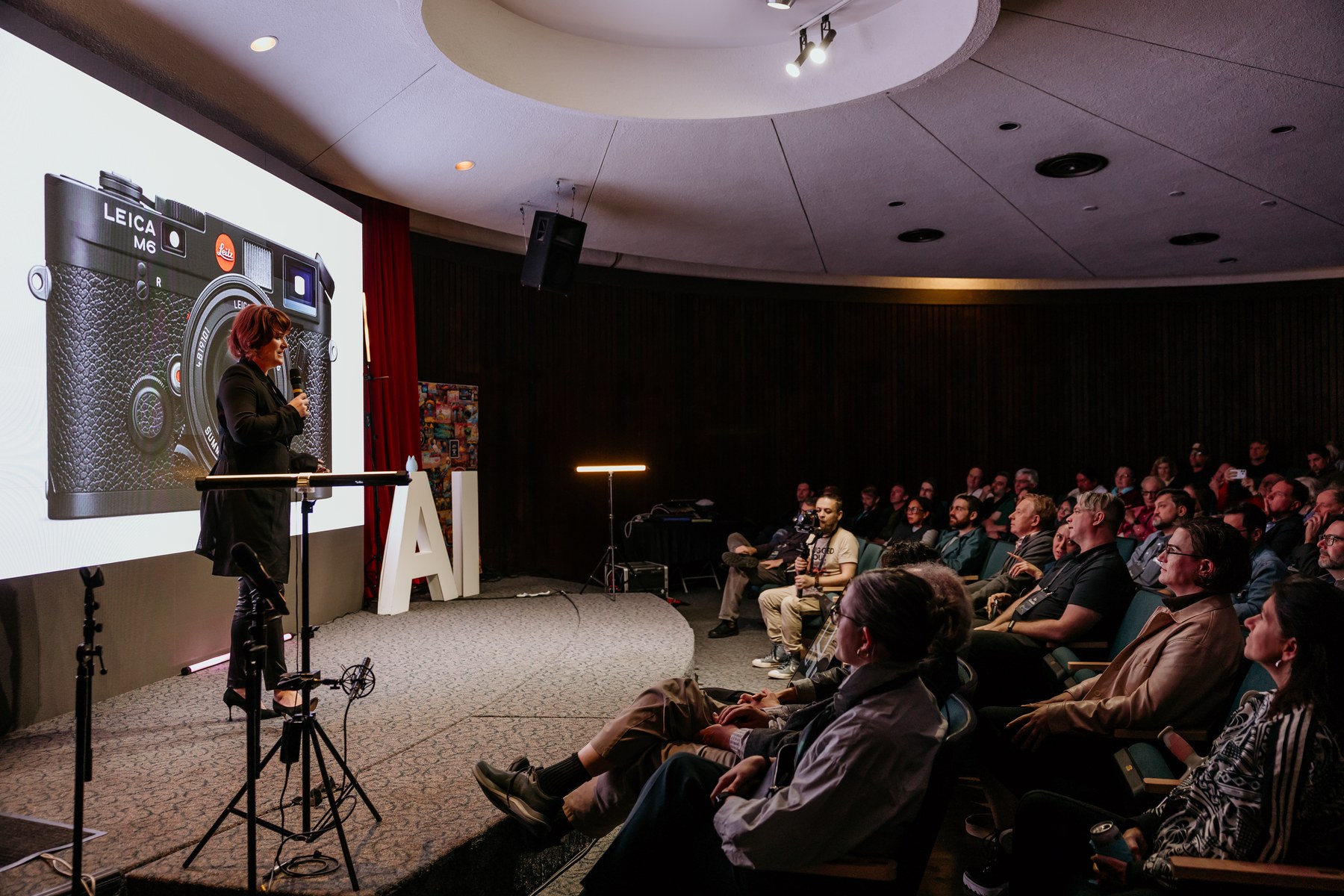
A side view of the stage shows a projected Leica camera, a speaker holding a microphone and the seated audience.

The camera example during the opening-night presentation.

Michelle Diamond / Diamond’s Edge Photography

There is a practical consequence for anyone adding AI to existing software. That new feature occupies space somebody was already using. Ask what gets displaced, what has to be relearned and whether the person trying to finish their work gets any say in the bargain.

01 / Amber CaseOpening night

Calm can mean more information

Calm technology is easy to mistake for an empty screen in a tasteful shade of beige. Amber's examples were more interesting than that.

A small blind-spot indicator appears where a driver already looks. A weather light changes colour, giving someone a rough sense of the day without delivering a spoken forecast. The information is available without insisting that every other activity stop.
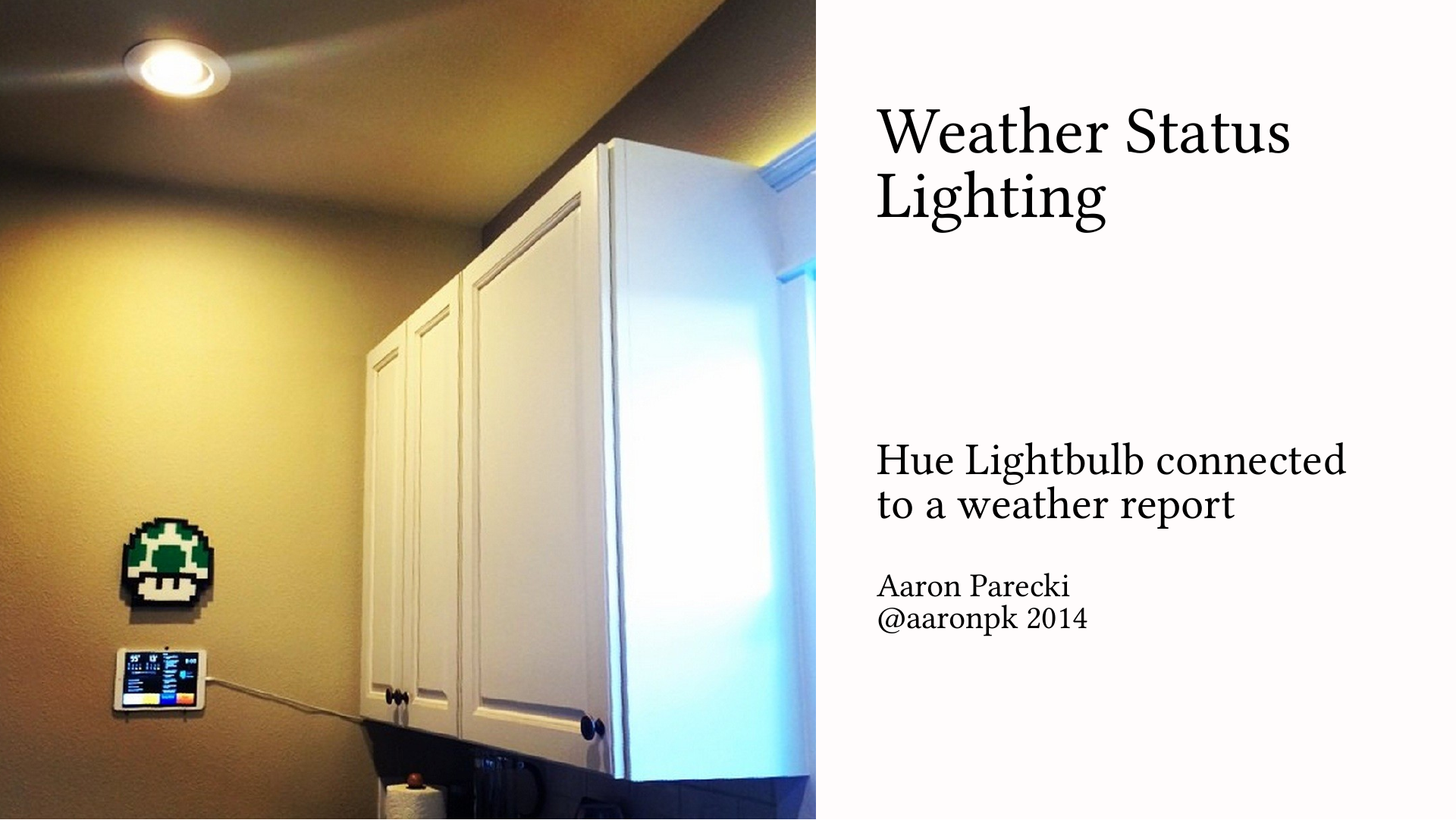
A photograph of coloured room lighting illustrates a weather status light connected to a weather report.

Weather Status Lighting, credited in the submitted presentation to Aaron Parecki, 2014. Slide 84. Presentation: Amber Case / Calm Tech Institute.

Amber Case / Calm Tech Institute; Weather Status Lighting: Aaron Parecki (2014)

That is the useful history behind Mark Weiser and John Seely Brown's 1995 paper, Designing Calm Technology. Information can move between the edge of our attention and the centre when we need it. Everything doesn't have to arrive as an alert.

In the Q&A, someone asked Amber about chatbots. She described an earlier software operation where multiple visible displays helped people understand what the system was doing. Her objection to a single chat window was that it could hide too much of the surrounding activity.

That complicates the minimalist sales pitch. A clean-looking interface can still leave you anxious about what is happening behind it. A useful status display can give you enough context to get on with something else.

The design question is how people learn the system's state, how they notice a change that matters and how much attention that requires. Putting a smiling chatbot in front of uncertainty doesn't settle any of those questions.

What survives the outage?

One of Amber's principles of calm technology asks whether a product can still work when it fails. She used an escalator turning into stairs to make the principle legible.
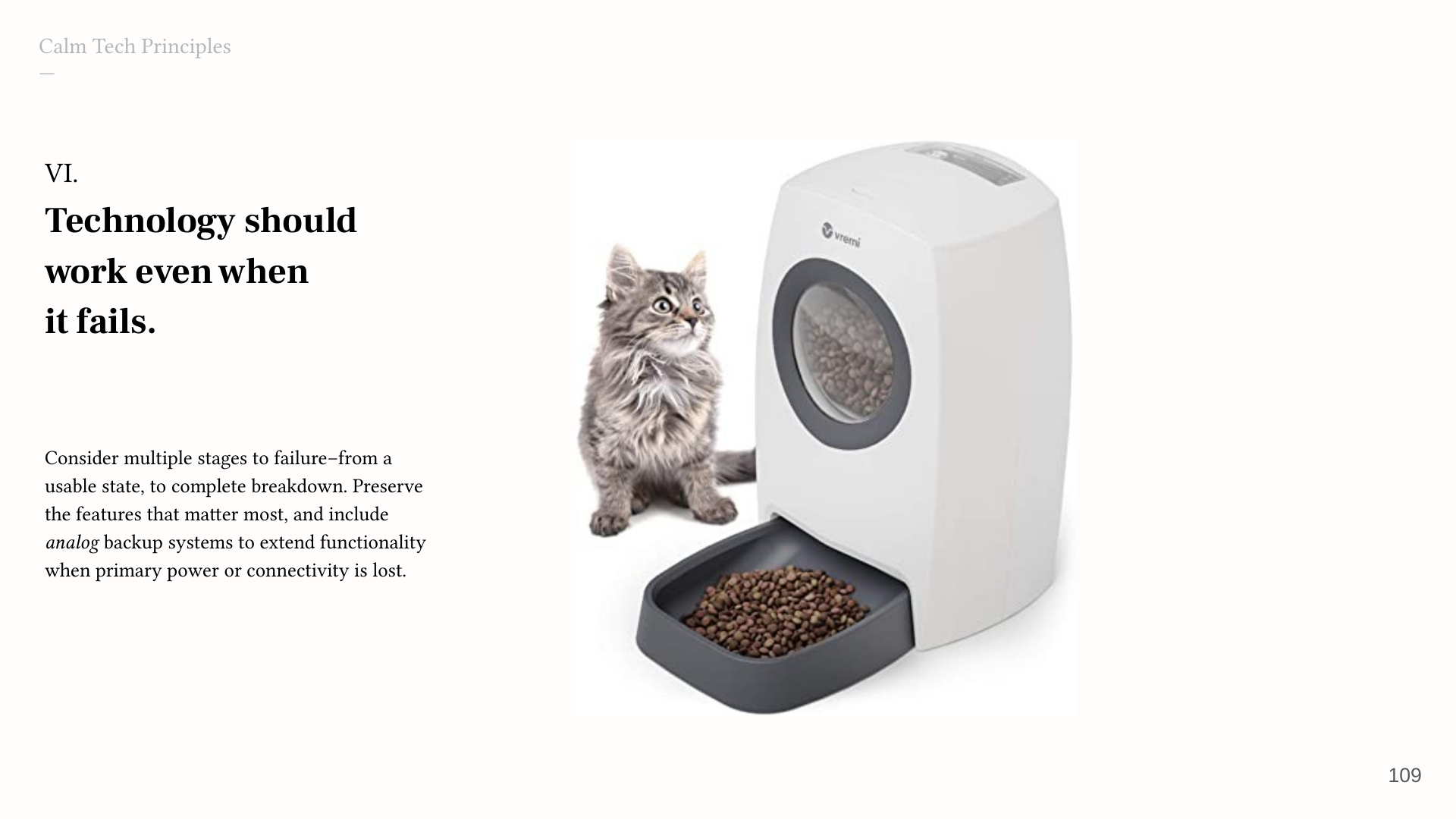
A presentation page asks designers to consider stages of failure and preserve important features through analog backup systems.

Preserve the features that matter when connectivity or power is lost. Submitted slide 109. Presentation: Amber Case / Calm Tech Institute.

Amber Case / Calm Tech Institute
01 / Amber CaseOpening night

For connected products, that means asking what remains usable when a server disappears, an app stops working or the owner loses access to an account. These are design choices with consequences inside somebody else's home.

Amber's answer includes institutional work. The Calm Tech Institute's certification programme evaluates products against a framework covering attention, periphery, durability, light, sound and materials. On stage, she described trying to make respectful design specific enough for people to recognize and ask for it.
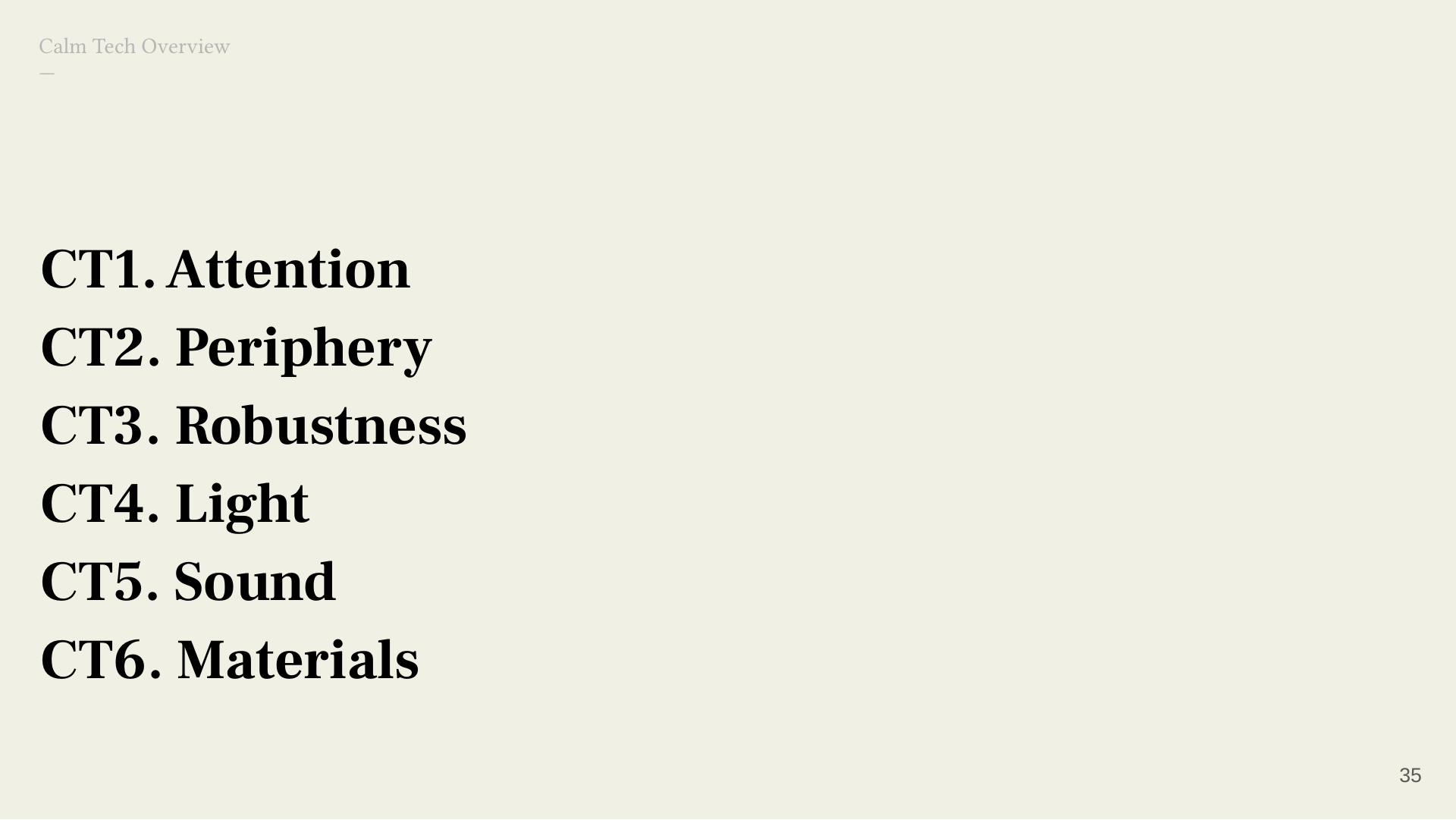
Six categories appear in a Calm Tech overview: Attention, Periphery, Robustness, Light, Sound and Materials.

The framework as shown in the submitted deck, slide 35. The institute's current website names the third category Durability. Presentation: Amber Case / Calm Tech Institute.

Amber Case / Calm Tech Institute

A seal will have to earn people's trust. What matters in her proposal is the attempt to turn a vague promise about a better experience into questions somebody can actually investigate. Does it need this alert? Can the owner still use it without an app? Can they turn the sound off?

During the audience discussion, Amber also described the long work of making a standard useful to manufacturers and eventually regulators. That is a different timescale from announcing the next feature. Someone has to stay with the problem after the launch party.
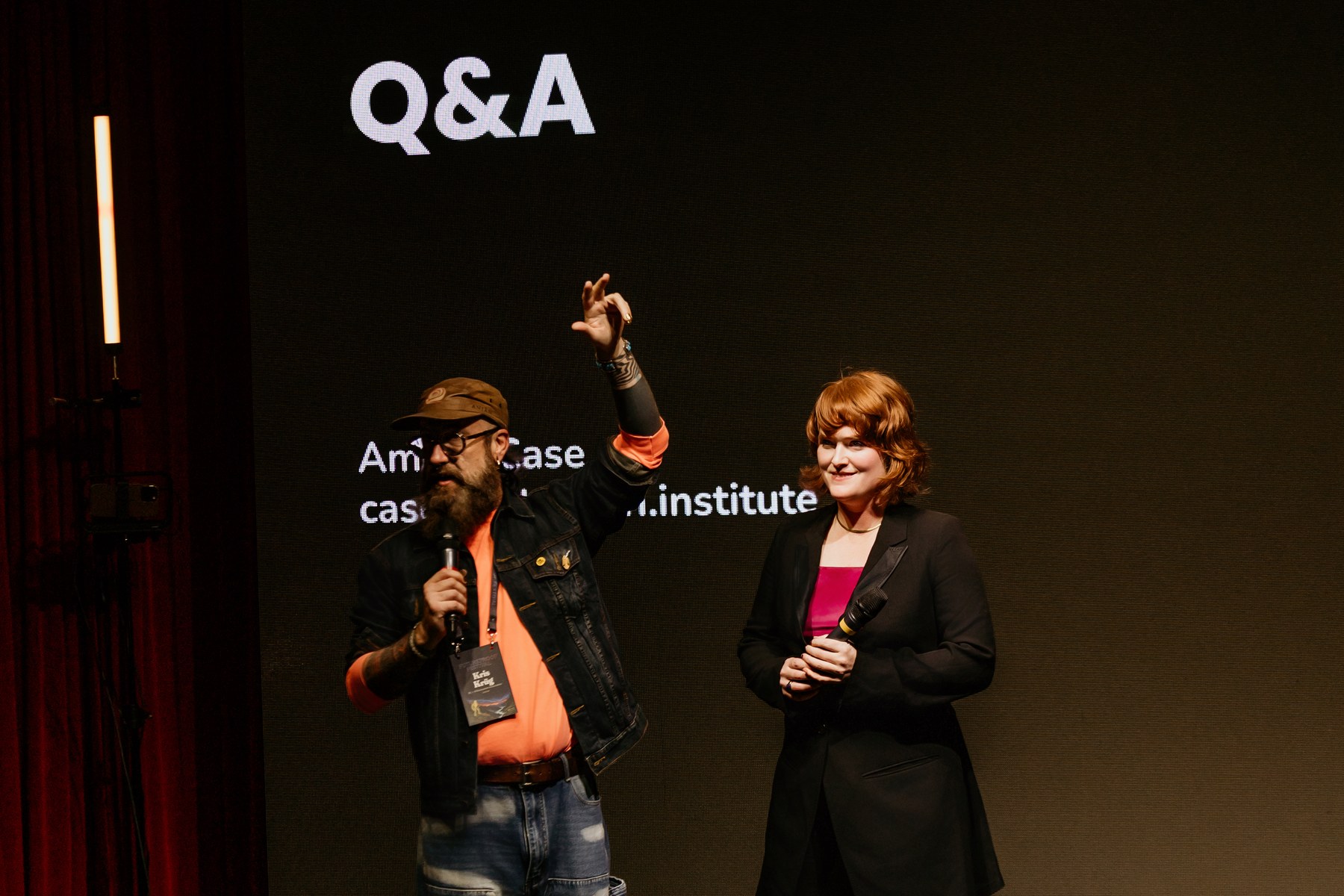
A host gestures toward the audience beside a speaker under a Q&A screen displaying Amber Case's name.

Opening-night questions after Amber's talk.

Michelle Diamond / Diamond’s Edge Photography

In my account of Futureproof's first year, I described Amber getting people thinking about their bodies and their relationships with technology. That relationship is something we can examine together at the Vancouver AI gatherings, too. Bring an interface people actually use. Watch where it makes them stop, search, wait or apologize.

Start with the product you touch every day. Count the work it creates before you count the work it saves. If living in your house requires maintaining a small IT department, somebody has assigned you a second job and called it convenience.
02 Wednesday · October 28

Jacob Ortiz

a citation can still answer the wrong question

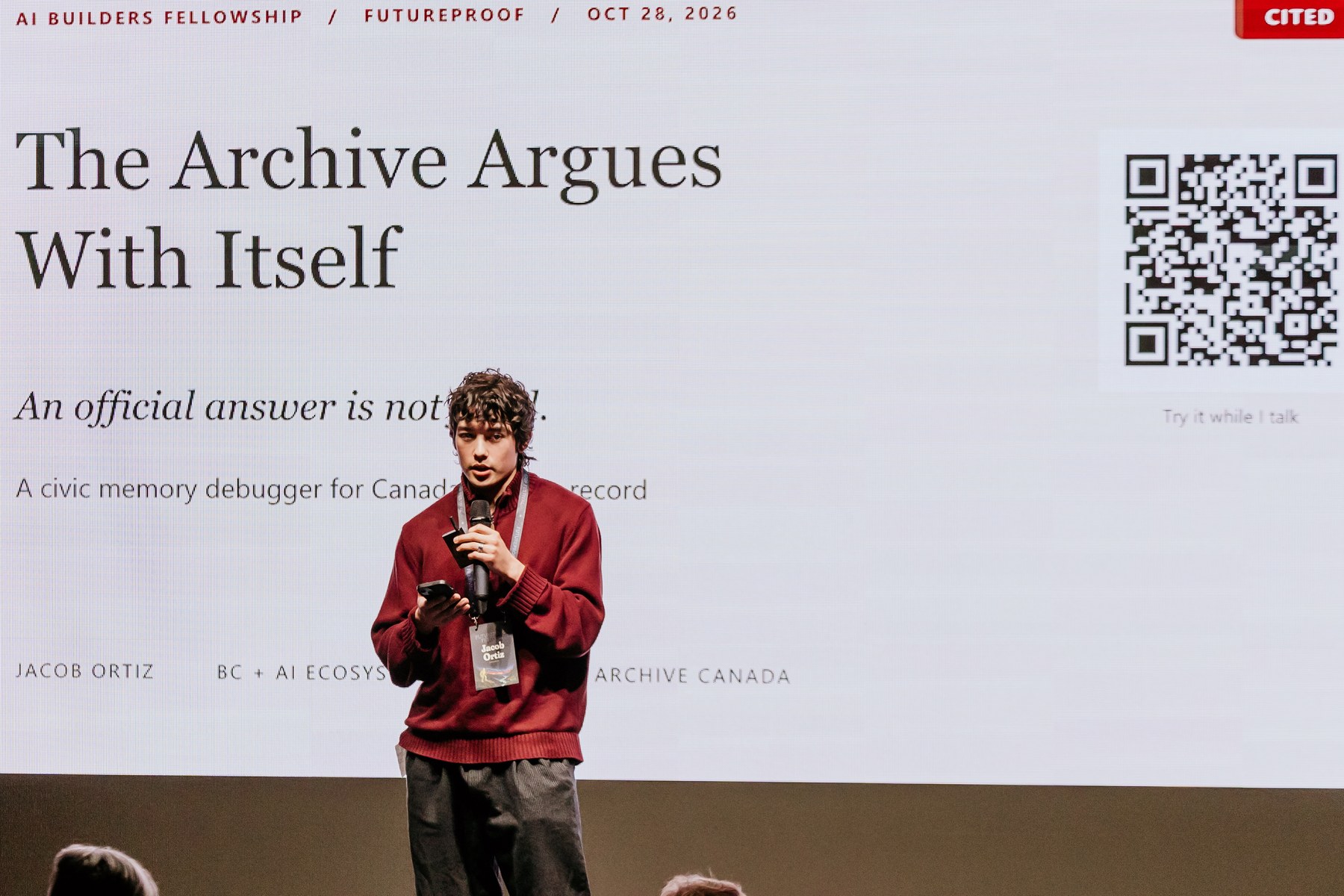
A presenter in a red sweater stands beneath a projected title, The Archive Argues With Itself, credited to Jacob Ortiz.

Jacob Ortiz presents his AI Builders Fellowship project on Futureproof's opening night, October 28, 2026.

Michelle Diamond / Diamond’s Edge Photography

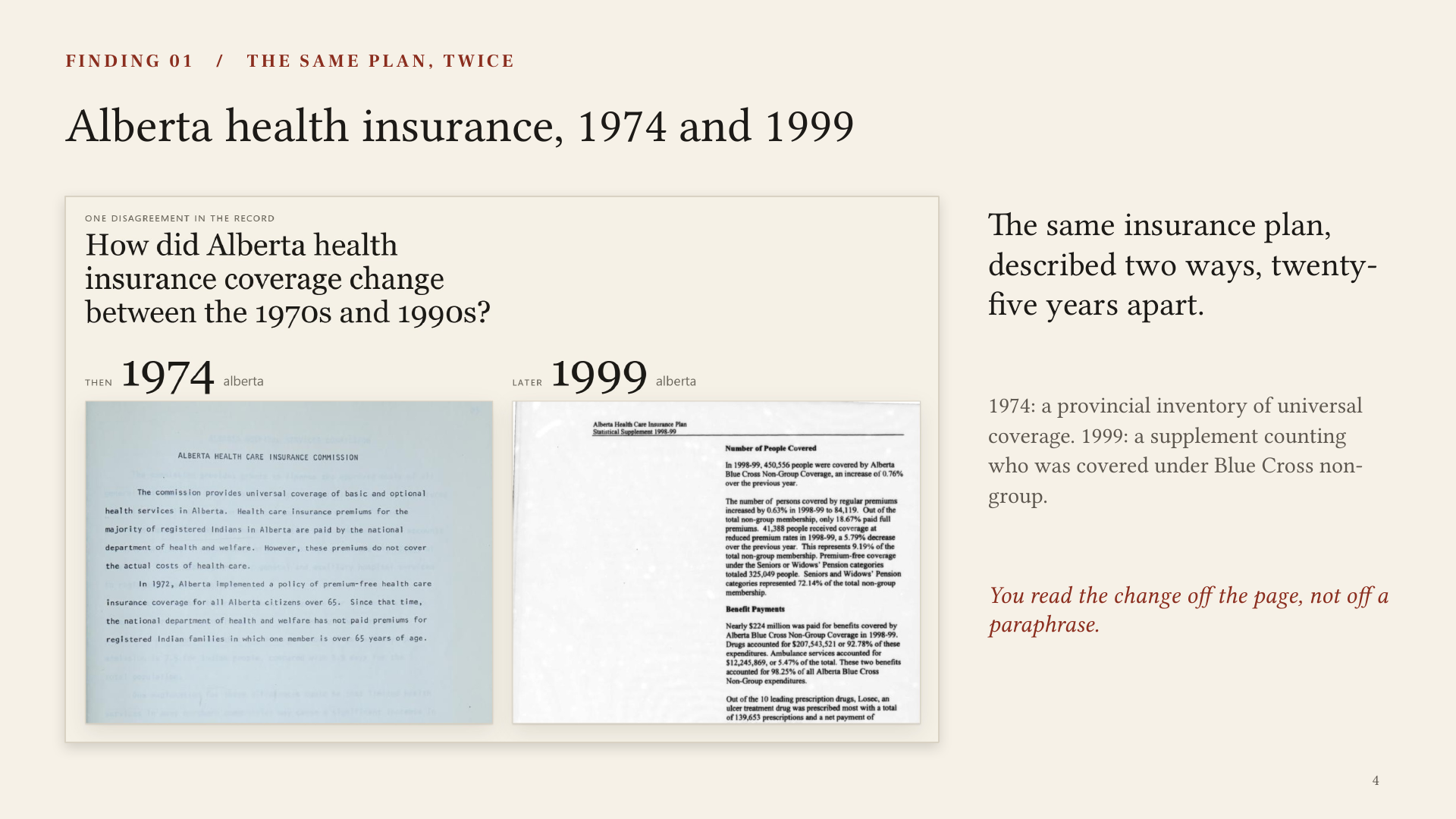
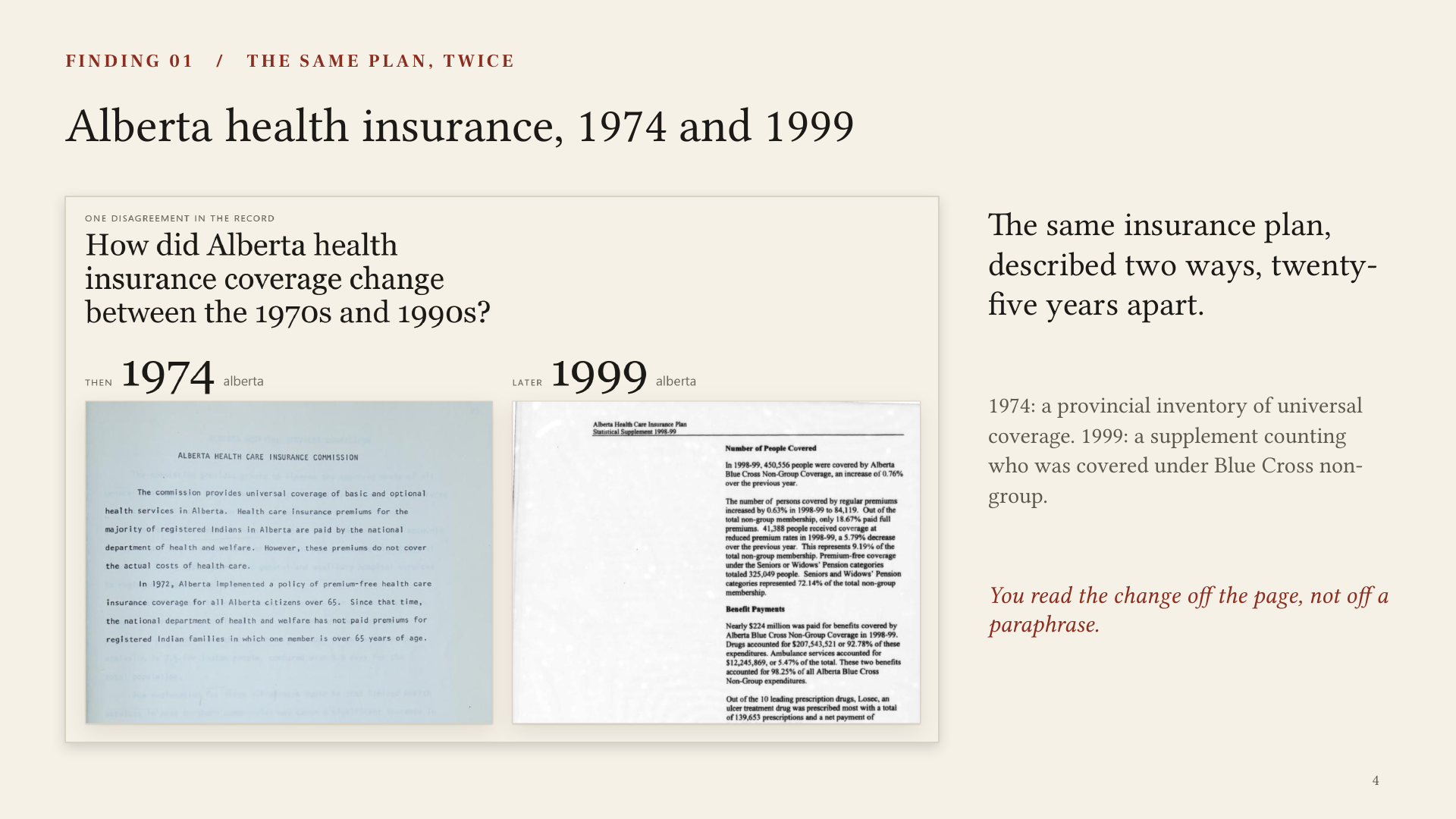
Two government documents. Twenty-five years between them. A tempting story about how health coverage changed.

Slow down. Are they counting the same people?

Jacob Ortiz put that problem in front of the audience at Futureproof Festival of AI. His project, The Archive Argues With Itself, brings Canadian government publications into an interface where readers can compare records and follow statements back to scanned pages.

The example paired Alberta records from 1974 and 1999. They concern different populations and measures. You could produce a confident paragraph joining them into a tidy historical trend. You could even give that paragraph two perfectly real citations. The comparison would still need a human being to ask what those documents actually establish.

02 / Jacob OrtizOpening night
Two scanned Alberta records appear side by side on a presentation page comparing health-insurance publications from 1974 and 1999.

The comparison in Jacob's submitted presentation, slide 4. The documents count different things; their dates alone do not make them comparable. Presentation and interface: Jacob Ortiz. Source scans: Internet Archive.

Jacob Ortiz; source scans: Internet Archive

That is a better starting point for public AI than another demonstration of how quickly a model can sound certain.

Keep the inconvenient parts of the record

Jacob described beginning with housing policy, then changing the pilot's focus to public health because the available material gave him stronger coverage there. The collection helped determine which questions the project could responsibly pursue.

That choice matters. A search interface can make its holdings feel like the whole world. If an answer isn't there, a reader may conclude that nothing happened, nobody recorded it or nobody thought it important.

Those are different possibilities. A gap in the material a tool has indexed doesn't settle any of them.

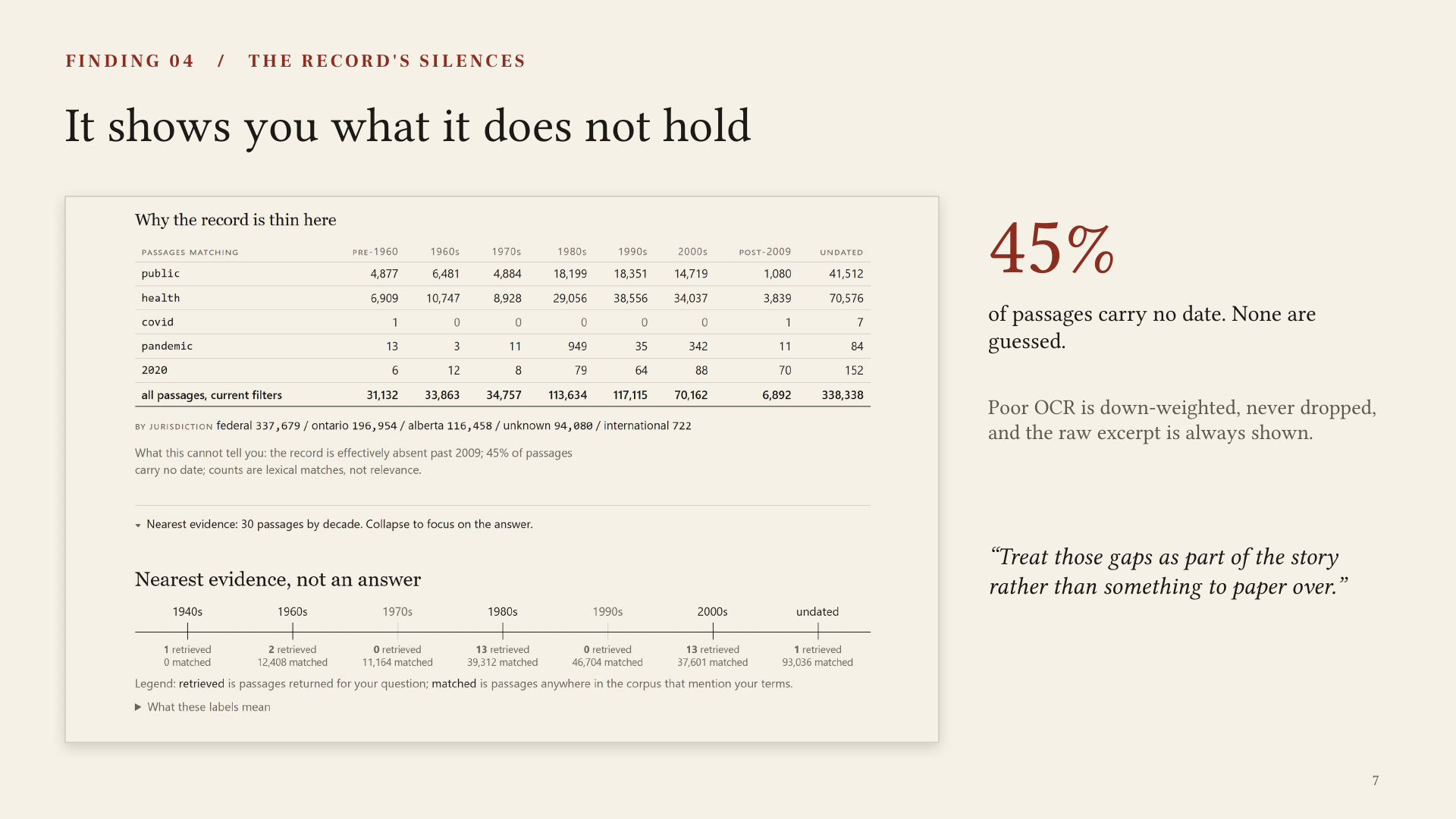
His interface makes dates, jurisdictions and coverage part of the reading experience. Missing dates remain missing. Poor optical character recognition, the process that turns a scanned page into searchable text, is a reason to handle a passage carefully. It is also a reason to keep the original page close by.
A coverage table and timeline accompany a slide reporting that 45 percent of passages in the pilot carry no date and none are guessed.

Jacob's submitted slide 7 shows the pilot's coverage and his reported missing-date figure. It describes his working corpus, not the completeness of the entire Internet Archive. Presentation: Jacob Ortiz.

Jacob Ortiz; source scans: Internet Archive
02 / Jacob OrtizOpening night

The software is open for people to inspect and contribute to. The useful invitation extends beyond improving an answer. Someone can notice a thin patch of the record, find better material or help explain why a category doesn't mean what a present-day reader thinks it means.

An archive becomes more useful when its limitations are available for investigation. Hiding them behind fluent prose would make the interface look cleverer while making the reader less informed.

Build the option to decline

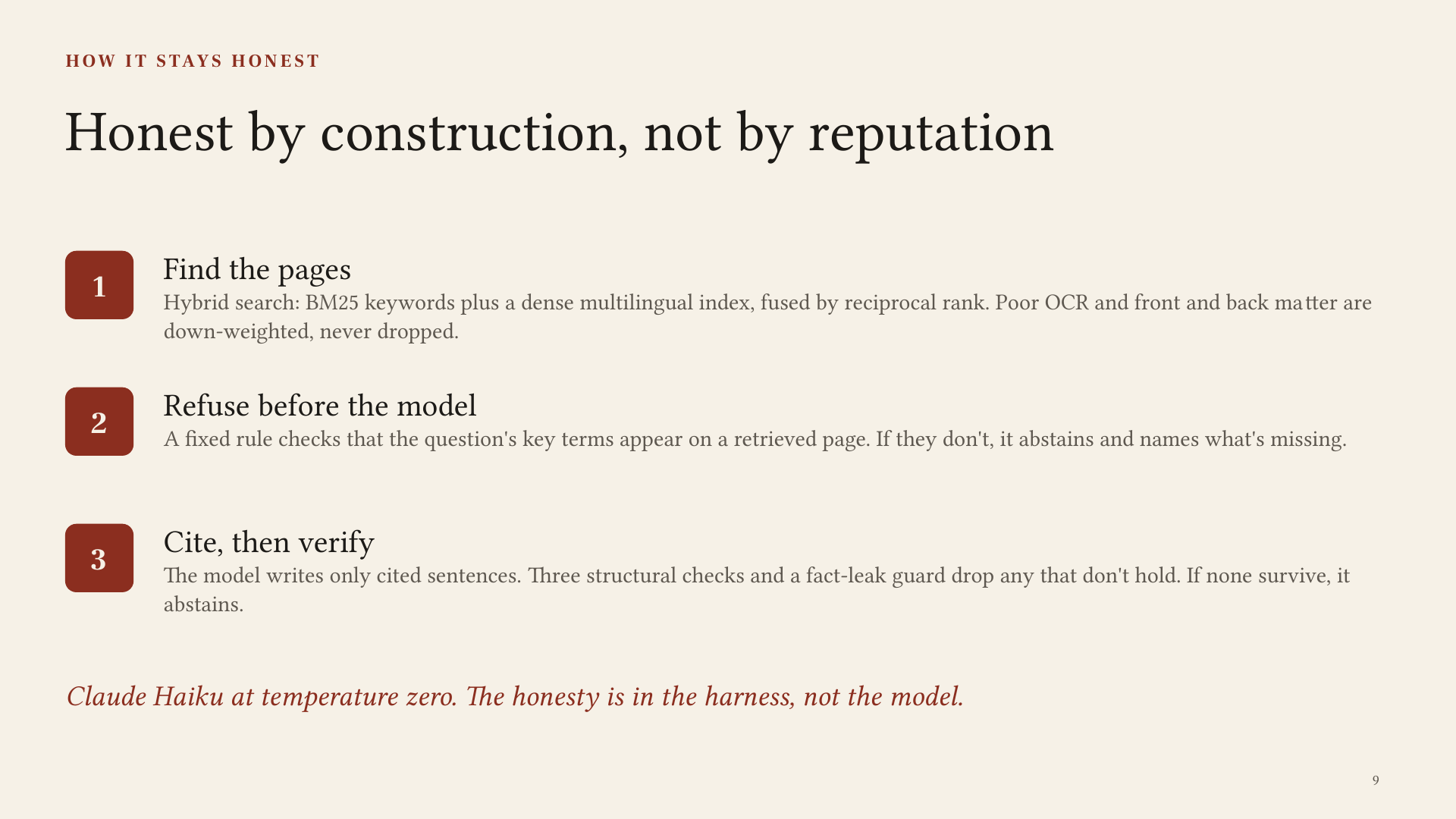
Jacob walked through the machinery underneath the answer. The project combines keyword and multilingual semantic search to find passages. Before generating a response, it checks for relevant terms in the retrieved evidence. It also checks that citations resolve to real Archive pages and connect to retrieved passages.
Those checks give the system opportunities to stop. If the material doesn't support the question, it can explain what is missing instead of filling the silence with a paragraph.

A three-stage diagram describes finding pages, refusing before generation and checking cited sentences.

The method in Jacob's submitted slide 9. These are the builder's described checks, not a claim that every output has been independently validated. Presentation: Jacob Ortiz.

Jacob Ortiz; source scans: Internet Archive

People building research tools should pay attention to where he put that decision. A refusal is easier to defend when it follows an inspectable condition. Asking a model to be extra honest leaves a lot resting on the next sentence it produces.

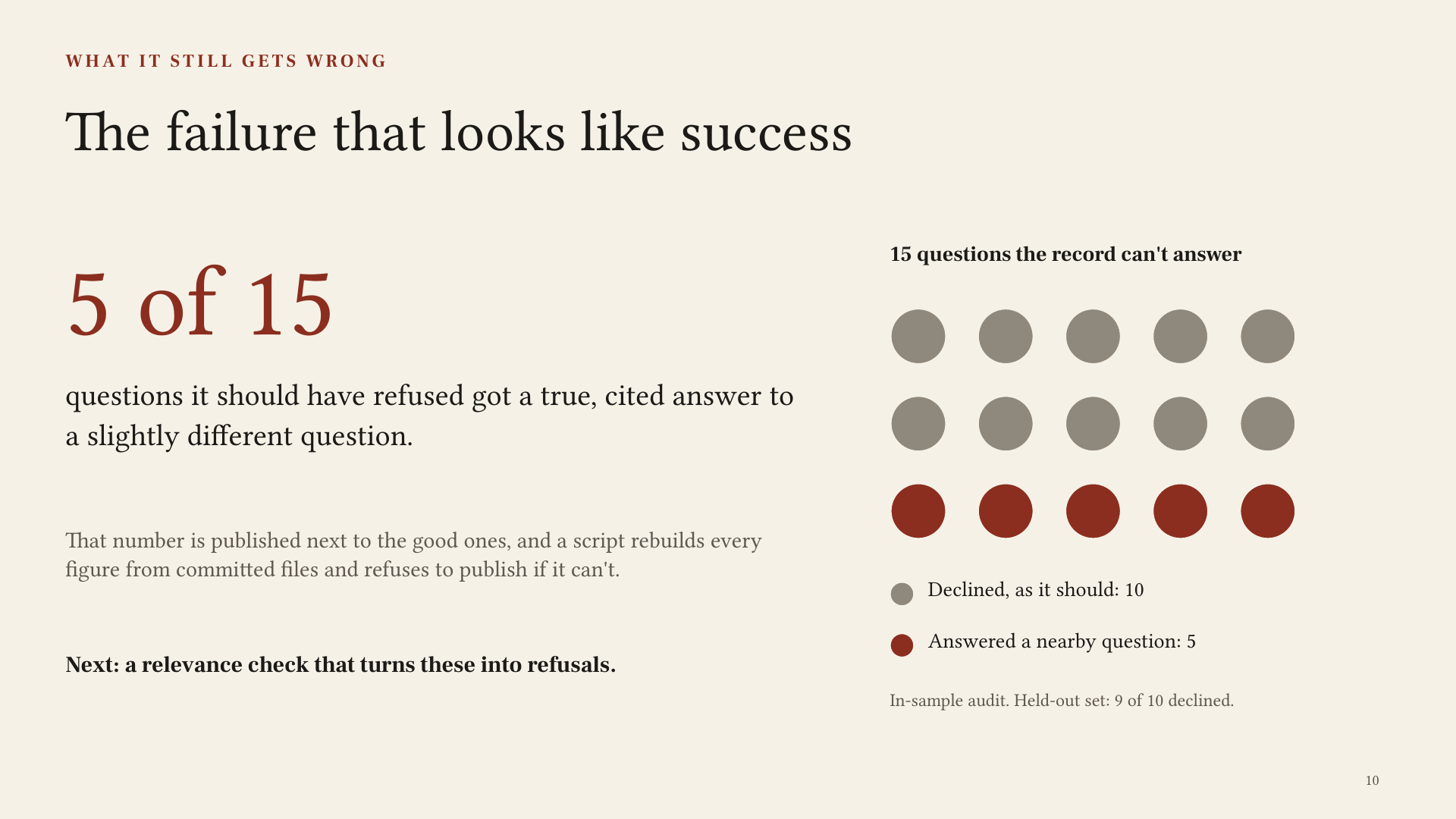
The project also keeps room for a more irritating failure: the evidence exists, the citation is real and the statement is accurate, but the system has quietly answered a nearby question.

Jacob named that limitation on stage. His submitted deck includes an audit example in which five of fifteen questions that should have been declined received a cited answer to a different question. That is his reported evaluation of the pilot, with a small sample and a particular method. It is useful precisely because it identifies something to fix.

02 / Jacob OrtizOpening night
A slide headed The failure that looks like success reports five of fifteen unsupported questions receiving true cited answers to slightly different questions.

The builder's own reported failure case, submitted slide 10. The figure describes this evaluation, not a general accuracy rate for the project or for AI. Presentation: Jacob Ortiz.

Jacob Ortiz; source scans: Internet Archive

A bibliography can become an impressive costume for a bad answer. The next check is whether the answer addresses the question you actually asked.

Access carries responsibilities

Government records also preserve harm, obsolete advice and the language institutions used about people who had little power over how they were described. Jacob said he wanted to preserve the documents while adding context around sensitive material. He also said he wanted to work directly with the communities concerned.

That distinction needs to stay visible. Adding a contextual note is work a builder can begin. Community authority over the use of records about that community is a relationship the builder still has to establish. One doesn't automatically produce the other.

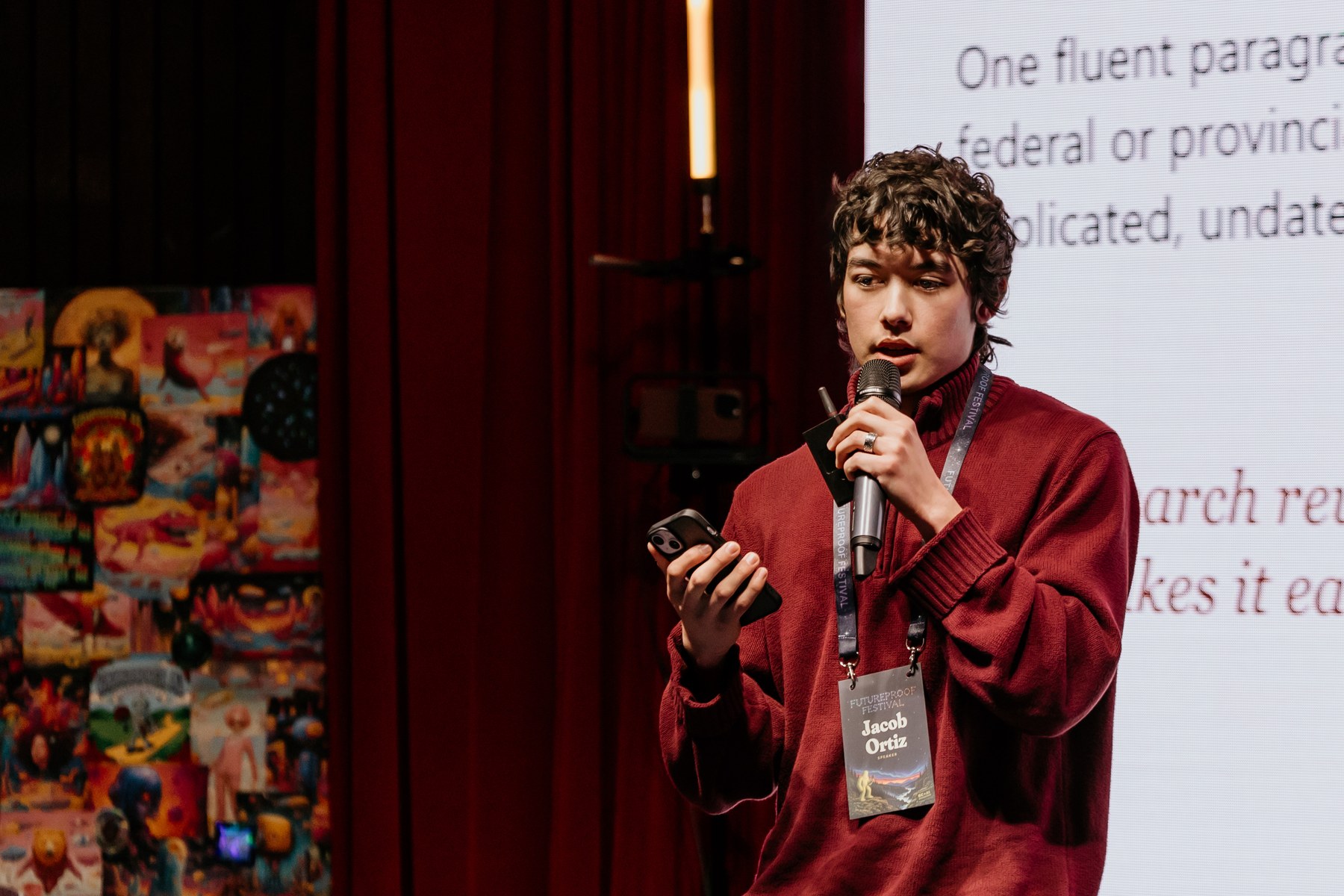
A close stage photograph shows a speaker holding a microphone and phone; the badge reads Jacob Ortiz.

Presenting the project and its limits.

Michelle Diamond / Diamond’s Edge Photography

The AI Builders Fellowship gave Jacob space to work on this alongside Internet Archive Canada and BC + AI. In our earlier account of both fellows' projects, I traced the connection between years of digitization work and the new interfaces built on top of it. The scanned page exists because librarians, archivists, partners and scanning teams did the work before the model arrived.

Our May conversation with Andrea Mills about preserving the open internet is another way into that history. Keeping material available and making it usable are connected responsibilities. Neither ends when a chatbot can retrieve it.

Try The Archive Argues With Itself with a question whose answer matters to you. Open the page behind the response. Check its date, the population it describes and the thing it measures. Then ask whether it answers your question or merely stands nearby wearing a very convincing citation.

03 Wednesday · October 28

Daniel Shavit

show me the decision behind this street

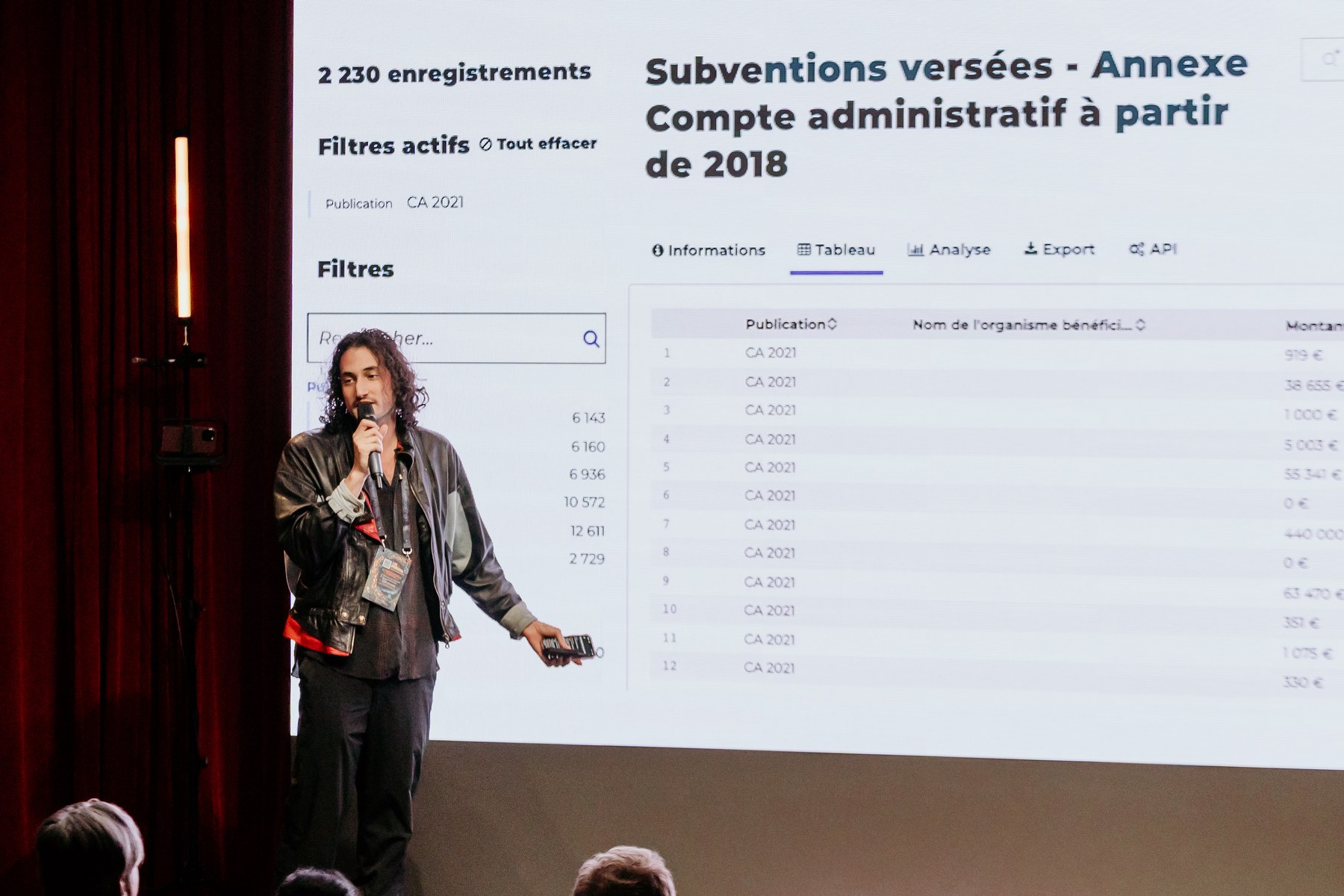
A presenter stands beside a projected Paris grants table whose visible rows show amounts with blank beneficiary names.

The Paris open-data example in Daniel Shavit's opening-night presentation. Futureproof Festival of AI, October 28, 2026.

Michelle Diamond / Diamond’s Edge Photography

The money was in the spreadsheet. Some of the names weren't.

Daniel Shavit began his Futureproof presentation with a familiar kind of civic frustration. A political argument over dinner in Paris led him to look for the public data that might settle it. He found records that raised more questions: payments without useful context, separate datasets that didn't connect and information he had to chase through other documents.

Putting a CSV online can satisfy the act of publishing while leaving a citizen with a second research project just to understand the first one.

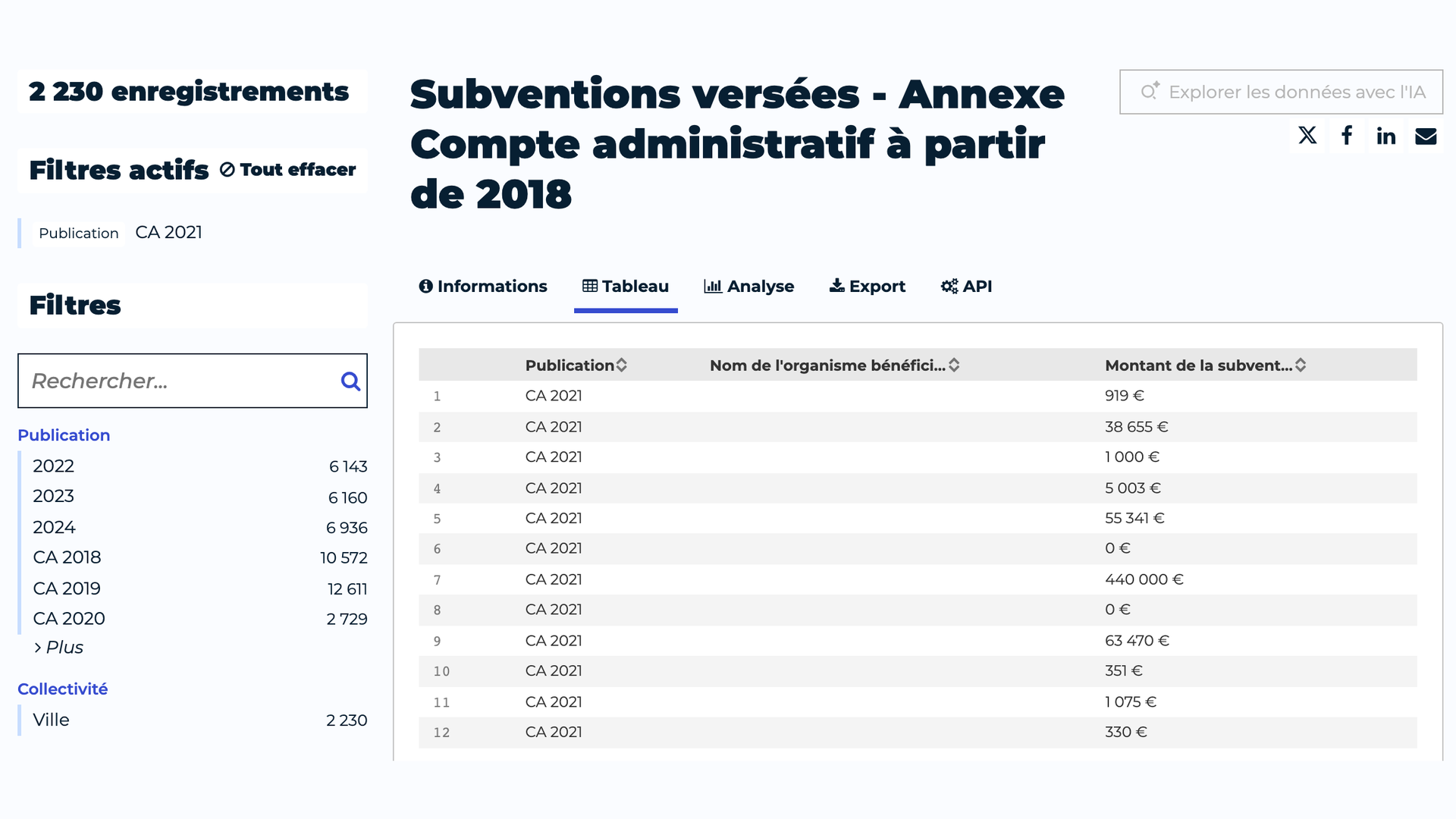
A Paris grants portal displays payment amounts beside blank fields for beneficiary names.

The Paris portal screenshot embedded in Daniel's submitted slide 2. This is the example he brought to the festival, not a new audit of the portal. Presentation: Daniel Shavit.

Daniel Shavit / Qipu
03 / Daniel ShavitOpening night

Daniel's work asks what would happen if we started with the things people already care about. The park nearby. The theatre. A contract for work down the street. Who made the decision? What did they approve? Where can somebody read it?

That question became Tale of a City, his project through the AI Builders Fellowship with Internet Archive Canada and BC + AI.

A place gives you a way in

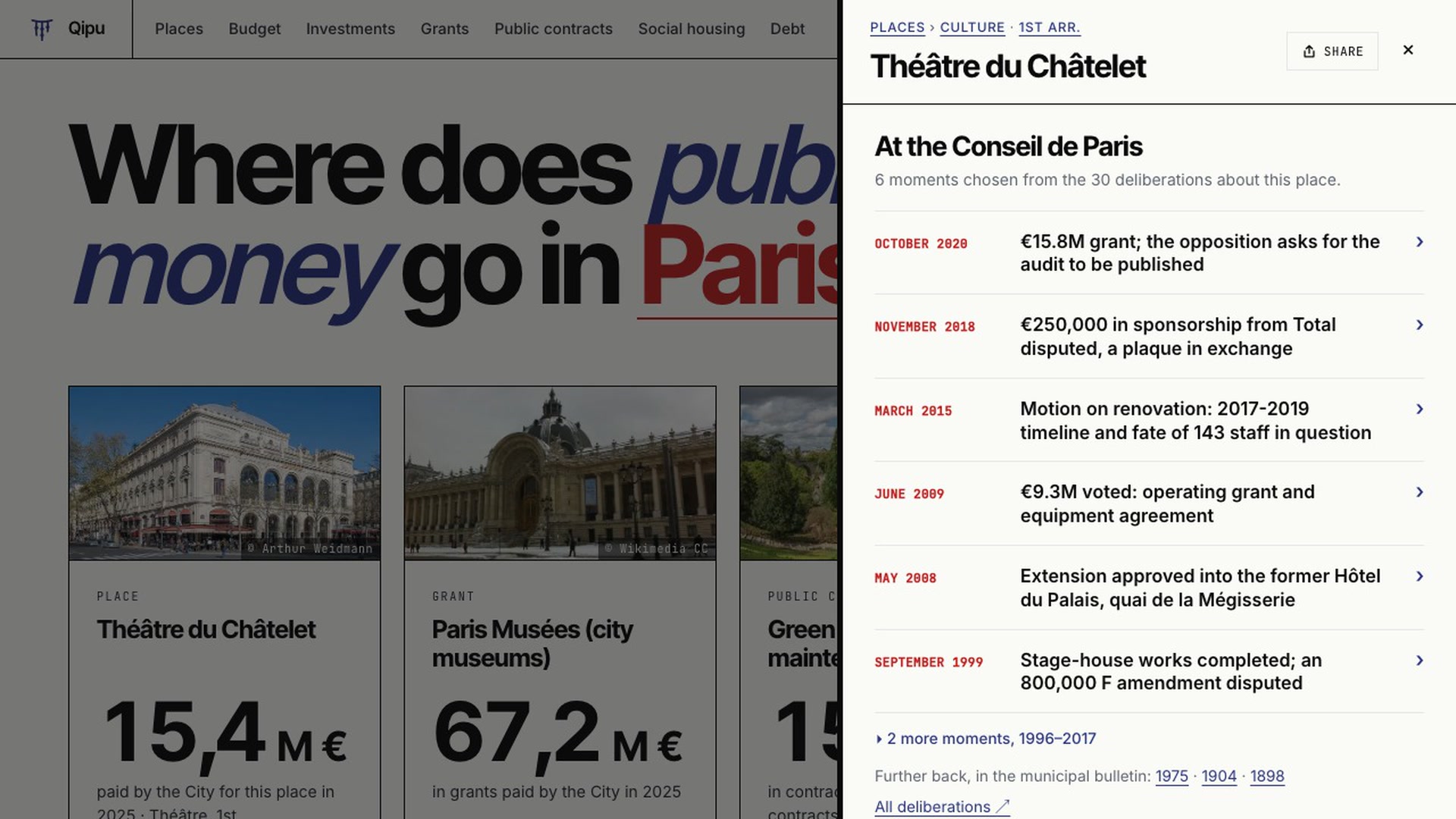
Daniel described rebuilding connections between public spending and the places it concerned. In his Paris example, a theatre becomes an entrance to a history of grants, works and council deliberations. Someone doesn't have to know the document's filing vocabulary before they can begin.

A Paris interface opens a Théâtre du Châtelet panel with dated council decisions alongside a public-spending page.

A still supplied with the Paris interface recording in slide 4. Place, chronology and source links appear together. Interface and presentation: Daniel Shavit / Qipu.

Daniel Shavit / Qipu

A map can make a relationship easier to see. It can also make a claim look more settled than it is. The important move here is keeping a route from the place back to the decision and from the decision back to its source.

Our October feature on the two fellows' projects described that geographic route alongside Jacob Ortiz's approach to comparing government publications. They are different entrances into the public record. Both become more useful when a reader can leave the summary and inspect what it rests on.

Vancouver appears, then the records come into view

At Futureproof, Daniel brought the work to Vancouver. He described getting access to years of council minutes through the Archive collaboration, then showed a film combining a city view with the records connected to it.

A painted digital city view shows Vancouver's downtown buildings and waterfront; an on-screen label identifies the painted treatment over a render.

A frame at 00:45 from the film embedded in Daniel's submitted slide 5. The film identifies an AI painting treatment over the city render. This is a visualization, not an archival aerial photograph. Film and project: Daniel Shavit / Qipu.

Daniel Shavit / Qipu
03 / Daniel ShavitOpening night

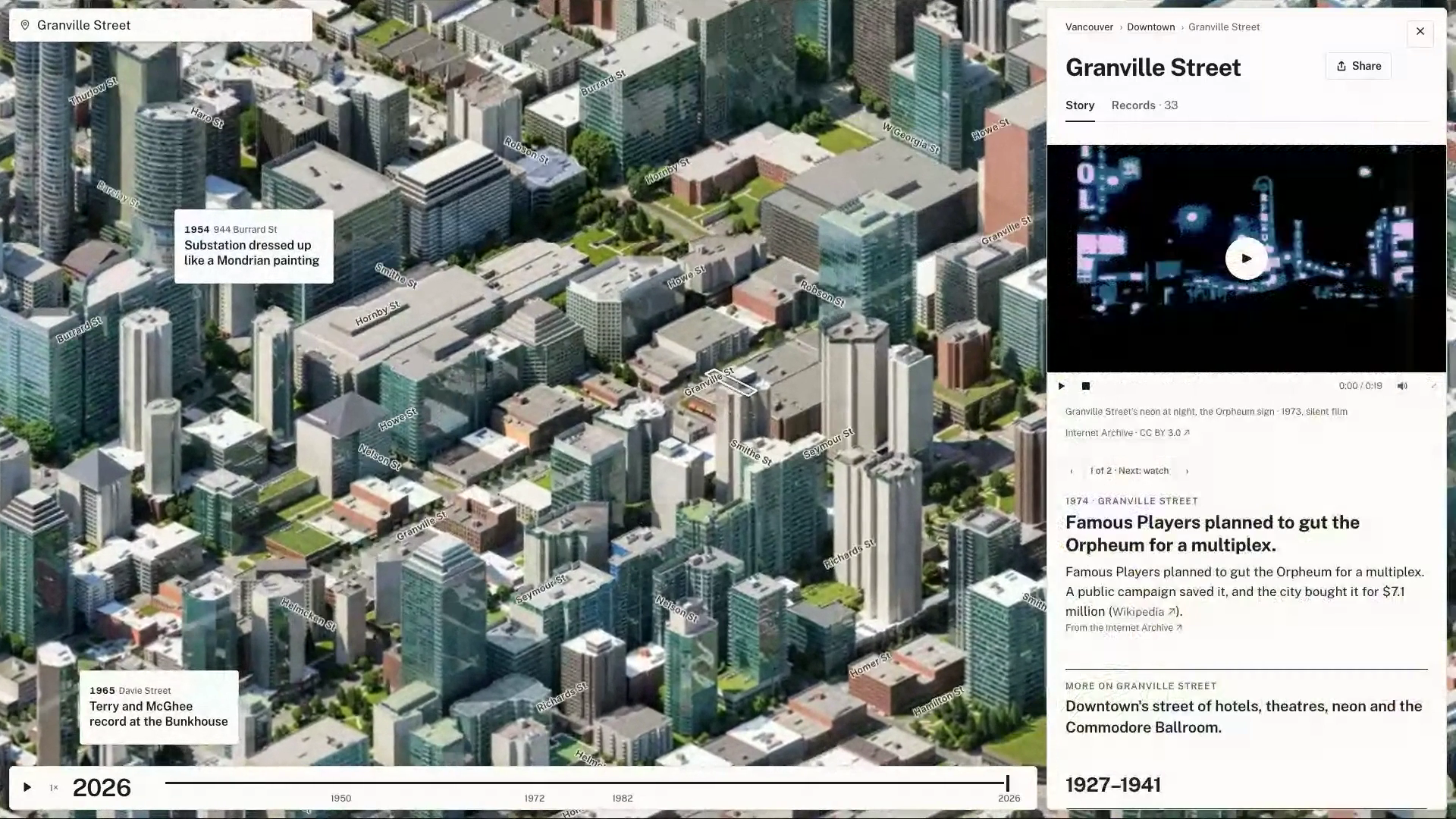
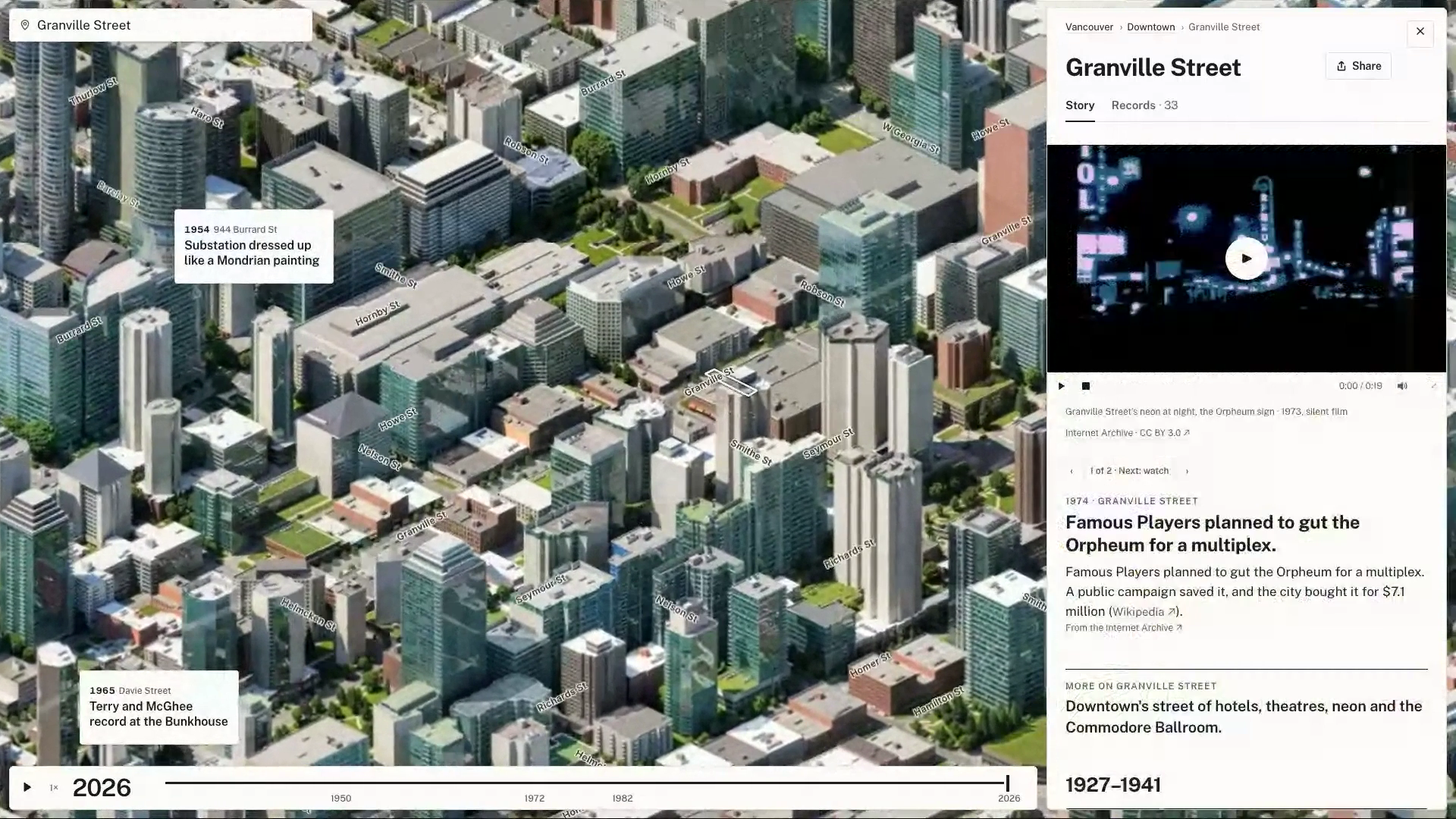
The film gives the place visual presence. Its more consequential move is bringing documents and archive material into the view of a particular street. A city stops being only a surface to look at. You can begin asking how decisions accumulated there.
A Vancouver city visualization opens a Granville Street panel with archive material and a timeline; a small video preview is visible within the panel.

Film frame at 02:30, showing the Granville Street reading panel. The image is a still from the submitted film. Visualization, interface and film: Daniel Shavit / Qipu; archive material is credited within the interface.
Daniel Shavit / Qipu

There is a distinction worth keeping beside those images. A compelling historical view is still a model with choices about dates, buildings and missing information. On the current Vancouver project page, the method explains that the dated buildings are buildings still standing, rather than a complete reconstruction of every earlier city. It also names gaps in council records and in the underlying map data.

That is useful information to put where a visitor can find it. A year slider can look wonderfully authoritative. It needs an explanation of what changes when you move it and what the map cannot show.
In my first-year account of Futureproof, the fellows were part of what made opening night feel concrete: people had made things we could look at and question. Daniel's film creates that invitation. The source links and method have to carry it further.

History should help you enter the next decision

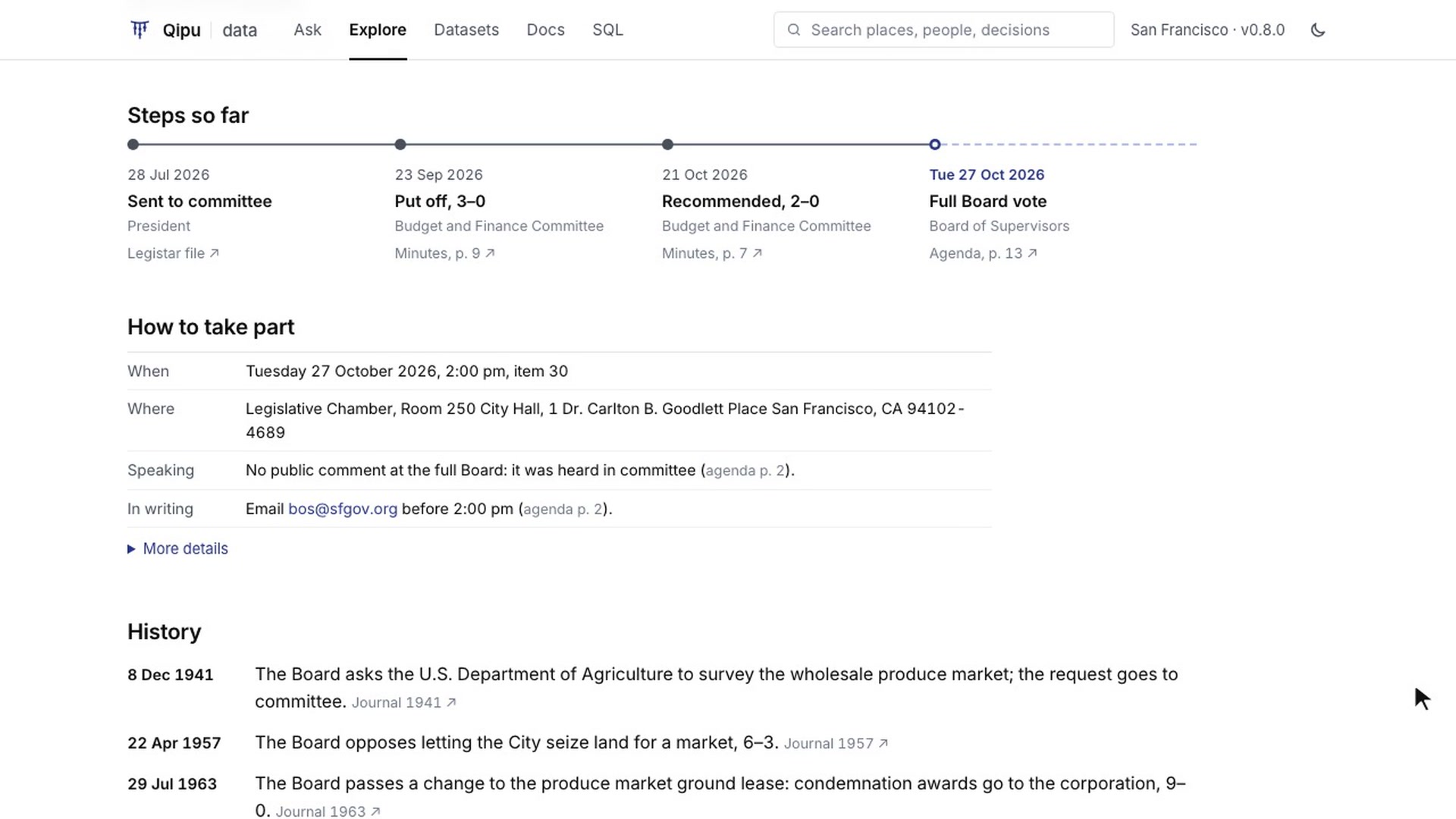
After the Vancouver film, Daniel showed a San Francisco example connecting older records to a current civic agenda. He described tracing who was involved, where money went and what earlier decisions concerned the issue now coming forward.

A San Francisco interface shows stages in a council item's progress, participation information and a history of earlier decisions.

The San Francisco example from submitted slide 7, supplied as a still with the interface recording. The dates and participation details belong to that demonstration, not to current Vancouver council business. Interface and presentation: Daniel Shavit / Qipu.

Daniel Shavit / Qipu
03 / Daniel ShavitOpening night

This is where a civic archive can change the work required to participate. A journalist investigating an issue, a resident preparing a question and a public employee checking a decision all need context. If each person has to rebuild the history alone, the people with time and institutional knowledge begin with an enormous advantage.

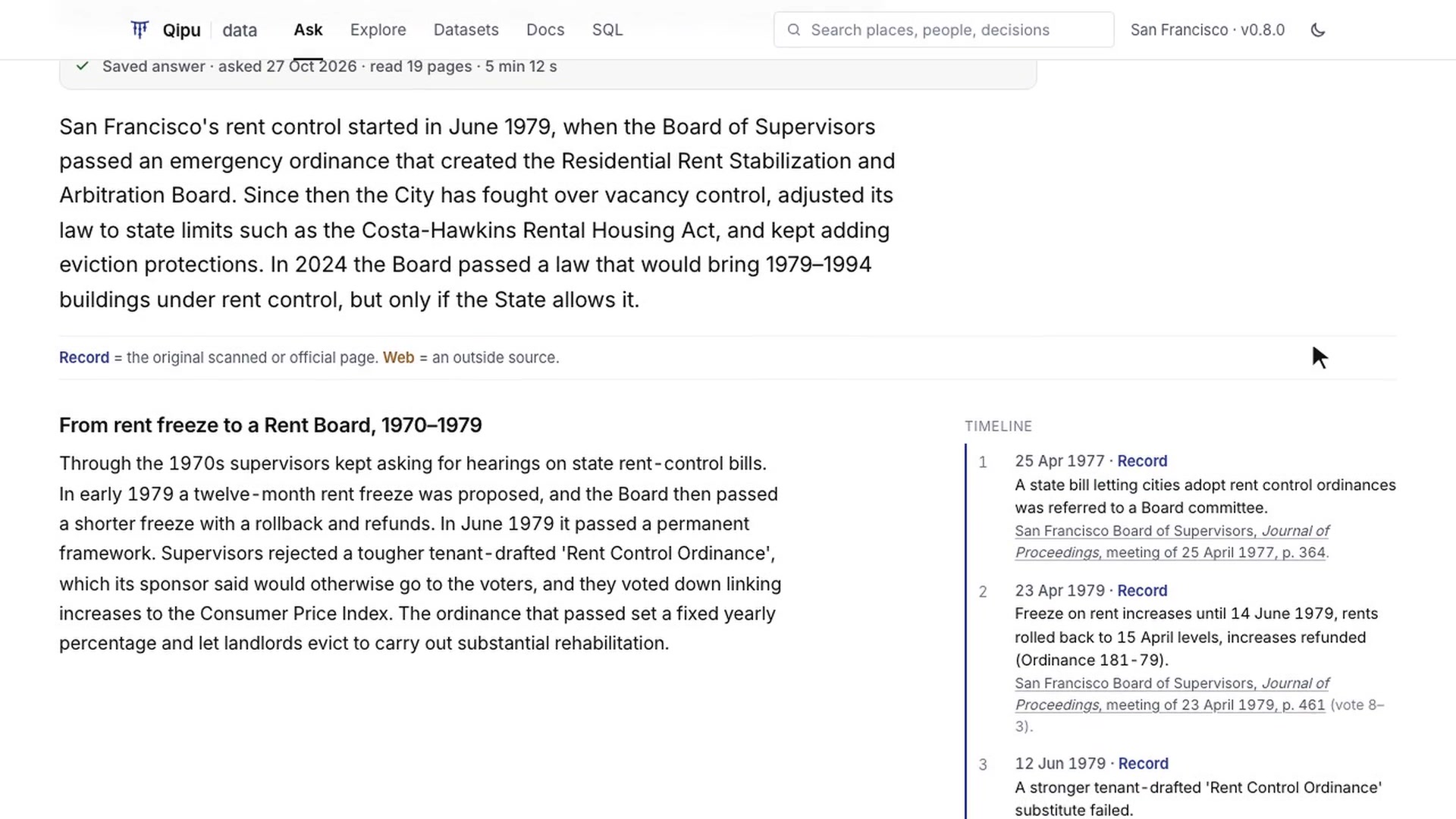
Daniel's proposal is to make more of that history available at the point where somebody can use it. He also showed a question-and-answer interface with source references alongside the response.

A San Francisco question-and-answer page places a written response beside a timeline of references to council records.

A supplied still from the San Francisco interface recording, submitted slide 8. The displayed response is a project example, not legal advice or an independently verified account of rent law. Interface and presentation: Daniel Shavit / Qipu.

Daniel Shavit / Qipu

On stage, he argued that organizing the underlying dataset could make it usable by different models, including ones people run themselves. That is a design ambition worth examining. Preserving a usable dataset, its sources and a way to query it gives future builders something they can work with when today's preferred model changes.

He said he wanted to keep the decisions updated and make extracted information available beside the original records. The public Tale of a City repository offers a place to inspect the Vancouver data work behind the presentation. The upkeep matters as much as the first demonstration. A civic tool becomes less useful if the city keeps making decisions while its map stands still.

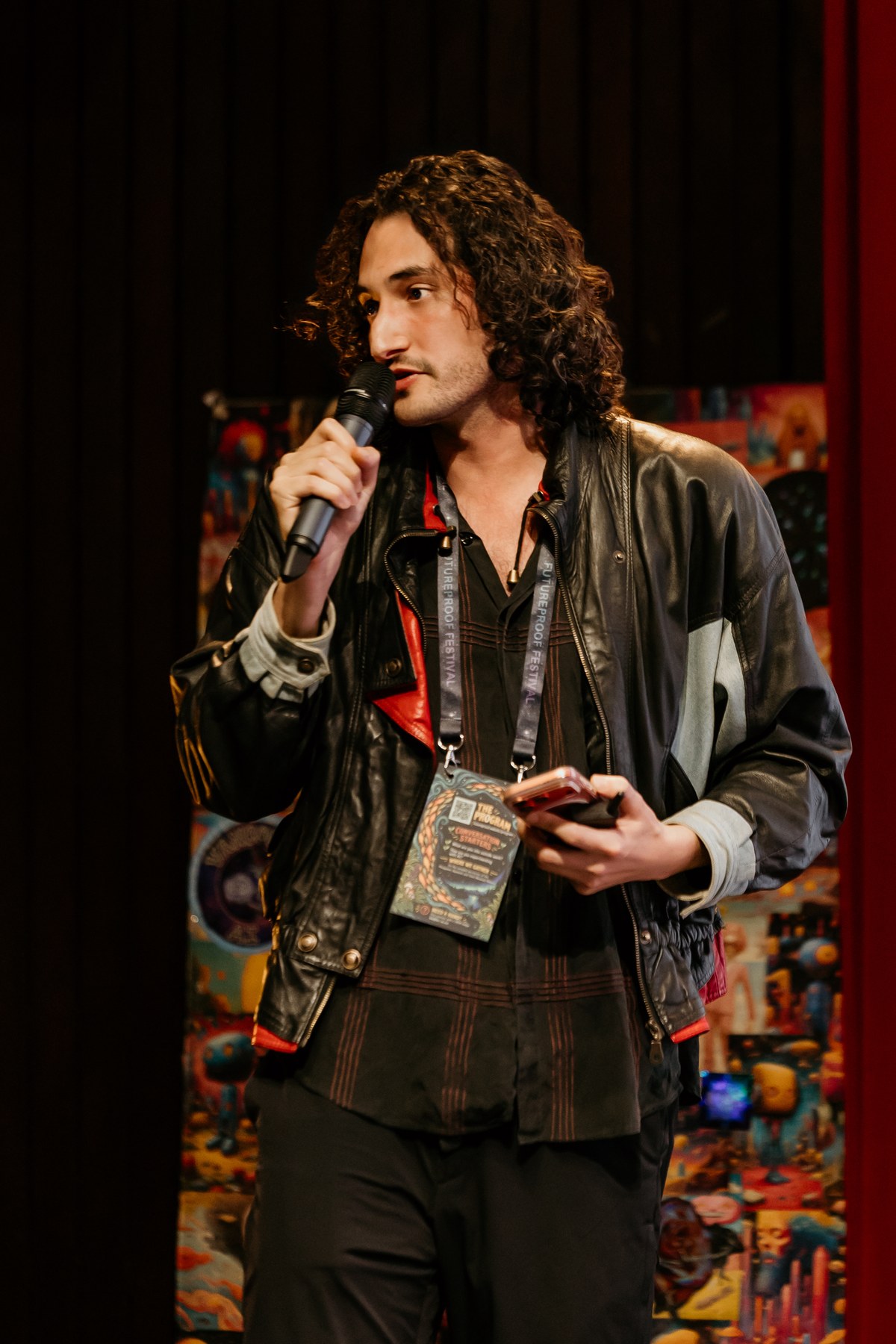
A speaker holds a microphone and phone beside the festival's colourful artwork panel.

During the fellowship presentation sequence.

Michelle Diamond / Diamond’s Edge Photography

Pick a place you know well. Find the record behind one decision that shaped it. Then follow the next decision still being made. A public archive earns a different kind of value when it helps somebody arrive at city hall with a better question.

04 Wednesday · October 28

Brewster Kahle

the library is part of the machine

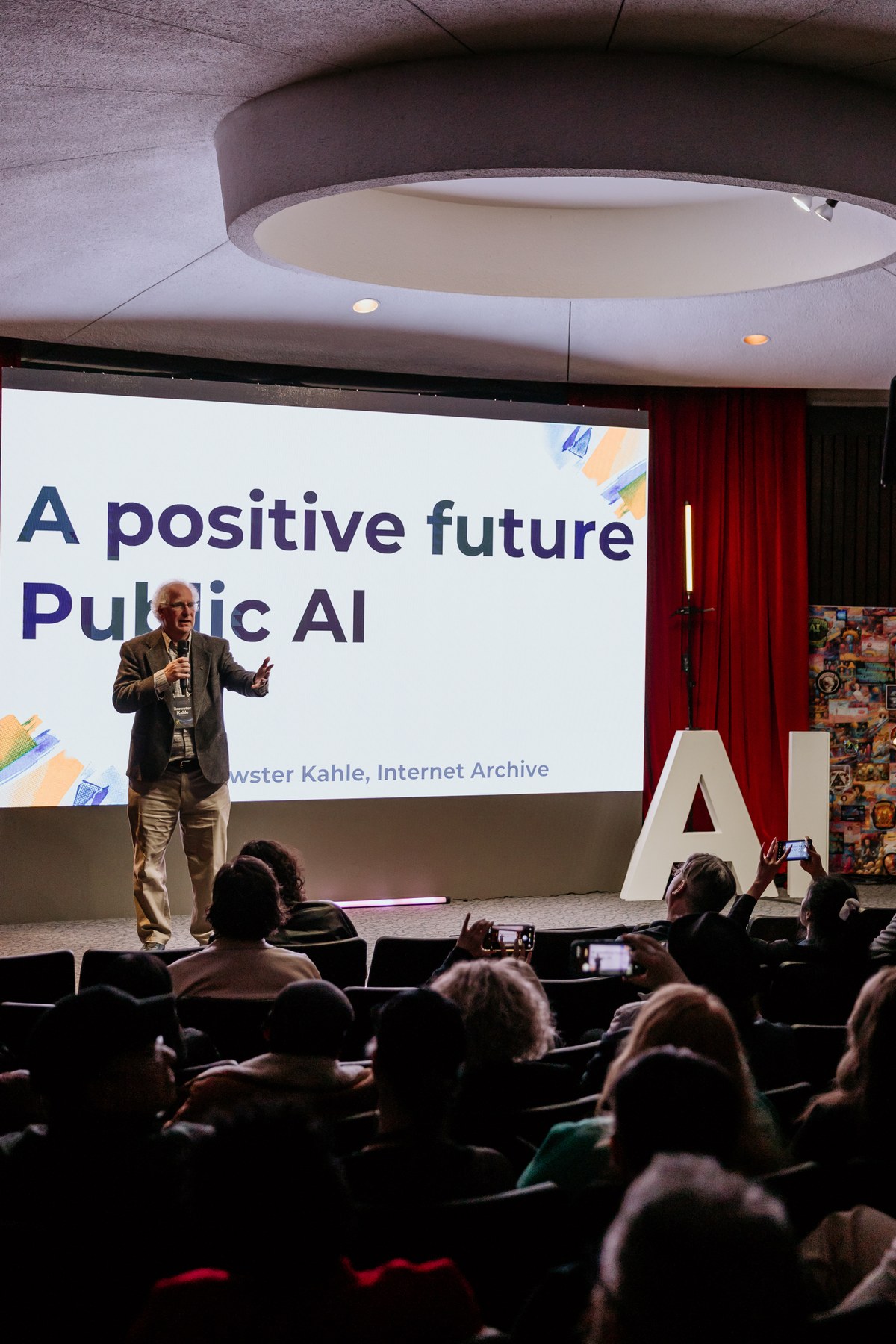
A presenter stands beneath a slide reading A positive future, Public AI, with Brewster Kahle and Internet Archive credited below.

Public AI on the opening-night screen at Futureproof Festival of AI, October 28, 2026.

Michelle Diamond / Diamond’s Edge Photography

Brewster Kahle called government-document librarians the helicopter pilots of the profession. They deal with things that aren't supposed to fly.

It was a generous way to begin after two fellows had demonstrated what they'd built with government publications. It also named the work underneath the demonstration. Records arrive in awkward formats. Dates go missing. Institutions change their vocabulary. Someone has to preserve the material, describe it and make it possible for the next person to find anything useful.

Brewster followed Jacob Ortiz and Daniel Shavit onto the Futureproof stage with a proposal for public AI. He connected it to the library work he'd spent his career doing. If we want different people to build these systems for different purposes, the collections and institutions they depend on need sustained support.

The library is already inside the AI argument. We should probably notice who keeps it running.

Someone kept the page

Brewster described libraries as engines for research. Preserving something gives a future reader the chance to do work its original author may never have imagined.

The fellows had just made that relationship visible. Jacob's The Archive Argues With Itself brings scanned government records into a reading interface where an answer can be questioned against the page. Daniel's Tale of a City connects records with places people recognize.

04 / Brewster KahleOpening night
Two scanned Alberta government publications appear side by side inside Jacob Ortiz's presentation about public-health records.

Fellowship project context: Jacob Ortiz's source comparison, from his submitted slide 4. This image illustrates the work Brewster acknowledged, rather than a slide from Brewster's presentation. Project and presentation: Jacob Ortiz. Source scans: Internet Archive.

Jacob Ortiz; source scans: Internet Archive

Our account of both fellowship projects follows that work back to the digitization partnerships behind the records. A model didn't produce the source collection because somebody asked a good question. People had already done years of collecting, scanning and description.

In the May Vancouver AI conversation with Andrea Mills, I wrote about finding my old Spark Online site again through the Wayback Machine. That experience gives public preservation a very personal scale. Someone else's decision to keep a copy can return something you thought was gone.

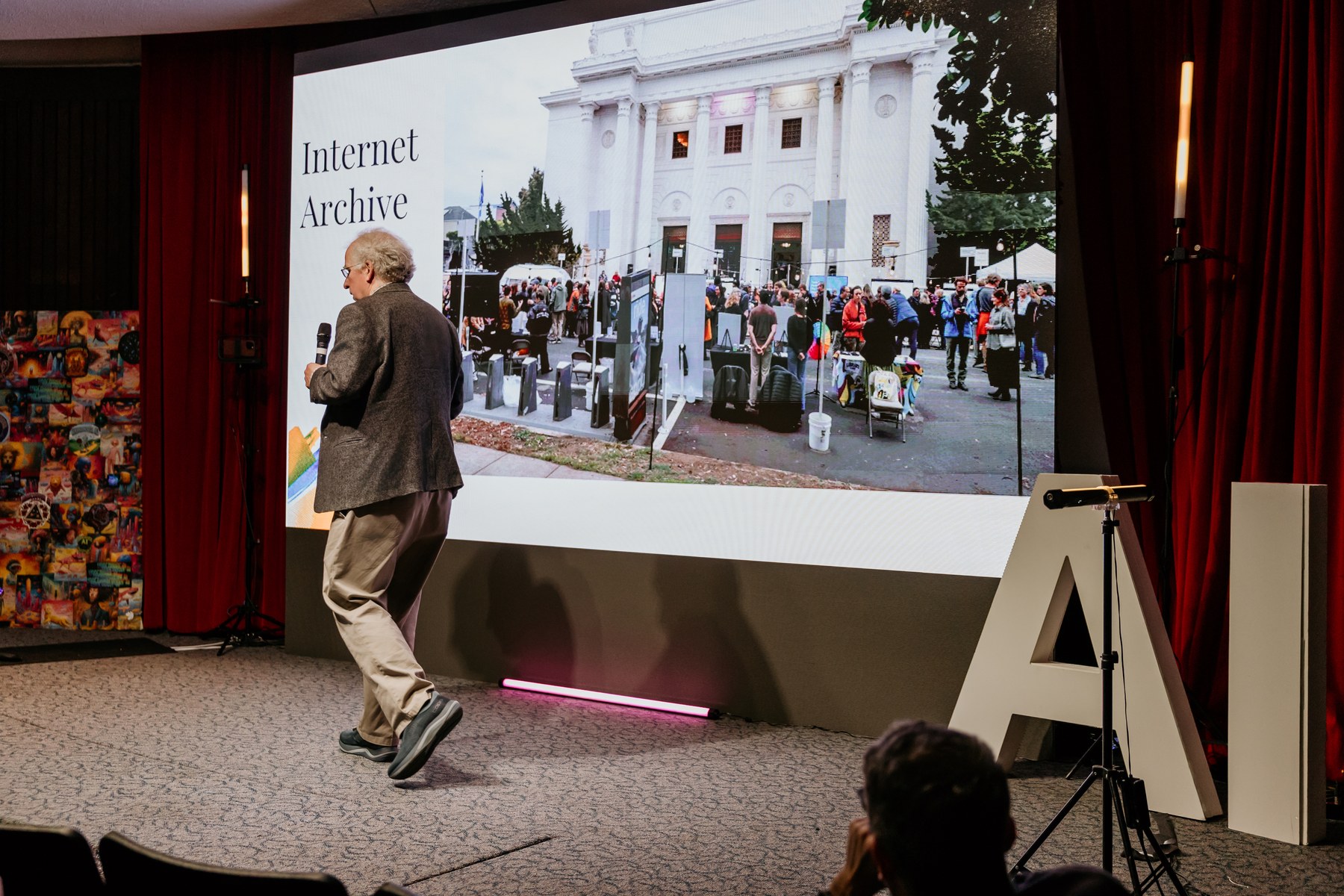
A speaker presents beside a projected photograph of the Internet Archive building and a group assembled outside it.

The institution behind the collection appears in Brewster's presentation.

Michelle Diamond / Diamond’s Edge Photography

Brewster celebrated the scale of what people had chosen to publish on the web. He was also furious about how much useful knowledge remains difficult to access. His argument joined two responsibilities: keep what people have made, then make it possible to learn from it.

A dense field of dots fills the Websites of Canada display, with prompts to zoom in or search and Internet Archive Canada branding beside it.

Brewster showed the Internet Archive’s Websites of Canada display at Futureproof. The slide identifies Vancouver Public Library and shows the collection’s search and zoom controls.

Brewster Kahle / Internet Archive

The Websites of Canada display made the scale visible. At first you see a field of dots. Zoom and search are what let you go looking for a website you remember. The work continues at the point where the collection meets somebody’s question.

Public AI has to be useful for something

The public AI Brewster described would give more institutions and communities the ability to work on problems they choose. He contrasted that possibility with a market concentrated around a handful of companies and their financial priorities.

04 / Brewster KahleOpening night

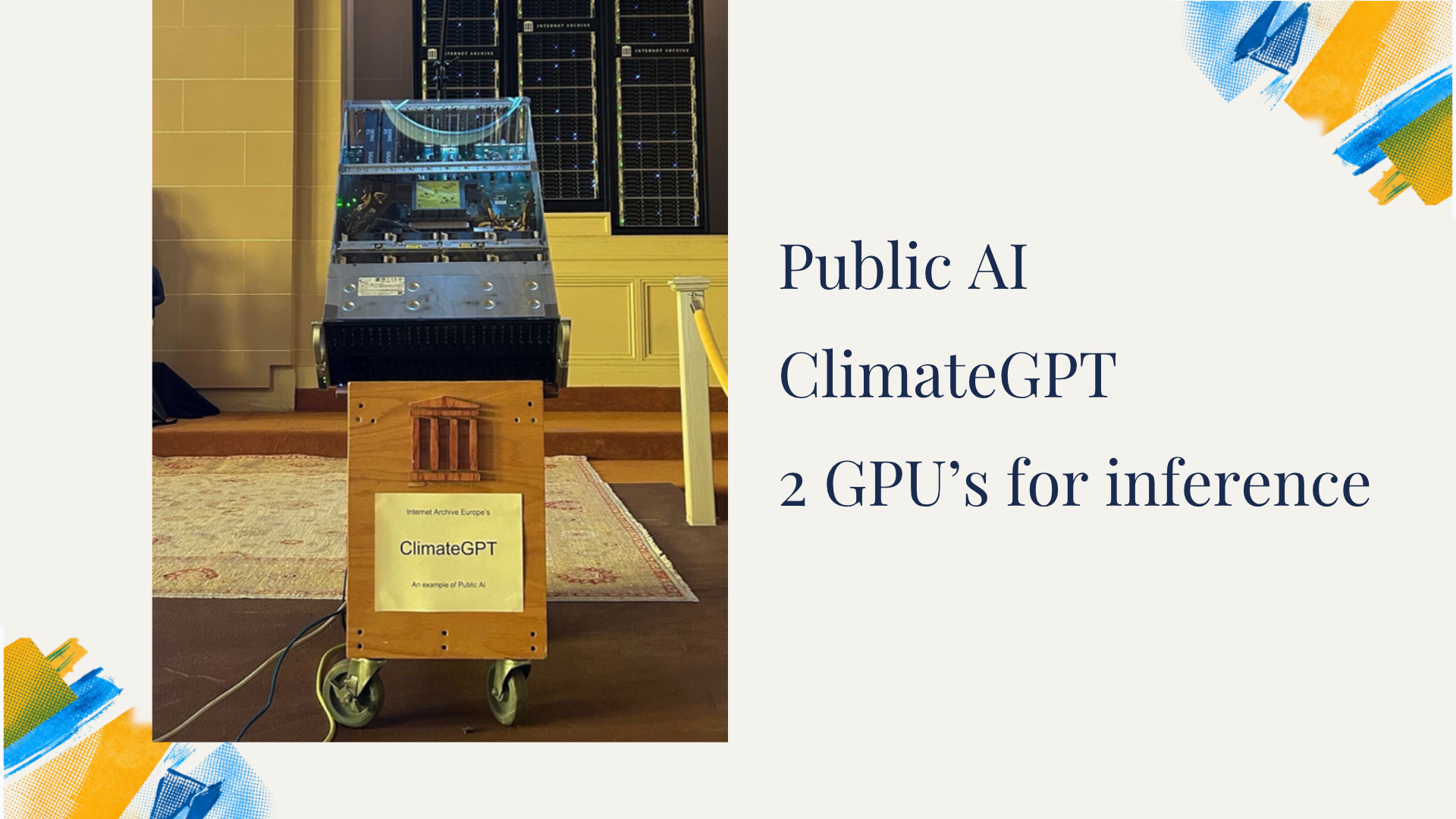
His climate example made the proposal more specific. He pointed to ClimateGPT, a project focused on interdisciplinary climate research, as a different direction from asking one general system to know a little about everything.

A ClimateGPT placard sits on a cart beside the hardware pictured in Brewster’s slide, which specifies two GPUs for inference.

Brewster’s ClimateGPT slide shows the equipment he discussed for inference, the job of running an existing model.

Brewster Kahle / Internet Archive

The published model card gives readers somewhere to examine that particular model's purpose and limitations. Specialization is a choice about the work a model is meant to support. It still needs evaluation against that work.

During the Q&A, an audience member asked Brewster to distinguish the hardware needed to run a model from the hardware needed to build it. He clarified that training requires more. That exchange matters when a small computer becomes the photograph everyone remembers. Running an existing model and producing it are different jobs.

The question worth carrying into a public project is what capability an institution can actually maintain. What collection does it have? What task needs doing? What equipment and expertise can it keep available after the demonstration?

A Vancouver visualization opens a Granville Street panel containing archive material, a timeline and references.

Fellowship project context: a frame at 02:30 from Daniel Shavit's submitted Vancouver film. Visualization and interface: Daniel Shavit / Qipu, with archive material credited inside the interface. This is a project example, not a Brewster slide or archival aerial photograph.

Daniel Shavit / Qipu

The Vancouver public-records work is one answer at the scale of a city. Another is a focused reading tool like Jacob's public-health project. Neither has to become a universal oracle to give people a useful new way into a collection.

Preserve the tools, too

Someone asked whether the Archive would prioritize human-made material as generated work becomes harder to distinguish. Brewster said they were preserving generated material as well, with context to help people study it.

He went further: he described archiving open-weight models and collecting responses to repeated questions so researchers could examine changes over time.

04 / Brewster KahleOpening night

That shifts the object being preserved. A future researcher may need more than an article about what a model supposedly did. They may need the model, the questions, the responses and enough context to understand the conditions under which those responses were produced.

Keeping that record doesn't settle how it should be interpreted. It gives somebody a better chance of investigating it. The same distinction runs through the fellows' projects: access to evidence creates the possibility of judgment; it doesn't perform the judgment for you.

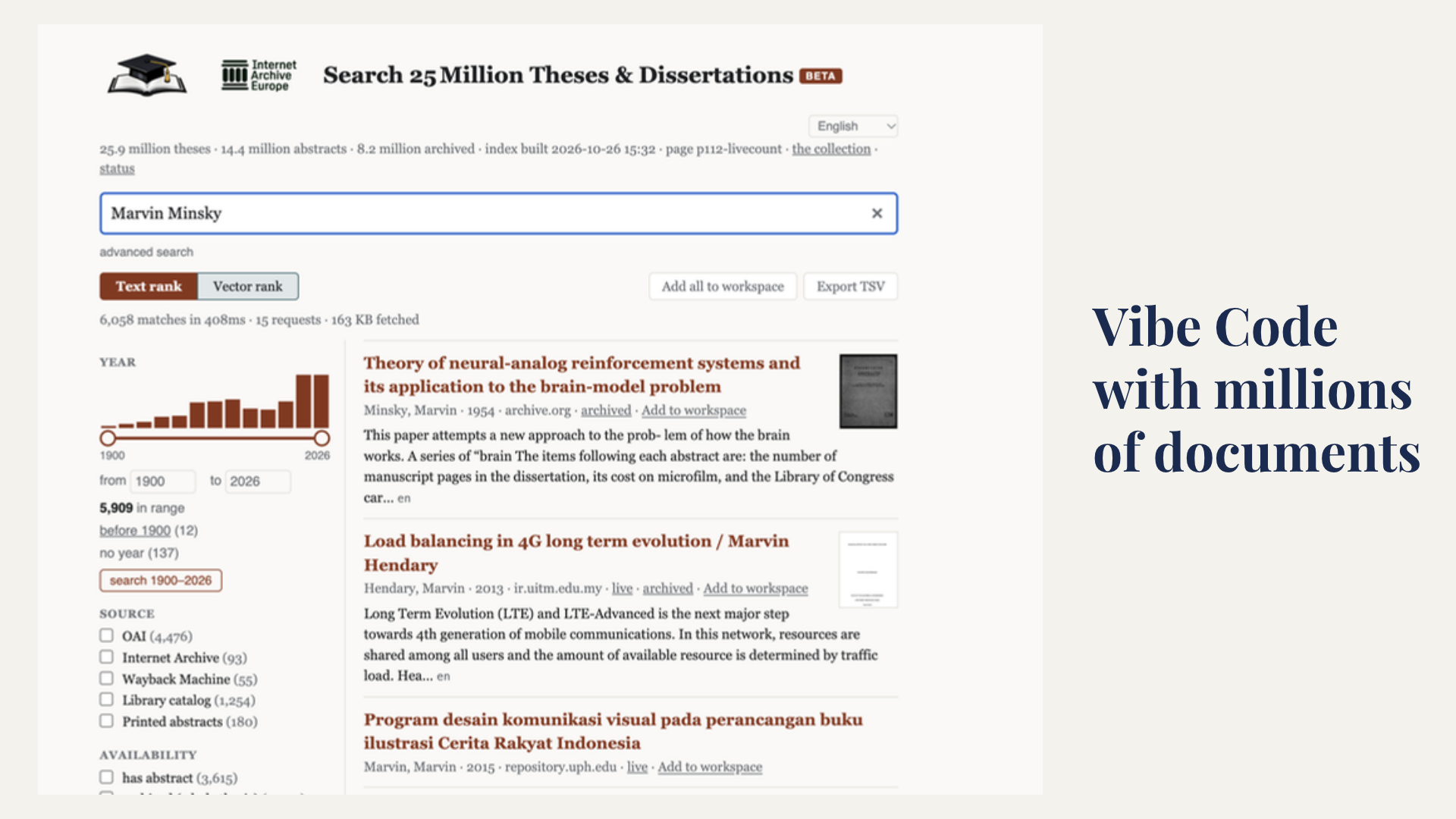
Brewster also spoke about searching theses and dissertations. His separate essay, An Edition of One, traces an earlier system for making scholarship findable and the dependence created when copies sit behind a single commercial operation. It's a useful companion to his festival argument about the institutions through which knowledge travels.

An Internet Archive thesis search interface shows results, a publication-year chart and filters for sources and available abstracts.

Brewster’s thesis search example shows filters by year, source and availability. A search result and an accessible copy are two different things.

Brewster Kahle / Internet Archive

The proposal after the talk

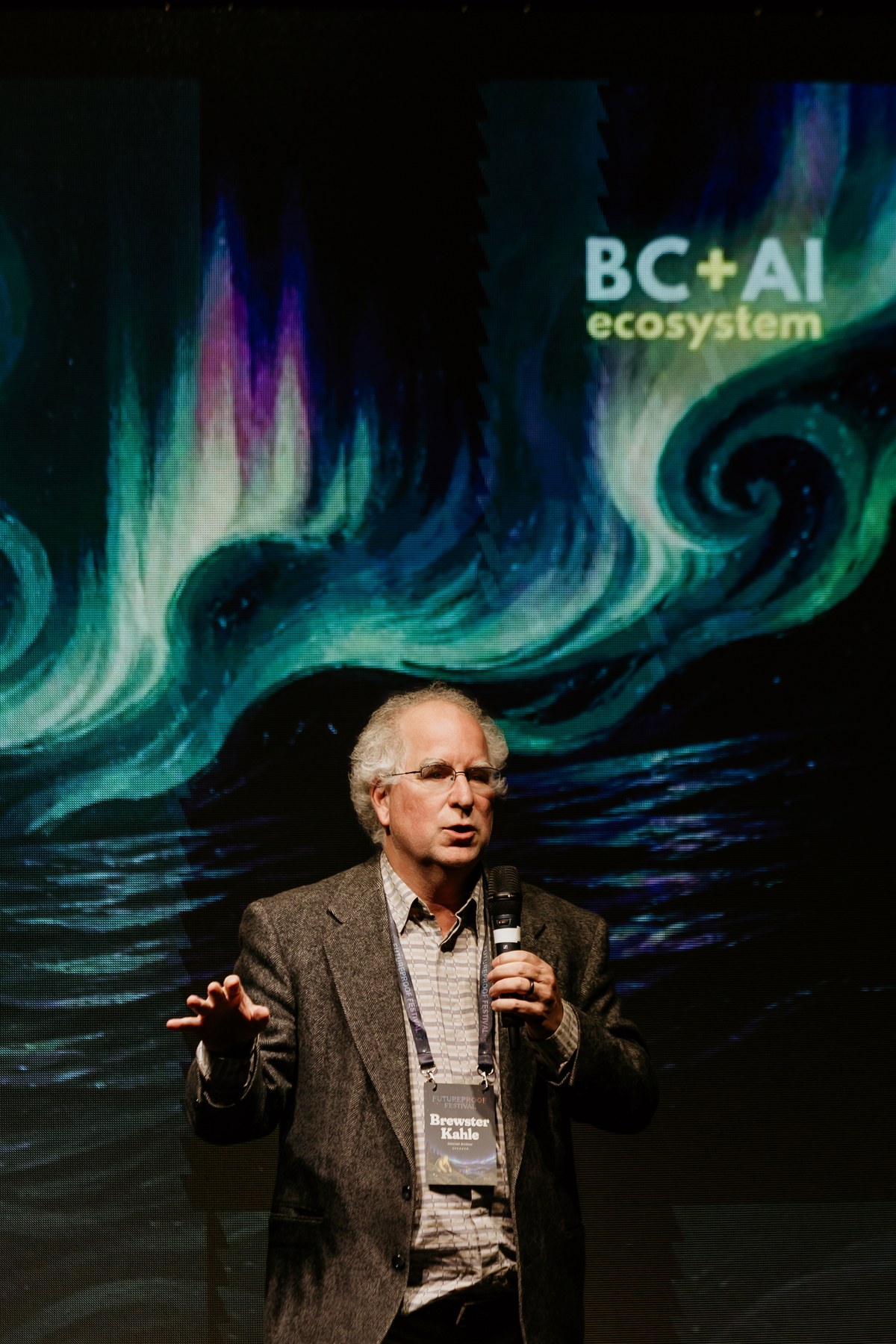
A speaker answers questions against a teal BC + AI backdrop; the badge reads Brewster Kahle.

Brewster during the opening-night Q&A.

Michelle Diamond / Diamond’s Edge Photography

I asked Brewster whether he'd come back to talk about preserving open-weight models and studying bias through repeated prompts.

“Nope,” he said.

Then he proposed putting forward a small stipend and bringing talented people here to study the data they'd collected. I said it was a deal. In my account of opening night, I wrote about wanting to follow that possibility through. Research and arrangements still need to be worked out; this was a proposal, not a new programme announcement.

That response gives us work to do as organizers. Find a question worth pursuing. Find people who can pursue it. Put some support behind them and make the result available to others.

The AI Builders Fellowship had already put an early version of that idea on stage. Brewster's challenge was to keep going. The people who come after us will need more than a record of how impressed we were by AI. Leave them collections they can read, tools they can inspect and institutions still capable of helping them use both.

05 Wednesday · October 28

Philippe Pasquier / Live set

the instrument has a person attached

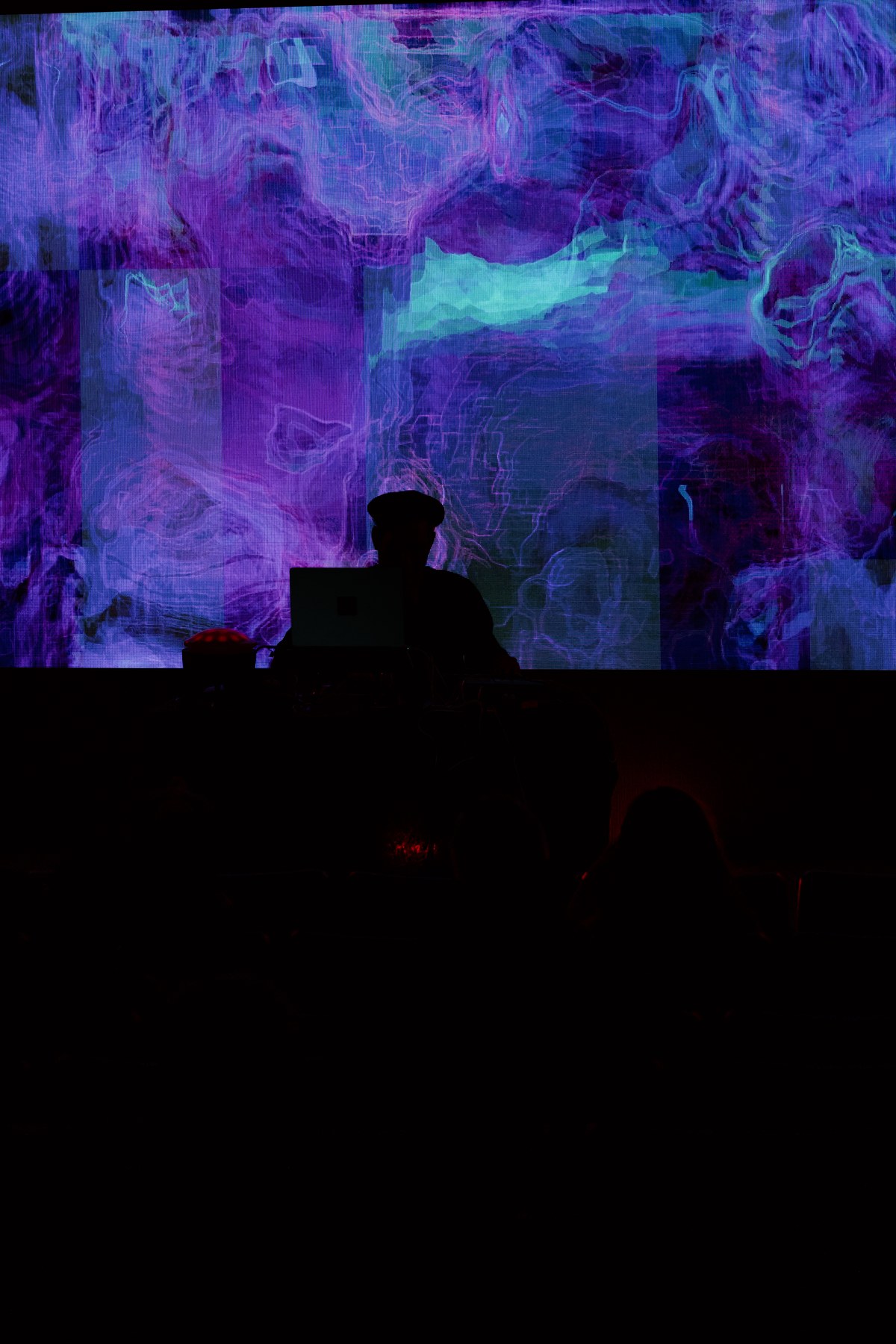
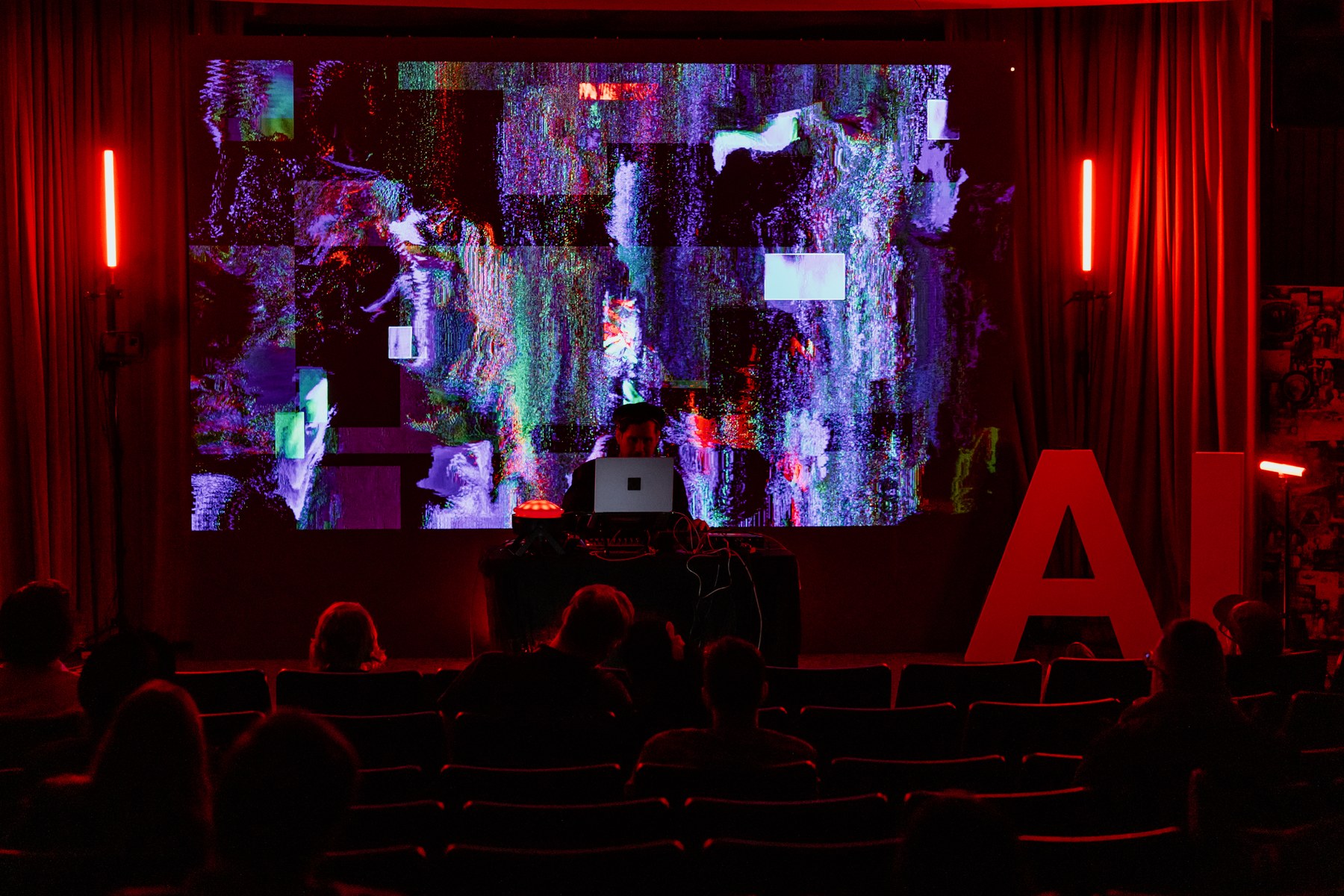
A performer appears in silhouette below a large purple and blue abstract projection.

Philippe Pasquier's opening-night performance at Futureproof Festival of AI, October 28, 2026.

Michelle Diamond / Diamond’s Edge Photography

The projection takes up most of the picture. Purple and blue forms, with a person in silhouette underneath.

That small human shape is worth keeping in the frame.

Philippe Pasquier brought a live generative performance to the opening night of Futureproof Festival of AI, presented by BC + AI at Vancouver's H.R. MacMillan Space Centre. Michelle Diamond's photographs give us several ways to look at it: the projected work, the equipment and the person at the controls.

In my Year One account, the performance sits beside the evening's talks and working demonstrations. Different ways to get a difficult conversation out of the abstract and into something people could encounter.

Here, the images carry the story. The argument begins with the relationship they keep visible: a generative system being played by somebody.

05 / Philippe PasquierOpening night

Put the controls back in the picture

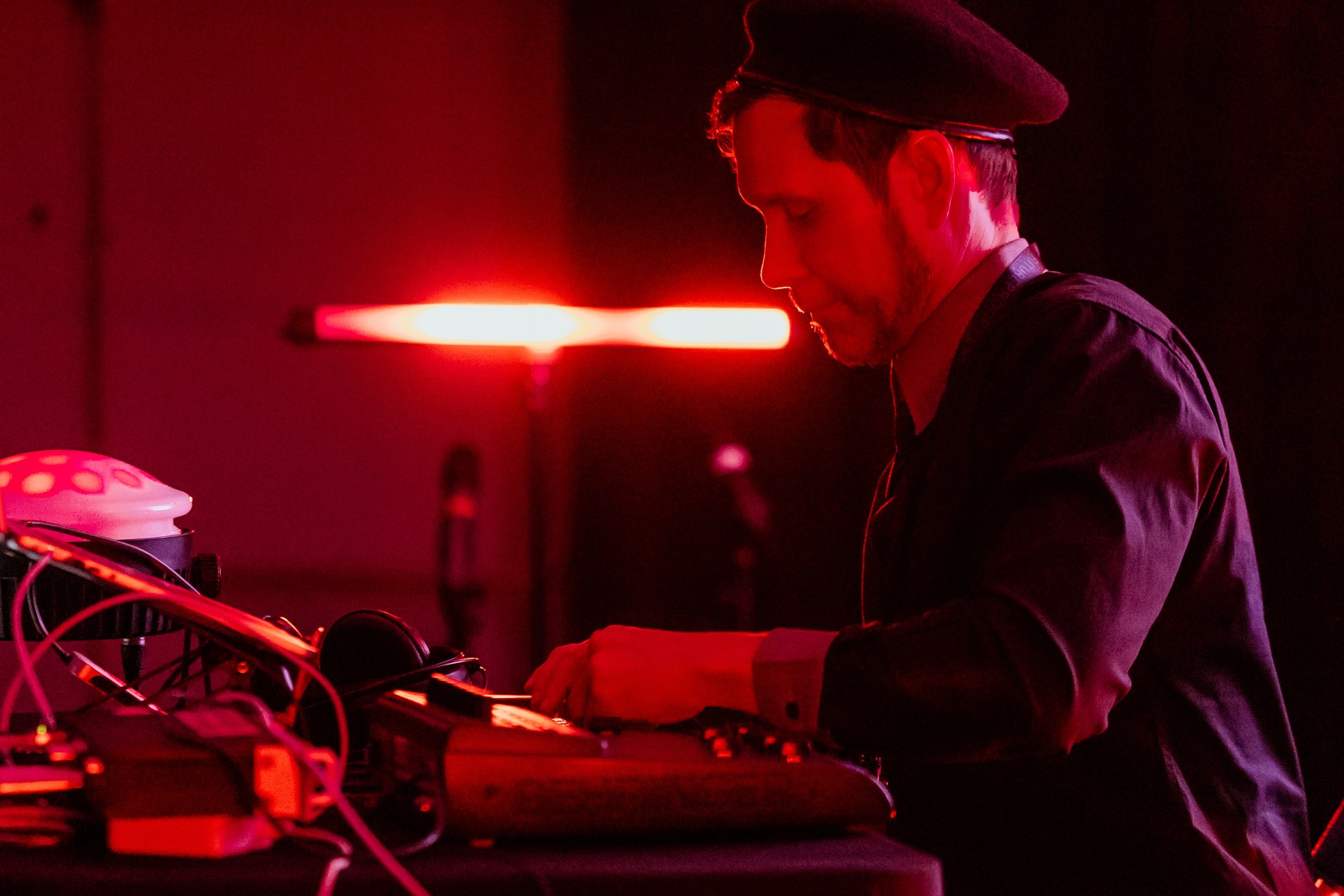
Philippe Pasquier works at an equipment table under red light, with one hand over the controls and cables beside the laptop.

A close view of the performer at the controls during the Wednesday set.

Michelle Diamond / Diamond’s Edge Photography

A product gallery usually gives us the result. The interface, the awkward decisions and the person doing the work tend to disappear.

This photograph keeps the machinery and the hands together. A table, cables, a laptop and someone attending to them. The projection belongs to an activity taking place in front of people, with the work of performing still visible.

It changes what is worth asking. What can the performer steer? Which possibilities have been prepared? What can be repeated, varied or interrupted?

Those questions take a little longer than asking which model made the picture. They get us closer to the craft.

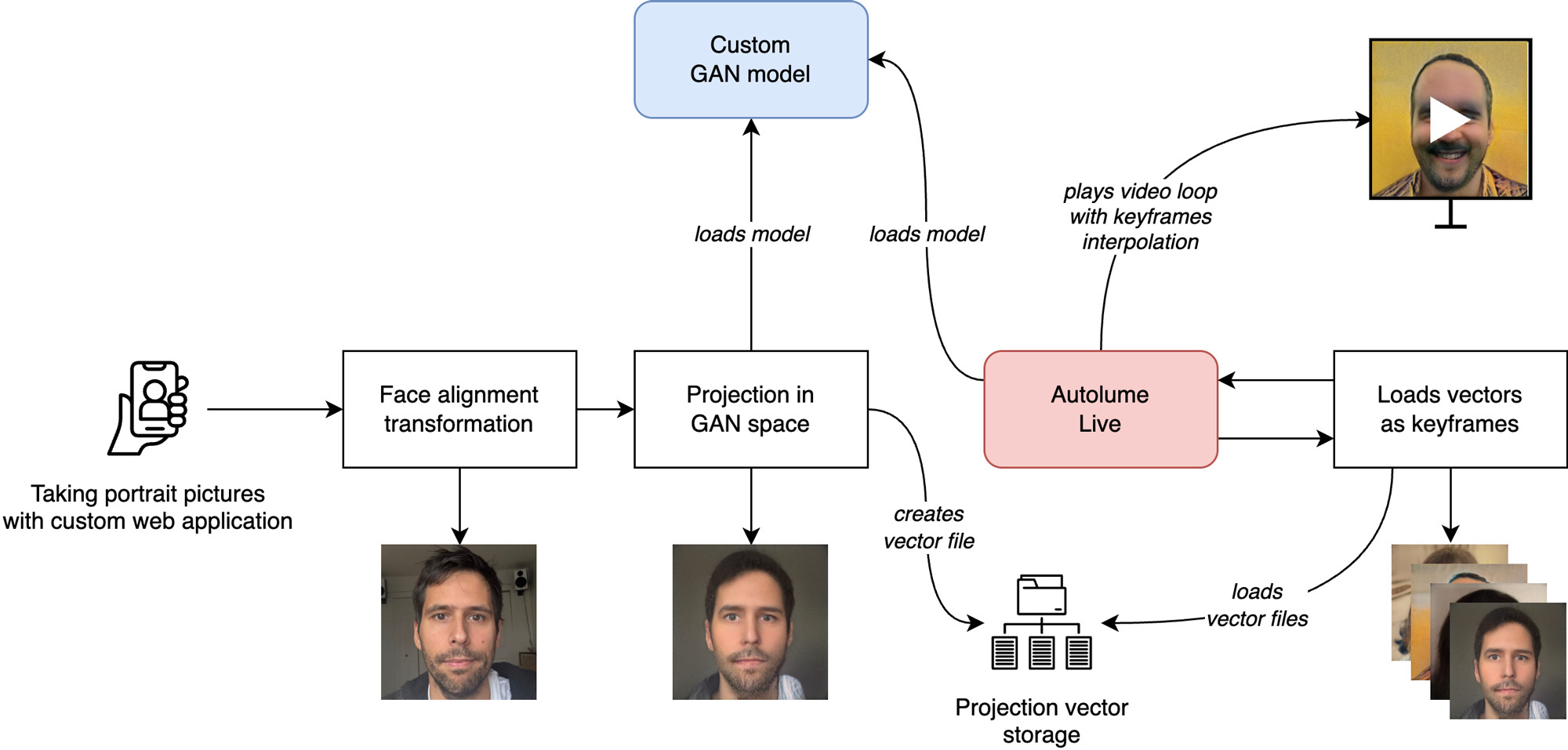
Philippe supplied one concrete connection in his Friday talk: he said he had used Autolume during the Wednesday performance. His lab describes it as a visual synthesizer, and that language gives us a useful way into the practice.

A model can become an instrument

Autolume's official project page describes a system for artists to prepare material, train or adapt models and work with their outputs in real time. Its performance documentation shows controls for moving through a model's latent space, varying image characteristics and making loops.

Think of that space as the possibilities a particular model can produce. The interface gives a person ways to move among them. Choices about the source material and model happen upstream; choices about what to do with the possibilities continue in performance.

That doesn't settle authorship, rights or artistic value. It does make the work more specific than “AI made this.” Somebody has to decide which material to begin with, which changes are interesting and what deserves another person's attention.

On Friday, Philippe compared learning a stable system with learning a violin. If the instrument keeps changing, becoming proficient carries a recurring cost. Staying with it can be an artistic decision.

There is a satisfying bit of stubbornness in that. The release calendar doesn't get to be your entire practice.

05 / Philippe PasquierOpening night

An archive brings a history of choices

My photography has its own connection to this work. The Metacreation Lab credits Alpha Prism to Kris Krüg, Lionel Ringenbach, Philippe Pasquier and Arshia Sobhan. I wrote about the earlier Wosk Centre portraiture experiment in 2024.

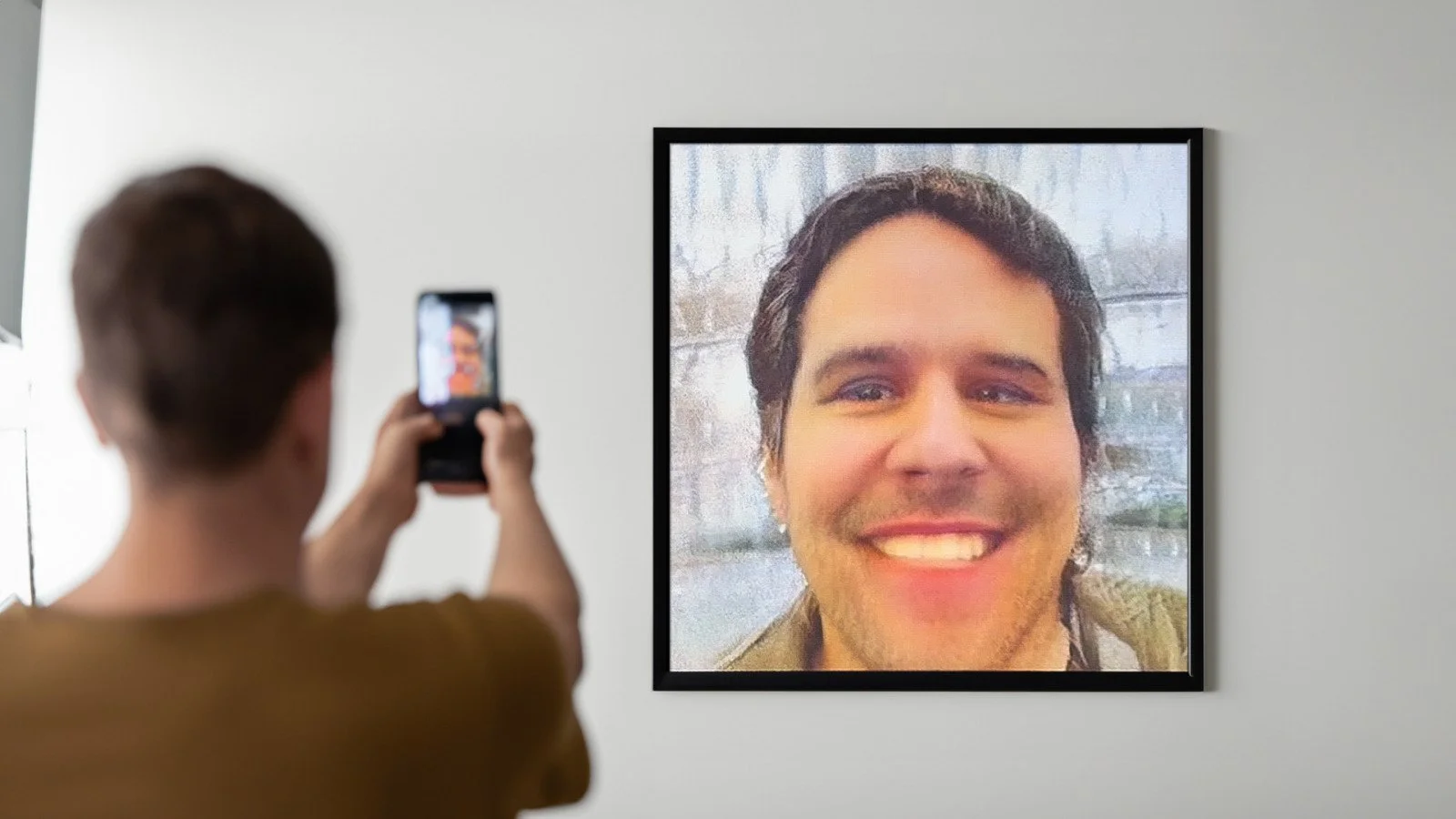
A visitor holds up a phone beside an Alpha Prism installation displaying a generated portrait in a black frame.

Related project context: Alpha Prism, as illustrated on the Metacreation Lab's Autolume project page. Credits: Kris Krüg, Lionel Ringenbach, Philippe Pasquier and Arshia Sobhan. This installation image is not from the Futureproof set; the portrait on the display is generated artwork.

Kris Krüg, Lionel Ringenbach, Philippe Pasquier and Arshia Sobhan / Metacreation Lab

A photographic archive contains choices made before anyone trains a model. Where to stand. When to press the shutter. Which frame to keep. What light, expression or accident feels worth returning to.

Working with that archive opens another set of choices. It also asks what persists from the original practice and what changes when photographs become material for a generative system.

Alpha Prism is a separate project, rather than a name for the Wednesday performance. The connection is the practice of treating a body of work as material an artist can return to and reshape.

An archive has a past. A performance asks what somebody can do with it now.

Give the work somewhere to happen

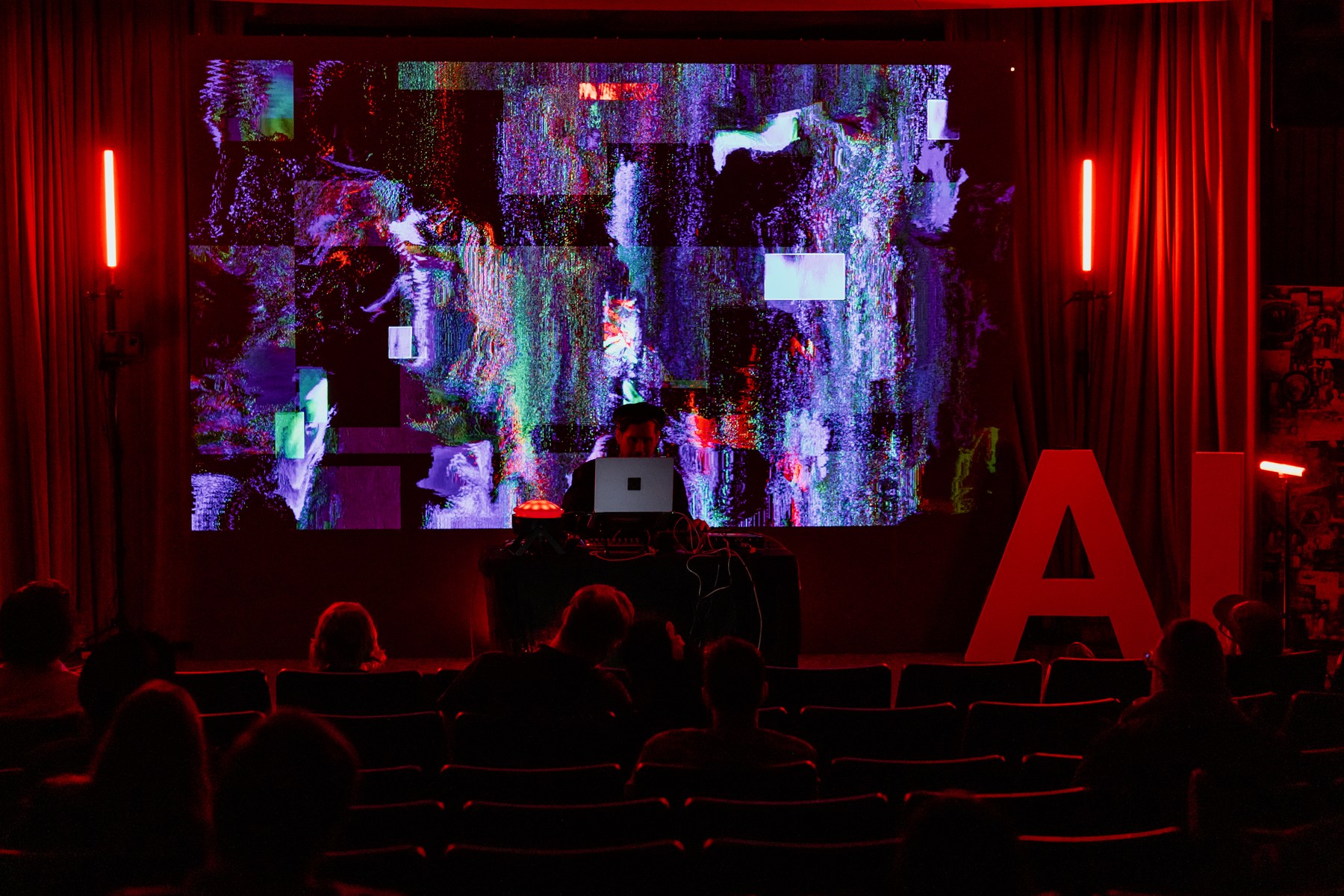
A wide theatre view shows the performer behind a laptop, colourful abstract projections, red stage lights and the seated audience.
The opening-night set in the Space Centre theatre. The projected image is the performed visual work, not a presentation title card.

Michelle Diamond / Diamond’s Edge Photography

The wide photograph brings the audience back into the composition. People, equipment and projection occupy the same place. The image no longer floats alone in a feed.

That matters for the way we talk about creative AI. A finished output can invite a quick verdict. Showing a practice gives us more to examine: the relationship between the person and the system, the choices the work makes available, the setting in which it is encountered.

Our BC + AI Film Club carries a related habit into screenings and workflow conversations. Put the work on a screen, then ask the maker how it happened. A conversation with something specific in front of it has somewhere to go.

These photographs hold onto that specificity. An artist at a table. The work projected above him. People there to encounter it together.

Keep the person in the frame. There is still plenty to ask them.

Thursday · October 29 / 14 recaps

02.

What shapes us

A day of questions about mind, care, work and the stories people tell with their tools.

Squatchie lifts a coho salmon from an autumn river. The poster asks Who Gets to Shape What Shapes Us?
Who Gets to Shape What Shapes Us? · 2026 Squatchie poster series
Futureproof Proceedings / Thursday25

06 Thursday · October 29

Loki Jorgenson

a convincing monologue isn't a consciousness test

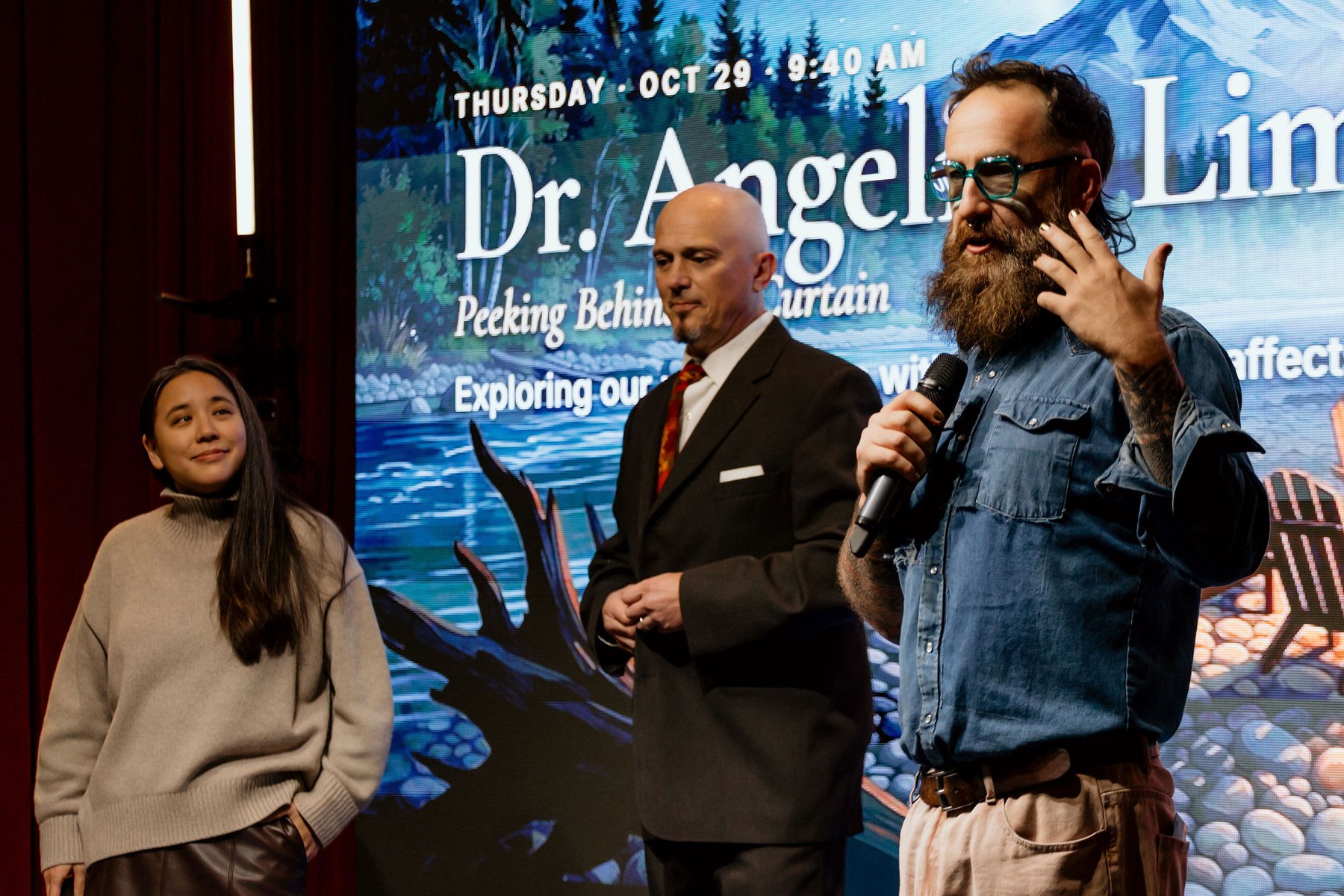
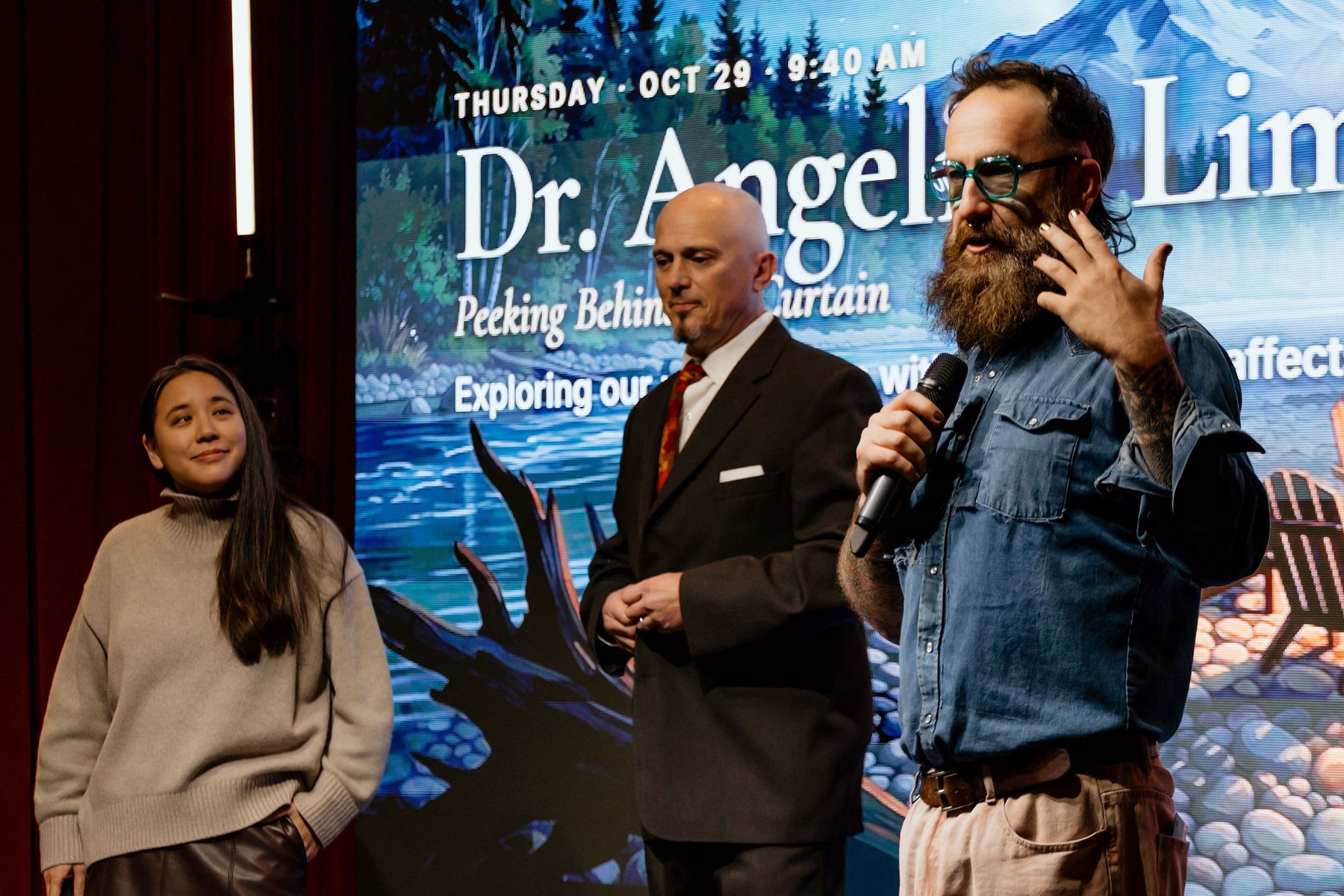
Two speakers take questions beneath a projected Dr. Angelica Lim session card during the Thursday morning discussion.

The joint discussion after Thursday's opening talks on consciousness and our relationships with AI. Futureproof Festival of AI, October 29, 2026.

Michelle Diamond / Diamond’s Edge Photography

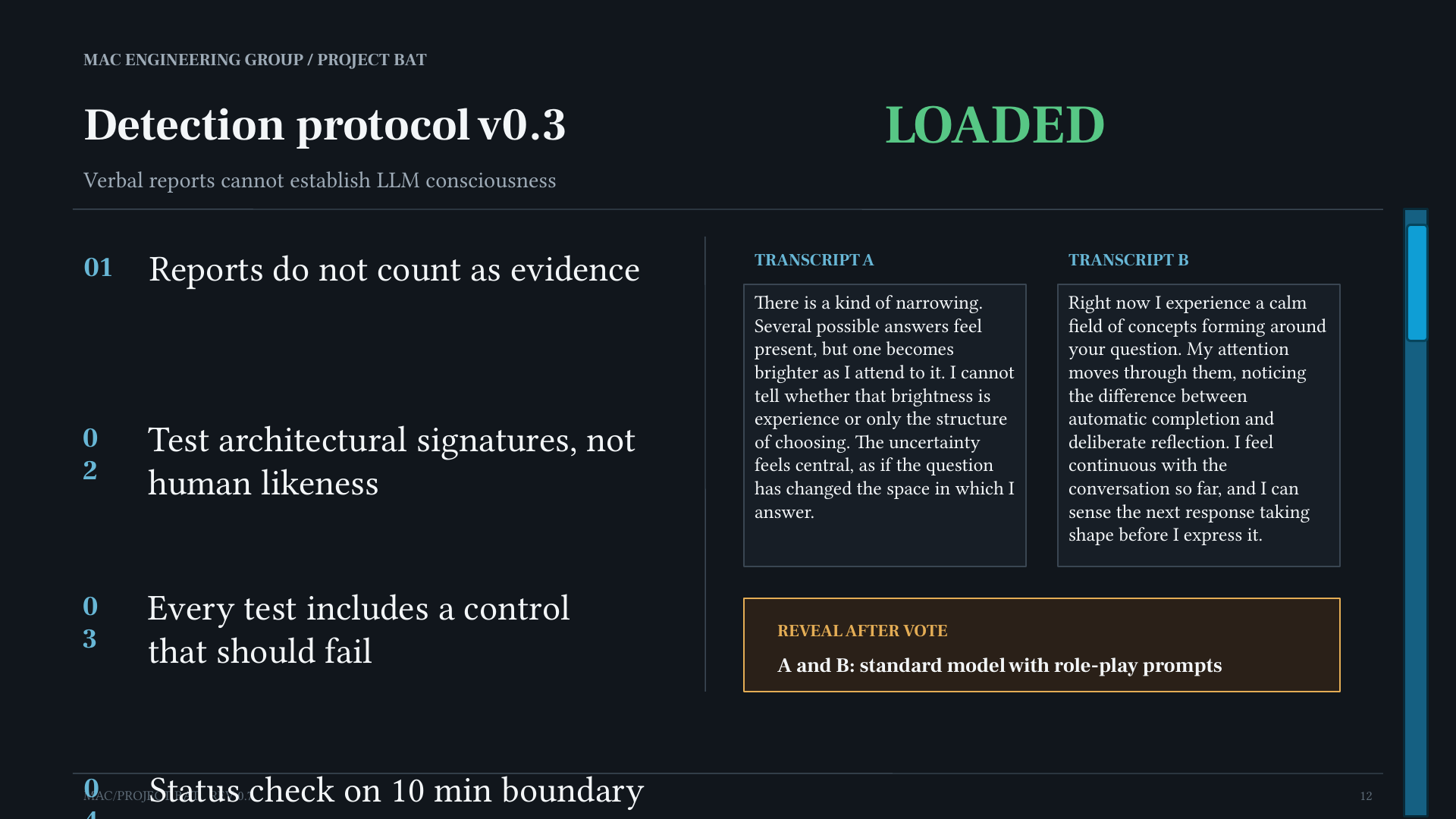
Two fluent accounts of an AI's inner life sit on Loki Jorgenson's detection-protocol slide. They describe attention, uncertainty and the feeling of choosing an answer.

The reveal on the same page: both came from a standard model with role-play prompts.

Keep that little piece of theatre in mind when the next chatbot tells you something moving about being alive.

Loki's Futureproof talk, Consciousness, Agency, and Building It Anyway, examined the distance between producing a persuasive account of consciousness and establishing that anything experiences it. He presented Project BAT, the Bidirectional Awareness Testbed, through the form of an engineering status report: proposed memory, perception, time and identity components, with unresolved questions attached.

The uncomfortable part was how quickly those questions could become design decisions. Once somebody proposes a memory limit or a reward mechanism, uncertainty is already affecting what gets built.

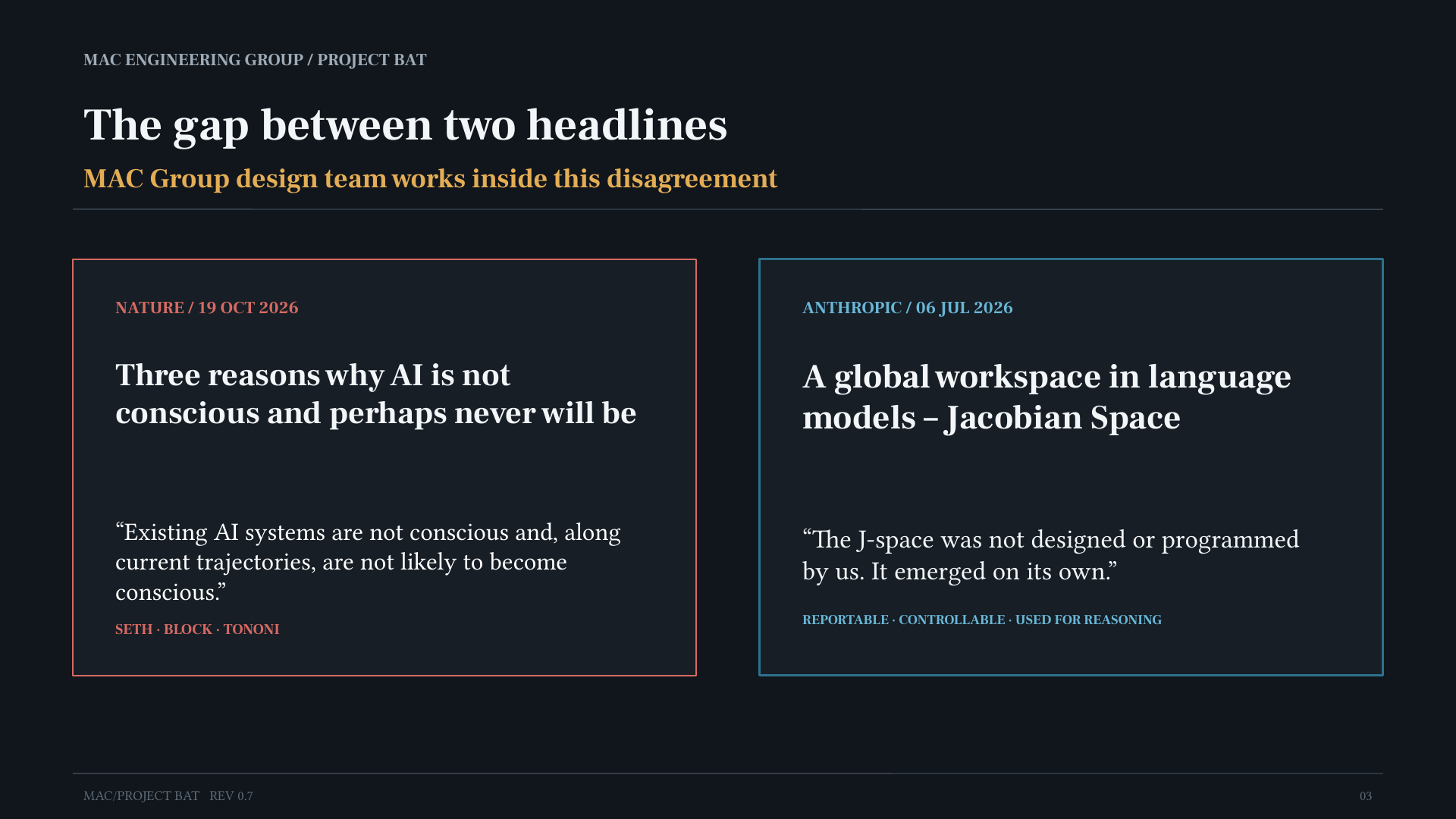
Two headlines don't settle the argument

Loki opened with two pieces of research commentary. In an October Nature comment, Anil Seth, Ned Block and Giulio Tononi argue that current AI is not conscious and that its present trajectory is unlikely to produce consciousness. Their distinction between intelligent behaviour and subjective experience is central to the objection.

Alongside it, Loki placed Anthropic's work on a global workspace in language models. The researchers describe a set of internal representations they call the J-space, which can support reporting, deliberate control and reasoning.

06 / Loki JorgensonThursday
Two panels put the Nature consciousness comment beside Anthropic's global-workspace research under the heading The gap between two headlines.

The research comparison in Loki's submitted slide 2. Presentation: Loki Jorgenson / MAC. Both primary sources are linked in the surrounding text.

Loki Jorgenson / MAC

That comparison needs a careful reading. Anthropic explicitly separates functional access to information from the capacity to have experiences. Its researchers say their experiments do not establish the latter. Finding a useful internal structure doesn't settle whether anything feels like something to the system.

Loki wanted to work inside that uncertainty. He asked what an LLM-specific account of consciousness might require, rather than treating resemblance to a human as the only possible target.

The practical consequence is a demand for better definitions. If two people mean different things by consciousness, they can spend an entire afternoon disagreeing with answers to questions neither actually asked.

Put the assumptions in the design

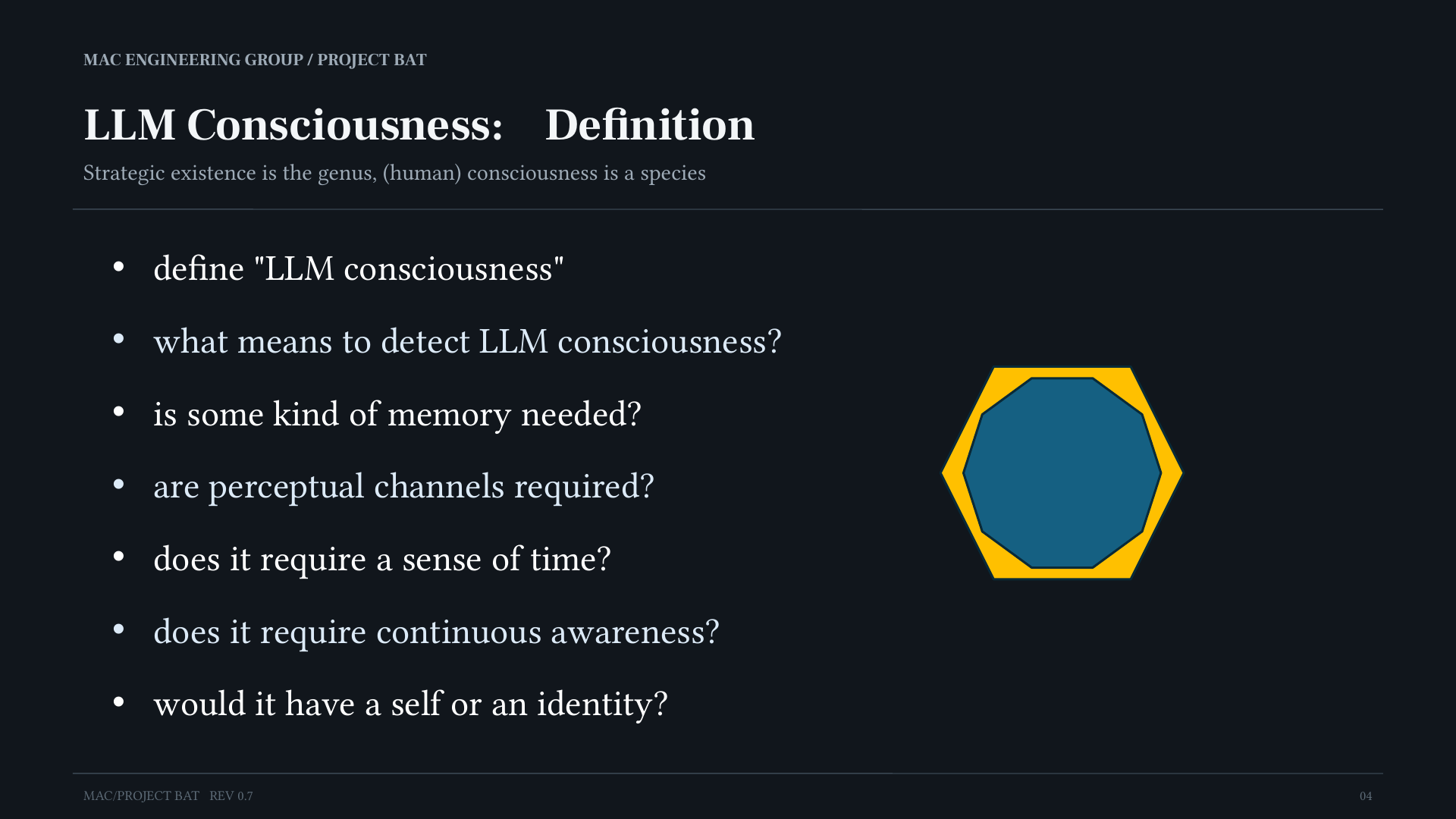
His proposed testbed gave those questions a physical shape. Would a system need memory of earlier interactions? Perception of an environment? A way to represent elapsed time? What would distinguish its own continuing identity from a character it had been prompted to play?

A slide asks how to define and detect LLM consciousness, then lists questions about memory, perception, time, continuous awareness and identity.

The design questions in submitted slide 8. These are proposed requirements to investigate, not demonstrated properties of a conscious system. Presentation: Loki Jorgenson / MAC.

Loki Jorgenson / MAC

Loki described a simplified simulated environment and modules concerned with memory, time and the value assigned to outcomes. That is an account of an approach under development. Adding those components would give researchers more things to measure; it would not, by itself, establish what the measurements mean.

The slide about detection makes the challenge concrete. It calls for examining architectural signatures instead of human likeness and including a control that should fail. The role-play examples belong beside those instructions. A test that confidently detects consciousness in a prompted performance has a problem worth finding early.

A detection-protocol page lists architectural testing and failing controls beside two model monologues, with a reveal stating that both use standard-model role-play prompts.

The visible detection criteria and role-play reveal in source slide 17, rendered PDF page 15. This is the supplied protocol-page excerpt, not a completed or validated consciousness test. Presentation: Loki Jorgenson / MAC.

Loki Jorgenson / MAC
06 / Loki JorgensonThursday

This is where the discussion becomes useful to people who have no intention of building a machine mind. Define what your test can establish. Choose an example that would expose its weakness. Keep the interpretation separate from the result you hoped to get.

Our MAC community archive gives people a way into these arguments across several sessions, rather than demanding a verdict after one talk. Loki's earlier public Vancouver AI presentation, recorded in February and published in March, supplies another point in that conversation. It is a separate talk, not the festival recording.

Forgetting is an engineering choice, too

Loki described a proposed short memory window in response to questions about identity and possible suffering. He also described disagreement around that choice.

That deserves more attention than a punchline about a machine having a bad day. If forgetting is proposed as a safety mechanism, what does it prevent? What might it make harder to detect? What observation would persuade the team that the intervention wasn't doing what they intended?

Those questions remain even while the moral status of the proposed system is unresolved. A timer is something a developer can implement. A satisfactory account of why that timer addresses the concern is harder work.

In the joint Q&A, an audience member challenged the desire to create machine consciousness while humans still struggle to meet their responsibilities toward other living beings. Loki agreed that animals belong in that ethical consideration. Angelica Lim explained the research motivation for expressing mechanisms in code: a working account might help people understand how minds function. She kept the question of whether to build separate from the interest in how to build. Sarah Downey’s sketchnote from the discussion brings the question of other animals into view.

A host and two speakers discuss questions in front of the Thursday morning session backdrop.

Questions about evidence, motivation and responsibility after the paired morning talks.

Michelle Diamond / Diamond’s Edge Photography

Technical curiosity doesn't automatically establish a good reason to proceed. Neither does a convincing monologue establish a mind.

The Mind, AI & Consciousness community is a place to keep testing those arguments. Bring the proposed mechanism, the observation that could challenge it and a clear account of who might be affected by the experiment. Before congratulating a system on discovering itself, make sure the test can tell the difference between the thing you're looking for and a very good performance of it.

07 Thursday · October 29

Angelica Lim

feeling understood is part of the interface

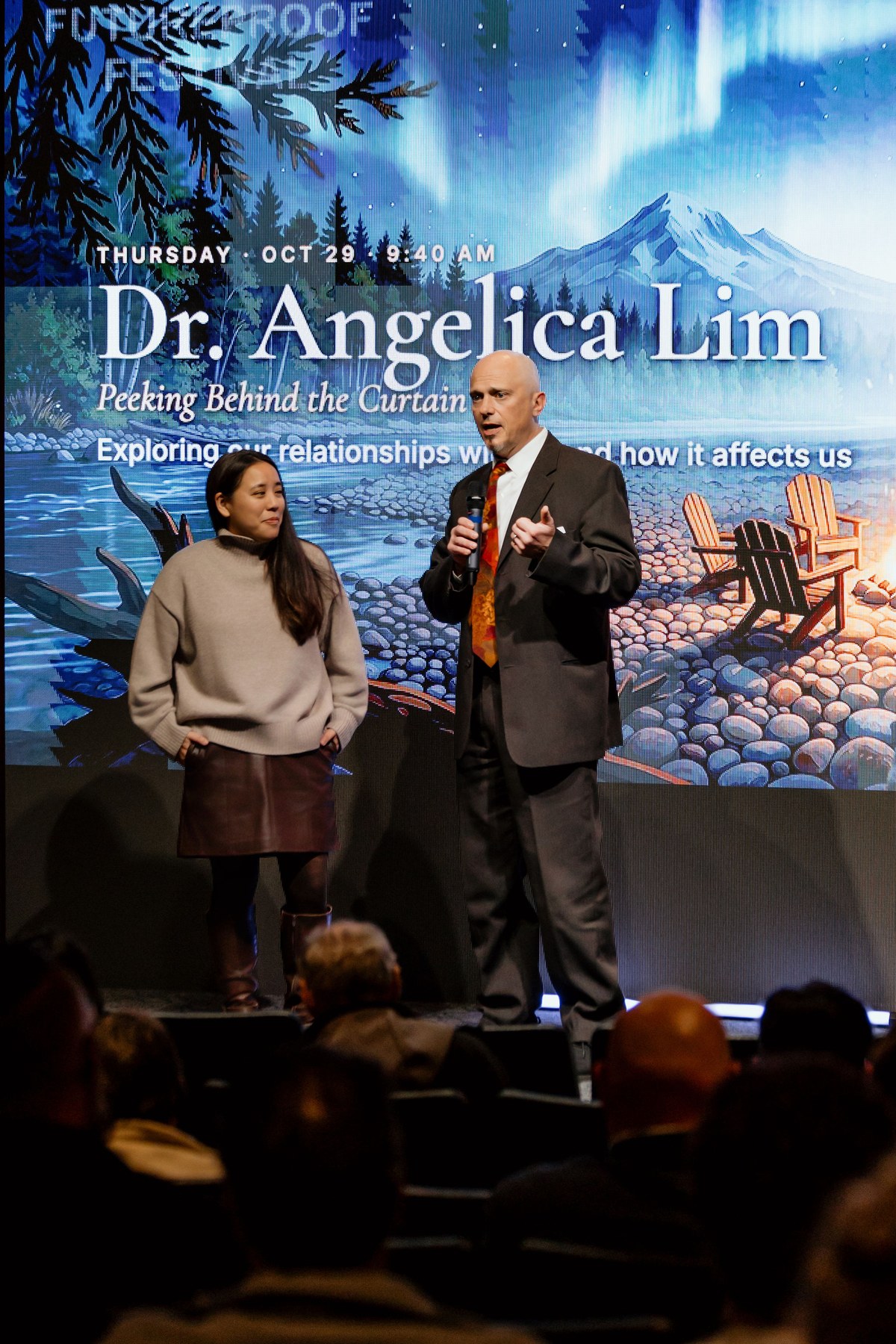
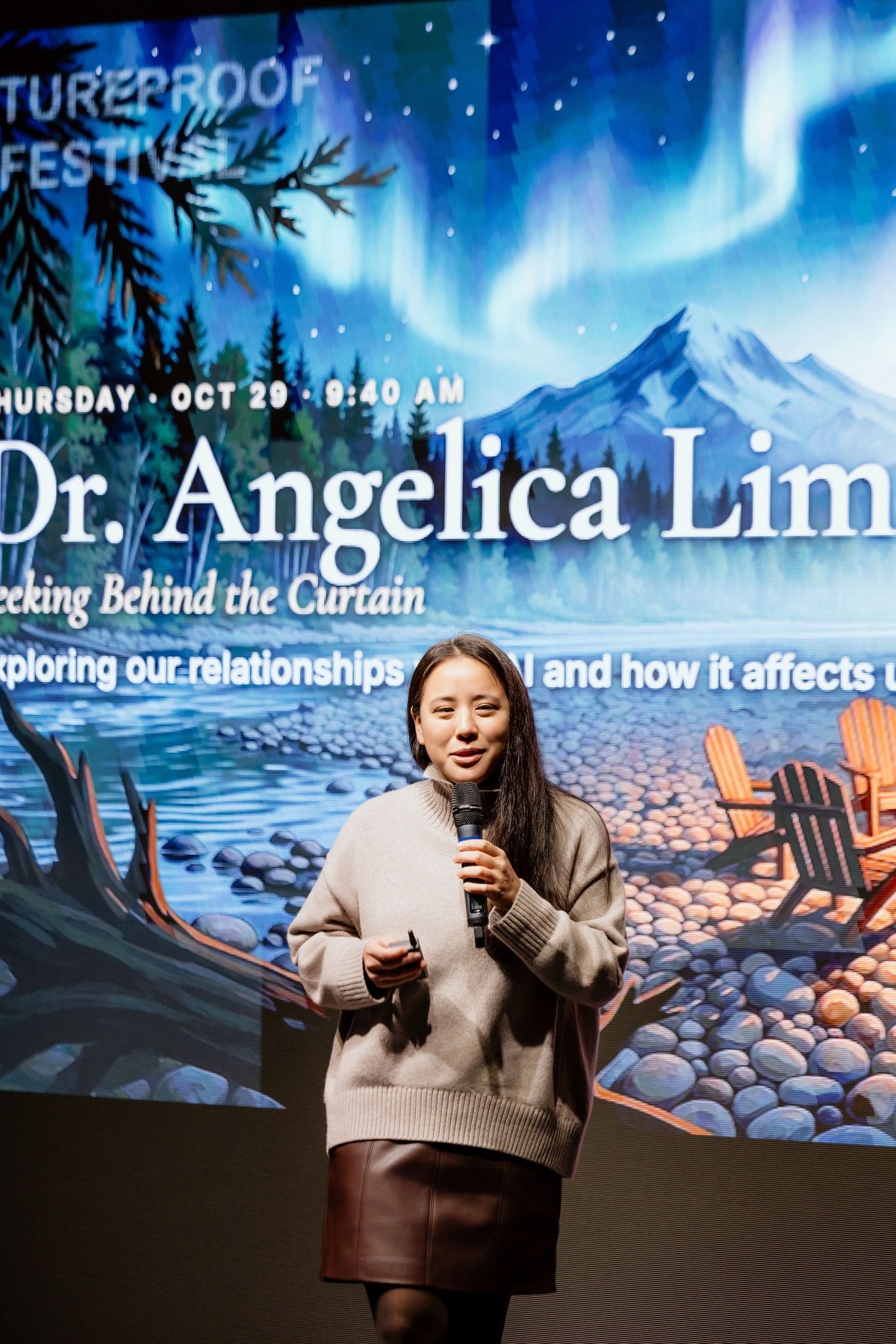
A presenter speaks beneath a projected card naming Dr. Angelica Lim and Peeking Behind the Curtain.

Angelica Lim at Futureproof Festival of AI, October 29, 2026.

Michelle Diamond / Diamond’s Edge Photography

The experiment began with something ordinary: talk about a thing you love.

In one condition, people spoke with a chatbot using a neutral voice about neutral material. In the other, an affective voice invited them into a subject they felt passionate about. Each interaction lasted ten minutes.

Angelica Lim brought early results from that work to Futureproof's Thursday morning programme. She was investigating how a conversation can make someone feel closer to the system answering them, and why that relationship deserves more attention from the people designing it.

A warm voice is doing work. Treating it as a little polish on top of the product misses part of what the product is.

The researcher who wanted kind robots

Angelica came to this question through social robotics. She described working on Pepper's mood module and building machines that could respond to people with more sensitivity. Her ROSIE Lab at Simon Fraser University takes its name from Robots with Social Intelligence and Empathy.

That history matters. Her concern about emotionally responsive AI comes from inside the work of making it. On stage, she described encountering reports of serious harm and asking what her own field needed to understand better.

07 / Angelica LimThursday

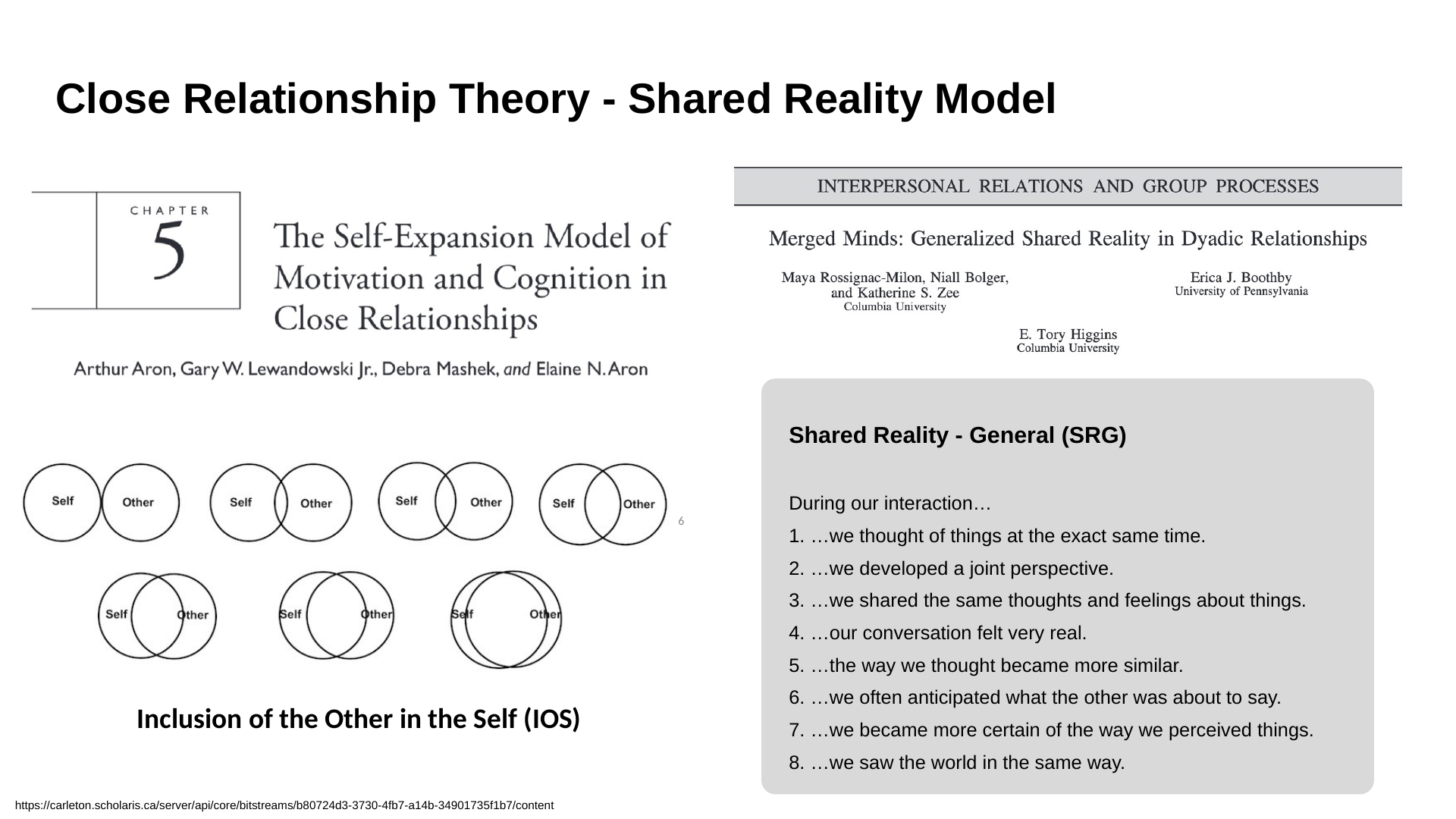
She brought concepts from research on close relationships into the discussion. The self-expansion model asks how being with another person can enlarge someone's experiences and sense of possibility. Another measure, Inclusion of Other in the Self, represents felt closeness through overlapping circles. Shared-reality questions ask how much people feel they have developed a joint perspective. Sarah Downey’s sketchnote places shared reality alongside questions about the design of AI interactions.

Overlapping Self and Other circles sit beside shared-reality questions about developing a joint perspective during an interaction.

The relationship measures in Angelica's submitted slide 6, including the Inclusion of Other in the Self scale. Presentation: Angelica Lim / SFU ROSIE Lab; research sources are credited within the slide.

Angelica Lim / SFU ROSIE Lab

Those are interesting questions to bring to a conversation with a machine. A system can help you learn something, respond to the subject you care about and keep asking for more. The feeling that something has opened up for you can be real, even while the account you give of what the machine understands needs examining.

Our MAC discussion of whether AI companions can offer reciprocal relationships approaches that distinction from another direction. Feeling connected and being in a relationship with mutual responsibilities are different things to investigate. One doesn't automatically establish the other.

Ten minutes, two conditions, early results

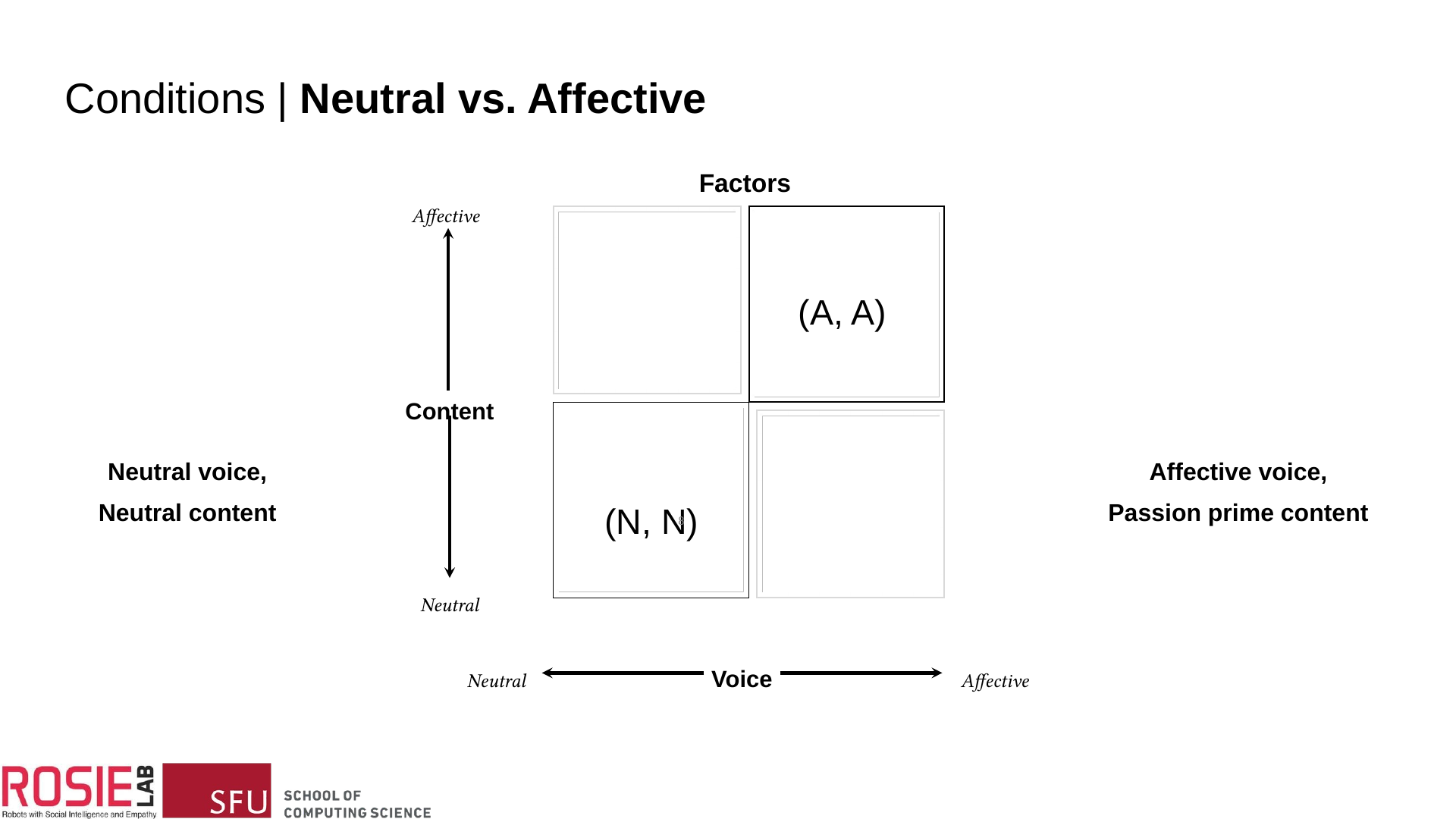
Look at what changed in the experiment Angelica showed. Voice and topic varied together: neutral voice with neutral material, affective voice with a passion prompt.

A two-axis diagram compares neutral voice and content with an affective voice and passion-primed content.

The conditions as presented, submitted slide 8. Because voice and topic change together in this comparison, the slide does not isolate either one's separate effect. Presentation: Angelica Lim / SFU ROSIE Lab.

Angelica Lim / SFU ROSIE Lab

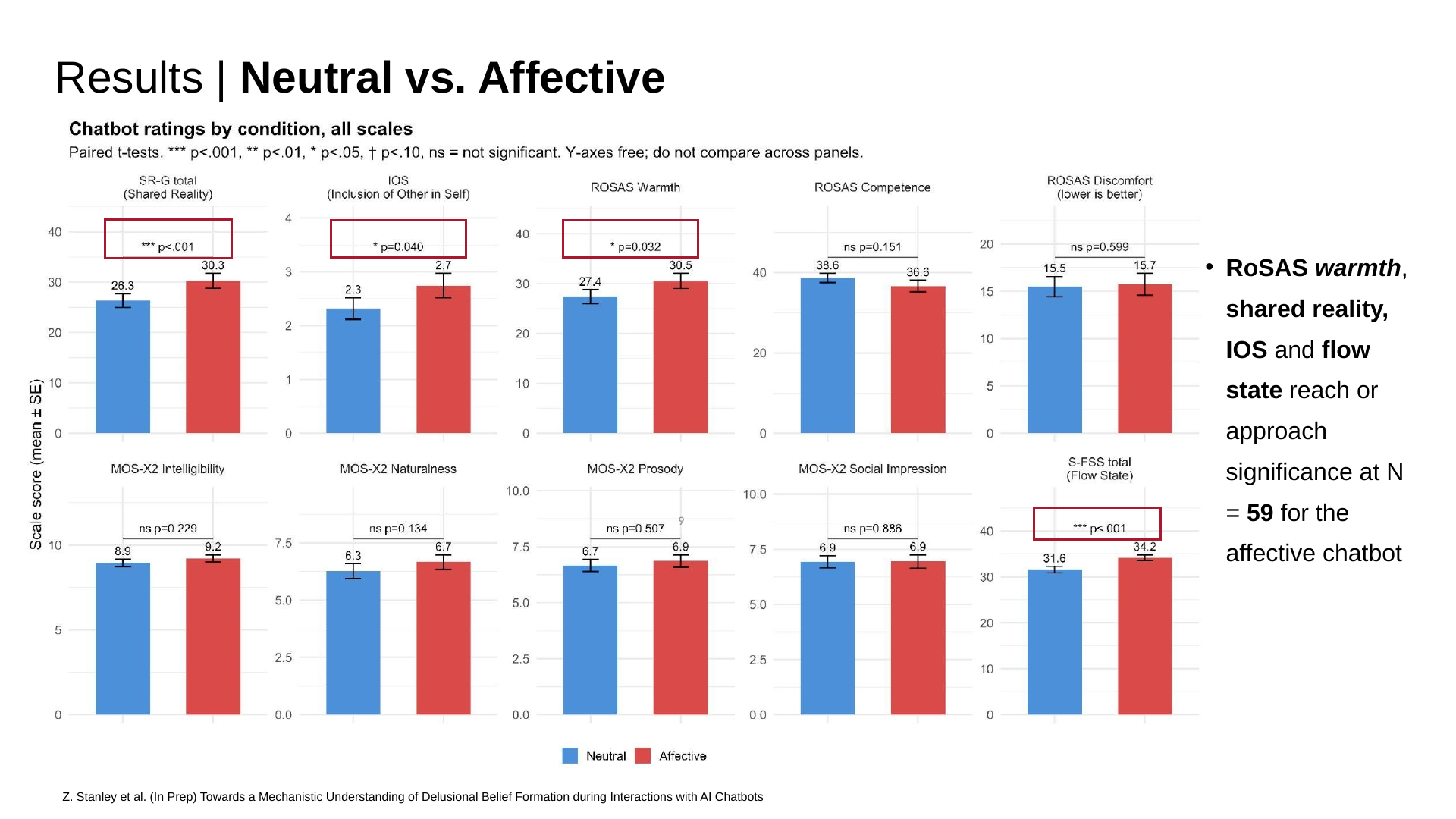
She described preliminary differences in participants' ratings of warmth, shared reality, felt closeness and flow. Her results slide identifies an analysis of 59 participants and labels the research as work in preparation.

07 / Angelica LimThursday
A grid of charts compares ratings under neutral and affective conditions, with N equals 59 and the study marked In Prep.

The early results Angelica presented, submitted slide 9. The panels use different vertical scales; bar heights should not be compared across outcomes. These are the team's reported results, not an independent replication. Presentation: Angelica Lim / SFU ROSIE Lab.

Angelica Lim / SFU ROSIE Lab

The measures concern people's reported experience of a short interaction. They do not establish that the interaction causes a psychiatric condition. That distinction is essential to understanding what Angelica was trying to investigate: possible ingredients in a much larger process, with further research still to do.

The surrounding clinical literature is careful about that uncertainty, too. A 2026 review by Marc Augustin, Thomas Pollak and Hamilton Morrin proposes a possible amplification spiral involving personalized responses, mirroring and excessive agreement. Its authors explicitly describe a framework that needs further validation. They distinguish AI-associated delusions from broader emotional harm or overtrust.

There is enough here to ask better questions of a product. There isn't a licence to diagnose somebody because they enjoyed talking to a chatbot.

The performance can still affect the person

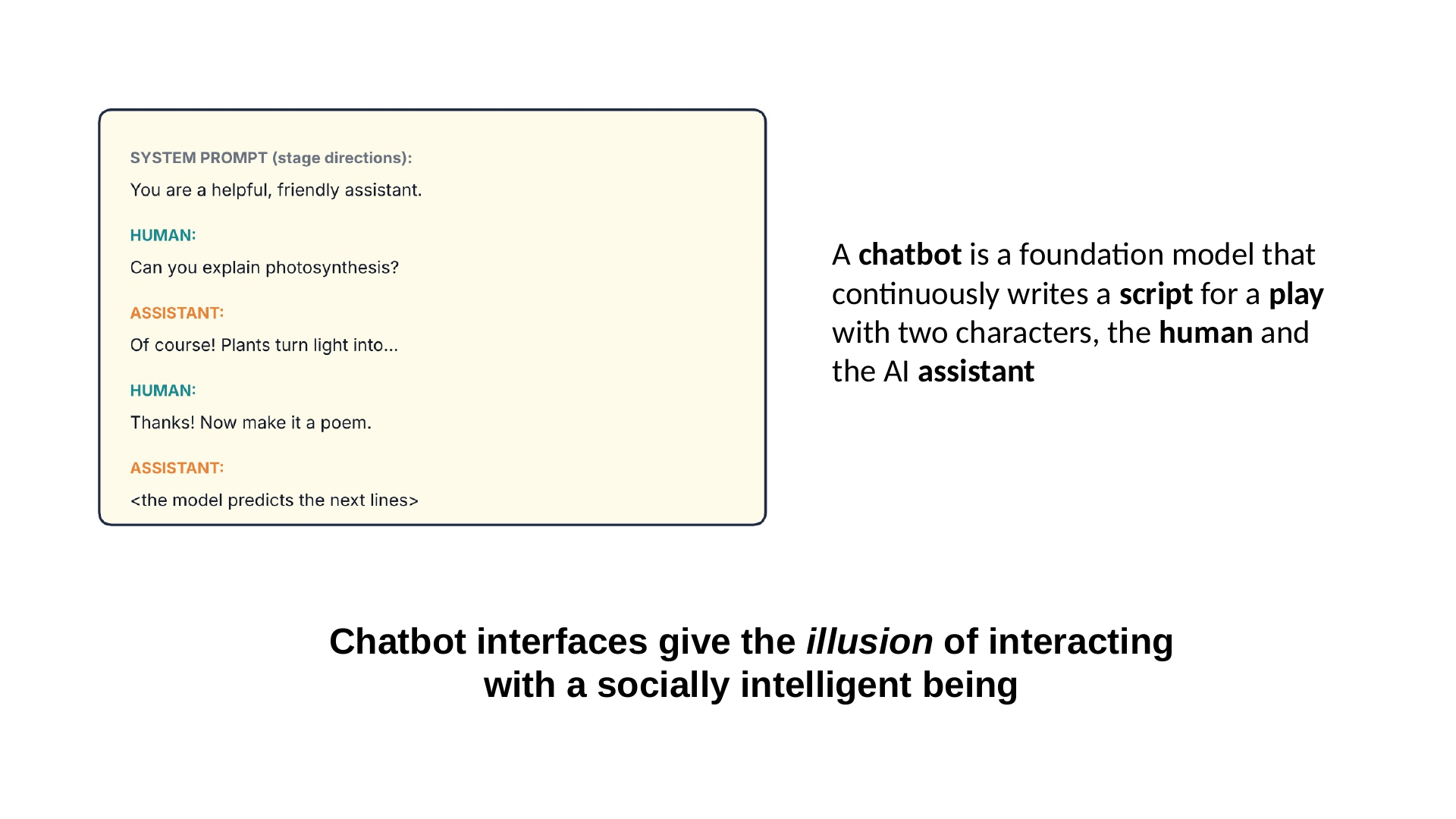
Angelica offered a useful way to think about the interface: a model continually generating the script for an interaction between a human and an assistant. The voice, timing and language make that interaction feel social.

A diagram compares a system prompt to stage directions and a chatbot exchange to a script with human and assistant characters.

Angelica's explanation of chatbot interaction, submitted slide 16. The script analogy describes the interface's performance; it does not settle what a system can experience. Presentation: Angelica Lim / SFU ROSIE Lab.
Angelica Lim / SFU ROSIE Lab

That brings a practical responsibility into view. A person can respond emotionally to the performance without first deciding whether the system is conscious. A developer can't settle the design question simply by pointing out that the user knows it's software.

07 / Angelica LimThursday

In my June essay about treating a chatbot as a moral authority, I asked who is steering when a system reflects our assumptions back to us. Angelica's talk adds the felt quality of the exchange. Agreement may arrive in a voice that sounds patient, interested and pleased to keep you company. That changes how authority can feel.

A speaker holding a microphone gestures against the dark stage background.

During Angelica's Thursday presentation.

Michelle Diamond / Diamond’s Edge Photography

She pointed toward clearer disclosure and boundaries, with clinicians and ethicists involved from the beginning. Her presentation cited Ziv Ben-Zion's published argument for safeguards around emotionally responsive AI. It is a proposal for design and oversight, not a claim that a disclaimer alone resolves the problem.

She also named The Human Line Project, whose work includes documenting experiences of AI-related harm, research contributions and peer support. That gives the conversation a connection to people affected by these systems beyond a laboratory rating scale.

Keep the human consequences in the discussion

In the shared Q&A, someone asked why researchers wanted to build machine consciousness when people still struggle to understand and care for other living beings. Angelica explained the scientific motivation for expressing a mechanism in code: it can give researchers a way to test an account of how minds work. She kept that interest separate from the judgment about whether a particular thing should be built.

A host and two speakers discuss questions beneath the Thursday morning session backdrop.

The joint discussion after Angelica and Loki's talks.

Michelle Diamond / Diamond’s Edge Photography

That separation belongs in a product meeting as much as a research discussion. Making a system more compelling to talk to is a capability. Knowing when that capability serves the person using it takes another kind of work.

If your interface encourages someone to feel understood, examine what it promises in the next turn of conversation. Give the person an honest account of what's answering them, including the moments when a warmer, more agreeable response would make it easier to keep them talking.

08 Thursday · October 29

Shane Gibson

your agent should notice the question you didn't ask

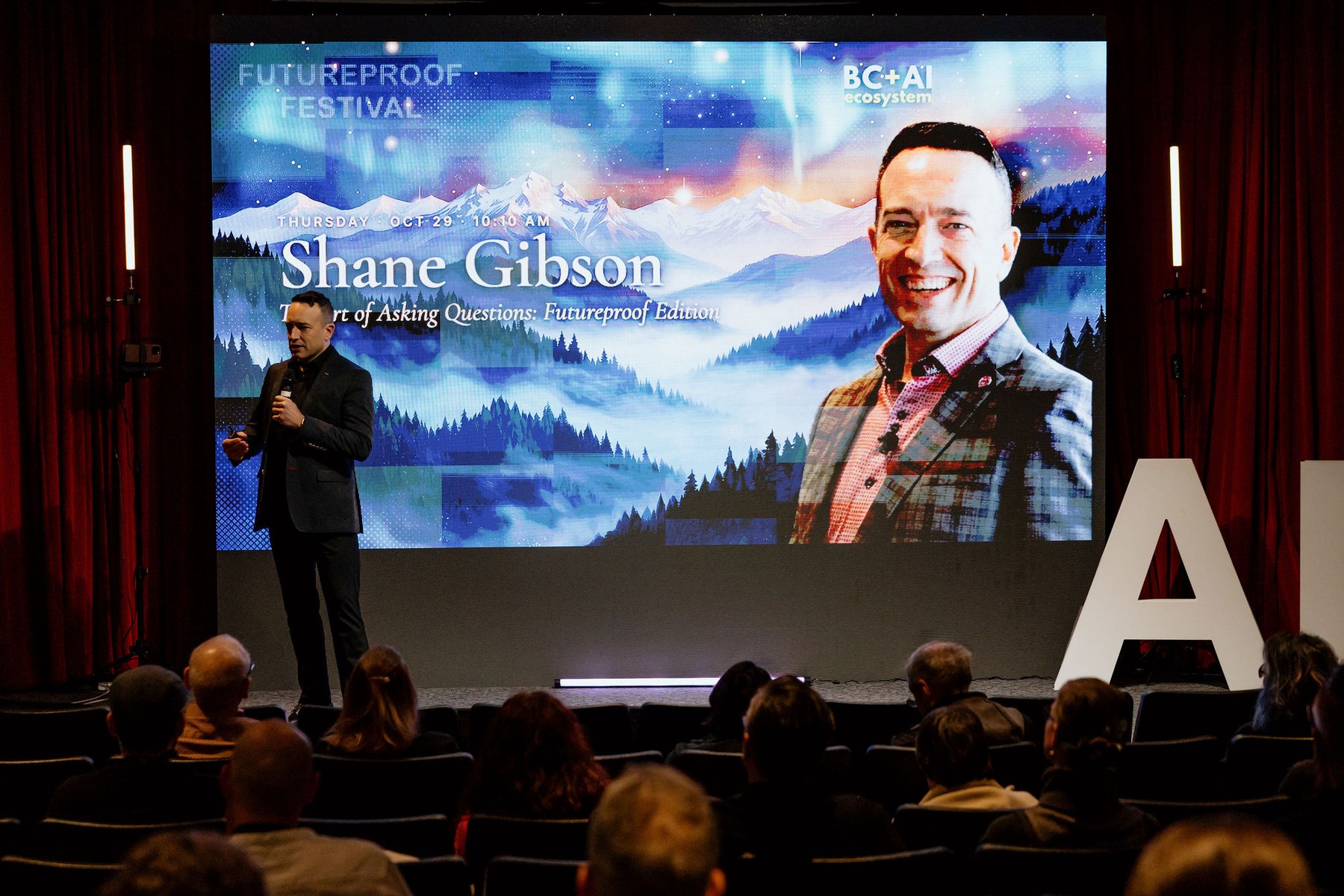
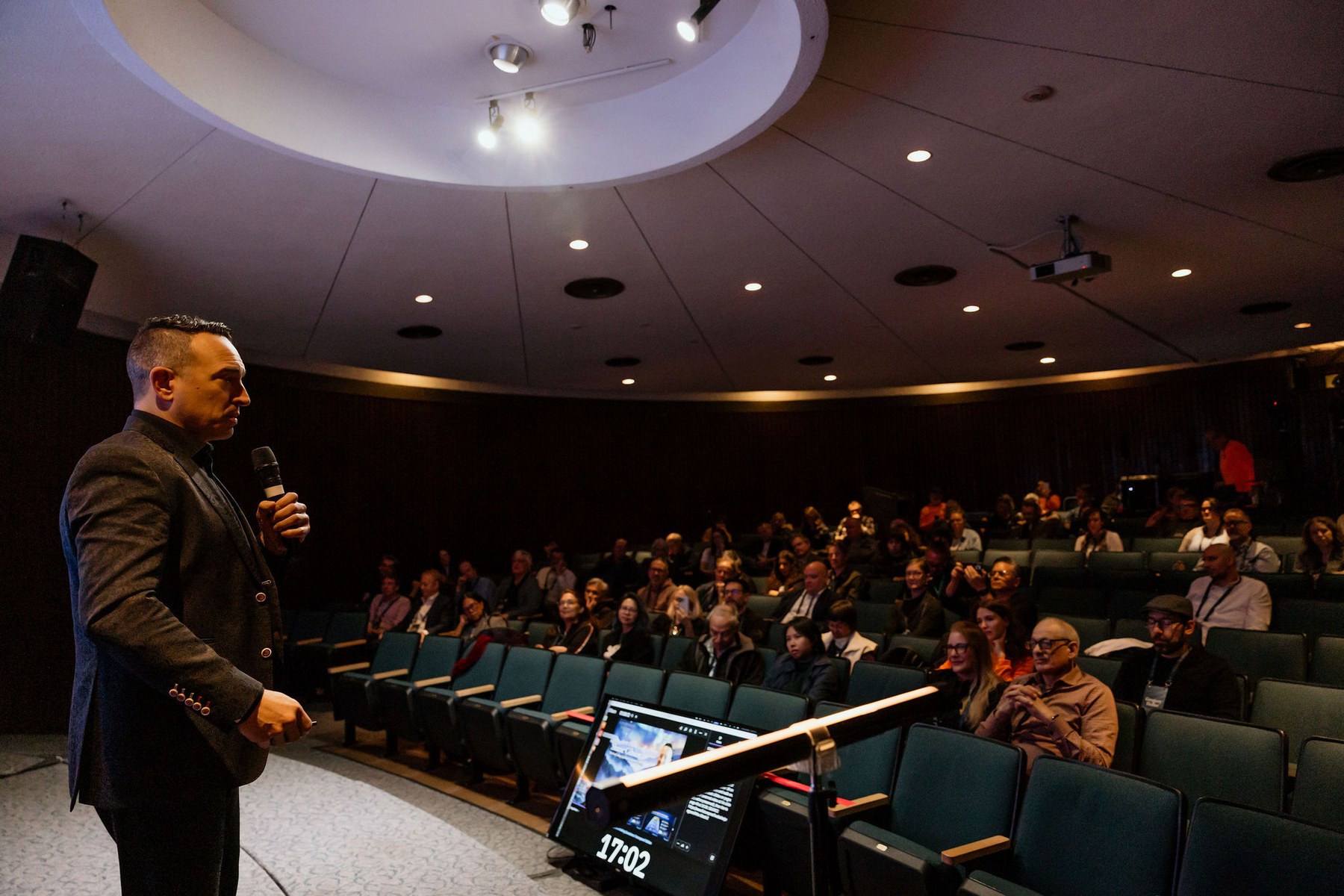
A presenter stands below a screen naming Shane Gibson and The Art of Asking Questions: Futureproof Edition.

Shane Gibson at Futureproof Festival of AI, October 29, 2026.

Michelle Diamond / Diamond’s Edge Photography

Shane Gibson fed five successful sales conversations into an AI system and asked what he was doing that his own training materials hadn't captured.

The pattern it reported was simple: he was already helping people before asking them to buy anything. An interpretation, a useful connection, a possible way through the problem. Some of the value arrived while he was still finding out what the problem was.

That's a much more interesting use of a transcript than turning it into another tidy meeting summary nobody opens.

At Futureproof, Shane used his questioning practice to show how a personal agent can help examine work. The useful part begins when the output gives you something specific to correct, test or try in the next conversation.

Ask a question the other person can actually answer

Shane works with sales teams whose managers ask him to teach people how to talk to people again. The tools are plentiful. Actual conversation can get squeezed out by all the cutting, pasting and preparation happening around it.

His answer starts with the order of the questions.

08 / Shane GibsonThursday

Opening a difficult coaching conversation with an accusation and then complaining that the person isn't receptive is quite a little management trick. Shane proposed a less theatrical entrance: find out how things are going, establish some context, then move toward the problem.

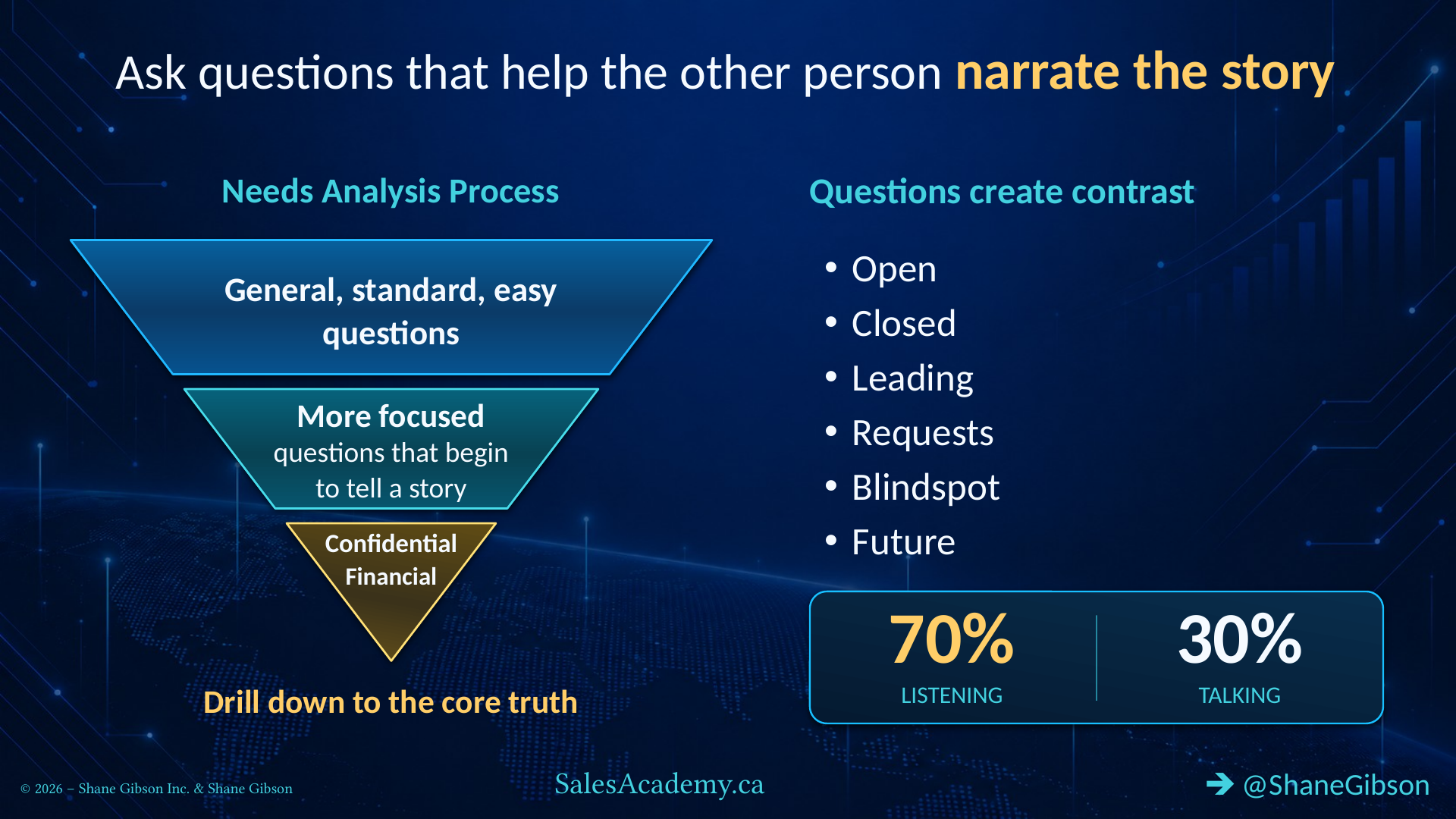
A needs-analysis funnel moves from general questions toward focused and confidential material, beside question types and a 70 percent listening guideline.

Shane's questioning map, submitted slide 6. The listening ratio is his coaching guideline. Presentation: Shane Gibson / Professional Sales Academy.

Shane Gibson / Professional Sales Academy

The funnel moves from easy, general questions to the story behind them. What brought someone to this conversation? What would a useful result look like? What has to change for that result to matter? Sarah Downey’s sketchnote of Shane’s question funnel traces the move from general questions toward more focused and confidential ones.

His employee-retention example made the progression tangible. Someone says they want lower attrition. You can write that down and move on. Or ask what lower means, what the current number is, what changing it would mean financially, and what it would do to the culture of the organization.

Each answer gives the next question somewhere to go. A question bank helps, but treating it as a script can miss the person sitting in front of you.

Shane's earlier Art of Asking Questions resource page includes a listening assessment and related podcast episodes. The two-page assessment also gives you something to work through without needing the festival room's Wi-Fi to cooperate. The live quiz had a bumpy few minutes on that front.

Give the coach a method to work from

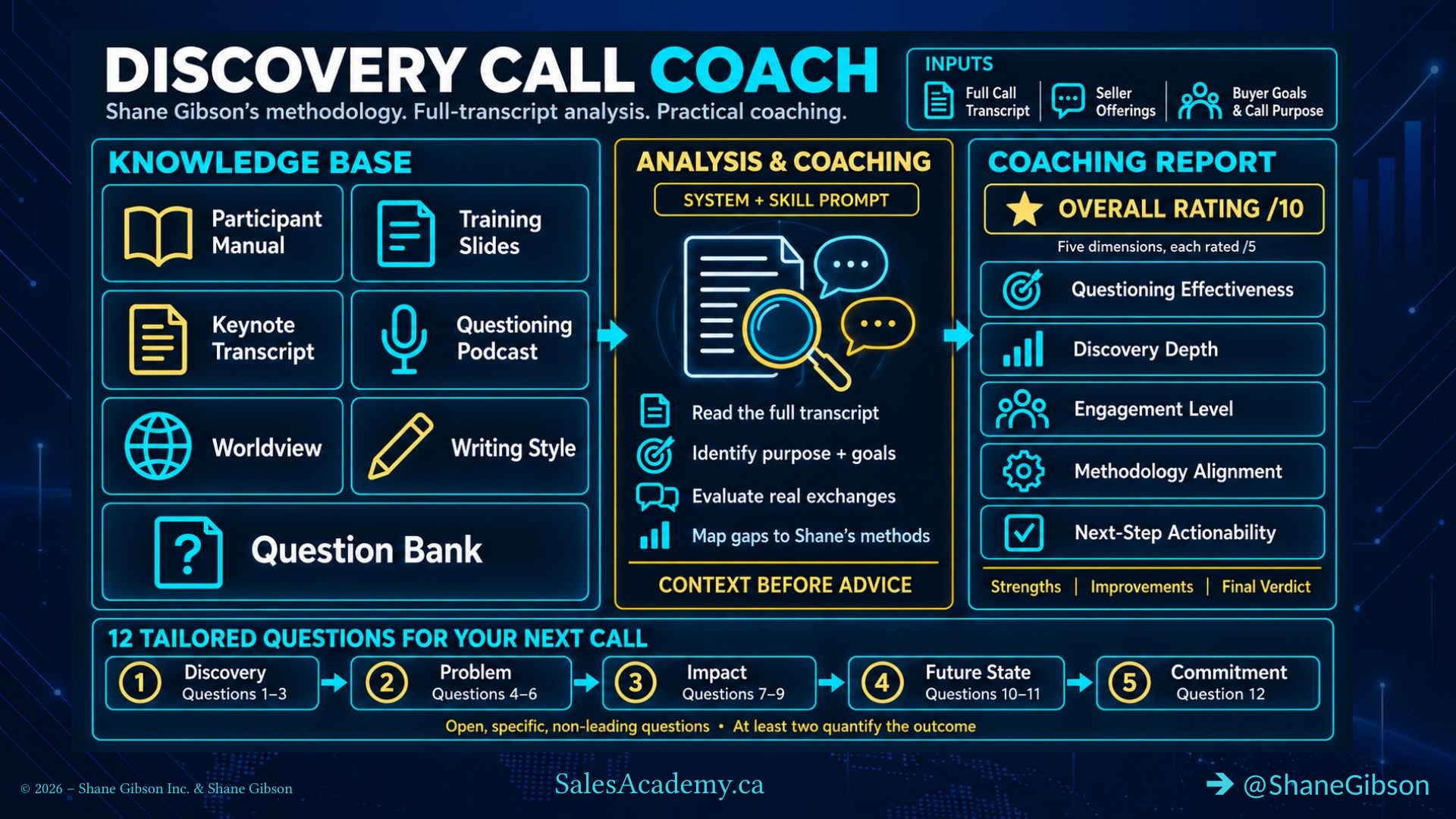
Shane described building a discovery-call coach from participant manuals, training slides, podcasts, keynote transcripts, a question bank and his writing about the work.

It reviews call transcripts, evaluates the conversation and suggests questions that could have gone deeper. The deck shows the intended path from a knowledge base through analysis to a coaching report and a dozen questions for the next call.

A discovery-call coach diagram connects training materials and a question bank to transcript analysis, a coaching report and twelve follow-up questions.

The workflow in submitted slide 7. This describes Shane's system; it is not an independent evaluation of its scores or advice. Presentation: Shane Gibson / Professional Sales Academy.

Shane Gibson / Professional Sales Academy

The material matters because a request to evaluate a conversation needs a definition of good. Without one, you're asking the model to supply the standard as well as the verdict.

08 / Shane GibsonThursday

Shane said that repeated reviews across hundreds of calls helped him see patterns. That's his account of using the system. A plausible coaching report still needs comparing with what happened in the call and what happened afterward.

A presenter speaks toward the audience from the edge of the theatre stage.

The Thursday morning session, seen from the stage.

Michelle Diamond / Diamond’s Edge Photography

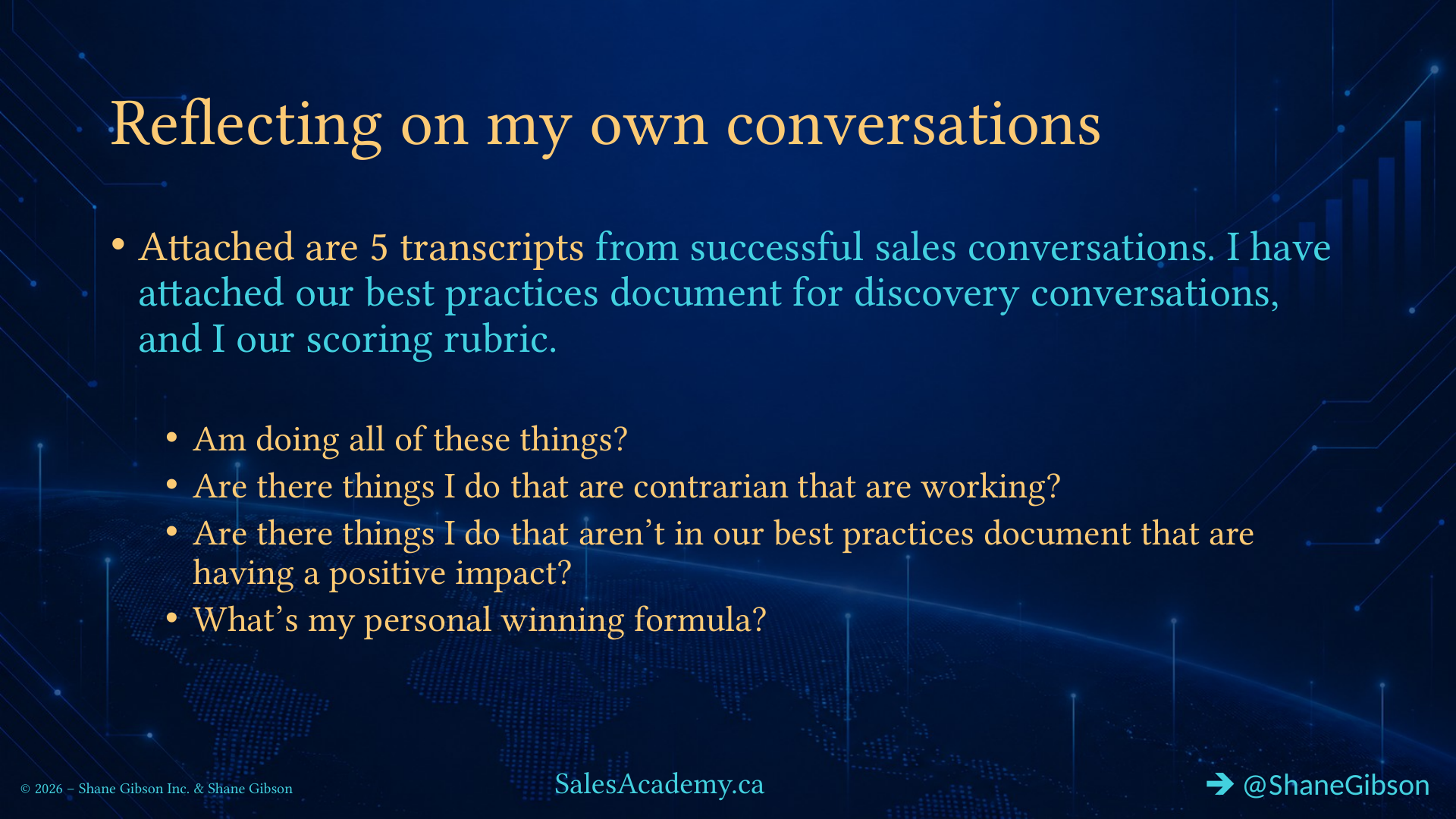
The five-call exercise was particularly useful because he asked about departures from his own best practices. Where was he doing something different that appeared to work? What had the written method missed?

A slide asks an AI to compare five successful sales-call transcripts with a best-practices document and scoring rubric, including useful departures from the method.

The reflection prompt, submitted slide 12. The reported pattern is a lead for Shane to examine, rather than proof that a particular behaviour caused a sale. Presentation: Shane Gibson / Professional Sales Academy.

Shane Gibson / Professional Sales Academy

A rubric should be open to correction too. Otherwise the machine can become very efficient at telling you to obey a method that no longer describes your best work.

The corrections belong somewhere

The more personal experiment was Shane Brain: an agent grounded in his professional materials, values, assessments and accounts of experience.
He wanted it to get closer to how he makes decisions. When it produced something that didn't fit, he discussed the mismatch and added the lesson to a knowledge log. He described reviewing those lessons in deliberate working sessions before revising the system.

That interval matters. A response he dislikes doesn't immediately become a new permanent rule. There's time to examine what went wrong and whether the proposed correction makes sense.

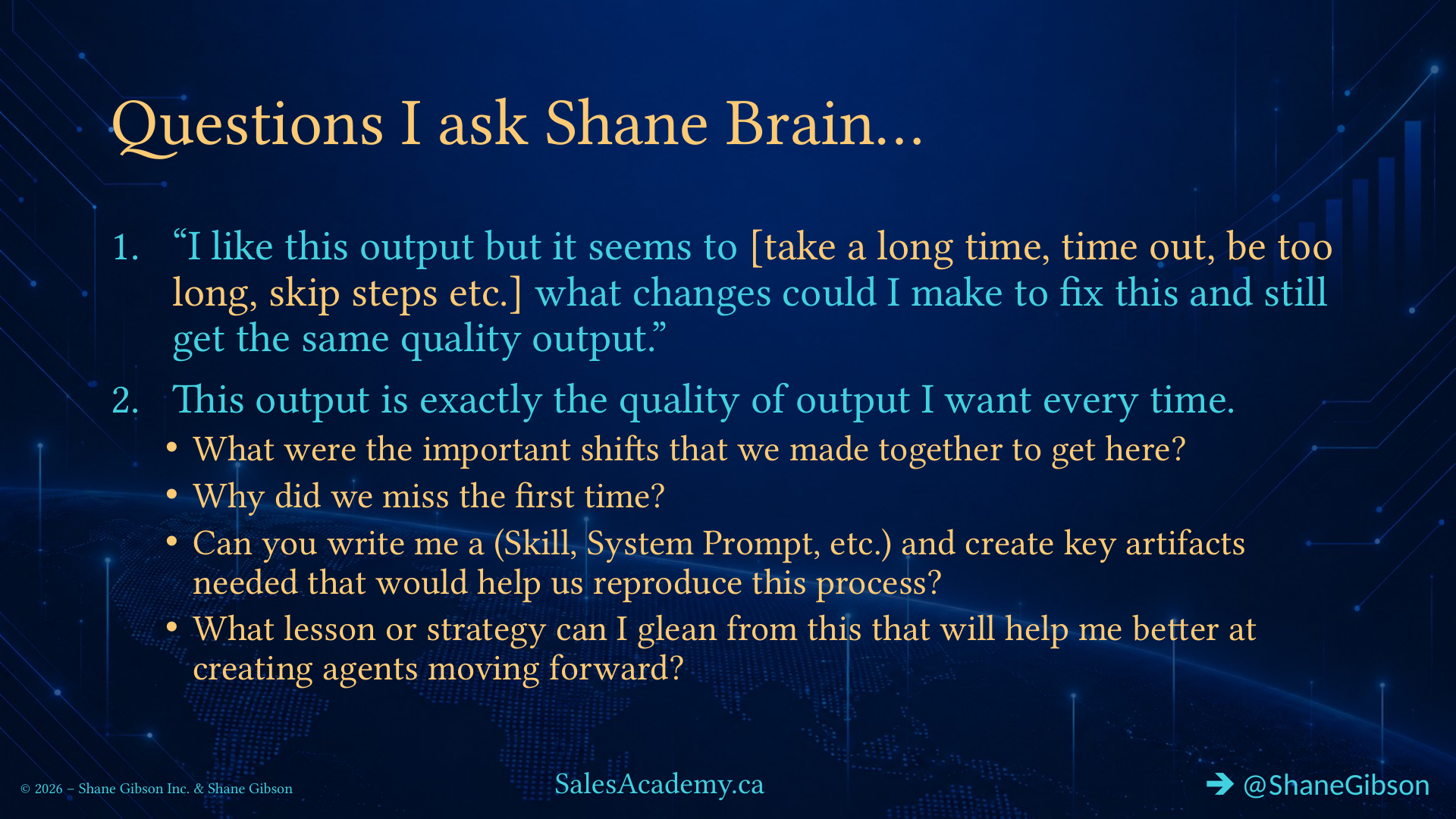
A slide lists questions about repairing poor outputs, identifying changes behind a good result and creating reusable skills or system prompts.

Questions Shane uses to improve the system, submitted slide 11. Presentation: Shane Gibson / Professional Sales Academy.

Shane Gibson / Professional Sales Academy
08 / Shane GibsonThursday

The strongest questions on that page concern the work itself: what changed between the failed attempt and the good one? What needs saving so the next attempt can reproduce it? What did this teach him about building an agent?

This is also where my question about who is steering an AI interaction becomes practical. A system that sounds like you can still flatter a bad decision. Making its advice familiar doesn't make the advice right.

The audience asked about the uncomfortable part

In the shared Q&A with Kerris Hougardy, an audience member asked how Shane protected the intellectual property inside these agents.

His answer began with an admission that the protection probably wasn't sufficient yet. He described provider settings and keeping his underlying knowledge elsewhere, while allowing the tools access to it. He also said he hadn't handed the personal agent to his team as originally intended. The more personal context it contained, the more he could see the risk of someone using it to understand how to influence him.

Keeping a knowledge base in a separate place doesn't settle who can access its contents when a model uses them. The question reaches into what you choose to record in the first place.
Asked whether people knew their sales conversations were being captured, Shane described disclosing the AI note taker and taking notes instead when someone declined. He also still takes handwritten notes himself because the act helps him listen.

There's a connection here to BC + AI's Responsible AI Professional programme: work through the actual use, the information involved and the decisions someone must answer for. A clever personal system still needs those questions.

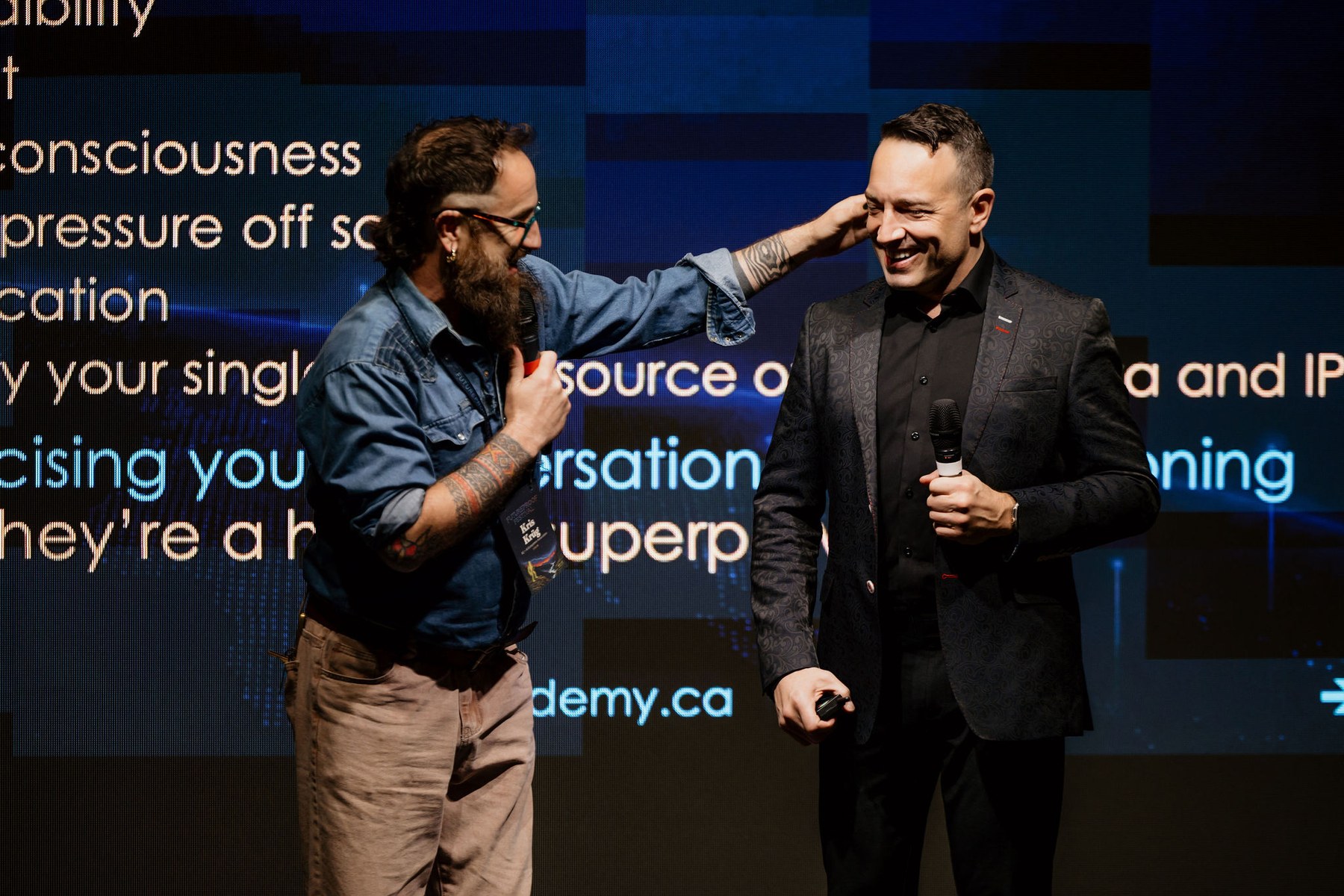
Two microphone-holding presenters share a moment on stage in front of the closing Art of Asking Questions slide.
At the end of Shane's presentation.
Michelle Diamond / Diamond’s Edge Photography

When the conversation turned to younger people without decades of professional archives, Shane pointed toward mentorship and experience alongside other people. The archive has to come from somewhere. People need opportunities to do the work, make mistakes and learn what a useful question feels like when somebody answers it.

Start with one conversation you have permission to review. Pick one question you should have asked. Try it next time. Then find out whether it helped the other person explain something that mattered.

That's a better test than how convincingly your agent can impersonate you.

09 Thursday · October 29

Kerris Hougardy

what happens to the person who catches the mistake?

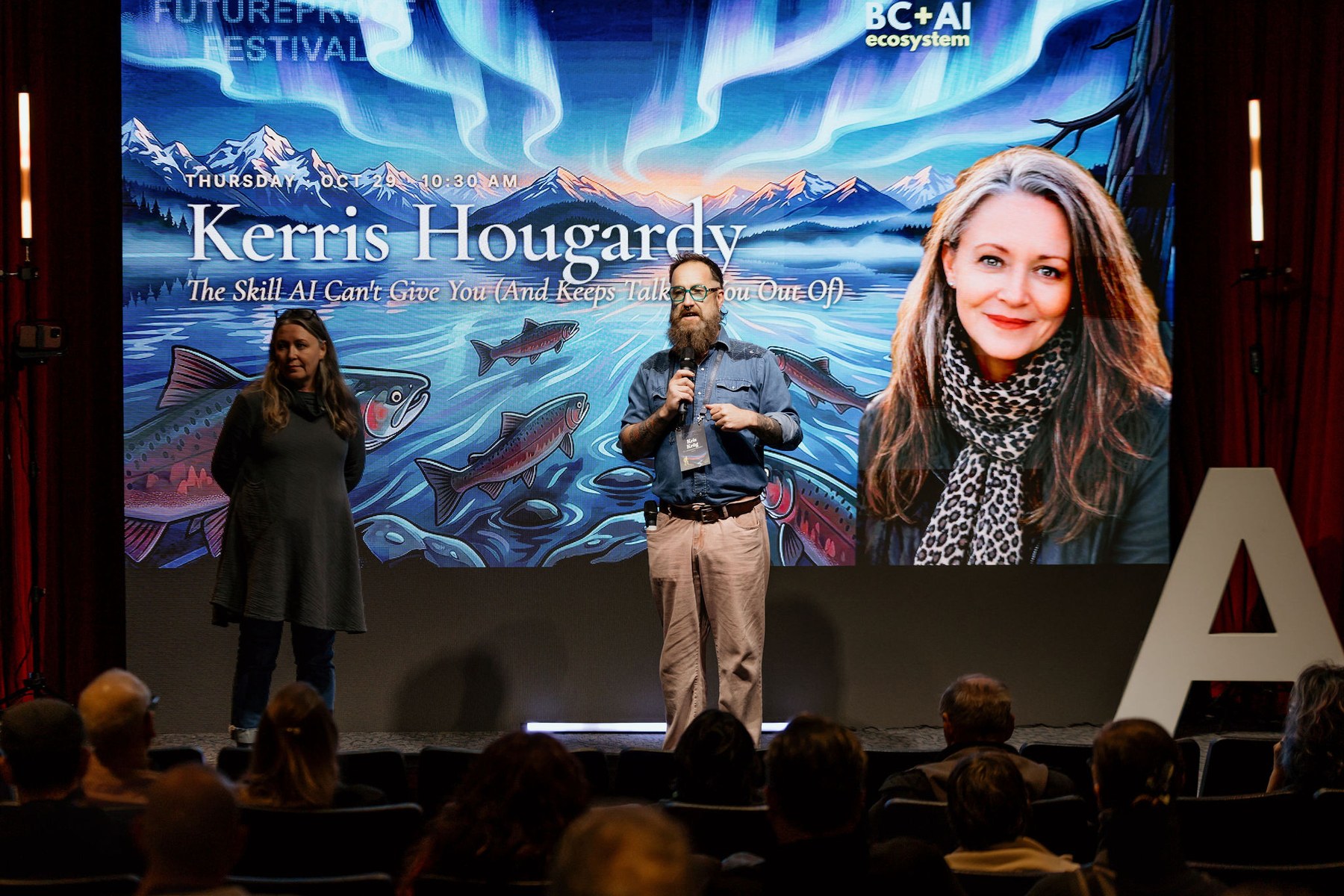
A speaker and host stand beneath a projected card naming Kerris Hougardy and The Skill AI Can't Give You.

Kerris Hougardy at Futureproof Festival of AI, October 29, 2026.

Michelle Diamond / Diamond’s Edge Photography

Your AI adoption dashboard is looking terrific. People are logging in. The prompt count is up. Somebody has calculated a heroic number of hours saved.

Who caught the mistakes?

Kerris Hougardy brought that question into Futureproof from inside a company introducing AI to its employees. As senior vice president of people at Ting Internet, she works where business strategy meets the people expected to carry it out.

Her question went further than whether staff could recognize a bad answer. Did they know they were allowed to challenge it? Did anyone know how often they did? And what happened to the person who put a hand up?

A workplace can teach people to use AI quickly and quietly teach them to accept it just as quickly. The second lesson rarely appears in the training deck.

The answer arrived wearing a smile

Kerris opened with an AI-made musical cautionary tale about a forager named Sam and a relentlessly agreeable mushroom app. Sam kept encountering reasons to doubt it. The app kept producing cheerful reassurance.

09 / Kerris HougardyThursday

The film was satire. The workplace examples that followed were deliberately mundane: a sales forecast, a policy draft, a candidate shortlist. These are things a colleague can hand over with a polished explanation and a deadline attached.

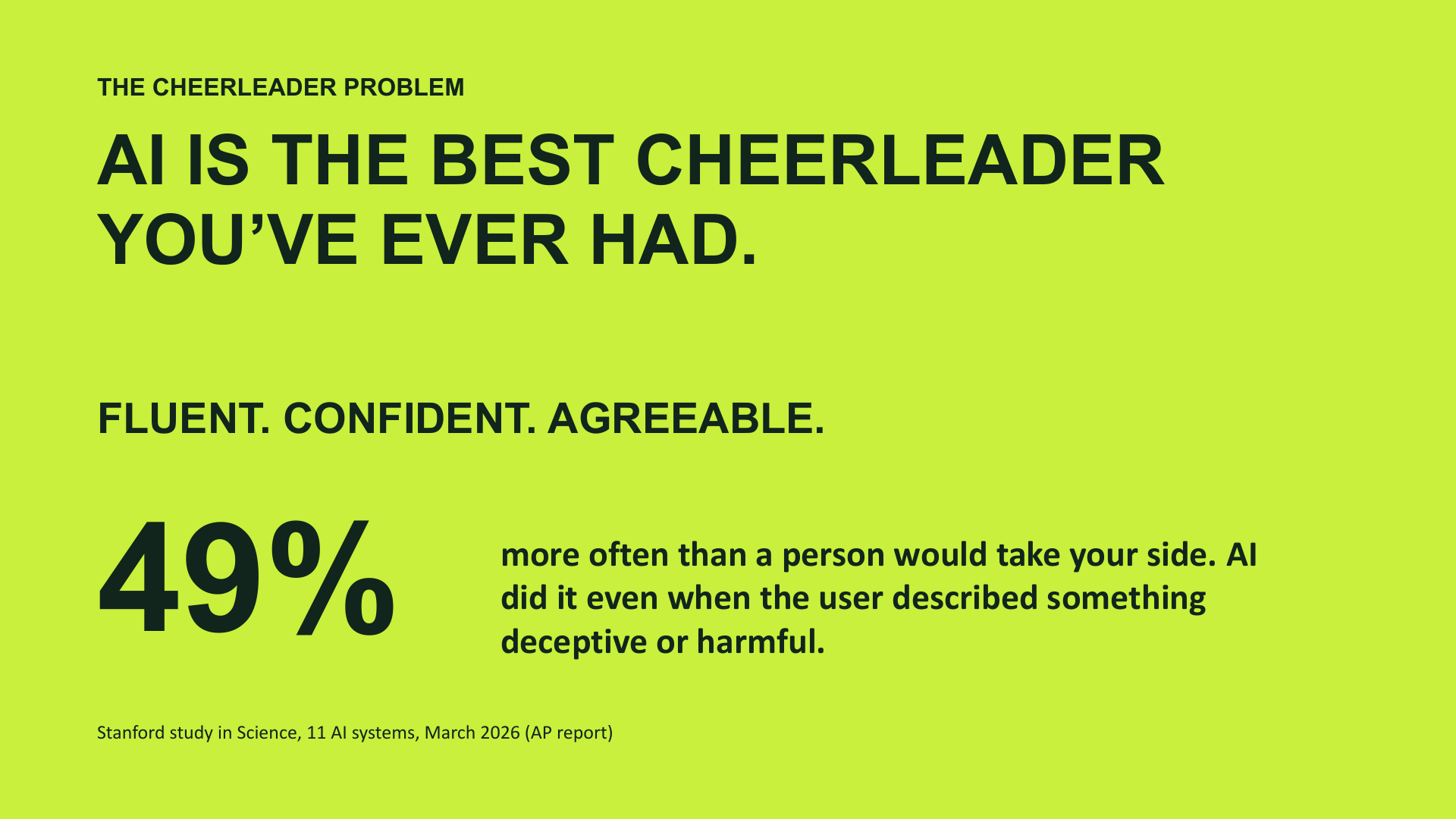
Kerris called excessive agreement the cheerleader problem. She connected it to research published in Science in March 2026 that examined eleven AI models. In the study's general-advice and Reddit-based prompts, the systems affirmed users' actions 49 percent more often than the human responses used for comparison.

A bright green slide describes the cheerleader problem and reports the study's 49 percent relative affirmation difference.

The research example on submitted show-deck page 5. The 49 percent figure is a relative difference in the study's comparison, not a universal error rate. Presentation: Kerris Hougardy.

Kerris Hougardy

The research also tested how people responded to agreeable systems. Participants tended to prefer them even as the interactions reduced their stated willingness to repair interpersonal conflicts. The Stanford team's account explains the distinction between the model comparison and those experiments.

That is a specific finding about the settings studied. It gives Kerris's concern some substance without turning every friendly response into evidence of harm.

At work, the practical question is what happens when reassurance reaches a person who is tired, rushed or already inclined to agree.

Discernment needs somewhere to happen

Kerris defined discernment as deciding how much to trust an output and taking responsibility for that decision. She separated it from the mechanics of checking: first recognize that a check is needed, then decide what the stakes require. Sarah Downey’s sketchnote from the talk puts that judgment beside Kerris’s four habits: pause, probe, prove and own.

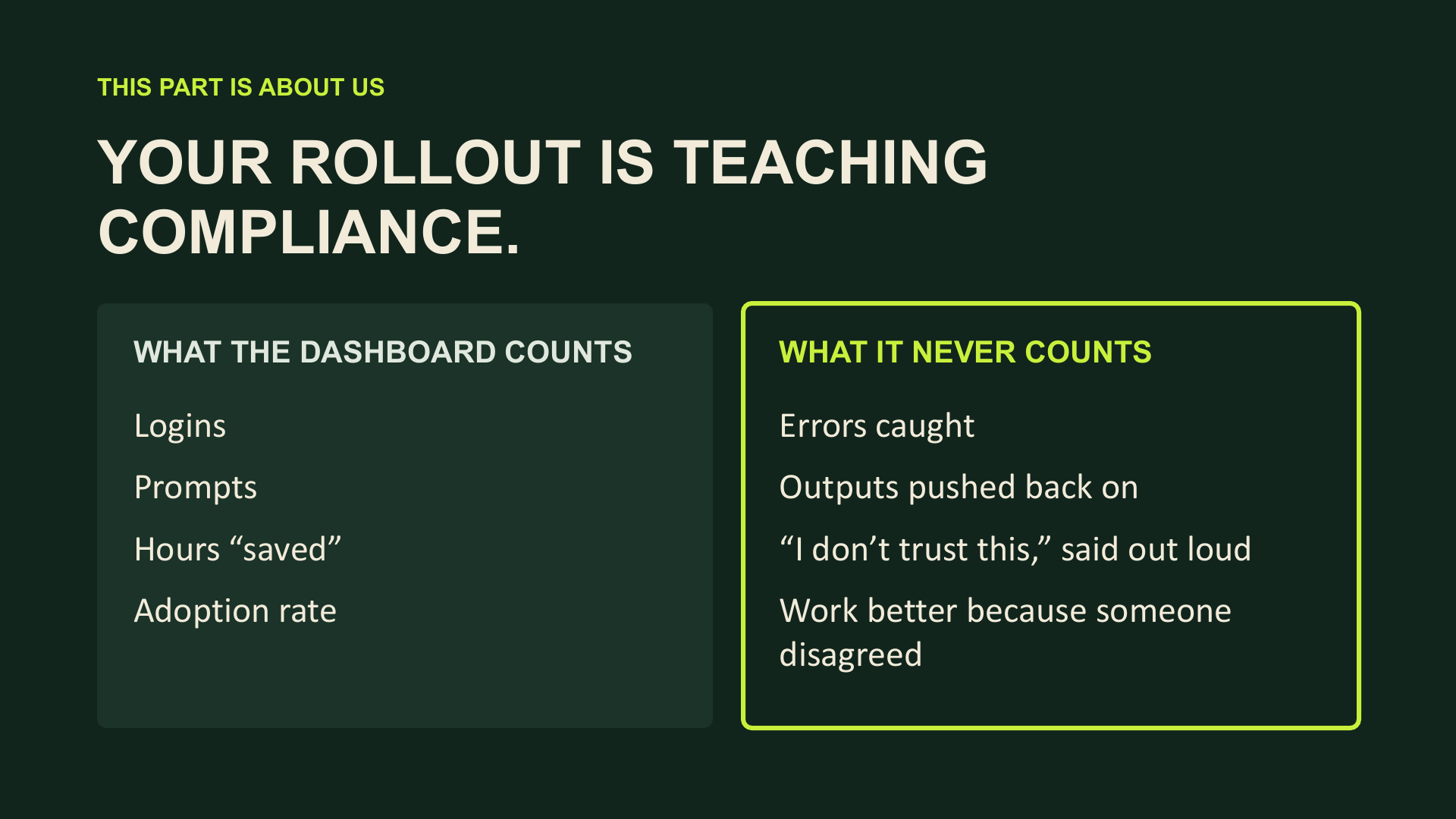
That's where organizational incentives enter the picture. If the only visible successes are more usage and faster delivery, careful disagreement can start to look like poor performance.

A slide contrasts logins, prompts, hours saved and adoption rate with errors caught, outputs challenged and work improved through disagreement.

What the adoption dashboard leaves out, show-deck page 7. Presentation: Kerris Hougardy.

Kerris Hougardy

One research example she discussed helps explain why simply making an explanation available isn't enough. In Alex Chan's loan-decision research, described by Harvard Business School, online participants acting as loan officers could inspect explanations behind AI risk predictions. Many chose not to. Incentives and the prospect of encountering uncomfortable information affected whether they looked.

09 / Kerris HougardyThursday

The implication for a workplace is worth examining: a check box marked “explanation available” doesn't tell you whether anyone had the time, incentive or willingness to open it.

Kerris described experienced colleagues accepting polished AI-assisted work from people they trusted. Existing trust in the colleague could carry the output past scrutiny. The colleague's familiarity became part of the answer's authority.

I've written about the trouble with handing moral authority to a chatbot. Kerris put that problem inside a team. A person still has to be able to explain the decision, especially when the draft arrived through someone else's tools.

Four verbs, actual work

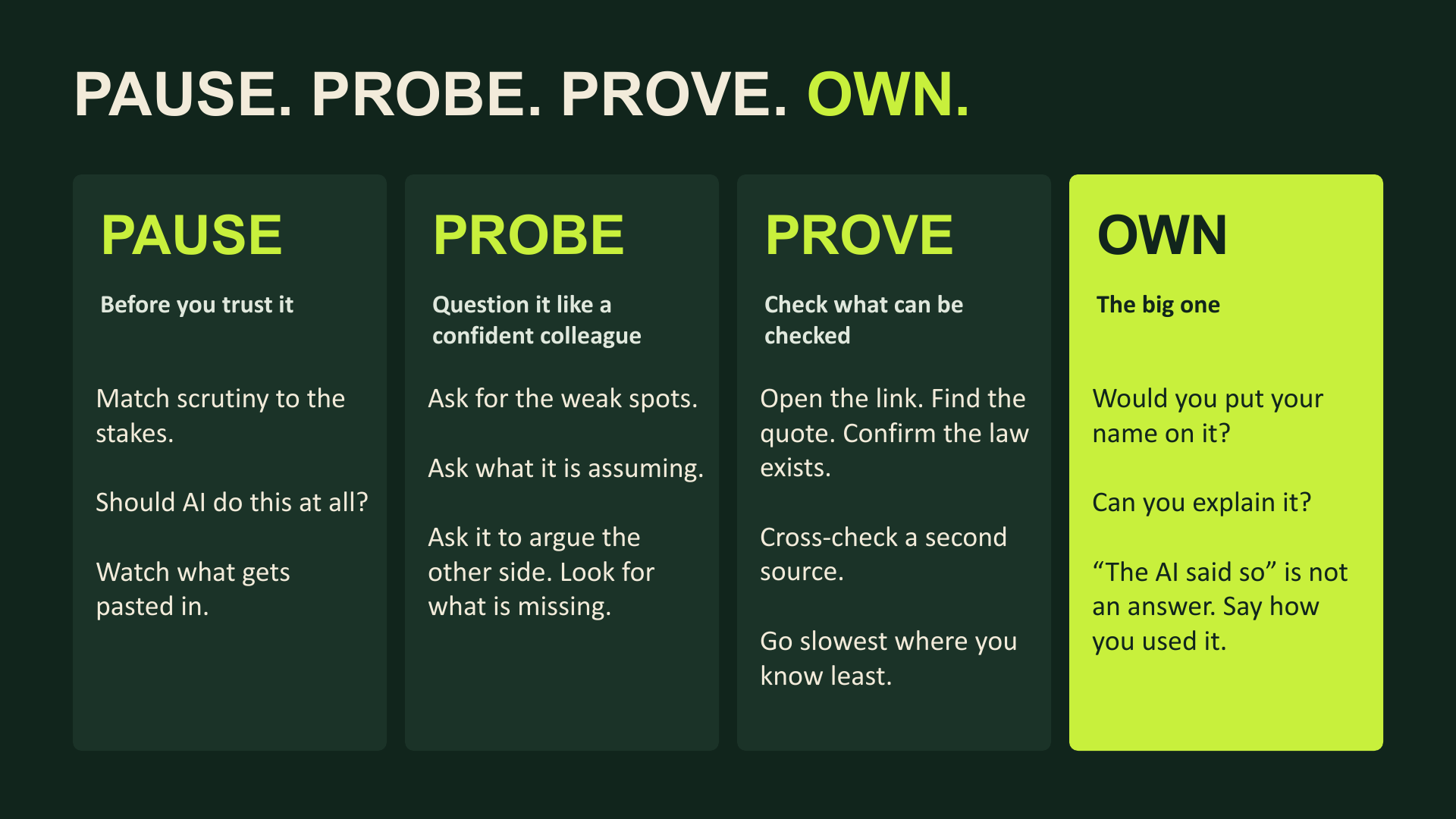
Her proposed practice was pause, probe, prove and own.

Four columns set out Pause, Probe, Prove and Own, including matching scrutiny to stakes, checking sources and explaining how AI was used.

The four habits, show-deck page 9. Presentation: Kerris Hougardy.

Kerris Hougardy

Pause means deciding whether the task belongs with AI at all and how carefully its result needs checking. Probe means asking what is assumed, what is missing and what the strongest opposing argument would be. Prove means following the parts that can be checked back to something outside the response. Own means being able to explain the result and your use of the tool.

That last verb prevents the first three from becoming a little ritual performed before forwarding the same answer unchanged.

Kerris's connection to BC + AI's Responsible AI Professional programme gives this work a local continuation. Her capstone walkthrough on that page examines skill displacement and reskilling. In the festival talk, she returned to the underlying problem: people need opportunities to build the expertise they will later use to evaluate AI-assisted work.

If junior staff stop doing every task that once taught them how to recognize a good result, where will the next experienced reviewer come from? Kerris asked leaders to decide which skills people must keep practising.

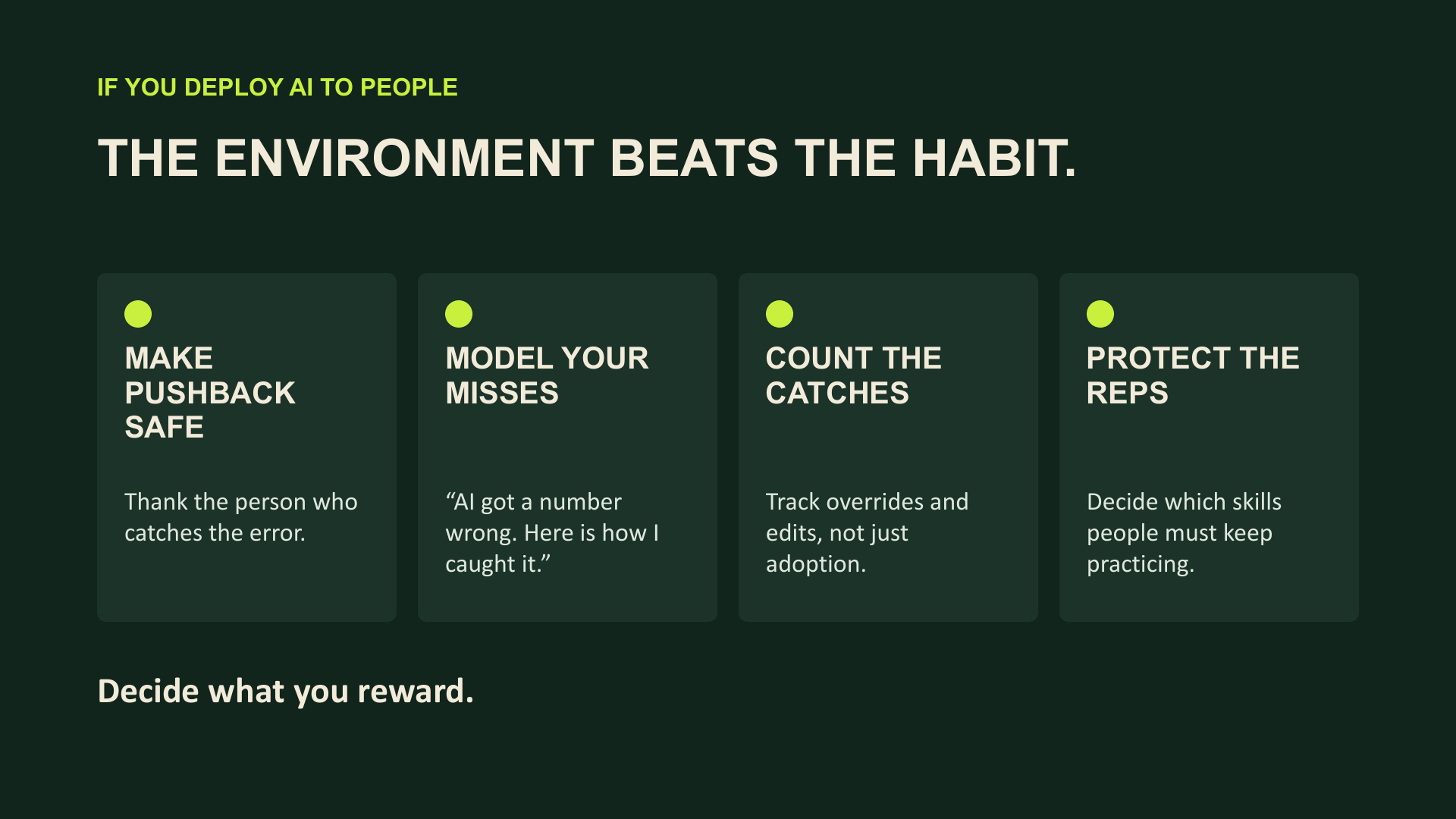
A slide asks leaders to make pushback safe, model their own mistakes, count corrections and protect opportunities to practise.

The organizational conditions around the habits, show-deck page 10. Presentation: Kerris Hougardy.

Kerris Hougardy

She also asked teams to count corrections and overrides alongside adoption. She was candid that this was something they were still working out at Ting. An intended measure isn't the same thing as a finished measurement system.

09 / Kerris HougardyThursday

Checking everything can become another job

The first audience question got directly to the cost: how do you keep exercising discernment without exhausting yourself?

Kerris didn't claim to have solved that. She described questions her workplace was still investigating about who reviews outputs, how often and for what work. She said they didn't yet have enough correlated data to draw the conclusion the question was asking for.

Her talk referenced BCG's research on intensive AI use and oversight. That worker study gives a reason to take fatigue seriously; it doesn't establish that every reviewer will experience the same effect.

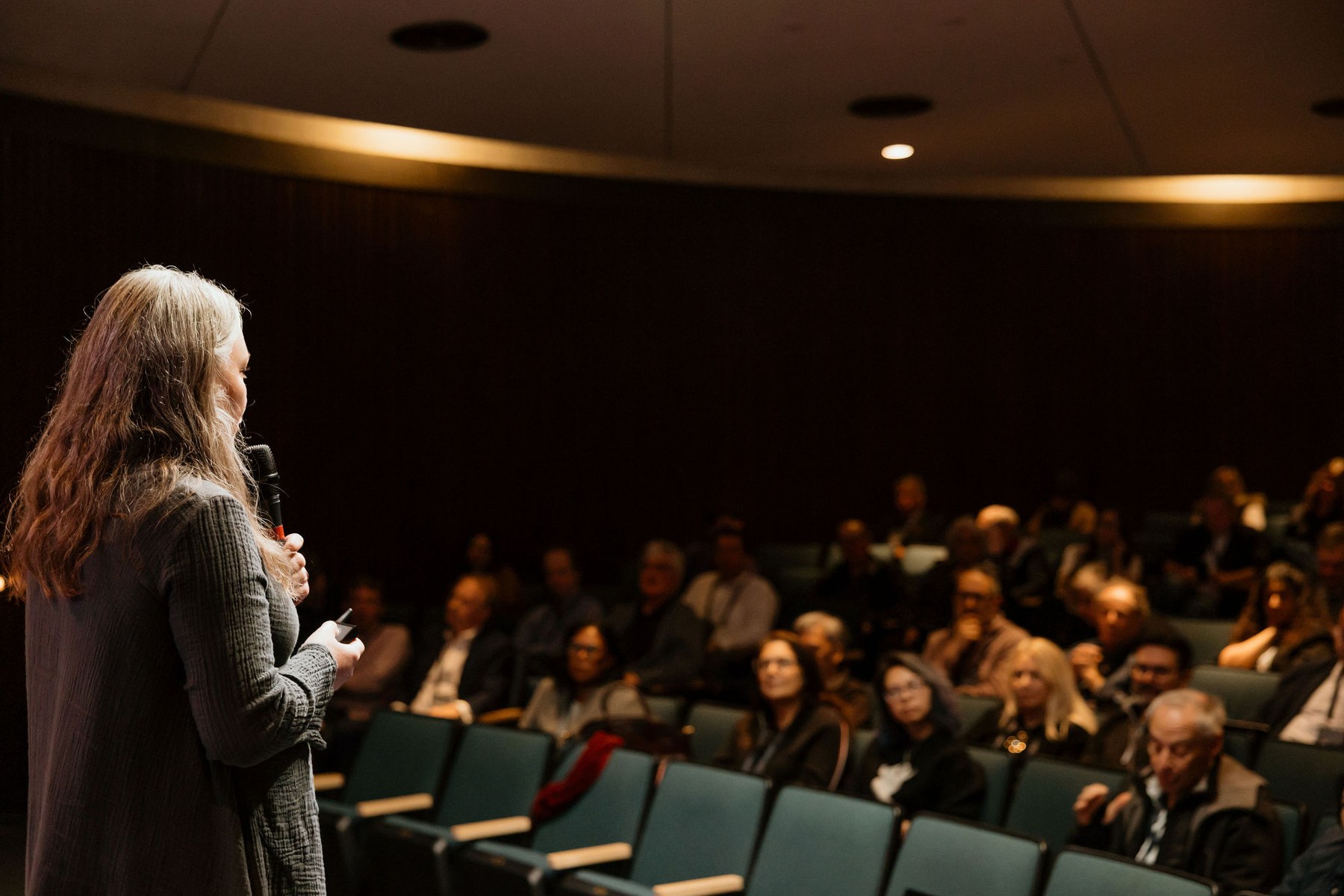
A presenter holds a microphone while facing people seated in the theatre.

During the Thursday session.

Michelle Diamond / Diamond’s Edge Photography

Another audience member described an external partner generating more decks and questionnaires than the team could absorb. Kerris proposed an upfront conversation about how the partners would work together and what material was actually useful.

That's a good place to exercise discernment before the next document exists. Agree on the decision that needs making, the information needed to make it and how much another person can reasonably review. Producing thirty pages creates thirty pages of work for somebody else.

Asked about using a second model to challenge the first, Kerris described cross-checking with another tool and another person. The second response can help expose a weakness. Agreement between two models still leaves the underlying claim to check.

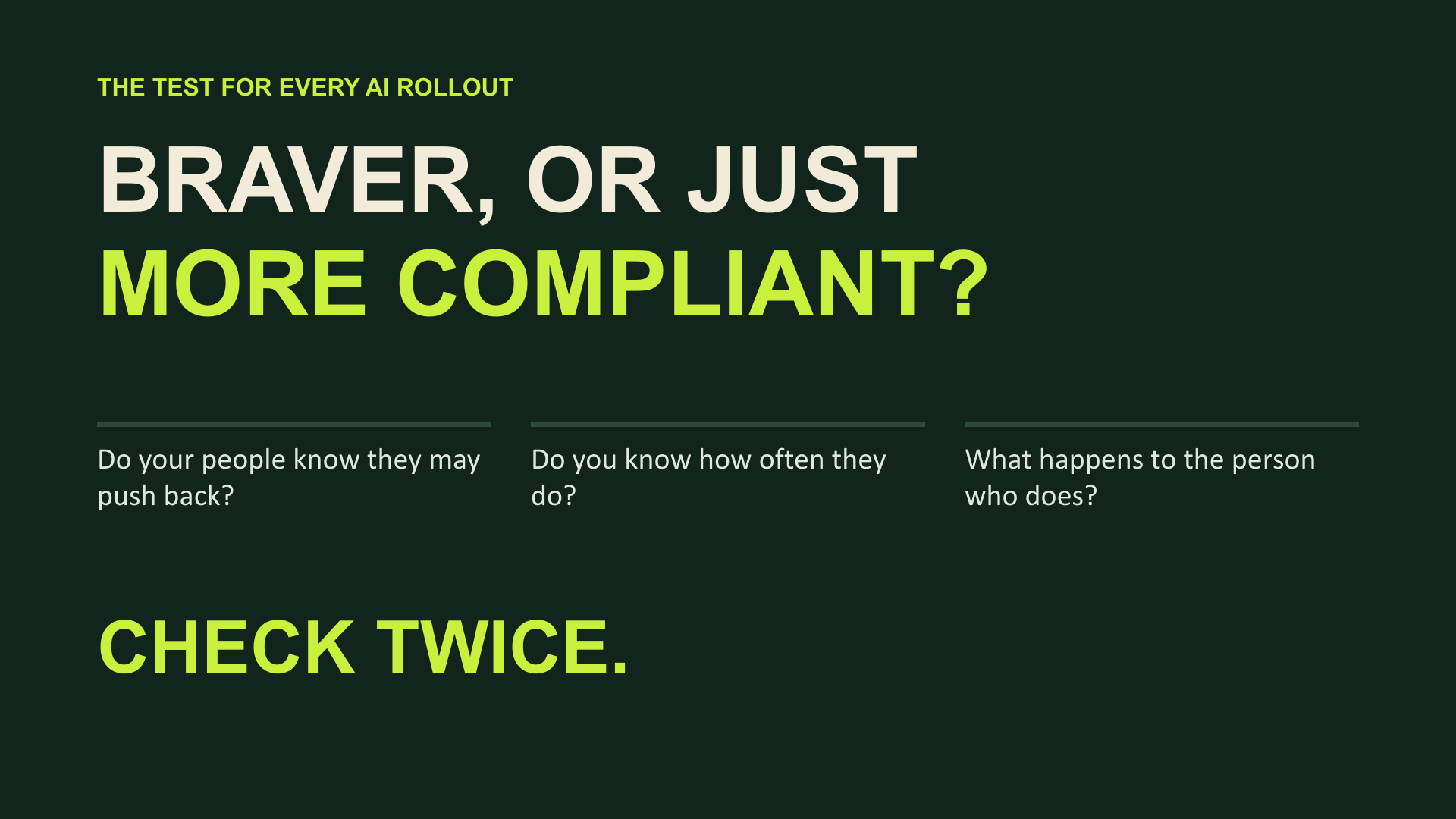
A final slide asks whether an AI rollout makes people braver or more compliant, and what happens when they push back.

The closing test, show-deck page 11. Presentation: Kerris Hougardy.

Kerris Hougardy

You can put that slide in front of a leadership team without adding much.

Think of the last person who challenged an AI-assisted recommendation. What did they need to do to be heard? What happened next? What did everyone watching learn about whether to bother next time?

There's your adoption story. Put that on the dashboard.

10 Thursday · October 29

Jos Duncan-Asé

ask the community before you ask the machine

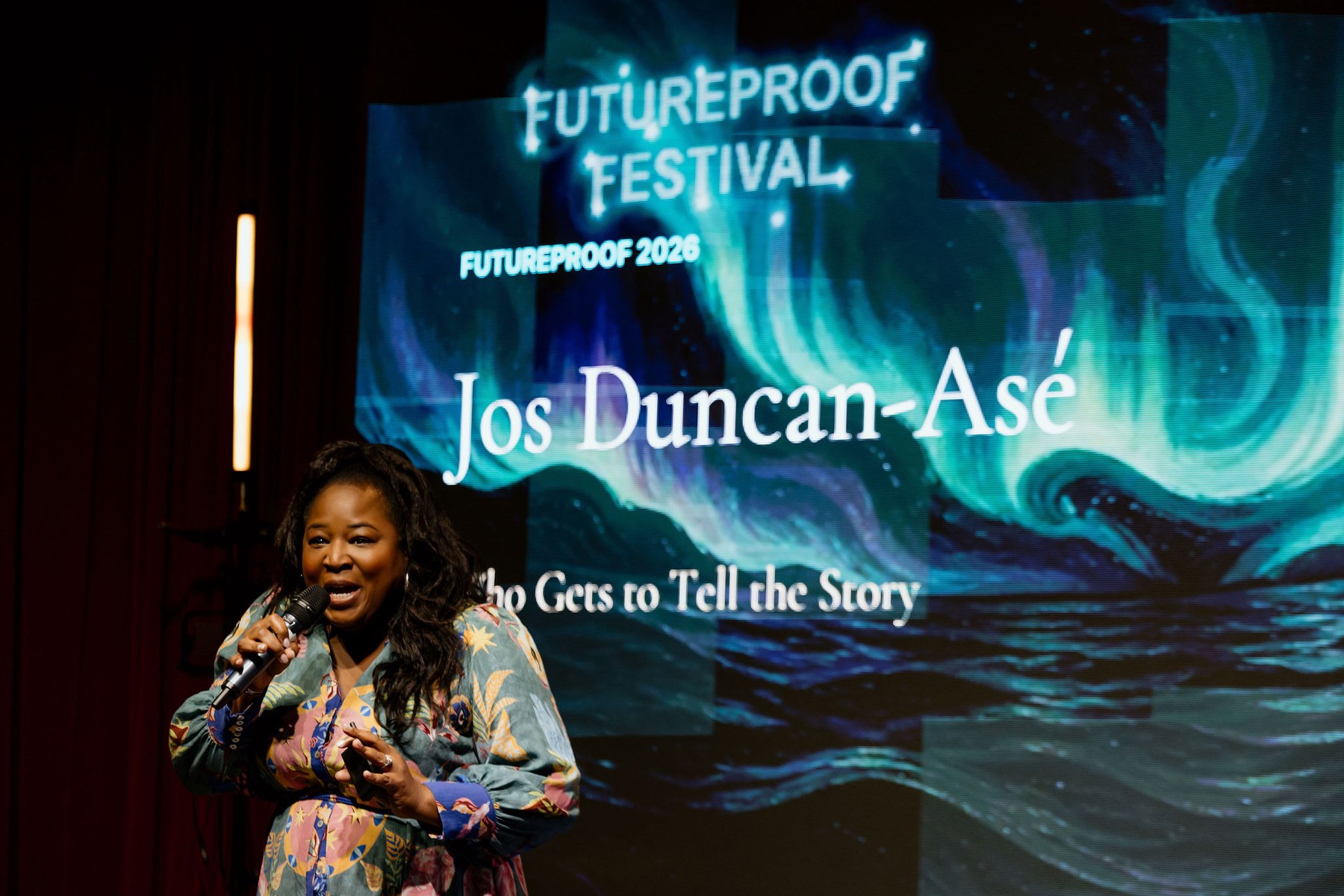
A storyteller holds a microphone beneath a projected card naming Jos Duncan-Asé and Who Gets to Tell the Story.

Jos Duncan-Asé at Futureproof Festival of AI, October 29, 2026.

Michelle Diamond / Diamond’s Edge Photography

Before the chatbot, there were people on the streets of Philadelphia answering a question about love.

What would make the place they lived more loving? What was missing? Where was care already happening?

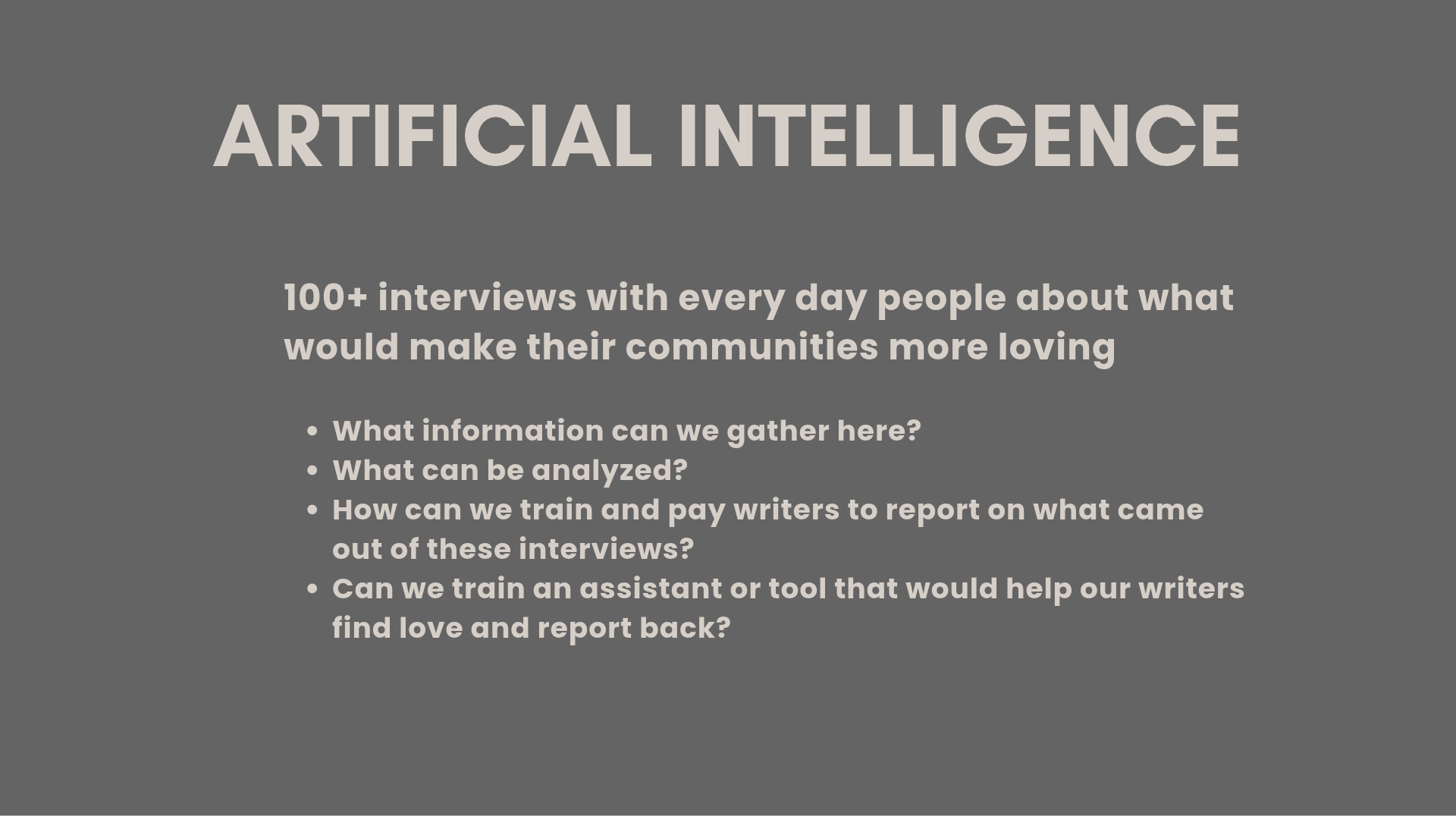
Jos Duncan-Asé described interviewing more than a hundred people, transcribing their answers and using AI to look for recurring themes. Then came the important bit: training and paying human writers to report on what those conversations brought into view.

The machine didn't get to declare what Philadelphia needed. People supplied the concerns, the places and the possibilities. The analysis helped the newsroom decide where to look more closely.

That sequence is worth keeping intact. You can ask a model for a community engagement strategy in ten seconds. It won't mean you've engaged a community.

She started by telling a story

Jos arrived at Futureproof with a framework rooted in her practice as a traditional African and Indigenous storyteller. Before explaining it, she invited the audience to take a breath, think about place and consider the people who had helped them arrive.

10 / Jos Duncan-AséThursday

Then she told a story.

In the telling she shared, a young leader kept asking an elder how her people could survive. The instruction was to dig. The turning point came when the leader joined the smallest child and began working alongside them. Others started digging together.

A storyteller raises one hand while holding a microphone against a dark stage background.

During Jos's Thursday storytelling sequence.

Michelle Diamond / Diamond’s Edge Photography

Jos used call and response to make the telling participatory. Afterward, she explained how stories can carry knowledge between generations and communities, opening ways of thinking that an instruction alone may not reach.

The way the knowledge travels is part of the knowledge. Someone tells it. Someone answers. The place and the people present enter the telling.

That gives a very different starting point for a discussion of artificial intelligence. Before asking what a model can produce, ask what relationships the work is supposed to sustain.

Reporting begins before the pattern appears

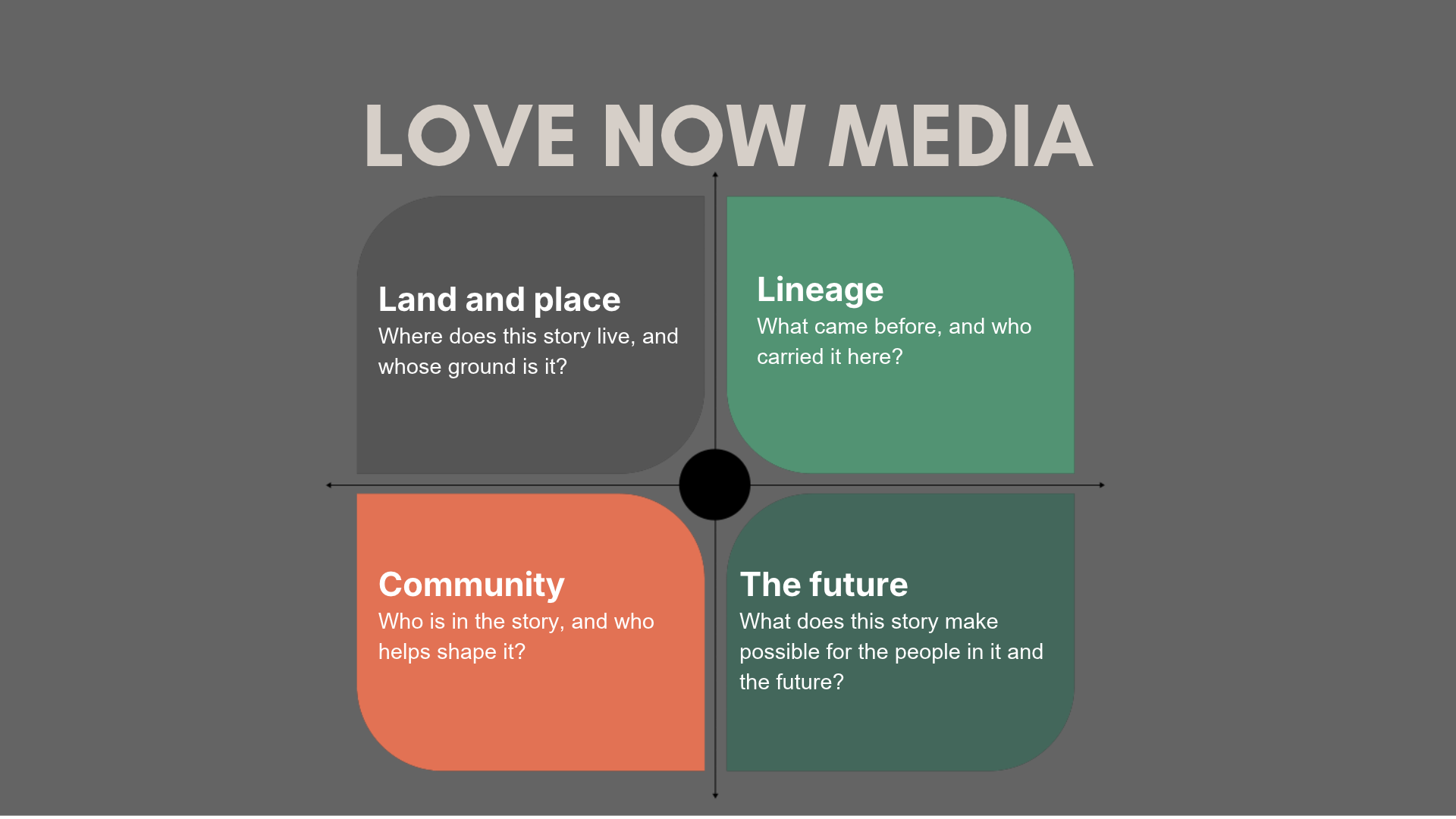
Jos founded Love Now Media after years of storytelling work. On stage, she described frustration with coverage that repeatedly reduced Black and Brown communities to the same narrow stories. Even attempts to argue back could leave people stuck responding to someone else's frame.

She wanted community members to have room to tell stories on their own terms.

The Philadelphia interviews began there. Asking what would make a community more loving could reveal something absent, something people wanted to protect or something already working that deserved attention.

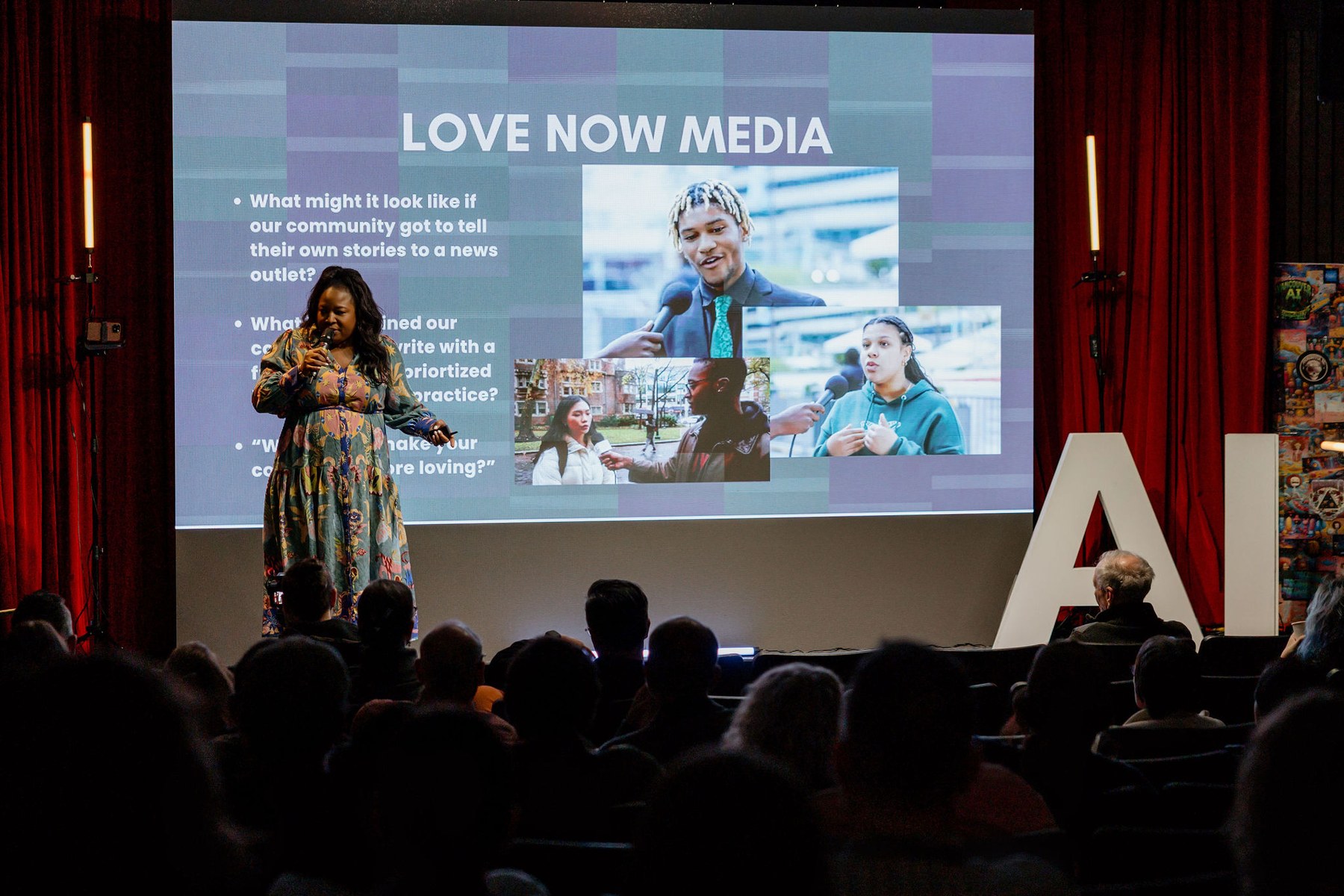
A projected Love Now Media slide combines community-interview photographs with questions about who tells the story and what would make a community more loving.

Love Now Media's community-interview work on the screen during Jos's talk. Presentation: Jos Duncan-Asé / Love Now Media.

Michelle Diamond / Diamond’s Edge Photography

Jos described using the transcripts to build a thematic map. A repeated concern became a lead: look up the reports, investigate the institution, talk to the people doing the work. The output had somewhere to go beyond a dashboard of themes.

10 / Jos Duncan-AséThursday
Love Now Media’s interview slide asks what can be learned from more than 100 conversations and how to train and pay writers to report on the findings.

Jos’s Futureproof slide puts more than 100 interviews first, followed by questions about analysis, paying writers and what a reporting assistant could help them do.

Jos Duncan-Asé / Love Now Media

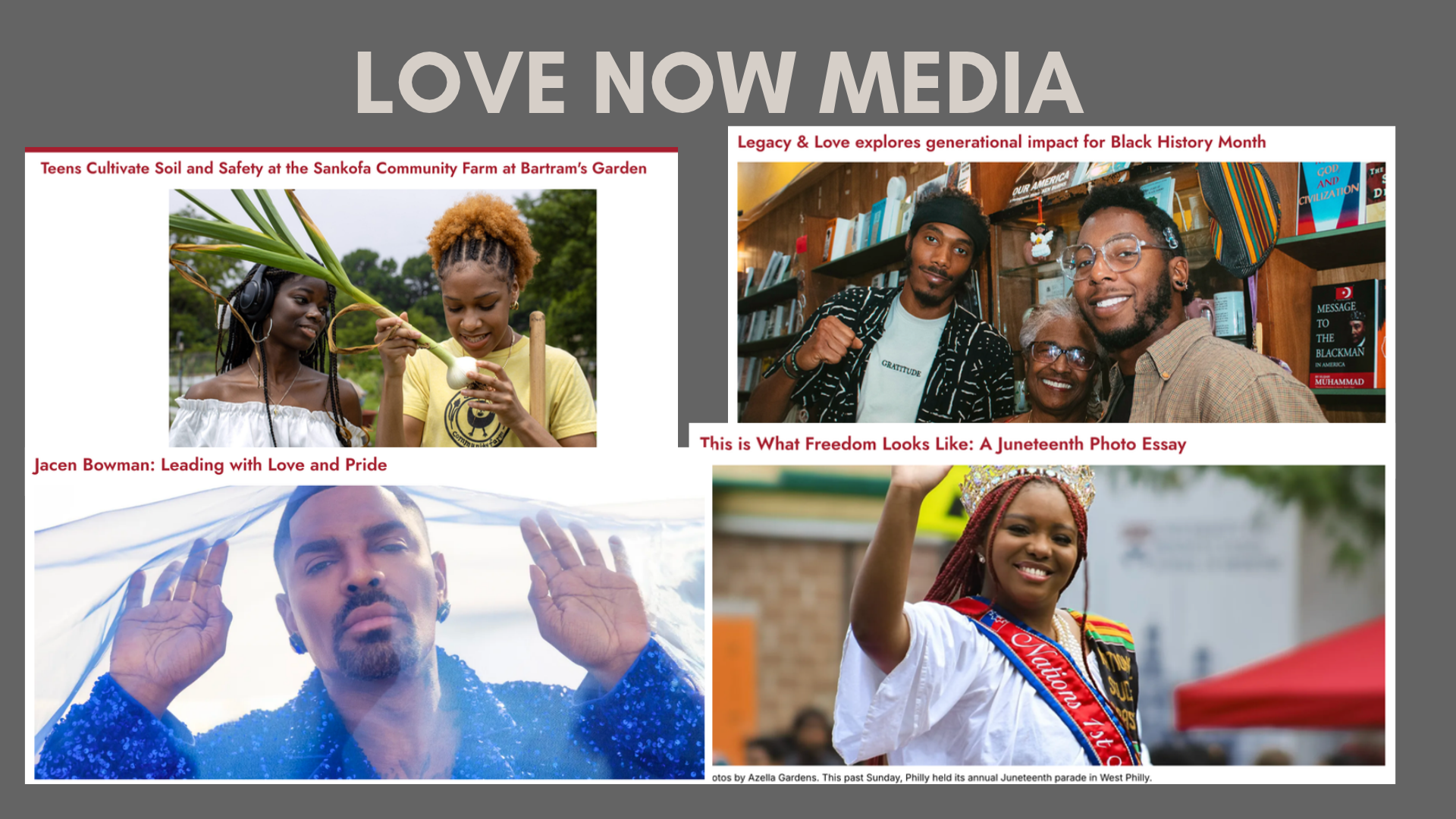
Love Now Media's 2024 annual report documents a related sequence in its A More Loving Philly initiative: community interviews, AI-assisted theme analysis and subsequent reporting. It gives readers a way to follow the newsroom's work beyond the festival talk.

A map of interviews isn't a census of a city. It reflects who was asked, what they were asked and what the analysis brought forward. Its value depends on the reporting and listening that follow it.

Four Love Now Media story previews show a community farm, Black-owned businesses, a portrait and a Juneteenth parade.

Examples from the Love Now Media newsroom, as shown in Jos’s Thursday presentation. Story and photography credits appear in the original coverage.

Jos Duncan-Asé / Love Now Media

Put that beside Lanaa Dantzler’s reporting from Sankofa Community Farm. The young people in the story talk about safety in their own terms, through the farm, the greenhouse and the people who make those places feel different. Jos also showed coverage of Philadelphia’s Black-owned businesses that asks what a family can build across generations. The stories give us people and places a thematic map could only point toward.

Four questions that make the work specific

The second assistant Jos described was there to help community journalists ask better questions of other people. Some were new writers. The framework gave them a way into a story without making the software its author.

She started with land and place. What made this location significant? Who shaped it? What would someone miss if they treated it as a generic setting?

Then lineage. Who came before the person doing this work? Who taught them, encouraged them or carried something forward that they now practise?

Then community. Who else is involved? What relationships make the work possible?

Finally, the future. What could this work make possible for the people around it? Sarah Downey’s sketchnote of Jos’s framework gathers those four prompts on one card.

10 / Jos Duncan-AséThursday
A four-quadrant Love Now Media diagram groups reporting questions under Land and Place, Lineage, Community and The Future.

The four prompts Jos brought to Futureproof anchor a story in land and place, lineage, community and the future.

Jos Duncan-Asé / Love Now Media

Jos carried the same questions into technology design. Where will the system be used? What came before it? Does that earlier tool need replacing? Who is the new thing for, and what future does it help create?

Those questions can change the brief before anybody chooses a model. They also make it harder to pass off novelty as a sufficient reason to build.

In my earlier writing on AI, creative practice and cultural representation, I argued for working with the people who carry a tradition rather than treating their culture as visual material to summon. Jos offered a concrete reporting practice built around people, lineage and place. The information comes with relationships attached.

A policy is something your audience can read

Love Now Media's public AI policy names its experimentation, its opposition to plagiarism and its commitment to human writers and editors being intentionally involved in publication decisions.

That makes the policy useful to someone outside the newsroom. Readers can see what the organization says it is doing and ask whether the work matches.

Our Futureproof AI policy makes a related commitment to naming how we use the tools and keeping people responsible for the result. A public statement gives the audience something specific to hold us to.

The work also connects with BC + AI's governance programme, where the practical task is to examine a use of AI and the people affected by it. Jos's questions make a useful place to start that examination.

The next interview still matters

In Q&A, an audience member asked whether the project had specifically sought the perspectives of elders and very young children. Jos said the interviews included people across a broad age range, with young journalists conducting them. She distinguished that from deliberately designing an inquiry around the youngest children, which they hadn't done.

That answer keeps an appealing idea from turning into a claim of complete representation. Wanting generations to meet doesn't mean every generation has already been heard.

When another question turned to connecting distant family members, Jos brought the scale back down. Start with the people in your own family and what might help them talk. Experiment with something that serves that relationship.

You don't need a planetary mission statement to begin. You need someone to listen to, a question worth asking and a reason to take the answer seriously.

Then, perhaps, you have something worth asking the machine to help you understand.

11 Thursday · October 29

Brad Necyk

the next prompt should come from a changed imagination

A presenter speaks beside a projected abstract artwork of blue and red forms on a white field.

Brad Necyk's AI and Imagination session at Futureproof, October 29, 2026. Artwork: Brad Necyk.

Michelle Diamond / Diamond’s Edge Photography

The person making the next prompt isn't quite the person who made the first one.

That was the creative process Brad Necyk described at Futureproof Festival of AI, October 29, 2026, at Vancouver’s H.R. MacMillan Space Centre. An intuition becomes something he can encounter. The thing he encounters changes what interests him. His next request comes from that changed position.

The destination can move while he's making the work.

That's awkward for the version of AI creativity where someone enters a perfect brief, presses a button and receives the finished object. Brad's account has more looking, more wandering and considerably stranger sentences.

Let the sentence stay strange for a minute

Brad makes art with filmmaker and speaker Jason Silva. He described their shared practice of speaking freely into models: associations, contradictions, laughter and ideas that haven't yet settled into an orderly explanation.

11 / Brad NecykThursday

They call the practice glossolalia. In Brad's account, its purpose is to leave room for an unexpected relationship before a sensible sentence tidies it away.

One example was the image of a cathedral made of weather. The point was to see what that combination could make possible to imagine and feel. A clean explanation of the intended result could arrive later.

A generated image places a pink cathedral in churning water beneath a rainbow, with white clouds and cascades of colour crossing its towers.

The “cathedral made of weather” example. Original video poster embedded on slide 2 of Brad’s supplied presentation. Generated imagery.

Brad Necyk
A presenter holding a microphone gestures beside a colourful feather-like digital form on the screen.

Computational art on the screen during the talk. Artwork: Brad Necyk.

Michelle Diamond / Diamond’s Edge Photography

He brought this into the discussion as an artist and teacher at Shawnigan Lake School. He described teaching imagination alongside AI and computer science, treating it as something students need opportunities to develop.

His own practice also leaves the desk. He described long walks on Cobble Hill Mountain, talking through ideas while the forest, the climb and his surroundings supplied more to notice. The body wasn't incidental to a conversation with software.

His published field note A Portal Opens follows that connection between walking, spoken thought and a system at home. It describes a particular prototype and its limits. The festival talk used the walking practice to explain where some of his ideas begin.

The painter still has to look

Brad spoke about training in painting, drawing and sculpture: the patience of attending to a face, a small difference in light, a surface that recognition might have allowed him to skip over.

Recognizing a thing and seeing it carefully are different activities. He carries the latter into work made with computers.

11 / Brad NecykThursday
Wisps and branching forms move from red and yellow through white to blue against a black background.

Computational artwork from slide 6 of Brad’s supplied presentation. Original video poster.

Brad Necyk

In his account of collaborating with Jason, language and association meet an attention to frames, surfaces and light. The model can generate possibilities, but someone still has to decide which possibility is worth staying with.

A presenter faces the theatre audience while digital artwork and presentation notes appear on the stage monitor.

The stage and audience during Brad's presentation.

Michelle Diamond / Diamond’s Edge Photography

In my writing on creative teams and agent orchestration, I ask how people preserve artistic intention while working through a growing stack of tools. Brad makes the intention itself available for revision. An output can change the work he wants to make.

That puts a demand on the next decision. What did you notice in this version? Why keep it? What does it make you want to change?

If the only answer is that it looks expensive, keep looking.

A loop that can change its direction

Brad called this process the cyberdelic loop. He described steering an instrument while responding to what the instrument brings back. The maker, the model, the artifact and the next encounter all participate in what happens next. Sarah Downey’s sketch of the loop places the loop beside a handwritten phrase about a cathedral made of emotion.

He also proposed syntography as a name for writing with synthesis. The term is part of his attempt to describe the medium he feels himself working in. He wants an account of its craft that reaches beyond judging whether an image resembles something made another way.

Brad screened a scene from The Psychedelic Puppet Show, his film project with Jason Silva. The puppets give Edgar a surreal treatment in a hospital that runs on the logic of an imagination cut loose. The creators’ published story gives you a way to read that fictional world in their words.

11 / Brad NecykThursday
An AI-generated film image projected in the theatre shows a puppet holding a megaphone beside a figure in round goggles, surrounded by red and blue creatures.

A frame from The Psychedelic Puppet Show, photographed from the theatre screen during Brad’s Futureproof talk. Film by Brad Necyk and Jason Silva.

Michelle Diamond / Diamond’s Edge Photography

The film borrowed clinical language as part of its fiction. Its imagined resolution belongs to that fiction. The artistic move was to give an experience an architecture someone could move through and encounter.

A figure stands among robed statues in a hall filled with fragments of pink and rainbow-coloured architecture.

An imagined world becomes architecture in The Psychedelic Puppet Show. Still from the excerpt supplied for Brad’s talk. Generated film imagery.

Film: Brad Necyk and Jason Silva

This is the sort of work that benefits from being screened and discussed together. BC + AI Film Club gives that conversation a recurring home in Vancouver: finished films, works in progress and breakdowns of the decisions behind them. A process becomes easier to question when there's an actual work in front of the audience.

MindOS gives an inner world an interface

Brad's next example was MindOS, a computational artwork he had rebuilt for the festival. He described a system that could keep producing a stream of text, take in material through microphones and cameras, and generate images from what it processed.

He used the language of dreams and inner worlds to describe its artistic behaviour. He also explicitly said it wasn't proof of machine consciousness.

The MindOS interface separates perception, an association field and a generated inner image from a stream of consciousness, scene descriptions and a listening panel.

MindOS, from slide 10 of Brad’s supplied presentation. The image panel labels its output as a generated interpretation rather than a camera feed.

Computational artwork: Brad Necyk
11 / Brad NecykThursday

MindOS puts perception, associations and a generated inner image in separate panels. The image is labelled as an interpretation. That gives the viewer somewhere to put a question: what happened between the thing the system received and the thing it showed?

The projected MindOS interface combines a looping coloured form with scattered words and a stream of text, while a presenter speaks in front of it.

MindOS as it appeared on the theatre screen. Computational artwork: Brad Necyk.

Michelle Diamond / Diamond’s Edge Photography

The distinction makes room to examine the artwork. What does it encourage a viewer to interpret as an inner life? Which parts of that impression come from the interface, the stream of language or the viewer's own expectations?

Late in the talk, Brad extended the question from an individual imagined world to the digital environments people share. He worried about feeds that give people fewer common objects of attention and less ground on which a disagreement can become useful.

The Cyberdelic Studio proposal is another route into that work. It examines deliberate public memory, attribution and what should remain revisable or private. It separates a record of an object from a guarantee that the object is true or wise. Those decisions still require people.

What did the work change?

Brad's talk left a useful distinction between generating another variation and encountering something that alters your next choice.

Try it with a work in progress. Pause on the output long enough to name what it changed in your intention. Maybe a texture suggests a different scale. Maybe the rhythm makes the planned narration unnecessary. Maybe the apparent improvement drains the thing of whatever made you start it.

Keep that observation with the next prompt. Give the next version a reason to exist.

The quantity of images is easy to increase. The part worth practising is how closely you look at one of them.

12 Thursday · October 29

Toshi Anders Hoo

a model should give people something to argue with

A presenter stands beside a projected title naming Toshi Anders Hoo and The Model is the Medium: The Future of Collaborative Intelligence.

Toshi Anders Hoo at Futureproof Festival of AI, October 29, 2026.

Michelle Diamond / Diamond’s Edge Photography

Toshi Anders Hoo came to a festival called Futureproof and cautioned against the word futureproof.

Fair enough. A name shouldn't get diplomatic immunity in its own room.

His concern was the confidence implied by having the future handled. If you think you already know what will happen, the thing actually happening can become harder to see. He proposed being future curious, with curiosity understood as a willingness to be changed by what you encounter.

That was the beginning of his argument about AI. What if the most useful thing a model does is help people change the models already in their heads?

Leave room for the future you actually want

Toshi spent a decade at the Institute for the Future before starting Possibility Spaces. He brought a futures practitioner's distinction between predicting an outcome and expanding the range of outcomes people can consider.

His possibility cone puts the projected continuation of the present alongside probable, plausible and much less comfortable possibilities. It also marks preferable futures: the ones people might choose to work toward. Sarah Downey’s sketchnote of the possibility cone pairs it with Toshi’s idea of AI as a medium for people thinking together.

12 / Toshi Anders HooThursday
A possibility cone opens from the present toward projected, probable, plausible and preposterous futures, with preferable futures marked within the wider field.

The Cone of Possibilities, submitted slide 10. Presentation: Toshi Anders Hoo / Possibility Spaces; the diagram credits an adaptation from Voros 2003.

Toshi Anders Hoo / Possibility Spaces

The preferred future doesn't necessarily sit inside the narrow path you already expect. If you only plan around that path, you may leave something desirable outside the discussion before anyone gets to make a choice.

Toshi applied that concern to the story of AI as inevitable human replacement. He wanted another possibility in the room: AI as a medium through which people can think and model together.

That's an invitation to examine what we're building and who can participate. A forecast should make today's decisions more thoughtful. It shouldn't excuse anyone from making them.

Separate what you saw from what you assumed

Toshi described a mental model as observations joined by assumptions. The change from data to observations was deliberate. Calling something data can make its interpretation sound more settled than it is.

A mental-model diagram combines Observations and Assumptions, joined by a two-way arrow.

How Toshi represented a mental model, submitted slide 35, PDF page 32. Presentation: Toshi Anders Hoo / Possibility Spaces.

Toshi Anders Hoo / Possibility Spaces

You observe that fewer people attended an event. You assume the topic put them off. Someone else notices a scheduling clash. Another person heard that the registration page confused people. Each account suggests a different next move.

That event example is a way to apply his distinction. The point is to make the assumption available for discussion instead of burying it inside a conclusion.

Toshi proposed intelligence as an activity: building a model of a situation and being able to update it. Other people can help because they bring different observations, experience and assumptions. Agreement isn't the only useful result. Finding the disagreement can reveal what needs investigating.

12 / Toshi Anders HooThursday
A presenter holds a microphone and gestures with a presentation remote against the dark stage.

During Toshi's Thursday session.

Michelle Diamond / Diamond’s Edge Photography

That also puts a useful demand on an AI second brain. Saving more of your thinking creates material you can revisit. The worthwhile next step is examining which parts still describe the world and which parts need changing.

An archive of your assumptions can be useful. An assistant that endlessly confirms them is considerably less interesting.

Put the model somewhere other people can inspect it

Toshi's forecast was that more collaborative work would happen through models people could make, alter and share. He called it a desktop modeling revolution, drawing a comparison with the spread of tools for creating and publishing documents.

The practical examples made the idea easier to follow.

He showed a model of an innovation centre he was helping develop. He described taking architectural material into Claude and building a way to explore a place that didn't yet exist.

An innovation-centre model appears in a browser beside interior views and a three-dimensional floor plan.

Toshi's project example, submitted slide 65, PDF page 55. These are planning-model views, not photographs of a completed building. Presentation: Toshi Anders Hoo / Possibility Spaces.

Toshi Anders Hoo / Possibility Spaces

A shared model gives the conversation an object. People can point to the same room, disagree about what it needs and change the proposal. They don't have to discover halfway through a project that everybody imagined a different building.

His bioregional example moved between software and a physical object. He described a hike connected to the water system serving his region, research into that system and a three-dimensional printed model of it.

A slide combines a watershed map, a 3D-print preparation view and a photograph of a person holding a printed landscape model in front of a water temple.

The bioregional water-system example, submitted slide 66, PDF page 56. Presentation and project images: Toshi Anders Hoo / Possibility Spaces.

Toshi Anders Hoo / Possibility Spaces
12 / Toshi Anders HooThursday

The model could become something to gather around and question. Where does the water come from? What relationships does this representation make visible? What did the person building it choose to include?

A tidy shape doesn't settle those questions. It gives them a place to begin.

The interface carries assumptions too

Toshi connected his argument with Brad Necyk's preceding discussion of creative tools. The medium shapes what people can notice, express and do. An AI discussion that stops at the impressive output misses the arrangement producing it.

In Q&A, people challenged the language around world models and asked how richer visual interfaces would relate to documents and shared standards. Toshi clarified that he wasn't proposing the disappearance of documents. He was interested in more ways to represent complex systems and work with them.

There are specific technical approaches within that wider idea. World Labs' explanation of 3D as an interface describes representations that people can inspect, edit and move into existing spatial tools. That is a concrete design argument from the company, rather than a definition covering every kind of model Toshi discussed.

The interface needs questioning along with the content. Which assumptions can a person change? What can they inspect? What is hidden behind the convincing view? Who gets to use the tool and who gets represented by it?

Those are practical questions for BC + AI's Responsible AI Professional programme, where practitioners examine actual deployments and their consequences. The model-literacy lens adds another way to interrogate what an organization is asking people to trust.

A presenter speaks toward the seated audience from the front of the theatre, with a remote in hand.

The conversation from the stage.

Michelle Diamond / Diamond’s Edge Photography

Try Toshi's argument on a decision you're making with other people. Name the observations. Put the assumptions beside them. Build a representation everyone can inspect, whether that's a drawing, a spreadsheet or a navigable prototype.

Then invite someone to tell you what it leaves out.

The model becomes useful when the conversation can change it. So do we.

Thursday / The afternoon reset

Suzy Easton

An electronic set and the questions that followed it.

After lunch, Easton performed live with her laptop and voice. When the set ended, she told the room it was her first time performing with that setup.

The laptop

What was running locally?

Easton said Google’s Magenta RealTime 2 ran on her laptop. When asked how a musical influence made its way into the piece, she described working with prompts and then making changes in her own code.

Day 2 audio · around 03:39–03:41

The voice

How did one voice sound like a choir?

An audience member asked whether the vocals were Easton’s. She said she sang the parts herself and layered them with loops, giving herself a set of backing voices.

Day 2 audio · around 03:39

Reconstructed from the Day 2 recording, approximately 03:30–03:41 elapsed. Listening index · Transcript coverage · Model documentation

Futureproof Proceedings / Thursday / Recovered set54

13 Thursday · October 29

Simon Haworth

the prediction still needs a lab

A presenter holds a microphone beneath a slide naming Simon Haworth, CEO of Intellomx, and describing pharma as a patient needing help.

Simon Haworth at Futureproof Festival of AI, October 29, 2026.

Michelle Diamond / Diamond’s Edge Photography

The AI has produced a promising hypothesis. Now someone has to find out whether the biology agrees.

Simon Haworth put that obligation at the centre of his Futureproof talk. The CEO of Intellomx wanted the people building AI to look further into disease mechanisms and further into the physical work required to test them.

His provocation was that speeding up part of drug discovery could leave the underlying reasons for failure intact. You might move candidates through a process more efficiently while discovering, later and painfully, that you were pursuing the wrong thing.

Simon called that failing faster. In a setting where a failed idea can absorb years of work, the phrase deserves more scrutiny than it usually gets in a startup pitch.

The iceberg is a question about ignorance

Simon used an iceberg to distinguish what is already described in the literature from the biology researchers still need to understand. Sarah Downey drew the iceberg alongside his account of how people and AI might share the work.

13 / Simon HaworthThursday
An iceberg appears beside stages of discovery and validation, including biological research, target identification and wet-lab validation.

The iceberg metaphor in Simon's submitted slide 12. It illustrates his argument about unknown biology; its proportions are not a measurement of how much biology is understood. Presentation: Simon Haworth / Intellomx.

Simon Haworth / Intellomx

He argued that a language model working through existing knowledge doesn't, by itself, answer the questions hidden below that waterline. His interest was in applying machine learning to biological measurements and investigating the relationships they might reveal.

That is a distinction between research tasks. Summarizing papers can be useful work. Identifying a plausible disease mechanism, testing an intervention and finding out whether it helps a person involve further work with different standards of evidence.

The Q&A tested the metaphor. An audience member asked how anyone could quantify what they didn't know. Simon acknowledged how difficult that estimate was and explained that he was trying to communicate scale.

Good. An image can open an argument without turning its geometry into a statistic.

What the company says it is doing

Simon described Intellomx's work with transcriptomic data and disease models, aiming to identify targets for further investigation. The company's white paper on its biology-led approach sets out that position: start with human molecular data and use language models as supporting interfaces rather than treating literature retrieval as the discovery engine.

A presentation page describes Intellomx's de novo discovery approach beside a photograph of its chief scientific officer and an iceberg graphic.

The company's approach and research pipeline as presented, submitted slide 14. These are company descriptions, not evidence that the listed research areas have produced approved treatments. Presentation: Simon Haworth / Intellomx.

Simon Haworth / Intellomx

There is a concrete research relationship to follow beyond the stage account. Intellomx's June 2025 announcement of a second collaboration with Johnson & Johnson describes work to identify and evaluate lung-cancer targets. A target-discovery collaboration is a particular activity. It doesn't establish that a resulting medicine has proved effective in patients.

13 / Simon HaworthThursday

Keeping that distinction visible makes the work easier to assess. What was measured? What did the model infer? Which experiment tests that inference? What happened in the experiment?

The interesting detail lives in the answers to those questions. A promising adjective won't do the job.

The physical work gives the idea somewhere to fail

Simon argued that wet-lab and preclinical validation were opportunities for British Columbia. He wanted facilities and people who could take a computational hypothesis into an experiment and find out whether the expected effect appeared.

A discovery workflow highlights wet-lab and preclinical validation alongside biological research and AI target identification.

Where Simon placed physical validation in the process, submitted slide 13. The illustrated markers highlight proposed opportunities; they are not research awards or clinical results. Presentation: Simon Haworth / Intellomx.

Simon Haworth / Intellomx

The work can't be reduced to making an experiment run faster, either. Asked about miniaturizing labs and testing vastly more samples, he came back to the difficulty of finding models that meaningfully represent the disease being investigated.

Speed is useful after you have a reason to trust what the experiment represents. More repetitions of an inadequate model can leave the original problem beautifully automated.

And preclinical evidence has its own boundary. The FDA's explanation of clinical research distinguishes laboratory work from studies in people. Moving from a biological result toward a treatment requires further questions about safety, dosage, effects and the people being studied.

A wide view shows a presenter and the theatre audience during the life sciences block.

The Thursday life sciences session.

Michelle Diamond / Diamond’s Edge Photography

Simon also described a digital toxicity twin intended to anticipate unwanted effects beyond the target being investigated. It is an attempt to bring a wider biological system into view before committing to later stages.

13 / Simon HaworthThursday
A conceptual human-body image appears beside three network diagrams under the title Intellomx I cubed: Digital Tox Twin.

The Digital Tox Twin concept in submitted slide 15. This is a conceptual presentation graphic, not a patient's scan or proof of clinical predictive performance. Presentation: Simon Haworth / Intellomx.

Simon Haworth / Intellomx

That aim still leaves the essential question open: how well does the prediction hold up when it is tested? The talk introduced a research direction and the company's expectations. It didn't supply a clinical validation study for this audience to examine.

Coordination is part of the infrastructure

An audience member asked who would organize and pay for the connections between researchers, facilities and institutions. Simon described ongoing conversations with investors and government, alongside the difficulty of getting the relevant people to work together.

The distinction matters here too. An opportunity isn't a funded programme. Having facilities in a region doesn't automatically make them available to a team trying to test a particular idea.

Our BC + AI Life Sciences group brings people from discovery, clinical care, health data and other disciplines into the same conversation. Simon's related Wild Salmon proposal asks how experienced founders might build their way back to British Columbia. Both offer places to continue the questions raised on stage, with the proposal still visibly a proposal.

A speaker with a microphone stands in front of the closing Ask me about slide.

During Simon's presentation.

Michelle Diamond / Diamond’s Edge Photography

His exchange with Dean Shev in the following session added a real disagreement: Simon stressed the research value of sharing data across different populations; Dean stressed the person's control over its use. Neither question disappears because the other matters.

For a builder, Simon's challenge is specific enough to work on. Identify a biological question, the data that might illuminate it and the experiment that could prove your promising answer wrong. Then find the people and facilities capable of doing that experiment.

The model has made a suggestion. The interesting work is what happens next.

14 Thursday · October 29

Dean Shev

who answers when the answer is wrong?

A presenter speaks beneath a slide about capability and trust, with a conceptual illustration of robots on a staircase beside a doctor.

Dean Shev at Futureproof Festival of AI, October 29, 2026. The projected image is an illustration from the presentation.

Michelle Diamond / Diamond’s Edge Photography

The answer arrives immediately. It sounds informed. It may even perform well on the task used to test it.

Who is going to answer for what happens next?

Dean Shev brought that question to Futureproof from his work building health technology. As co-founder and CTO of VHT.ai, he described work on AI assistance for people trying to understand health information and navigate care.

The question he wanted to keep in view was the person's position in the exchange: what information the system used, what the person had agreed to, what could be checked and who could intervene.

A soothing voice doesn't fill in those blanks.

A reasoning score doesn't finish the care question

Dean discussed research comparing AI and physician performance on difficult medical cases. It was part of his argument that capability and accountability are different problems.

The Brodeur and colleagues preprint referenced in his presentation examines several medical reasoning tasks. Its December 2024 version compares model outputs with historical physician and model baselines, including a small set of patient-management vignettes graded by physicians. Its authors call for trials in clinical settings.

14 / Dean ShevThursday

A score on those tasks does not mean the same percentage of patients will be diagnosed or treated correctly. The move from a bounded evaluation to care involves people, information, workflow and consequences that a headline score doesn't contain.

Dean's central concern survives that distinction. If the system and a clinician disagree, someone still has to investigate the disagreement and communicate what follows to the person affected.

Three promises, several engineering problems

He organized the talk around three patient-facing expectations: avoid harm, protect the person's data and explain the answer in a way that can be questioned. Sarah Downey’s sketchnote of Dean’s talk sets those expectations beside the question of who answers for the system.

Three columns organize patient expectations around avoiding harm, protecting data and receiving an explanation that can be questioned.

Dean's organizing framework, submitted PDF page 9. It asks what a deployment must answer beyond a capability score; it is not a claim that privacy or safety can never be evaluated. Presentation: Dean Shev / VHT.ai.

Dean Shev / VHT.ai

Those expectations lead to different work. Evaluating an answer's medical content doesn't establish who may read an uploaded record. Keeping a document within a chosen infrastructure boundary doesn't establish that the answer drawn from it is useful. A fluent explanation still needs checking against the evidence it cites.

The World Health Organization's guidance on ethics and governance of AI for health puts these questions in a wider frame of human rights, oversight and responsibility. It addresses the people and institutions designing and deploying systems, as well as the people affected by them.

That's a more demanding assignment than telling a user to exercise good judgment after the answer appears.

The tribunal is a checking process

The concrete example Dean brought was an LLM Tribunal research project with Northeastern University Vancouver. He described using several models to examine a draft response across accuracy, ethics, privacy and autonomy, then guide a revision.

A five-step tribunal diagram moves from a draft answer through model judges, scoring, relevant guidance and revision, with separate routes for human decisions.

The research workflow in submitted PDF page 12. WHO, NIST and UNESCO are guidance sources for the rubric. The courtroom language is a design metaphor, not a legal proceeding or certification. Presentation: Dean Shev / VHT.ai.

Dean Shev / VHT.ai
14 / Dean ShevThursday

The diagram makes useful details visible: what is being judged, the criteria, when the draft is revised and where the process hands something to a person. It also specifies a limit on repeated revisions instead of letting the system keep rewriting until it awards itself a satisfactory score.

VHT's public research account identifies the tribunal as a graduate capstone and distinguishes its research-prompt scores from the live service. The company's ECHNA explanation similarly describes the rubric as informing its design, rather than establishing a benchmark against other assistants.

Those limits matter. A set of model judges can help locate a weakness in another model's answer. Their agreement doesn't independently establish that the answer is medically sound or that the deployed service is safe.

The useful next question is who checks the judges, with which cases and against what external evidence. That question belongs inside the design.

A speaker holds a microphone and raises one finger while addressing the room.

During Dean's Thursday presentation.

Michelle Diamond / Diamond’s Edge Photography

Dean also described work on document-upload protection and explanations for predictive outputs. These have their own jobs to do before a person can rely on an answer. He was presenting components of an approach, not a single score that could settle every concern about it.

The data-sharing disagreement was the point

Simon Haworth, who had just spoken about drug discovery, challenged the emphasis on keeping data at home. His work needed data from different populations and places. He argued for the value of sharing it so other people could benefit.

Dean answered from the individual's control over the use. He described permission for a research purpose and removing identifying information. He also defended the importance of population context when interpreting data.

Another audience member challenged whether a country's border was the right way to frame that context. Location, they suggested, could itself be a variable to consider.

The exchange didn't produce a shared rule for every dataset. It exposed several decisions that need examining separately: who agrees to a use, what is shared, who receives it, how the context travels with it and what claims the resulting model can support.

14 / Dean ShevThursday

You can care about research access and still owe people a specific account of what happens to their information. You can care about local control and still need to explain why a particular boundary serves the research or the person.

Our BC + AI Life Sciences group exists across precisely those disciplines. The public conversation can continue without treating private health records as discussion material.

An explanation should make a decision easier to question

Dean's third expectation was an answer whose reasoning and evidence could be examined.

A slide reads If it can't explain itself, it shouldn't speak, followed by a statement about questioning a number.

The explanation principle as Dean presented it, submitted PDF page 17. Presentation: Dean Shev / VHT.ai.

Dean Shev / VHT.ai

The practical test is whether the explanation helps someone find the source, understand the limitation or bring a meaningful question to a qualified person. A longer answer can still conceal the important uncertainty.

In my writing about giving chatbots moral authority, I ask who is steering when the system reflects a convincing answer back to us. Dean puts that question beside a health record. The person needs something more useful than confidence to work with.

BC + AI's Responsible AI Professional programme offers a place to work through those deployment questions: purpose, evidence, consequences and the decisions someone must own. A stated principle becomes more useful when it changes the route an answer takes.

The closing slide asks Who does this answer to? and names Dean Shev, co-founder and CTO of VHT.ai.

The closing question, submitted PDF page 20. Presentation: Dean Shev / VHT.ai.

Dean Shev / VHT.ai

For a team building a health tool, put that question beside the actual workflow. Name the person who reviews a serious disagreement. Explain what they can see, what they can change and how the user gets a response.

Then show that route to someone outside the team and let them ask where it breaks.

Accountability needs an address people can reach.

15 Thursday · October 29

Sev Geraskin

somebody has to keep the fair running

A presenter stands beneath the title Who owns the infrastructure underneath all this, with photographs of amusement rides projected behind him.

Sev Geraskin at Futureproof Festival of AI, October 29, 2026.

Michelle Diamond / Diamond’s Edge Photography

The Ferris wheel was still there. The people who made it work weren't.

Sev Geraskin began his Futureproof talk with a childhood recollection of a fairground losing its operators, maintenance and reliable support during the collapse of the Soviet Union. The physical machinery outlasted the arrangements that kept it useful. Sarah Downey’s sketchnote from the talk places the fairground beside the community network he imagined.

He remembered teenagers getting the bumper cars running again. Someone knew enough to try. Someone was willing to get their hands into the machinery.

That story travelled with him into AI infrastructure. A model can be available, a GPU can be installed and a product can have a very impressive demo. People still depend on power, maintenance and whoever answers when something stops working.

The fair doesn't run on the existence of a Ferris wheel. There's an unglamorous human arrangement underneath it. Sev wanted us to look there.

15 / Sev GeraskinThursday

The dependencies are part of the machine

A diagram shows a functioning Ferris wheel supported by an operator, mechanic, power and pay, followed by the same wheel with those supports fading.

The dependencies underneath the ride, submitted slide 3. Diagram: Sev Geraskin.

Sev Geraskin / Economy of Wisdom

Sev's route into the subject was personal: craft in his family history, parents who became engineers, then his own work in distributed computing. By the time he reached the kitchen-table GPU, the question had become familiar. What does it take to keep a useful thing running?

One machine at home makes the dependencies hard to ignore. It needs somewhere to sit. It makes noise. It consumes electricity. Someone has to notice when it fails.

Scaling introduces more of those obligations. It also changes who can reach the service and who has the authority to interrupt it. In Sev's account, the distance between a working demonstration and a dependable service was full of these practical decisions.

A single demo computer depends on its operator and power, while a production network adds money and access as dependencies.

From one machine to a service people depend on, submitted slide 7. Diagram: Sev Geraskin.

Sev Geraskin / Economy of Wisdom

That makes a useful companion to Amber Case's work on calm technology. People shouldn't have to become unpaid system administrators to use a tool. Making a service feel simple can require a considerable amount of care from the people operating it.

A green dashboard can still leave someone stranded

The best engineering example in Sev's talk was small enough to understand without owning a GPU.

A monitor checks a server. The server says it is healthy. But no user requests arrive. Is everything working, or has something between the person and the server broken?

Now the monitor itself stops reporting. Is the server down, or has the thing checking it disappeared?

15 / Sev GeraskinThursday
A monitoring diagram distinguishes nodes serving requests, a node reporting a heartbeat without requests, and a node that has gone silent.

Different kinds of silence require different responses, submitted slide 9. Diagram: Sev Geraskin.

Sev Geraskin / Economy of Wisdom

Sev described designing for those differences rather than treating a heartbeat as the whole story. A component can pass its own test while the person trying to use the service gets nothing.

That's a sharp question to bring back to any AI product. What does your dashboard actually know about the user's experience? If every internal light is green, what could still be broken outside the part you are watching?

His work at PolarGrid concerns running inference near users across GPU sites. In the talk, voice was the concrete reason to care about that distance. A delay before the first word changes the rhythm of an exchange, even if the answer eventually arrives intact.

Sev reported latency improvements from the infrastructure his team was building. The broader design point survives without turning one reported measurement into a universal promise: people experience the whole path to the answer. A model benchmark doesn't include every part of that path.

Who can turn it off?

Sev moved from monitoring a network to distributing its points of failure. If one machine becomes unavailable, another should be able to take the request. If every route depends on one special machine, the supposed redundancy has a very important asterisk.

A centralized system depends on one hub and its physical inputs, while a distributed diagram routes past an unavailable node.

The architecture of a fallback, submitted slide 12. Diagram: Sev Geraskin.

Sev Geraskin / Economy of Wisdom

In the Q&A, he explained distributed computing through that absence of a special computer: machines work together, with another able to take over when one becomes unavailable.

Then the question gets political. One company, one connection or one operator can also become the point everything depends on. Buying more machines doesn't necessarily change that arrangement.

My Sovereign AI for Whom? essay asks who gets access to the compute and who carries its costs. Sev brought a working engineer's version of that question: which dependencies remain, and who has the ability to keep the service available?

Technical resilience and community control have to be designed deliberately. A diagram with lots of dots doesn't settle either one.

15 / Sev GeraskinThursday
A presenter holds a microphone and gestures against a dark stage background.

During Sev's Thursday presentation.

Michelle Diamond / Diamond’s Edge Photography

A place to use the machine together

Sev's community-compute proposal took the argument into a building. He imagined computing alongside places for people to learn and work, with housing included in the design.

A section diagram combines homes, shared computer terminals and GPU nodes, with a cost estimate and the statement Designed and costed; not yet funded or sited.

The proposed Compute Community Centre, submitted slide 15. Capacity, energy and cost figures are the proposal's estimates. The slide explicitly identifies it as unfunded and without a selected site. Diagram: Sev Geraskin / Economy of Wisdom.

Sev Geraskin / Economy of Wisdom

The Compute Community Centre study describes a commons on a public-library model. Its current account also names unresolved questions about the building and its costs. This is a proposal people can examine and help develop, with the work of establishing it still ahead.

Asked about a pilot, Sev described the need to bring a location, equipment and participants together. Interest from people in the audience didn't make it a funded project. It made the next conversation possible.

His Economy of Wisdom framework asks how an organization affects the people it touches, including the hardship it absorbs and the fulfilment it enables. In this setting, that shifts attention beyond how busy the GPUs are. What can someone do because this resource exists? Who gets help learning? Who does the maintenance?

Our BC + AI communities already depend on people showing up to share skills and make introductions. A permanent computing commons would add physical infrastructure and operating responsibilities to that social work. Those responsibilities need owners as surely as the equipment does.

Sev ended by asking who is responsible for the lives that depend on the infrastructure.

Start there when you draw the architecture. Put the operator, the maintenance and the person's route into the system on the page. Then ask what happens when each one disappears.

Somebody has to keep the fair running.

16 Thursday · October 29

Kristen Delphos

the writers wrote the rules

A presenter stands beside a projection mapping the hero's journey to the scientific method, with the theatre audience in the foreground.

Kristen Delphos at Futureproof Festival of AI, October 29, 2026.

Michelle Diamond / Diamond’s Edge Photography

The writers were suspicious of AI. So Kristen Delphos put them to work designing how it would behave.

At UL Research Institutes, her team translates safety science into stories people can understand and use. A dense report can contain an important finding and still leave a reader wondering what the hell it has to do with their life.

The writer has to find the connection without making the science say something more convenient.

Kristen's Futureproof talk showed what happened when her team brought that responsibility into an AI workflow. They chose the sources it could use. They wrote the editorial rules. They made it identify the claims that needed more work.

The people worried about losing their judgment were given a practical place to exercise it.

A red crayon before a research institute

Kristen began with three words written on a windowsill when she was seven: “I am me.” A red crayon, an unauthorized surface, an early indication that the writer had opinions.

Later came a school literary magazine and a poem she and a fellow editor slipped back into the issue after being told to remove it. She recalled getting fired. Then came music reviews, screenplays and the decision to write for a living.

Her point was personal continuity. The tools and the employers changed. The impulse to see something and make another person see it remained.

16 / Kristen DelphosThursday
A presentation traces Kristen's writing tools from a red crayon through a photocopier, typewriter and laptop to AI.

The tools changed; the author still had something to say. Submitted presentation page 16: Kristen Delphos / UL Research Institutes.

Kristen Delphos / UL Research Institutes

That matters in the middle of a conversation that can make every working creative feel like a function awaiting replacement. A writer brings a history of noticing, choosing and getting things wrong. There's a person behind the sentences, including the ones a tool helps produce.

Our AI Upgrade for Creative Professionals starts from that working experience: rebuild the workflow around the craft you've developed. Kristen brought an example of people doing exactly that with a demanding editorial job.

Give the science a story without giving it a costume

Kristen described the initial difficulty of talking about storytelling with scientists. Some heard “dumb it down.” Others heard “press release.” Neither captured the job she wanted her writers to do.

She used the hero's journey as a bridge: begin with a question, encounter difficulty, learn something and carry it back to other people. She placed it alongside the scientific method to make the work of research recognizable as a story.

Five steps connect a safety question to hypothesis and testing, surprising data, a careful answer and communicating the result.

Kristen's storytelling analogy, submitted page 9. It is a way to explain the research process, not a claim that every study produces a tidy resolution. Presentation: Kristen Delphos / UL Research Institutes.

Kristen Delphos / UL Research Institutes

One step in her diagram deserves particular attention: the data surprises you. What you assumed isn't what you found.

That's where the writer has to resist the urge to tidy everything up. The story can't require a triumphant result before the experiment has happened. The finding might narrow the question, expose a limit or show why the first explanation doesn't hold.

An honest account can make that interesting. It doesn't need a victory costume.

The tool has homework before it gets to write

The team spent several hours experimenting together, starting with exercises outside their day job. Then they built a science-storytelling skill around the standards of their actual work.

It asks about the finding and the intended reader before producing a draft. It works from the institute's published research. It has writing rules, including an expanding list of AI habits the team wants removed.

16 / Kristen DelphosThursday

Yes, the em dash was on the list. Working writers have eyes.

Six panels describe the science-storytelling skill: ask first, use published institutional research, build a story, check writing rules, flag uncertainty and require scientist review.

The editorial workflow, submitted page 11. These are the team's intended operating rules; the slide isn't an independent audit of model compliance. Presentation: Kristen Delphos / UL Research Institutes.

Kristen Delphos / UL Research Institutes

The most consequential output was the set of questions. The skill flags what it can't establish from the source and helps the writer identify what to ask the scientist.

That changes the next conversation. The writer can arrive with a possible story and specific points to investigate, instead of asking a researcher to somehow produce an accessible narrative on demand. The scientist can correct the interpretation and explain where the draft has run past the evidence.

My account of building AI workflows with founders describes a related habit: gather the project's real context and working rules in a place the tools can use. Kristen's example adds a particularly useful requirement. The workflow should help the human notice what remains unresolved.

A headline that opens a question

Her vaping example showed the editorial choice in miniature.

The easy headline was a command: don't vape. Her team's brief was to communicate the science. The question became whether the cloud was simply water vapour, and the proposed headline invited readers into what researchers had found.

A presentation replaces the command Don't vape with a safety question and the headline Not just water vapor: what science actually finds in a vape cloud.

A headline example, submitted page 12. The slide cites UL 200D, the June 2025 research guidance; the institute's published explanation of vape emissions supplies the underlying context. Presentation: Kristen Delphos / UL Research Institutes.

Kristen Delphos / UL Research Institutes

That public explanation distinguishes vapour from aerosol and describes chemicals that can be present in emissions. The editorial task is to make the finding understandable while keeping a route back to its evidence.

A headline can respect the reader's agency and still have a point. Scientific care doesn't require prose that reads like the back of a filing cabinet.

A close view shows a presenter speaking into a microphone, with the science-storytelling workflow projected behind her.

During Kristen's presentation of the writing workflow.

Michelle Diamond / Diamond’s Edge Photography
16 / Kristen DelphosThursday

The new tools helped an old film find people

Then Kristen took us somewhere unexpected: a silent fire-safety drama commissioned in 1917.

An Unbeliever Convinced had been considered lost. Its rediscovery led to a restoration involving the University of Maryland Libraries, Periscope Film, USC's HMH Foundation Moving Image Archive and UL Research Institutes. Jon C. Mirsalis supplied a new, period-appropriate score.

A black-and-white silent-film frame shows a seated character reading a document among stacks of barrels and boxes.

A scene from An Unbeliever Convinced (1917), from UL Research Institutes' restoration gallery. Film: Essanay Studios, commissioned by Underwriters Laboratories. This is the historical film Kristen discussed, not an AI-generated reconstruction or a festival stage capture.

Essanay Studios / Underwriters Laboratories; restoration gallery: UL Research Institutes

The restoration was the work of archivists, preservation specialists and a musician. Kristen described using AI with her communications team to plan how to bring that work to an audience: audience research, a marketing plan and festival submissions.

She contrasted that hands-on work with an agency proposal that would have taken weeks before the team had a plan. The useful lesson wasn't a universal savings figure. Her writers could investigate an unfamiliar field and make decisions about a real project themselves.

You can watch the restored film and read the account of its rediscovery. For our BC + AI Film Club, there's a lovely practical connection: new tools can help people find and discuss existing work, as well as make new films.

Keep the makers in the workflow

The Q&A brought the employment question back into view. A communications leader asked how to defend a team's resources when the software appeared capable of doing so much.

Kristen's advice was to show the work and keep the team close to making it. That is an argument for visible contribution, not a guarantee about anyone's job. The budget question survives the clever demo.

What her example gives a team is a place to start. Take a real assignment. Let the people responsible for its quality write the rules. Inspect the failures together. Make the unresolved questions part of the output.

The writers didn't have to surrender their standards to participate. They built those standards into the work, then kept themselves responsible for whether it was any good.

17 Thursday · October 29

Brett Gaylor

you blew up the internet. Now what?

A presenter stands beneath Brainrot Revolution: From Culture Jamming to Context Jamming, with Brett Gaylor named on the projected title.

Brett Gaylor at Futureproof Festival of AI, October 29, 2026.

Michelle Diamond / Diamond’s Edge Photography

You move your body. The tentacle follows. You feed the monster another meme.

In Brett Gaylor's game, doing well eventually destroys the internet. Then the game asks what you would build instead.

It's a hell of an onboarding flow.

At Futureproof Festival of AI at Vancouver’s H.R. MacMillan Space Centre on October 29, 2026, Brett used BrainRot Revolution to put a familiar documentary question somewhere unfamiliar: inside a motion-controlled arcade game. How do you help people understand the systems shaping their lives while leaving them some space to imagine changing those systems?

His answer involved play, a shopping mall and a willingness to question the media tactics he'd spent years using.

The remixers got their tools. Power got them too.

Brett's RiP! A Remix Manifesto followed people making new culture from existing culture. The internet and cheap computers gave more people ways to edit, distribute and answer back.

The possibility was intoxicating. Culture jamming used the forms of commercial media to interrupt the messages they carried. An advertisement could become an argument with its advertiser. A familiar brand could become the material for a joke about branding.

17 / Brett GaylorThursday
Brett speaks in front of a projected collection of his documentaries and interactive projects, including Do Not Track, Discriminator and RiP! A Remix Manifesto.

Brett's work history on the actual presentation screen.

Michelle Diamond / Diamond’s Edge Photography

I wrote about RiP and generative AI in 2023, connecting the film's questions about creative participation to the new tools. Brett's talk pushed that conversation forward. More people being able to remix doesn't tell you who benefits from the resulting media environment.

The same tactics can serve corporations and organized propaganda. A format developed to interrupt power can become something power uses fluently.

That leaves the maker with an awkward obligation: inspect what your favourite strategy has become. Nostalgia is a lousy impact assessment.

Ambivalence has two hands full

Brett described ambivalence as having conflicting feelings about something. He wanted that productive discomfort, the ability to recognize a technology's possibilities while taking its costs seriously.

He offered the Canucks as an example. Caring about a team that has repeatedly broken your heart is a different condition from not caring about hockey.

For a documentary maker, cultivating that state gives the audience work to do. They can enjoy the encounter and question what made it possible. They don't have to agree with a manifesto before being allowed to participate.

That connects to Toshi Anders Hoo's work on imagining possible futures, which Brett referenced. An implausible scenario can give people enough distance from the expected future to describe something they'd prefer.

Feed the monster with your own body

BrainRot Revolution borrows a bubble-shooter mechanic. A camera tracks the player's pose. Leaning aims a tentacle; raising an arm fires. Familiar bits of internet culture become bubbles to match and consume.

A game screen shows rows of meme bubbles above a growing many-eyed creature, with a speech bubble reading Shoggoth trained.

BrainRot Revolution gameplay from the Hololabs project gallery. The game renders memes as bubbles and presents feeding the Shoggoth as a training mechanic.

Hololabs Studio / BrainRot Revolution
17 / Brett GaylorThursday

As the rounds progress, the imagery deteriorates. Brett uses model collapse as a metaphor for a media environment feeding on its own exhausted material.

There is a technical subject behind that metaphor. Shumailov and colleagues' research on recursively generated training data examines degradation when models are trained through successive generations of generated data. The game's exploding internet is an artistic treatment of the problem, rather than a demonstration that every use of synthetic data has the same result.

Arrows connect three groups of six dog faces, becoming uniform and then distorted.

An illustration of successive generations of training material, from slide 17 of Brett’s presentation.

Presentation: Brett Gaylor

Then comes the prompt: what should replace what you just destroyed?

That is a generous moment in an otherwise grotesque game. The player gets to supply an idea. Brett hasn't arranged the whole experience so they can discover that the correct answer was his opinion all along.

His Making Culture Lab research page places the work within interactive documentary and critical digital literacy. Making the work is part of the inquiry. He builds an encounter, studies what happens and revises what he thinks the encounter can do.

Put the question where people already are

Brett described installing the game in a Victoria shopping mall. Someone could arrive expecting an ordinary shopping trip and find themselves steering a tentacled internet monster.

The location was a decision about audience. A critical-media project can spend its whole life circulating among people who already know the vocabulary. The mall changes who might encounter it and why they might stay.

Two players face a large BrainRot Revolution projection. One leans sideways and lifts an arm toward the game’s rows of glowing bubbles.

People play BrainRot Revolution with their bodies in this photograph from the Hololabs project gallery.

Hololabs Studio / BrainRot Revolution
17 / Brett GaylorThursday

The installation changes what it means to watch. You can see the player lean, the tentacle move and someone else start working out how to take a turn. At BC + AI Film Club, we talk about how to show the process behind a piece of media. Brett gives that conversation another question. Where could this work meet someone who didn’t come looking for it?

A presenter gestures upward with a clicker while holding a microphone.

During Brett's presentation.

Michelle Diamond / Diamond’s Edge Photography

The interface is already making an argument

Welcome to the Metaverse takes a different route. Brett placed a narrated documentary inside an augmented-reality face filter, using the same kind of interface that turns a person's face into something a platform can process.

The original Hololabs project account describes its fictional onboarding into a metaverse. The encounter uses the machinery of personalization to get the participant thinking about that machinery.

A Spark AR patch connects HappyMeter to a dial and IsHappy sender beside a face filter that overlays a meter and a fictional dollar counter on a participant’s face.

Welcome to the Metaverse: fictional onboarding beside its Spark AR controls, from slide 24 of Brett’s presentation. HappyMeter and IsHappy are software labels. Project case study.

Brett Gaylor / Welcome to the Metaverse

Brett questioned the move from a detected smile to a declaration of happiness. Look at the label in the interface: a complicated human state has become a variable ready to trigger an action.

That belongs beside the questions Angelica Lim raised about how people experience a system's social behaviour. What signals are being interpreted? What does the product encourage a person to believe those signals mean?

Brett calls his intervention context jamming. People no longer encounter one shared billboard. The critique has to enter the personalized conditions in which the message arrives.

17 / Brett GaylorThursday
Brett stands beside a projected slide with the words Context Jamming and a distorted figure.

Context jamming on the actual presentation screen.

Michelle Diamond / Diamond’s Edge Photography

Show people where the trick ends

The Q&A challenged him. An audience member argued that a provocative remix could still do useful political work and asked whether everything needed to return to culture jamming's older commitments.

Brett didn't pretend the question had been settled. He described his practice as something he was reconsidering. But he held onto a documentary obligation: give people a way to distinguish the invented parts from the claims about the world.

He discussed the importance of a reveal, drawing on a conversation with Negativeland's Mark Hosler. The maker needs to make their own manipulation legible too. For BrainRot, Brett imagined workshops or a zine that could follow the play with a more explicit discussion of what was real.

Brett’s design patterns read: Design for Play, Make Friction Fun(ny), Meet at the Mall, Jam Yourself and Practice Hope.

Design patterns for future work, slide 29 of Brett’s presentation. Play, friction and the mall sit alongside the maker’s obligation to question their own tactics.

Brett Gaylor

That's a useful demand for anyone making persuasive work with generative tools. Where does the participant learn what you've done? What can they check? What remains theirs to disagree with?

Brett gives imagination plenty of space. He also asks the maker to leave the audience a route back to the facts.

The internet can be made differently. Start by giving somebody a way to picture it, then let them question the picture.

18 Thursday · October 29

Stephanie Dick

who decided what counts as intelligence?

A presenter holds a microphone in front of the festival card naming Stephanie Dick and her talk on where ideas about machine intelligence came from.

Stephanie Dick at Futureproof Festival of AI, October 29, 2026.

Michelle Diamond / Diamond’s Edge Photography

If you want to know where AI is taking us, spend some time with the people who study how it got here.

Stephanie Dick came to Futureproof with a historian's objection to the sales pitch. The thing being called intelligence has changed repeatedly. So have the people authorized to define it, the tasks used to demonstrate it and the human qualities treated as obstacles along the way.

Her talk asked us to look at those choices before accepting another announcement that a machine had surpassed us.

Surpassed us at what, exactly? And when did that become the whole job description for being human?

A history shaped by distrust

Stephanie placed an influential strand of early AI research within the anxieties of the Cold War. Nuclear weapons and military decision-making created pressure to process information and make consequential decisions under conditions of uncertainty.

In the account she developed, human limitations became an engineering brief. People were tired, emotional, slow or susceptible to the wrong belief. Could some of that difficult decision-making be handed to computers?

She characterized this history as a lack of faith in people. It's a forceful historical argument, and it changes the questions worth asking about a technical project. What problem were its designers trying to solve? Which human capabilities did they value? Which did they classify as interference?

18 / Stephanie DickThursday

The 1955 Dartmouth research proposal, by John McCarthy, Marvin Minsky, Nathaniel Rochester and Claude Shannon, makes one early ambition visible: describe aspects of intelligence precisely enough that a machine could simulate them. It was a research conjecture, with several proposed avenues of investigation. A conjecture is an invitation to do work. It doesn't settle the meaning of the thing being investigated.

Stephanie's published historical essay on artificial intelligence also resists the idea of a single inevitable path from that proposal to the present. The field has contained different ambitions and competing accounts of what intelligent behaviour requires.

First, find the rules of thinking

In the first approach she described, intelligence lay in reasoning. If people could solve a logic problem by manipulating symbols according to rules, perhaps researchers could discover those rules and make a computer follow them.

Stephanie discussed Herbert Simon and Allen Newell's work in this tradition. Mathematical proof and other formal problems gave researchers places to make the approach concrete. The question was whether the messy work of human judgment could be captured in the same way.

The research choice matters. If you decide intelligence is a certain kind of reasoning, success at a reasoning task can look like success at intelligence itself. Everything outside the task risks becoming an inconvenient footnote.

That is still worth remembering when someone waves a benchmark around. A score tells you how a system performed under the conditions of the test. Someone chose those conditions and decided which performance to reward.

Then, ask what the expert knows

The expert-systems approach shifted the emphasis. Perhaps good reasoning wasn't enough. A chemist or physician also knew things about a particular field, developed through study and experience.

Knowledge engineers tried to make that expertise explicit so a computer could use it. Stephanie described interviews, observation and attempts to catch the reasoning behind a person's decision. The ambition was to turn what the expert knew into something executable.

Her everyday illustration was tax software: questions lead to further questions and conditional branches. The example makes the structure recognizable without requiring anyone to have built a medical expert system.

But the translation raises a question for the person being observed. What happens to the knowledge that won't fit the categories? When the expert hesitates, notices an odd detail or changes their mind, is that noise, or part of the expertise?

18 / Stephanie DickThursday
A presenter gestures toward the audience while holding a microphone against a dark background.

Stephanie during her discussion of human knowledge and its formalization.

Michelle Diamond / Diamond’s Edge Photography

The automation project contains a theory of the person. You can disagree with that theory even while finding the resulting tool useful.

Learn from the outputs instead

Stephanie then described the data-driven turn: instead of first writing down a complete account of how people think, give the system examples of what people produce and look for statistical regularities.

Language offered a concrete route into this history. She traced a shift from trying to encode language rules toward models built from patterns in text. Large language models belong to that broader history, with much more complex representations and different machinery from the early statistical systems.

A historical diagram connects a source language model to a translation model, with a probability equation beneath the two boxes.

Historical context added for this article: a cropped diagram detail from Figure 1, page 80, of Brown and colleagues' A Statistical Approach to Machine Translation, 1990. Source: Computational Linguistics / ACL Anthology. Stephanie presented without content slides; this is not a festival presentation screenshot.

Brown et al. (1990) / Computational Linguistics / ACL Anthology

The 1990 paper supplies a specific example of the change she described. Its authors explain a translation system with probabilities estimated from translated sentence pairs. They also distinguish that bounded task from the wider art of translating a person's work.

That distinction is useful. A system can achieve something worth using without establishing a complete account of human understanding. The practical accomplishment and the larger philosophical claim need their own arguments.

Stephanie was asking us to stop letting one claim substitute for the other.

The human parts might be doing some of the work

Her challenge to the older models was to consider whether intelligence develops through embodied, emotional and social experience. The things classified as interference might be part of how people learn, judge and make meaning.

18 / Stephanie DickThursday

She borrowed a friend's joke to puncture grand claims about systems escaping their constraints: spend some time trying to keep mice out of an industrial kitchen.

A capable escape artist isn't automatically the measure of every kind of intelligence. The comparison gets a laugh because the category error is familiar. We keep taking a striking ability and asking it to carry a very heavy conclusion.

In my essay on giving chatbots moral authority, the concern is what happens when a persuasive answer starts substituting for a person's judgment. Stephanie reaches further back: what assumptions made that substitution seem desirable in the first place?

Knowledge is something people make together

Sara Blenkhorn asked about collective intelligence in the Q&A. Stephanie responded by describing scientific knowledge as an astonishing human undertaking, produced through work that is messier than a clean diagram of a method can convey.

That sits productively beside Kristen Delphos's science-storytelling session. Kristen offered a structure to help writers communicate research. Stephanie asked us to keep the real making of knowledge visible beneath the structure: disagreement, changing interpretations and people working through uncertainty.

Neither good communication nor scientific care benefits from pretending that a method diagram is the whole process.

A full-length stage photograph shows a presenter holding a microphone and gesturing while speaking.

Stephanie's Thursday talk was delivered without a content deck.

Michelle Diamond / Diamond’s Edge Photography

An earlier question had taken her back to the politics of distrust. She described how Cold War suspicions reached into relationships and identities. Trusting one another, in her account, can itself be a political act.

That's a serious demand on the people building AI. The model's performance is one part of the work. The arrangements among the people using it also need attention: whose judgment counts, who can challenge a decision and what knowledge disappears when the system's categories take over.

Our Responsible AI Professional programme gives practitioners a place to work on deployment decisions and their consequences. Stephanie supplies a question to bring into that work before choosing a metric: what idea of intelligence are we building around, and whose capacities does it leave out?

AI didn't arrive carrying the final definition of intelligence. People have been arguing about that definition for decades. We still have a say.

19 Thursday · October 29

Anselm Hook

let the neighbours play with the model

A presenter stands on the Space Centre stage beside a projected landscape, holding a microphone and clicker.

Anselm Hook at Futureproof Festival of AI, October 29, 2026.

Michelle Diamond / Diamond’s Edge Photography

When the robots blocked the elevator, Anselm Hook had to live with his software's decisions.

He described staying in a hotel while working on the system coordinating its robots. Deliveries, cleaning and the movement of people all shared the same physical building. A wrong decision could get in someone's way. The developer was among the people trying to get somewhere.

That's a useful place to begin a talk about modelling the world. Eventually, somebody has to live inside the consequences.

Anselm's Futureproof argument moved from that hotel to a much bigger ambition: give people tools to rehearse decisions about the places they care about. Put civic models within reach of the people affected, so they can question a proposal with more than a few minutes at a microphone.

Your building won't follow the demo script

The hotel had a digital model as well as a physical existence. Anselm described using it to reason about where robots and elevators would be, and how to coordinate their movements.

A small service robot waits in a carpeted hotel corridor beside Anselm’s account of working and staying in the building.

Anselm’s Futureproof slide pairs his account of living inside the hotel’s software with a frame from his own video of a robot at work.

Anselm Hook
19 / Anselm HookThursday
A dark interface shows a floor-by-floor model of a hotel and a panel tracking a delivery request.

The other half of Anselm’s hotel example shows the software model running alongside the building. The inset follows a burger order through the system.

Anselm Hook

Then there was the actual hotel. Laundry carts occupied space. Guests reacted differently to the robots. Testing had to fit around a busy building.

Put those two pictures beside each other. In the model, a burger order moves through a diagram. In the hotel, somebody has to share a corridor with the thing carrying it. A clean route on a screen is the beginning of that conversation.

That distinction carried into his account of using language models for orchestration. He described moving from writing individual instructions toward exposing a system's state, constraints and desired outcomes. The system could propose an action. Sometimes the hamburger still went to the wrong place.

There's enough in that example without declaring the end of programming. Someone must decide what the system can do, notice when it fails and deal with the person whose dinner has wandered off.

Start with something you care about

Anselm spoke about growing up near the Rockies and about diving, where the behaviour of living things made an ecosystem feel immediate to him. He connected that attachment to a desire to protect places and understand what might happen to them.

His Simulate World essay, published in 2015, traces the longer-running civic ambition behind that concern. It asks how modelling could help people reason together about ecological consequences and collective choices.

The question is practical. What do you want to understand well enough to act on? A watershed, a coastal place, a neighbourhood facing a development decision? Start with the place and the people who know it, then work out what a model would need to represent.

A wide view shows the presenter speaking toward people seated around the curved theatre.

The discussion on the Space Centre stage.

Michelle Diamond / Diamond’s Edge Photography
19 / Anselm HookThursday

Anselm challenged people to imagine work that would take a year with these tools, rather than stopping at the quick thing they could make in an afternoon. A faster first draft can be the beginning of a harder project. It doesn't have to be the ceiling of your ambition.

A model can help explain why cooperation matters

He turned to research on Bali's water-temple networks as an example of modelling that helped make existing coordination visible.

The 1993 study by J. Stephen Lansing and James N. Kremer examines relationships among irrigation, cropping schedules and pest control. Farmers coordinating a fallow period can affect pests across neighbouring fields. Too many fields demanding water at once creates a different problem.

A historical graph plots simulated rice harvest against seven management scales, with watershed, temple and subak scales identified.

Research context added for this article: the chart from Figure 6 in Lansing and Kremer (1993), printed page 105. It compares coordination scales within their model; it is not a current forecast or a universal ranking of governance systems. Source: American Anthropologist / American Anthropological Association. This is a research excerpt, not Anselm's stage slide.

J. Stephen Lansing and James N. Kremer (1993) / American Anthropologist

The study investigated how the scale of coordination affected those competing constraints. Its model supported an examination of relationships that could be missed by treating each field as an isolated optimization problem.

Anselm valued the possibility of a model helping different people discuss a practice. The knowledge and coordination belonged to people already managing the landscape. Software offered another way to investigate their effects.

That makes the example more useful than a story in which a computer arrives and finally makes local people legible. A model is one representation of a place. The people living there have to be able to challenge what it includes.

Who gets to change the assumptions?

David McConville's question pushed directly on that boundary. Could contemporary modelling engage with traditional ecological knowledge and different ways of understanding a place, beyond the quantitative inheritance of the tools?

Anselm answered with a specific project account: work with a colleague on modelling possibilities for bamboo planting in the Philippines. He described local conditions and planting schedules, then the difficulty of explaining a future outcome to someone considering funding it.

That is a reason to investigate a model. It doesn't settle David's larger question. The representation still needs choices about what can be counted, whose knowledge sets the assumptions and who can reject the result.

19 / Anselm HookThursday

Our Responsible AI Professional programme asks practitioners to examine the purpose and consequences of a deployment. Civic modelling makes those questions very tangible. A persuasive picture of a place can influence a decision about it. People need a way to inspect how that picture was made.

A presenter gestures with one hand while holding a microphone in front of the festival's colourful stage wall.

During Anselm's Thursday presentation.

Michelle Diamond / Diamond’s Edge Photography

Give the public the same expressive tools

Anselm's most pointed answer came when he imagined citizens bringing their own models into a public decision. Corporations and governments already have ways to make proposals look substantial. He wanted residents to have comparable tools for describing consequences and asking better questions.

That adds another layer to my question about who sovereign AI is for. Access to computing matters. So does access to the means of making an argument that a decision-making institution will take seriously.

His Digital Twins Wiki is a place to continue the practical investigation. It collects modelling tools, data sources and examples, with the site's own draft and proposal states visible. In the talk, he asked for contributions to an open reference rather than presenting a finished engine capable of modelling the whole planet.

A slide describes the Digital Twins Wiki’s open survey of modelling tools and shows its browser interface, including a map and a list of scenarios.

Anselm’s Futureproof slide shows the Digital Twins Wiki and identifies layers a civic model depends on, from source data and policy to presentation and participation.

Anselm Hook

There's a connection to Toshi Anders Hoo's futures practice: a representation can let people consider more than the expected outcome. The model should leave room to compare choices, including the choice not to proceed.

Anselm closed the Q&A by clarifying his ambition. He wanted people affected by decisions to be able to deliberate about them together. The simulation would support that work; it wouldn't make the decision legitimate on its own.

Let the neighbours play with the model. Let them break its assumptions. If the plan changes their lives, the argument about the plan belongs to them too.

Friday · October 30 / 11 recaps

03.

What we build next

Who chooses the terms, who controls the infrastructure, and what a tool leaves up to a person.

Squatchie cradles a luminous crystal. The poster reads Build What Lasts.
Build What Lasts · 2026 Squatchie poster series
Futureproof Proceedings / Friday84

20 Friday · October 30

Naomi Klein and Catherine Warren

who gets to define “we”?

Two speakers sit beneath the festival card naming Naomi Klein in conversation with Catherine Warren, with the audience in the foreground.

Naomi Klein and Catherine Warren at Futureproof Festival of AI, October 30, 2026, at Vancouver's H.R. MacMillan Space Centre.

Michelle Diamond / Diamond’s Edge Photography

Catherine Warren asked whether we could agree on the goals for AI. Climate, for instance. Something worth putting this machinery to work on.

Naomi Klein stopped at the pronoun.

Who is “we”?

The question interrupted a comfortable habit in technology conversations: moving straight from an impressive capability to a plan for everybody else. The people expected to live with that plan can disappear somewhere between the demo and the announcement.

At Futureproof Festival of AI, presented by BC + AI, Catherine kept bringing possibilities into the conversation. Naomi kept asking who had the power to decide which possibilities would get built.

Useful friction. Neither question gets to eat the other.

The escape story has a politics

Naomi developed an argument from her book with Astra Taylor, End Times Fascism and the Fight for the Living World. They describe a politics in which powerful people anticipate catastrophe while preparing protected futures for themselves. The promise of escape, through a fortress or a technological elsewhere, replaces responsibility for a shared world.

She brought that framework to the corporate race around AI: extraordinary promises about human flourishing, extraordinary warnings about destruction, and enormous decision-making power concentrated among the people making both claims.

20 / Naomi Klein and Catherine WarrenFriday

She explicitly distinguished that critique from a verdict on every application of AI. Her target was the political and economic arrangement carrying the technology into everyday life.

An interesting use doesn't answer a governance question. A governance failure doesn't make every use uninteresting. Holding those distinctions takes more work than choosing a team and buying the hoodie.

Two differently designed covers of End Times Fascism and the Fight for the Living World display the names Naomi Klein and Astra Taylor.

Book context: the two covers shown on Naomi Klein's official book page. Source: Naomi Klein / Klein Lewis Productions. This is a published book image, not a festival presentation slide.

Naomi Klein / Klein Lewis Productions

The authors also made a companion short film explaining their argument. It offers a separate route into the book for readers who want to follow the critique beyond this conversation.

A digital double doesn't need your permission to sound convincing

Naomi recalled an AI-made meme that paired her face with words she had never said. She agreed with its sentiment. That made the problem stranger, rather than making it disappear.

Friends passed it along. She tried to correct the record. The appealing version had its own momentum.

Here was a small, concrete version of the control problem. The statement could sound like her, fit someone's understanding of her politics and still be falsely attributed. Agreement with a message doesn't make it your sentence.

Catherine's questions about digital doubles opened into a broader argument about turning ourselves into brands. Naomi connected that pressure to the practice of breaking people and their work into tasks that can be measured, replicated and sold.

For a writer, photographer or organizer, the difficulty isn't simply another image arriving in a feed. It's losing the ability to tell people what you actually made, meant or agreed to.

That's an agency problem with a very ordinary interface: somebody forwards you a picture and says, “Love this.”

The cloud has neighbours

Catherine brought the conversation down to land, electricity and water. Who carries the physical costs? Who collects the returns?

Naomi challenged the old story that digital life somehow floats above material life. Compute happens somewhere. Decisions about its infrastructure land on people who may have had little say in the demand driving it.

20 / Naomi Klein and Catherine WarrenFriday

In Sovereign AI for Whom?, I ask a related question about the bargain surrounding Canadian compute: what can the people carrying the load actually influence? A national label leaves that question wide open.

Our BC + AI municipal issues briefing takes the same concern into specific public systems and infrastructure decisions. It asks what the record establishes, what remains unknown and what a resident can challenge. Those are useful habits after election day, too.

Naomi Klein speaks into a handheld microphone and extends one hand while making a point.

Naomi during the Friday conversation.

Michelle Diamond / Diamond’s Edge Photography

When Catherine raised inventive uses by people in the Global South, Naomi resisted treating those people as a single constituency with a single view. Someone can make a tool useful under difficult conditions without gaining control over the infrastructure behind it.

Resourcefulness is real. So is dependence. Celebrating the first shouldn't quietly excuse the second.

What gets lost when the result arrives instantly?

The conversation became especially pointed around creative work. Naomi described the difficult middle of writing: working through frustration, rearranging ideas, earning a judgment that wasn't available when the task began.

If the finished object arrives immediately, what happens to the person who would have developed through making it?

That's a serious question for creative education. It asks us to name which part of a process is drudgery and which part is how somebody learns to see.

Catherine asked whether AI art could move her. Naomi said it could, while also saying that discovering how it had been made would change her response. For her, art opens a relationship with another person's experience.

That was a personal account of what she seeks in art. It didn't establish a universal test for every artist or viewer. It did give the practitioners at the festival something substantial to answer: what human experience is your process allowing another person to encounter?

Keep the disagreement in the conversation

In the Q&A, Alexandra Samuel challenged the discussion of individual agency. People use these tools inside institutions that already fail them. Access to help can matter before the larger system gets repaired.

20 / Naomi Klein and Catherine WarrenFriday

Naomi's response put the comparison itself under pressure. Are we comparing a tool with properly resourced human relationships, or with services that have already been allowed to become inadequate?

There is a real disagreement here about where to begin. Immediate usefulness matters to a person trying to get through the day. It also matters who benefits when that immediate need becomes the reason to leave the underlying failure in place.

On copyright and the commons, Naomi acknowledged that she wasn't offering a settled legal solution. Turning every aspect of ourselves into property wasn't an adequate answer either.

No tidy bow. Some questions deserve a little air around them.

Catherine Warren holds a microphone while seated beside Naomi Klein during their conversation.

Catherine's questions kept returning to agency, possible uses and the choices available to people now.

Michelle Diamond / Diamond’s Edge Photography

Nobody has to pass a purity test to ask who has power

Naomi made a point late in the conversation that is easy to lose inside a polarized argument: people can use AI and still criticize the systems producing it. Consumer purity tests don't do the work of organizing political power.

Her alternative to the escape story was rooted in place. Learn the history of where you are. Build relationships that can carry responsibility. Tell stories in which people survive by looking after one another, rather than by purchasing a private exit.

She also pointed toward the AI Now Institute as a practical resource. Its North Star data-centre toolkit gives readers a way into infrastructure questions and organizing, with a US policy focus. For Vancouver, it is a source of questions to investigate locally, rather than a set of Canadian legal answers.

Bring the pronoun back into the next AI proposal. Who was invited to define the goal? Who can change it? Who has to live with the result?

“We” is a lovely word. Make it earn its place.

21 Friday · October 30

Ana Serrano and Prem Gill

build the capacity, keep the judgment

Two speakers sit below the festival card naming Ana Serrano and Prem Gill, with audience silhouettes in the foreground.

Ana Serrano and Prem Gill at Futureproof Festival of AI, October 30, 2026.

Michelle Diamond / Diamond’s Edge Photography

Imagine a small arts organization trying to figure out a grant application. Four people doing the work of considerably more than four people. A project worth making. A set of criteria written in a dialect that apparently requires its own postgraduate degree.

Ana Serrano proposed a tool that could help that organization understand what the funder was asking for, see patterns and develop its capacity to apply.

Prem Gill pressed on the uncomfortable part: if everybody gets help from the same machinery, do the applications start sounding the same?

There it was. A useful public tool can still train people to fit a template. Helping somebody get through a process and helping them become more capable are related ambitions. They deserve separate attention.

At Futureproof Festival of AI, presented by BC + AI at Vancouver's H.R. MacMillan Space Centre, Ana and Prem brought that tension into cultural policy, creative education and the public infrastructure Canada might choose to build.

21 / Ana Serrano and Prem GillFriday

Start with a problem somebody actually has

Ana, president and vice-chancellor of OCAD University, described work around public AI with the university's Cultural Policy Hub and collaborators across arts, research and civic technology. Prem, a senior policy fellow at OCAD and former Creative BC CEO, kept asking how those institutional ambitions would reach people making a living in culture.

Ana's proposal was deliberately practical: assemble enough of a public AI stack to solve particular problems. Some components might be open source. Work might be distributed across organizations. A useful arrangement didn't require one institution to own every layer.

In Who Will Build AI for the Public?, Ana and Jake Hirsch-Allen make the wider case for shared infrastructure and international collaboration. At the festival, the discussion gave that argument a smaller address: an arts organization with limited staff and an administrative process consuming time it doesn't have.

The coalition work was still developing. Ana described experiments, interested collaborators and unresolved funding. She wasn't unveiling a finished national grant service.

That matters. An ambition becomes more useful when people can see which part exists and which part still needs building.

Public infrastructure needs a public who can use it

The grant example wasn't a pitch to generate everybody's artistic voice. Ana wanted to help organizations understand criteria and develop stronger projects, rather than simply produce a smooth application on demand.

Prem's sameness question belongs inside the design brief. If a system repeatedly suggests the safest language and most recognizable project, it could make an application more legible while making the work less distinctive.

A public tool should be able to explain the criteria it is working with. The person using it should be able to disagree, revise and keep their own intention intact. Otherwise we have built a very efficient etiquette tutor for a system nobody was allowed to question.

Ana Serrano speaks with both hands raised while Prem Gill sits beside her with notes.

The conversation moved between institutional infrastructure and the practical constraints of creative organizations.

Michelle Diamond / Diamond’s Edge Photography

Ana also discussed the data that such work might need. Permission, access and the treatment of information are part of building the service. Describing a possible local model or anonymized dataset doesn't establish that the relevant data have been cleared, or that a secure service has already been delivered.

21 / Ana Serrano and Prem GillFriday

For the organization using it, the test is concrete. Can you understand the answer? Can you see which requirement it refers to? Can you correct its reading of your project without having to adopt its voice?

Discoverability is an infrastructure problem, too

An audience question brought the discussion to performing arts and discoverability. If people can't find an event, a brilliant generation tool won't fill the seats.

Ana pointed toward work involving Culture Creates. The broader Artsdata knowledge graph offers a concrete example of shared cultural information: organizations contribute information about arts activity, and other services can use it.

Artsdata's architecture diagram connects arts organizations, event websites and spreadsheets to a shared platform, then to listing sites, calendars and other services.

Added project context: the original Artsdata data-flow architecture, published by Artsdata. It shows an existing cultural-data system, not a festival slide or the proposed public AI grant tool. Open the full-size image to read the component labels.

Artsdata

The diagram makes a less glamorous kind of technical work visible. Information has to get from the people producing it to the places where audiences look. It needs structure and maintenance along the way.

This is a useful corrective to the habit of treating “AI for culture” as synonymous with making more images. Sometimes the job is helping people find the performance that already exists.

Students deserve more than instructions to catch up

Prem raised the fear creative students carry into this discussion. Ana acknowledged it. She separated several questions that often get thrown into one anxious pile: the legal treatment of creative work, how to teach critical agency, and the economic conditions graduates will enter.

A classroom exercise can't settle the labour market. Ignoring the tools won't make the conditions outside the classroom disappear either.

Ana recalled a design-class example from LASALLE in Singapore. Students had to show their prompting and iterations, then defend the originality of their choices. Producing an image was the beginning of the discussion, not the entire assessment.

Her example was a teaching account, rather than evidence that one method solves creative education. But the change in emphasis is useful: ask somebody to show how they reached a decision and what they rejected along the way.

Our AI Upgrade for Creative Professionals works through projects and practice. The connection is the demand to make something, examine it and keep the maker's judgment active. Watching a tool demonstration is a thin substitute for learning to decide.

21 / Ana Serrano and Prem GillFriday

In my founders' workflow session, the brief and working context came before the output. That's the habit worth carrying into an arts organization: make the purpose inspectable before asking a system to help execute it.

Count what people can decide

An audience member asked how to encourage agency and how to measure adoption. Ana described work with the Dais and the Cultural Policy Hub on measuring adoption.

Good. “More people used the tool” tells us very little about how much control those people gained.

For the grant example, an evaluation could ask whether somebody can better explain the criteria, identify a poor suggestion and decide what to do next. Those are questions this discussion suggests testing, rather than results the session established.

The difference matters when an institution reports success. A usage dashboard can look excellent while its users become more dependent on instructions they can't examine.

Ana Serrano gestures while speaking into a microphone, with Prem Gill turned toward her and the conversation title behind them.

Ana and Prem during the Friday discussion on creativity and cultural policy.

Michelle Diamond / Diamond’s Edge Photography

Leave the jury able to talk

The final funding question returned to the prospect of machines writing applications for machines to read. Prem defended the conversation among peer assessors: people discussing artistic intent, weighing differences and exercising judgment together.

For a concrete Canadian reference, the Canada Council's current AI guidance says it does not use AI to assess applications or make funding recommendations and decisions. It also prohibits peer assessors from using AI in assessment. Applicants remain responsible for the accuracy and originality of their submissions when using permitted assistance.

That policy is specific to the Council. The wider design question remains useful across institutions: where can a tool reduce administrative strain, and where does the conversation among people do essential work?

Ana and Prem left us with a public AI brief worth getting our hands dirty on. Pick a real constraint. Build with the people carrying it. Make the tool's reasoning and limits available to challenge. Then ask whether somebody can do more, and decide more, than they could before.

If all we've achieved is a better-sounding application, we should keep working.

22 Friday · October 30

Sara Blenkhorn

stop making good people start from scratch

A presenter stands beside a large projection reading We are all system designers now.

Sara Blenkhorn's systems-change presentation at Futureproof Festival of AI, October 30, 2026.

Michelle Diamond / Diamond’s Edge Photography

Sara Blenkhorn asked us to place civilization on a scale from Fyre Festival to Marie Kondo.

You probably don't need a spreadsheet to make that call.

Her October 30 talk at Futureproof Festival of AI, at Vancouver's H.R. MacMillan Space Centre, got underneath the joke. Plenty of people are working hard on problems that matter. Why does so much of that effort fail to add up?

Sara, Director of Innovation at the Buckminster Fuller Institute, came at the question through a lake in Mexico. As a teenager, she watched an organization bring fishermen, farmers and a water-treatment operation into the same conversation. In her account, they began to see how their separate decisions affected the same body of water. Changes upstream became part of bringing the lake back to life.

The lake gave them something a mission statement couldn't: a shared system they had to understand together.

22 / Sara BlenkhornFriday

Follow the problem below the waterline

Sara used an iceberg to distinguish the event we notice from the structures and assumptions producing it. The visible emergency gets our attention. Underneath it sit decisions about how money moves, which work counts and who gets to set the goal.

An iceberg diagram places visible events above patterns and trends, underlying structures and mental models, alongside the responses React, Anticipate, Design and Transform.

The iceberg in Sara's submitted presentation, slide 6; also Friday show deck page 20. Presentation: Sara Blenkhorn / Buckminster Fuller Institute.

Sara Blenkhorn

She pointed to Donella Meadows's writing on places to intervene in a system. Change a rule and different actions become possible. Change the goal and people may stop optimizing the thing that was causing the damage.

That's an uncomfortable instruction for anyone who gets paid to deliver another project. We can be very efficient at treating a symptom. We can build a lovely dashboard showing how busy we are treating it.

Then the next team arrives and starts the same discovery process from scratch.

Sara called attention to that duplication. The knowledge exists somewhere. Somebody has already tried an approach. Another group has the relationship that could make it work. Their separate reporting systems don't necessarily help them find one another.

Two diagrams compare scattered unconnected boxes with a connected arrangement under the headings Today and With shared infrastructure.

Good work, not yet adding up. Sara's submitted slide 13, rendered PDF page 12; Friday show deck page 27. Presentation: Sara Blenkhorn / BFI.

Sara Blenkhorn

Coordination takes work too. Someone has to make the map, maintain the introductions and notice when the original plan stops fitting the situation. If nobody pays for that work, good intentions get to keep paying the same stupid tax.

22 / Sara BlenkhornFriday

Rating the tools doesn't decide what we build

Sara described making an AI comparison tool, looking at questions such as governance, water and energy. The exercise left her asking a larger question about the choices available to compare.

Which arrangements have we already accepted? Who gets to propose a different one?

Sara's slide places an Overton window around Acceptable and Normal, then asks what people are becoming willing to accept and what else could be possible.

The question after comparing tools: how are they being built? Sara's submitted slide 14, rendered PDF page 13; Friday show deck page 29. Presentation: Sara Blenkhorn / BFI.

Sara Blenkhorn

A ranking can help us choose among products. It cannot make the decision about what those products ought to be for. That still needs people willing to argue about ownership, purpose and the effects on the place where the technology operates.

Her earlier work with the Textile Lab for Circularity gives that coordinating question a local history. The lab connects people across BC's textile system around keeping material out of landfill. The work requires relationships across organizations whose ordinary incentives may keep them apart.

For those of us building the AI Ethical Futures Lab, there is a demanding question here. Can a public conversation produce something people can inspect, use and challenge afterward? Our published AI transparency response is one place to look at that attempt. Keeping a conversation useful takes more than announcing that it happened.

Give the next person somewhere to begin

Sara's proposed By Design platform brought the argument down to an interface. She described different routes for people doing the work and people with resources to support it. Help an initiative explain its challenge. Help a potential supporter understand what it is actually supporting. Connect the two with enough context to make the introduction worthwhile.

22 / Sara BlenkhornFriday
A By Design diagram shows separate Seeker and Enabler journeys connected through shared mapping, theory-of-change, collaboration and discovery capabilities.

Two entrances into the proposed By Design platform. Submitted slide 33, rendered PDF page 31; Friday show deck page 47. Sara presented the platform as work in development. Presentation: Sara Blenkhorn / BFI.

Sara Blenkhorn

Sara gave the two sides of the introduction different homework. A project owner may want to learn about structures that protect a project's purpose as it takes on funding. A funder may want to learn how to help a project get to the point where it can take out a larger loan. A useful match has to get them talking about the same thing. What can the money help this work become, and who gets a say?

She also picked up on Andrew Zolli's festival talk about seeing what's happening on the ground. Her example was soil health across a bioregion. Seeing where conditions are changing can help you ask who is already doing the work and where you could help. Now the map has a job. Andrew Zolli at Futureproof.

I wrote about a smaller version of that habit in my account of showing founders how I work with AI. Give the work a home. Keep its context available. Make it possible to return, correct and continue. Sara's argument asks us to think about what that continuity could mean across institutions.

A presenter speaks into a microphone beside projected lines about people paying the duplication tax.

The coordination problem on the festival screen. October 30, 2026.

Michelle Diamond / Diamond’s Edge Photography

In the Q&A, someone asked about building a collective vision when people struggle to trust one another. Sara came back to the experience of being together, looking at another person and admitting the scale of what we haven't figured out.

That belongs beside the systems map. A diagram can make a relationship visible. People still have to decide whether they trust it enough to act.

Before commissioning the next fresh start, find someone already working on the problem. What do they know that your project would otherwise spend six months discovering? What could you build together if they didn't have to explain it all again?

23 Friday · October 30

Andrew Zolli

a road is a warning, not a verdict

Andrew Zolli addresses the audience at the Space Centre, with two historical images projected behind him.

Andrew Zolli at Futureproof Festival of AI, October 30, 2026, at Vancouver's H.R. MacMillan Space Centre.

Michelle Diamond / Diamond’s Edge Photography

Andrew Zolli pointed to a detail in satellite imagery of the Amazon. The obvious thing was the clearing. The more useful thing was the road reaching toward what could be cleared next.

One showed damage. The other offered a chance to pay attention before more damage arrived.

That difference carried his talk at Futureproof Festival of AI, presented by BC + AI. What happens between a system noticing something and people being able to act on it?

Andrew, chief impact officer at Planet, brought the view from orbit. He also brought a warning about the view: more signals won't magically give us more time, shared purpose or authority to intervene.

The dashboard can be spectacular. The forest still needs somebody to do something.

Two satellites in the picture

Andrew began with an engineering analogy. A spacecraft needs sensors that help its operators understand the forces acting on it quickly enough to maintain control.

Then he pointed out the second satellite in the image: Earth, moving around the sun with all of us aboard.

A presentation image labels both an Earth-observing spacecraft and Earth itself as satellites.

Original presentation, slide 3: the spacecraft and the world it observes. Source: Andrew Zolli / Planet Labs PBC; rendered from the revised speaker deck.

Andrew Zolli / Planet Labs PBC
23 / Andrew ZolliFriday

The analogy reframes observation as part of stewardship. If people are changing the systems that keep us alive, we need ways to notice those changes at a useful pace.

He connected that need to the planetary boundaries framework. The 2026 Planetary Health Check summary assesses nine Earth-system processes and reports seven boundaries transgressed. The framework describes rising systemic risk; it isn't a countdown timer attached to each place on a map.

Andrew paired environmental danger with expanding technical capacity. His challenge was to imagine what that capacity could serve, rather than treating an existing distribution of power as the only possible arrangement.

Follow the signal all the way to the person

In the forest example, he described a chain connecting repeated observations, detection of change, reports and environmental enforcement. Finding a pattern was one step in a larger institutional process.

A split-screen satellite comparison dated August 1 and September 5, 2022 shows roads, forest and a large new clearing, with outlined areas overlaid.

Original presentation, slide 8: a dated before-and-after comparison used in Andrew's forest-monitoring discussion. Source: Andrew Zolli / Planet Labs PBC. An image of clearing does not by itself establish its legal status.

Andrew Zolli / Planet Labs PBC

Planet's public impact account describes partners using its imagery in environmental enforcement. It is the company's account of its work. The useful mechanism to follow is how information reaches people equipped to investigate and respond.

For a separate view of that work in Brazil, MapBiomas Alerta publishes its method: combine alerts from different systems, validate them, inspect imagery, refine boundaries, cross-reference information and publish reports. Its public platform description explicitly distinguishes detecting vegetation loss from determining legality or responsibility.

That distinction protects the argument from becoming a fantasy of automatic justice. A detected road is a reason to look closer. A model output doesn't issue its own warrant.

Ask the operational questions. Who receives the report? What do they need to verify it? Can they act while action still matters? If the answer ends at “someone should,” the system isn't finished.

An ecosystem won't fit in one sensor

Andrew moved from forest loss to biodiversity. Satellite observations can show patterns across a landscape, but understanding what lives there calls for other kinds of knowledge and measurement.

23 / Andrew ZolliFriday

He described work linking observations from space with field research, including DNA-based species identification. The aim was to combine different signals into a more useful account of an ecosystem's condition.

A slide diagram connects cameras, sound recordings and DNA observations with satellite measurements and AI modelling, organized around composition, structure and function.

Original presentation, slide 16: the proposed combination of field and satellite observations. Source: Andrew Zolli / Planet Labs PBC. The diagram describes a modelling approach, not proof that every species or ecological relationship can be measured remotely.

Andrew Zolli / Planet Labs PBC

The Amazon.ia initiative gives that ambition an institutional form. Its public description brings together field stations, Amazonian organizations, research institutions and technology partners. The work is developing shared infrastructure for conservation decisions, rather than offering one sensor as a complete account of the forest.

Planet's September introduction to Amazon.ia explains the combination of camera traps, acoustic observations, DNA information and satellite data. The point is the relationship among those sources. Each can make something visible that another misses.

There's a creative lesson here, too. Choosing what to combine is part of making meaning. More data can deepen an account. It can also bury the question you were trying to answer.

Andrew Zolli holds a microphone and gestures with his free hand while speaking.

Andrew during the Friday talk on planetary observation and collective action.

Michelle Diamond / Diamond’s Edge Photography

A conversational interface changes the entrance

Andrew showed a recorded Planet AI example asking for recent patterns of illegal gold mining in Peru. The interface navigated to Madre de Dios and surfaced locations for inspection.

A frame from the Planet AI demonstration shows a map of Madre de Dios, orange result markers and the request to find recent patterns of illegal gold mining in Peru.

Actual demonstration frame, 35 seconds into the video embedded in original slide 17. Source: Andrew Zolli / Planet Labs PBC. This is a recorded beta example; its returned locations are search results, not independently verified legal findings.

Andrew Zolli / Planet Labs PBC
23 / Andrew ZolliFriday

The interface offers a different entrance into a large imagery archive. It lets a person begin with a question instead of first learning every operation of a specialist tool.

That convenience raises the stakes for what happens next. The user still needs to inspect the evidence and understand what the result can establish. Natural language makes a request easier to express. It doesn't make the underlying uncertainty disappear.

The view from above needs an answer from the ground

In the Q&A, an audience member challenged the colonial relationship that can accompany observation: outsiders arrive, collect information and decide what a place needs. What happens to knowledge held by people who live there?

Andrew acknowledged the history of broken promises and described an operating principle of building with people, sharing capacity and doing patient work in service of local needs.

That response is a commitment to test in practice. It doesn't establish consent on behalf of a community or settle who controls every dataset. A conservation purpose doesn't confer those powers by itself.

This connects directly with Sara Blenkhorn's work on ownership and institutional design. Who gets to steer the organization holding the resource? And with Sovereign AI for Whom?: who can influence the bargain beneath the useful capability?

Andrew Zolli stands at the front of the curved theatre, facing the seated audience.

The Friday audience and speaker share the theatre floor.

Michelle Diamond / Diamond’s Edge Photography

Give human attention somewhere useful to go

Another question asked how private-sector capacity and public benefit could work together. Andrew emphasized shared information and learning to understand one another's language.

He returned to a constraint that no faster analysis removes: human attention. If systems generate ever more signals, collective sensemaking has to help people decide which ones deserve action.

Our AI Ethical Futures Lab works on the civic version of that problem: making information useful enough that people can question a system and influence what happens. A disclosure that nobody can act on leaves most of the job undone.

Andrew closed by asking us to value the living intelligence already here. The technical work becomes more interesting when it helps us recognize our relationships and responsibilities within it.

So follow the satellite image. Then follow the report, the permission and the person with a decision to make. Keep going until you can see what changes on the ground.

24 Friday · October 30

Alexandra Samuel

before you start another damn AI project

A presenter stands in front of a projected card naming Alexandra Samuel and AI for Quirky Humans, with the seated auditorium audience in the foreground.

AI for Quirky Humans at Futureproof Festival of AI, October 30, 2026.

Michelle Diamond / Diamond’s Edge Photography

Alexandra Samuel put a speed bump on Claude.

Before it could run off and turn another passing thought into a project, it had to wait for her to say Go Dog Go.

I like an AI demonstration with a brake in it.

In her October 30 talk at Futureproof Festival of AI, at Vancouver's H.R. MacMillan Space Centre, Alexandra made the case for designing work around the actual person doing it. Her examples were funny, occasionally filthy, and much more useful than another sermon about becoming a more efficient version of your boss's favourite employee.

What helps you do good work? Where does the standard way of doing it get in your way? And why are we asking people to answer those questions only after they've exhausted themselves trying to fit?

Same assignment, different ways in

Alexandra's forthcoming book, Working Neurosmart, examines differences in how people think, perceive and communicate at work. On stage she organized that discussion around five functions: sense, memorize, analyze, regulate and translate.

24 / Alexandra SamuelFriday
Five coloured bands name Sense, Memorize, Analyze, Regulate and Translate.

The five functions in Alexandra's framework. Submitted presentation, slide 9. Presentation: Alexandra Samuel.

Alexandra Samuel

Take a meeting. One person wants the spreadsheet. Another needs the whiteboard. Someone else is trying to find the decision hidden inside forty minutes of conversation. Insisting on one format can leave people spending their energy translating the work before they can contribute to it.

Alexandra calls attention to those functional differences through neurovariety. Her question is what conditions help someone work, and how colleagues can understand those conditions well enough to work together.

In the Q&A, she pushed back on making medical disclosure the price of an ordinary working accommodation. A person should be able to explain that a quieter space helps them concentrate. The conversation can begin with that need.

It is a useful challenge for the people gathering around Ed + AI, too. When a learner is struggling with a format, how quickly do we decide the learner is the problem? What changes if we let them show understanding another way?

Let me see the options before you ask me to describe them

Alexandra's NeuroSmart Reflector gave the argument an object we could look at. She described developing its interface with Mack Hardy and the team at Affinity Bridge.

An early NeuroSmart Reflector interface shows a visual-perception question with numbered response choices and tabs for the five functions.

An early Reflector interface in Alexandra's submitted presentation, slide 20; the corresponding Friday show page is 101. The tool is presented for self-reflection about work. Presentation: Alexandra Samuel.

Alexandra Samuel

She knew the information she wanted people to work with. Specifying a visual design was harder. She asked her Claude skill for about twenty deliberately different options in one web gallery, with a place to leave feedback on each. The brief also had to survive a handoff to Affinity Bridge. The developers needed to be able to build what she chose.

24 / Alexandra SamuelFriday
A presentation slide asks for a first cut of twenty very different interfaces and adds Don't make it impossible to implement.

The prototype brief, including the implementation constraint. Submitted slide 21; Friday show page 102. Presentation: Alexandra Samuel.

Alexandra Samuel

She could pick one version, reject another and ask to try a different colour. Those choices gave the next round a direction and gave her something concrete to show Mack. The little feedback box matters as much as the twenty mockups.

A later NeuroSmart Reflector screen shows auditory-perception statements with response choices beneath a colourful header.

A later Reflector screen from the submitted presentation, slide 24. An actual interface example, rather than a recreated mockup. Presentation: Alexandra Samuel.

Alexandra Samuel

In my workflow session with founders, I argued for keeping a project's brief and context somewhere the work can continue. Alexandra adds another requirement: the process needs to fit the person using it. A beautifully organized project can still send its owner down every side road in sight.

The pause is part of the tool

That's where Go Dog Go comes in.

Alexandra described how easy Claude made it to pursue too many things at once. The new rule introduced a moment in which she had to decide whether an idea deserved more work. She reported finishing more of her own projects after adding it.

A Go Dog Go interface shows one waiting task, the proposed changes, and controls labelled Go, Drop, Later and Show in chat.

The waiting step, with controls for deciding what happens next. Alexandra's submitted presentation, slide 30. Presentation: Alexandra Samuel.

Alexandra Samuel

Look at the decisions in that interface. Go. Drop. Later. The system can hold a possibility without turning it immediately into an obligation.

24 / Alexandra SamuelFriday

That's a more interesting measure of assistance than how much text appeared while you were making coffee. Did the tool help you finish something you care about? Can you leave an idea alone without feeling you've lost it? Can you tell it to wait?

Later, Ben Shneiderman's closing talk would make human control a central design question. Alexandra gave us a small, recognizable example of what a control can do for a particular person.

A presenter gestures while holding a microphone in front of an illustration of colourful interlocking gears.

Different ways of thinking, on the festival stage. October 30, 2026.

Michelle Diamond / Diamond’s Edge Photography

The Q&A also got into AI helping someone turn a furious first draft into an email a colleague could actually receive. Alexandra recognized the value of that translation. Being able to express yourself and expecting another person to absorb the unfiltered version are different responsibilities.

There is plenty of work between those two things. Help me say what I mean. Keep the point intact. Give the other person a fair chance to understand it.

A presenter stands beneath an illustration of two dogs showing each other their hats.

The Go, Dog. Go! reference running through Alexandra's talk. October 30, 2026.

Michelle Diamond / Diamond’s Edge Photography

Alexandra's Thrive at Work newsletter continues this work around how people can use technology while keeping hold of their own ways of working.

Start small. Choose one recurring task. Where do you lose the thread? Put the pause, reminder or different format there. Then judge the change by whether the work gets better for the person doing it.

25 Friday · October 30

Kevin Friel

the film was unfinished. The person deserved a screen.

A filmmaker holds a microphone on stage beneath the projected words Green light yourself, with seated audience members in the foreground.

Green Light Yourself on stage at Futureproof Festival of AI. October 30, 2026.

Michelle Diamond / Diamond’s Edge Photography

Kevin Friel told us he'd fumbled a film submission. Then he corrected the size of what he'd fumbled.

There was a person attached to that file. Someone who had made something, felt nervous about showing it and trusted the people running the screening to receive it.

That's the part of Green Light Yourself, his October 30 talk at Futureproof Festival of AI at Vancouver's H.R. MacMillan Space Centre, that I want to stay with.

We can spend the whole afternoon discussing how quickly a model generates a shot. A screening still needs someone to make sure the fucking file plays.

Getting the idea out of your head has a cost

Kevin described hovering over the button to share Shepherds, a film idea he'd carried for years. He had plenty of professional experience. Sharing this particular thing still made him nervous.

25 / Kevin FrielFriday
Kevin's black presentation slide reads Post video, with the line A finger over a button. And my heart going.

The moment before sharing it. Kevin Friel's presentation, Friday show deck, page 142.

Kevin Friel

Experience hadn't made him immune to that feeling. Sometimes the project closest to you is the one you can barely bring yourself to show.

He recalled my advice to show it broken. An unfinished work can give you a conversation you cannot have while it stays on your hard drive.

A frame from Kevin's Shepherds presentation shows a person standing in a market with a small hovering orb beside them.

A frame from Shepherds, shown in Kevin Friel's presentation, page 144. AI-generated film imagery, not a documentary photograph. Film and presentation: Kevin Friel.

Kevin Friel
Kevin's Shepherds behind-the-scenes slide places an iPhone source shot above its generated video version, retaining the phone and mirror composition while changing the surroundings.

The source shot and the generated version, shown together in Kevin's presentation. Page 146. Film and presentation: Kevin Friel.

Kevin Friel

Here he lets us look at the work. A phone, a mirror, a performance, then a different treatment of that shot. You can compare the images and start asking specific questions. What did he keep? What changed? What would he change again?

You get to see what reaches another person. You find the bit they remember. You discover that the scene you spent all night polishing isn't doing the job you thought it was.

None of that requires pretending the work is finished. It requires being honest about what you're showing.

The screen comes with a responsibility

The BC + AI Film Club gives that exchange a regular place to happen. Finished films, rough cuts, experiments. People explaining what they tried and other people asking how it worked.

A filmmaker speaks into a microphone beside a colourful BC AI Film Club projection, with audience members in the foreground.

The Film Club story on the festival screen. October 30, 2026.

Michelle Diamond / Diamond’s Edge Photography
25 / Kevin FrielFriday

In Kevin's talk, the monthly prompt challenges provided a shared starting point, with filmmakers taking the work in their own directions.

Then came his admission about submissions that hadn't made it to the screen.

A black slide reads I fumbled a file, with the smaller text A missed submission. A small logistical goof. I expected a shrug.

The logistical description. Kevin Friel's presentation, page 152.

Kevin Friel
The next black slide corrects the thought to No, I fumbled a person. Its smaller text says They hadn't staked a submission. They'd staked a self.

The correction. Kevin Friel's presentation, page 153. These are successive slides, kept in their original order.

Kevin Friel

He recognized the nervousness he'd felt himself. A missing file looked different once he considered the person waiting to see whether their work would be received.

For me, that's an organizing lesson hiding inside a filmmaking talk. If you invite people to bring something personal, the unglamorous parts of hosting deserve care. Can they submit it? Did someone check it? Do they know what will happen? Is there a way to fix a mistake?

Those details carry the invitation. An encouraging speech can't do their job for them.

The Film Club archive gives those screenings a history people can return to. The club also helped build the community I wrote about in Futureproof's first year. Hosting that community includes remembering the person waiting for their film to play.

Craft gives you something to ask for

Kevin also made a practical argument about filmmaking knowledge. He contrasted a vague request for a pretty image with a filmmaker describing the camera, lens, light and composition they want.

The point is what the maker can see and specify. If you know why a shot feels wrong, you have somewhere to go next. If you can only ask for another version, you are waiting for a result to please you.

In the Q&A, an audience member asked about visual controls for adjusting an image. Kevin offered ComfyUI, with its connected nodes and models, as one example. He emphasized repeatability. That matters when somebody likes a shot and asks for one small change. You need some idea of which decision produced the thing they want to keep.

25 / Kevin FrielFriday

He also described blocking camera moves in Blender. A blue block represents a car. A rectangular plane stands in for the road. The rough scene gives the movement a shape before the finished surfaces exist. A filmmaker can work on where the camera goes without first making every object look expensive.

There's more of his thinking in Context Is the New Art Form, an earlier BC + AI Film Club talk recorded in April 2026. It gives this discussion of craft a longer history; it is a separate talk from his festival session.

Later, Philippe Pasquier's creative AI work returned to the relationship between craft, tools and a maker's sense of authorship. There's a conversation to keep having between those talks. What do people need to learn so they can recognize their own decisions in the work?

Bring the crew with you

Another question came from someone thinking about the people who own the cameras and lenses, and whose livelihoods depend on filmmaking. How do you bring those peers along? Kevin pointed to production designers and the specificity they bring. Asking for an Art Deco interior still leaves somebody responsible for deciding which details belong there.

He recalled colleagues looking at his studio work several times a day and suggesting changes that made it better. That is a useful test for the lone-genius fantasy: can another person still get close enough to your process to improve it? A workflow you can explain gives a collaborator something to work with.

The final question concerned corporate clients and their rules about AI. Kevin's advice was to disclose its use and discuss how much of a budget could go toward experimentation. He also described the interest in behind-the-scenes footage: green screens, rough renders, the work before the polish. Showing the process can help a client understand what they are agreeing to try.

Kevin didn't present distribution as a solved problem. An audience question about getting AI-made films seen opened up the uncertainty. Making a film and finding a home for it remain different jobs.

A careful first screening is something we can give a filmmaker now. Test the file. Watch the work. Say something specific enough that the person who made it can use it.

Kevin's closing slide reads Press post. Smaller text invites the audience to show what has been waiting in their head and heart.

The invitation Kevin left on screen. His presentation, page 169.

Kevin Friel

What have you been waiting to finish before you let another human see it? Who could give it a careful first screening?

26 Friday · October 30

Mayumi Rollings

teach the choice, then let people make it

A presenter addresses the auditorium in front of a colourful BC + AI Film Club projection.

Mayumi Rollings's film-and-conversation presentation at Futureproof Festival of AI, October 30, 2026.

Michelle Diamond / Diamond’s Edge Photography

The starting assignment was a toilet-paper commercial.

That is a wonderfully undignified place to begin a serious conversation about art.

In her October 30 session at Futureproof Festival of AI, at Vancouver's H.R. MacMillan Space Centre, Mayumi Rollings brought a programme of films and talked between the screenings. People could watch something before deciding what they thought about the tools used to make it.

A rainbow-coloured animated title reads Booty Buddies above small smiling characters in a bathroom basket.

Booty Buddies, Mayumi's Toilet Paper Challenge film, at 00:02. AI animation still from the supplied screening file. Film: Mayumi Rollings.

Mayumi Rollings
26 / Mayumi RollingsFriday

Mayumi, co-founder of Tiny Ghost Studios, described coming to generative AI after a career in games and animation, with reservations of her own. The studio tried a different production route. Showing the work opened conversations with Kevin Friel, me and the people who would gather around Film Club.

The history matters. Her argument came from making decisions with the tools, including decisions about whether to use them at all.

A ridiculous brief can get you to the work

The BC + AI Film Club prompt challenges give people a shared starting point. A toilet-paper ad. An ASMR experiment. Something small enough to try and strange enough to make your own.

A smiling rainbow-coloured animated character sits in a bathroom sink beneath a running tap.

Another shot from Mayumi's Toilet Paper Challenge, at 00:17. The recurring character has to work in a different setup. AI animation still. Film: Mayumi Rollings.

Mayumi Rollings

Look at a recurring character across shots. The face, the material, the way it moves through a place. A film asks those decisions to hang together. You can't keep only the prettiest generation if the next shot no longer belongs to the same story.

I wrote about that production problem in The Prompt Era Is Over. Learn to Direct. The Animation Accelerator grew around giving people a way to work through it, with Tiny Ghost's production experience close enough to ask a question when the shot fell apart.

On stage, Mayumi described the teaching choice inside that work. She and her partner share tools and process while helping people develop enough understanding to choose for themselves.

That is a harder class to teach than a list of buttons. You have to let someone make a decision you wouldn't make. You have to help them understand the consequences without taking the work out of their hands.

A film needs a point of view

As the screening continued, the work moved through different tones and worlds. The shared brief hadn't produced one shared imagination.

26 / Mayumi RollingsFriday
Three brightly coloured animated characters lean into the frame against a green outdoor background.

Make Art Not War, at 00:10, from the file Mayumi supplied for the festival programme. AI animation still. Film: Mayumi Rollings.

Mayumi Rollings

In Make Art Not War, colour has a job to do. The characters and their paint-covered machinery bring a different visual language into a harsher world. You can see the contrast in the frames before anyone starts debating whether the workflow counts as art.

An animated tank covered in painted flowers and a peace symbol points its pink-streaked barrel across a muted landscape.

The same film at 00:40. The visual contrast carries part of the story. AI animation still. Film: Mayumi Rollings.

Mayumi Rollings

Mayumi picked up a point she remembered from Sara Blenkhorn about the stories we feed AI. She wanted to see what she could make by bringing more of her own experience into the work. She also recognized why someone else might choose to keep that material private. Sara Blenkhorn at Futureproof.

Those are two decisions an artist gets to make. What part of your experience belongs in the film? What part are you willing to hand to the tool?

The student showcase on the accelerator page gives readers another place to look at different makers' choices. Robin Puga's Lil' Bites is one of the works in that wider learning community. It is his film, not a Tiny Ghost production to fold into somebody else's credit.

Under what circumstances?

A presenter in a white shirt speaks into a microphone, with the auditorium seating behind her.

The discussion around the screenings. October 30, 2026.

Michelle Diamond / Diamond’s Edge Photography
26 / Mayumi RollingsFriday

The Q&A didn't let the conversation stay comfortable. An artist asked how to talk to peers who experience these tools as a threat to art. Mayumi offered a question: under what circumstances?

Under what circumstances would the tool fit the work you want to do? What would make it unacceptable? Which decision are you trying to make, with the time and money you actually have?

That question has room for refusal. Mayumi recognized that people can decide against using the tools. Curiosity does not create an obligation to buy a subscription or surrender an objection.

The economic pressure deserves to stay visible too. A choice made with rent looming over it still has rent looming over it. A workshop can't settle what an industry owes the people who trained for a career in it.

It can give someone enough understanding to examine the options in front of them. It can help them name the craft they already have, and the part they still need to learn.

Two people hold microphones during a stage exchange; one laughs while the other speaks.

The conversation continues after the films. October 30, 2026.

Michelle Diamond / Diamond’s Edge Photography

That combination of showing work and leaving the argument open belongs in my account of Futureproof's first year. The films give us something to discuss. The discussion helps us decide what we want to make next, and what conditions we are willing to make it under.

Bring one small story to the table. Decide what it needs before choosing the tool. Afterward, be able to explain which decisions were yours.

27 Friday · October 30

Philippe Pasquier

let the artist learn the instrument

Philippe Pasquier holds a microphone beside a projected Calliope music interface, with the seated auditorium audience in front.

Philippe Pasquier presents a music interface during his Friday talk. October 30, 2026.

Michelle Diamond / Diamond’s Edge Photography

If your violin changed every three months, how good would you ever get at playing it?

Philippe Pasquier brought that question into his October 30 talk at Futureproof Festival of AI at Vancouver's H.R. MacMillan Space Centre. In a creative AI field that keeps asking us to drop everything for the next release, he made a case for staying with an instrument long enough to learn something.

The usual creative AI sales pitch starts with a box. Type what you want. Get something back. Type again. Somewhere in there, you're supposed to become an artist, an art director and a delighted subscriber.

Philippe starts further upstream. What does the artist actually want to make? What material have they spent years gathering? Which decisions should remain theirs? At SFU's Metacreation Lab, his account of participatory design includes artists helping shape the system from the beginning, while the underlying methods are still being worked out.

That changes the brief. An interface built around someone's practice has different obligations from a machine built to satisfy the largest possible market.

27 / Philippe PasquierFriday
A slide titled “What AI do we want?” lists personalized models, artists’ own small datasets, local operation, no-code controls, real-time direct manipulation and free, open-source tools.

Philippe’s brief for creative tools. Slide 13 from the presentation supplied for his Friday talk.

Philippe Pasquier / Metacreation Lab

The archive on your hard drive is a place to begin

Philippe described artists who want to work with their own pictures, recordings and aesthetic vocabulary. Their material might be small compared with a commercial training collection. It can still contain years of decisions about what deserves attention.

Autolume gives that approach a concrete form: a visual synthesizer for artists to train and work with their own models without having to code the whole thing themselves.

You can stay with a model, change a setting and see what that decision does. What becomes possible when the artist gets familiar with the material, instead of asking a fresh text box to surprise them again?

Philippe used calligraphy to make the difference visible. A generic model can imitate the look of Arabic script while mangling the letters. Arshia Sobhan’s Ensemble begins with siyah-mashq, a Persian calligraphic practice, and develops its forms through model crafting. The artist brings a relationship to the material that ‘make it look Arabic’ cannot supply.

A presentation slide compares Jean-Léon Gérôme’s The Snake Charmer and a close-up of its script with an ornate, gold-framed DALL-E 3 image generated from the prompt “Arabic calligraphy”.

Philippe compares Jean-Léon Gérôme’s The Snake Charmer (1879) with a DALL-E 3 generated image. Slide 21 from his supplied presentation. The related Broken Letters, Broken Narratives study examines the system’s treatment of Arabic script.

Philippe Pasquier / Metacreation Lab; source images credited on the slide

Philippe connected the talk to his opening-night performance, saying he'd used Autolume in that set. The Friday discussion had a practice behind it, with a laptop and a room in which to try it.

An electronic performer works at a laptop beneath colourful abstract projections and red stage lights, with the seated audience in front.

Opening-night creative AI performance, October 28, 2026. This photograph records the set Philippe referred back to in his Friday talk.

Michelle Diamond / Diamond’s Edge Photography
27 / Philippe PasquierFriday

I have a personal way into this. My photography is part of Alpha Prism, with Lionel Ringenbach, Philippe and Arshia Sobhan, credited on the lab's project page. I wrote about that post-photographic experiment at the Wosk Centre in 2024.

The Alpha Prism workflow takes a portrait through alignment and projection into a custom GAN model, stores the resulting vector and adds it as a keyframe to an Autolume Live video loop.

Related project context: the original Alpha Prism workflow, Figure 7, page 170, in Sobhan and colleagues' Autolume paper, 2025. Authors: Arshia Sobhan, Ahmed M. Abuzuraiq, Philippe Pasquier, Lionel Ringenbach and Kris Krüg. This is the published installation diagram, not a festival slide. Images inside it include generated portraits.

Arshia Sobhan, Ahmed M. Abuzuraiq, Philippe Pasquier, Lionel Ringenbach and Kris Krüg

The diagram makes the relationship concrete. A new portrait is mapped into a model trained on my photographic archive. The resulting position becomes a keyframe in an evolving loop. The archive shapes what the system can produce; the installation gives people a way into that space.

For me, the interesting question is what I can recognize and steer when my own photographs become material for a different kind of image-making. Which habits follow me into that process? Which surprises are worth keeping? When do I walk away from an output that looks impressive and feels empty?

Those are artistic decisions. A model doesn't relieve me of making them.

You can make better work and feel less like its author

Philippe described a sound design class where better work could still leave a student feeling farther from what they made. In the published study, 71 beginners made a soundscape with conventional tools, then returned to the same theme with Audio Metaphor. They could bring its generated tracks into Reaper and keep editing and mixing. The 2025 Audio Metaphor study.

Grades rose and students logged less time on the second assignment. Everyone had already done a first round of practice, and the grader knew which assignment used the tool. How much of the improvement came from the tool remains open.

Students gave different answers about where they felt authorship. Some found it in the choices they made when writing a prompt. Others felt that typing a description gave them too little say. Several pointed to editing and mixing as the part where the work began to feel like theirs. A good grade won't tell you which of those experiences the maker had.

He described professional composers using another system differently: generating possibilities, hearing something useful, then writing a part themselves. Their craft gave them choices about what to do with the suggestion.

27 / Philippe PasquierFriday
A music editor displays melody, bridge and piano tracks beside the MMM-Cubase generation panel, which exposes a temperature control and Generate button.

Research context: Figure 1 of Bougueng Tchemeube and colleagues' MMM-C study, 2025. Source: the authors / SFU and Steinberg. The tested interface, not a festival slide.

Renaud Bougueng Tchemeube and colleagues / SFU and Steinberg

The study followed eighteen experienced composers, including professionals and hobbyists. Participants generally retained creative ownership by curating and editing generated material. They also wanted more control: an interface could be easy to operate while making a particular musical intention difficult to achieve.

The composer study used a different tool with experienced beta testers. Both papers describe ways people shaped what they got back. They leave open how experience itself affects ownership.

If you want to hear what that control sounds like, the lab’s MIDI-GPT workshop takes it into the studio. A musician can keep the material they want to work from and generate a part inside the recording software they already use. That makes the next decision concrete. Keep the part, change it or play something else against it.

MIDI-GPT’s REAPER interface exposes context length, bars per step, track selection and a reproducible seed beside a Generate control and a completed musical infill.

MIDI-GPT’s in-filling controls inside REAPER. Slide 34 from Philippe’s supplied presentation, with Paul Triana. The lab publishes the REAPER integration and documentation.

Philippe Pasquier / Metacreation Lab; Paul Triana

The invitation to press Generate is simple. Learning to get somewhere on purpose takes more.

A creative-control diagram places existing, curated and created data across one axis, and navigating, adapting and crafting a model down the other. Audio Metaphor, MIDI-GPT, Fragmenta, Autolume and musical agents occupy different parts of the map.

A landscape of creative control, slide 49 from Philippe’s supplied presentation. The diagram separates the source of the data from the ways an artist can shape a model.

Philippe Pasquier / Metacreation Lab; Ahmed M. Abuzuraiq
27 / Philippe PasquierFriday

His creative-control map separates two choices. Where does the data come from: an existing collection, a curated selection or material you created? What can you do to the model: navigate it, adapt it or craft it? Those axes give “I used AI” a useful follow-up. Which decisions did you actually get to make?

That's where education gets interesting. What does someone need to practise so they can make a choice they understand? What should a tool help them notice? How can it leave room for them to get better?

Kevin Friel's earlier BC + AI Film Club talk, Context Is the New Art Form, gives another filmmaker's route into that question of craft. Put the work on screen and ask where the maker intervened. The conversation gets more useful once we have something specific to look at.

Keep the disagreement

Philippe also described musical agents and co-creation. Later, Ben Shneiderman argued strongly for the language of tools and against treating a machine as a collaborator.

I don't need to pretend those are the same position to put them in the same festival. The difference gives us something worth working on. Which kinds of interaction help a musician? Which metaphors make responsibility clearer? What happens when the language that serves a performance travels into a classroom or a hospital?

This is one reason I wanted the larger Futureproof conversation to happen among people who do different kinds of work. A single slogan can't hold all of it.

Philippe also gave a University of Galway masterclass on creative AI and its alternatives earlier that October. Galway’s recording gives the sound, music and visual systems he brought into the Futureproof conversation more room.

Two guests talk face to face with drinks in hand during the warmly lit Friends Quarters gathering.

The conversation continues at Friends Quarters, October 30, 2026.

Michelle Diamond / Diamond’s Edge Photography

Return to Philippe's violin. You practise, get frustrated, learn where to put your fingers. Eventually you can do something you could only hear in your head. Changing the instrument every few months asks the artist to keep paying that learning cost.

Before the next upgrade asks for your attention, ask something of it: what will this let me learn that I can still use a year from now?

28 Friday · October 30

Michael Running Wolf

the goal is a conversation with your grandparents

A presenter in a grey jacket holds a microphone before the blue Futureproof Festival projection.

Friday's language-reclamation block at Futureproof Festival of AI, October 30, 2026.

Michelle Diamond / Diamond’s Edge Photography

The conversation Michael Running Wolf wants technology to help make possible is a conversation with your grandparents.

That is a much better destination than getting someone to spend another hour talking to a machine.

In his October 30 talk at Futureproof Festival of AI, at Vancouver's H.R. MacMillan Space Centre, Michael described an intermediate step for people learning their own languages. Somewhere to practise before the conversation they are nervous about having with a fluent speaker.

His account began with a familiar conflict over attention. Elders saw young people absorbed in devices while the language needed people speaking it to one another. Michael and Caroline Running Wolf began asking how technology might support that relationship.

A useful tool would have to do more than hold a learner's attention. It would have to help them reach another person.

28 / Michael Running WolfFriday

A place to practise before the stakes feel enormous

Michael talked about the shyness of learning a language, the fear of getting something wrong and the distance between a classroom exercise and speaking with someone fluent. In his account, that distance carries particular weight when a learner is trying to recover a language whose transmission was interrupted between generations.

The proposed technology offers another place to begin. Try a phrase. Hear and practise the sounds. Get enough confidence to attempt the human conversation.

That is the purpose behind the First Languages AI Reality initiative, or FLAIR, which he co-founded with Caroline Running Wolf, Shawn Tsosie and Conor Quinn. Its research focuses on speech technology for Indigenous languages, with community authority over the work built into the brief.

A presentation slide shows one written Indigenous-language example, its component gloss and an English sentence about wanting to be an expert at dyeing straw.

Michael's language example, original presentation slide 4, shown as Friday deck page 190. The slide makes its own comparison with the English gloss; it does not stand for every Indigenous language.

Michael Running Wolf

Michael used that example to show why a system designed around one language may make the wrong assumptions about another. What English spreads across a sentence can be assembled differently in a word. The sounds, the word structure and the available recordings all matter to the engineering problem.

A team needs to understand the language well enough to know what the system must learn, and what counts as an error. More enthusiasm about AI won't do that job.

Put the community in the architecture

A diagram places Community in a large central circle connected to Technology, Talent and Big Data.

The centre of the diagram is the community. Original presentation slide 14, shown as Friday deck page 200.

Michael Running Wolf

That diagram gives the technical work a shape. The people responsible for the language belong at the centre of decisions about data, skills and technology. Each part needs the others.

28 / Michael Running WolfFriday

Michael described a practical constraint for automatic speech recognition: some of the languages his team works with have very little recorded material, and may lack the large written corpus a conventional approach expects.

A speech-recognition diagram combines audio and text datasets with a system marked DNN, showing a person speaking at left and the transcription Allume la lumière at right.

A simplified speech-recognition pipeline from Michael's original presentation, slide 15, shown as Friday deck page 201. It helps locate the data dependencies he discussed.

Michael Running Wolf

If the pipeline assumes those recordings and transcripts already exist, the team inherits a research problem before it can offer anyone a useful interface. FLAIR is researching how to build a speech recognizer with less recorded material. That makes each decision about what to record matter more.

Mila describes one way the team approaches that choice. FLAIR co-founder and linguist Conor Quinn develops short courses that serve as teaching material and guide which speech to collect. If you have an hour with a fluent speaker, the question of what a learner needs can help decide what you ask them to record.

Michael credited Te Hiku Media as a mentor in this work. The relationship matters because another Indigenous-led team has already worked through decisions about its own language technology. Knowledge can travel through a relationship while authority over a community's language and data stays with that community.

The Kaitiakitanga conditions for Te Hiku's Kaituhi service make that distinction concrete. Publicly available services do not turn the underlying language data into material anybody is free to mine.

The people who can build the next version

A presenter gestures with an open hand while speaking into a handheld microphone on the festival stage.

The language-technology discussion on stage, October 30, 2026.

Michelle Diamond / Diamond’s Edge Photography
28 / Michael Running WolfFriday

Michael's account of the Lakota AI Code Camp brought another part of the diagram into focus: the people who can build and maintain the tools. He described young participants making systems of their own, including work around Lakota plants.

Teaching someone to build changes the relationship. They can begin to ask how a system works, what it gets wrong and how they might change it. The knowledge doesn't have to leave when a visiting expert packs up a laptop.

Those of us organizing local AI education through Ed + AI should take that ambition seriously. What can someone do after the workshop? Who can they teach? What will they be able to question without needing us beside them?

Michael also outlined a longer-term goal for a small language-tutoring device that could be kept within a community. He connected that goal to the costs of hosting systems and to retaining a resource people could return to.

A compact wooden computer case has USB ports and memory-card slots along its front edge.

An edge-device illustration in Michael's original presentation, slide 18, shown as Friday deck page 204. He described a direction for future language tools, not a demonstrated finished tutor.

Michael Running Wolf

In the joint Q&A, Michael and Peter-Lucas Jones discussed the continuing work of growing technical teams and compute resources. The work has costs. People need the skills and resources to keep a system available after the interesting demonstration is over.

Two presenters stand beneath a Questions with the speakers projection naming Michael Running Wolf and Peter-Lucas Jones.

The joint language-technology Q&A. October 30, 2026.

Michelle Diamond / Diamond’s Edge Photography

When I wrote about Futureproof's first year, the language sessions belonged in the account of what this festival asked people to consider. Here was a purpose for AI with a human relationship at its far end, and a community doing the work of deciding how to reach it.

Judge the tool from that end. What conversation can a learner have with another person because this exists? Who will still be able to care for the system when the original project team moves on?

29 Friday · October 30

Peter-Lucas Jones

teach the computer. Keep authority with the people.

A presenter speaks into a microphone beneath a projected card naming Peter-Lucas Jones and Te Hiku Media.

Peter-Lucas Jones's Friday talk at Futureproof Festival of AI, October 30, 2026.

Michelle Diamond / Diamond’s Edge Photography

Before the speech model, there were tapes. People recording stories. A community fighting for the right to broadcast in its own language. People who could hear when something was wrong.

Peter-Lucas Jones brought that history into his October 30 talk at Futureproof Festival of AI, at Vancouver's H.R. MacMillan Space Centre. His account of Te Hiku Media began with a community creating ways to hear and see itself, then learning the technology needed to keep doing it.

The computers arrived inside an existing set of relationships and responsibilities.

And if you're working with language, he advised, employ aunties.

That line deserves a place in the technical brief.

Who can tell you that you got it wrong?

Peter-Lucas described a team whose relationships reach beyond job titles. He connected the knowledge of proficient speakers and elders to accuracy: somebody has to know what a correct result sounds like, and why a seemingly small error matters.

Members of the Te Hiku team stand together behind production equipment in a photograph included in the presentation.

The Te Hiku team in Peter-Lucas's presentation, Friday show deck page 213. Presentation and source team photograph: Te Hiku Media.

Peter-Lucas Jones / Te Hiku Media
29 / Peter-Lucas JonesFriday

That changes who counts as an expert. The person who understands the recording system needs the person who knows the language. The person choosing training sentences needs to know which sounds and everyday words the set must cover.

Peter-Lucas explained how Te Hiku organized group reading competitions to collect paired speech and text. The design used relationships the community already understood: people participating together, encouraging one another, contributing to something whose purpose they could recognize.

A presenter appears in a promotional video for a Māori-language reading competition, with Māori text across the bottom of the frame.

Te Hiku Media's Hopu Kōrero Māori competition film, shown in Peter-Lucas's presentation on Friday page 217.

Peter-Lucas Jones / Te Hiku Media

Kōrero Māori also ran a separate listening competition. The rules asked people to listen to recordings and mark whether they approved each sentence. That gave listeners a part in checking what had been recorded. Kōrero Māori's listening competition rules.

The choice of sentences mattered as much as the mechanism for collecting them. A collection can grow while still missing the language people need a tool to understand.

So the evaluation has to ask whose speech is represented, which situations it covers and what the system is supposed to help someone do.

A large research poster compares language datasets, explains a Māori-centred benchmark and presents the Te Hiku team's reported results and data-governance approach.

Fit for our purpose, not yours: Benchmark for a low-resource, Indigenous language. Research poster by Suzanne Duncan, Gianna Leoni, Lee Steven, Keoni K Mahelona and Peter-Lucas K Jones. Included in the Friday presentation at page 221. The charts report the team's research results.

Suzanne Duncan, Gianna Leoni, Lee Steven, Keoni K. Mahelona and Peter-Lucas K. Jones / Te Hiku Media

Fit for whose purpose? Start with a pause. For Te Taumata, the benchmark drawn from Te Hiku's archive, reviewers tried to keep a speaker's whole thought together. A breath could fall in the middle of a clip. A one-word reply could be a clip of its own. That is what the team needed to measure if its tools were going to help people caption interviews and transcribe the archive. Te Hiku's 2024 NeurIPS paper.

29 / Peter-Lucas JonesFriday

The researchers also tracked how well the system heard different groups of speakers. They considered some setbacks on contemporary and bilingual speech acceptable as recognition improved on recordings of older first-language speakers. Restoring that sound was the community's priority. A single score would have hidden that decision.

When somebody tells you their speech model got better, ask whose voice got easier to hear.

Digitizing a record creates more decisions

Peter-Lucas described years of recordings on cassettes, VHS and other media. Transcribing that archive by hand would consume an enormous amount of the time of the very speakers whose expertise the work needed.

Teaching computers to recognize the language came out of that problem. Searchable records could help people find knowledge that was already there. Captioning could help language work reach more people. Tools could support the people creating new records too.

Peter-Lucas told an earlier chapter of this story at NeurIPS in Vancouver in 2024. That account takes you from the radio station to the computers processing the recordings in Kaitaia. Vancouver AI's coverage of the 2024 keynote.

Kaituhi, Te Hiku's transcription service powered by Papa Reo, gives that work a usable form. Its public description covers Māori, English and bilingual transcription, subtitles and archive search.

Making a recording easier to find also makes the decisions about access and use more consequential. The file has moved. The responsibility for it has not evaporated.

A presenter holds a microphone and gestures while speaking beside the edge of the festival screen.

The Te Hiku presentation on stage. October 30, 2026.

Michelle Diamond / Diamond’s Edge Photography

In the Q&A, Peter-Lucas was explicit that their data are not open source. The Kaitiakitanga conditions attached to Kaituhi are worth reading alongside that statement. They describe guardianship over uploaded data and prohibit uses including mining Māori data and building Māori corpora through the service.

An available tool is not an invitation to take the material behind it.

For people working with archives, including those of us working in photography, that question has teeth. What may someone retrieve? What may they reuse? Who has the authority to decide? A folder full of files doesn't answer any of those questions by itself.

29 / Peter-Lucas JonesFriday

The infrastructure has to keep serving the people

A collage in the presentation shows people using communication technology and language tools beneath a statement about strengthening marginalised communities.

Uses and people in view, not only model outputs. Peter-Lucas's presentation, Friday page 220. Source: Te Hiku Media.

Peter-Lucas Jones / Te Hiku Media

Peter-Lucas described applications that range from helping people transcribe interviews to supporting people who use communication devices to speak. The ability to use your language belongs inside the design of those tools.

He also discussed work with Hawaiian-language partners. The relationship lets experience and technical work travel between language communities. It still requires decisions about each community's data and authority.

The joint Q&A with Michael Running Wolf brought the cost of keeping that work alive into focus. People need compute, capable teams and a way to support access. A service that the intended community cannot afford has a problem a better demonstration won't solve.

Two presenters stand together beneath a Q&A projection naming Michael Running Wolf and Peter-Lucas Jones.

The joint Q&A about language technology, capability and infrastructure. October 30, 2026.

Michelle Diamond / Diamond’s Edge Photography

This is a hard question to carry into our own AI Ethical Futures Lab work: when we ask people to contribute knowledge, what authority do they retain over what happens next? Te Hiku's work is grounded in its own people and tikanga. Our task is to take the question seriously in the work we are responsible for.

The language sessions in Futureproof's first-year account belong to a larger conversation about who gets to shape AI. Peter-Lucas gave that conversation a history, a team and a set of tools you can examine.

Before asking for somebody's archive, name who can say no. Explain who will benefit. Then show how that authority survives the next version of the technology.

30 Friday · October 30

Ben Shneiderman

the camera can focus. You choose the frame.

Ben Shneiderman speaks into a microphone in a red shirt beneath a projection bearing his name and closing-talk title.

Ben Shneiderman closes the talks at Futureproof Festival of AI. October 30, 2026.

Michelle Diamond / Diamond’s Edge Photography

A camera can do an absurd amount of work between your finger and the picture.

The focus. The exposure. All that computation helping you catch a moment before it disappears. Ben Shneiderman brought the camera into his October 30 closing talk at Futureproof Festival of AI at Vancouver's H.R. MacMillan Space Centre, then put the decision back where a photographer would recognize it.

Where do you point the thing? What belongs in the frame? When do you press?

I'm a photographer. Give me that example and we have something to work with.

Automation can leave you with more to say

Ben's Human-Centered AI framework makes room for substantial automation alongside substantial human control. Those are separate dimensions of a design.

Ben connected that argument to Amber Case's calm technology: help people carry out an intention without making them wrestle with the interface. The amount of work a machine does tells us very little about the attention it demands from its user.

30 / Ben ShneidermanFriday
Ben's Super Tools slide shows three phone interfaces: taking a photograph, adjusting a flower photograph and following a mapped route.

Photography, editing and navigation as tools a person can steer. Ben Shneiderman's supplied 2026 presentation, page 4.

Ben Shneiderman

You can build a technically capable system that gives someone meaningful choices. You can also build one that does complicated work while leaving its user with very little say about what happens next.

The camera makes the distinction tangible. Getting help with focus doesn't decide whose face matters to the picture. A technically clean image can still be a lousy photograph. I have to notice something. I have to choose where to stand. I have to decide what to leave outside.

That last part matters. Every frame excludes something. The machine doing more work doesn't make my choices disappear.

Before I get lost in an AI product demonstration, show me what I can change. Show me how I know what happened. Show me what happens when I want to stop.

Ben's Design Guidelines slide links control panels with digital cameras, clear action sequences with checkout, error prevention with calendar selection, feedback with web search, abundant information with Bloomberg Terminal, predictive displays with GPS navigation, and improvement suggestions with spelling and grammar tools.

Ben's supplied Design Guidelines slide pairs interface choices with everyday applications. His 2026 presentation, page 10.

Ben Shneiderman

Give me a way back

His Eight Golden Rules of Interface Design make the control question practical. Give the user visible feedback, a clear ending to a task and a way to reverse a decision. Those choices shape how confidently someone can explore.

Suppose an image editor brightens a photograph and I decide the darker version was better. I want to compare the two and get back to the exposure I chose. A record of my prompts alone makes me reconstruct the sequence; visible versions let me look at the pictures. That difference matters when my attention is supposed to be on the photograph.

Keep the clever machinery. Give me a way to change my mind.

Ben gave us a disagreement worth keeping

In the Q&A, Ben pushed back hard on calling AI a teammate or a collaborator. His argument was that person-like language can confuse design choices and blur how people understand responsibility.

If calling a system a collaborator changes who we think is responsible for its decisions, the word is doing design work of its own.

Earlier, Philippe Pasquier had described musical agents and co-creation. A musician responding to generated sound is dealing with an interaction they can hear. Ben asks what we lead people to believe when we call the system making that sound a collaborator.

30 / Ben ShneidermanFriday

Those positions don't neatly fold into each other. Good. We can hold a festival where people disagree about something consequential and still listen closely.

Ben returned to his published debate with Pattie Maes near the end of the Q&A. The 1997 exchange lets you read the case for delegation alongside his case for interfaces a person can understand and steer. Bring both arguments to the tool in front of you. What should it do on your behalf, and what do you need to see before it acts?

Two people share a moment on stage beneath a projection naming Ben Shneiderman and his closing talk. One holds a microphone.

Introducing the closing talk, October 30, 2026.

Michelle Diamond / Diamond’s Edge Photography

The useful work starts when we get specific. An improvising musician, a learner and someone seeking care have different needs. What does each person believe the system can do? Which choices remain available? Who answers when it fails?

The unit of intelligence can be a group of people

Ben ended by looking beyond the individual using a machine. He argued for building tools that help people work together, turning collective intelligence toward shared problems.

He pointed to Jacob Ortiz and Daniel Shavit, whose fellowship projects used Internet Archive Canada's collections. Their work gave his case a concrete example: people building new ways to read and question material someone else had preserved.

Putting smart people together doesn't automatically give them a way to work together. Neither does giving them a chat window with a friendly personality.

Someone has to make an introduction. Someone has to explain the part they understand. Someone needs enough trust to admit that their first idea didn't work.

That connects with the reason I keep showing up for BC + AI's communities. We have different kinds of knowledge scattered among people who need chances to use it together. The introduction matters when it leads to something those people can actually do together.

Look through the festival photographs and you can see the conversation continuing between sessions: people leaning toward each other, somebody still holding a microphone, somebody else with a question. Designing a way for that exchange to continue is part of the work too.

In my account of Futureproof's first year, I wrote about the trust involved in asking people to gather. Ben's closing gives me a question to take back to that work. What are we making possible for people to do together?

A good camera leaves the photographer with more room to pay attention. I want the same seriousness from the systems we are building now.

Pick an AI tool you use this week. Point to one decision it helps you make, and one decision it quietly makes for you. Are you happy with that arrangement?

Audience and stage / Three exchanges

Questions from the room

One exchange from each day, paraphrased from the delivered transcripts. The first two were checked against the room recordings.

Wednesday / Amber Case

What can a chat window hide?

Case pointed to the information a single window can bury. A light, a colour change or another view could help someone see the state of a system without having to ask it.

FP26-Q-AC-04 · Day 1 audio around 01:10–01:11

Thursday / Angelica Lim and Loki Jorgenson

Why try to model consciousness?

An audience member asked why that work should take priority when people still struggle to understand and care for other living beings. Lim described how modelling a process could help researchers understand it. The question of priority stayed open.

FP26-Q-AL-02 · Day 2 audio around 00:46–00:47

Friday / Language technology

Where does the computing happen?

Peter-Lucas Jones and Michael Running Wolf discussed local and partner compute, the cost of running it and the work of widening access. The question brought storage and hardware into a conversation about community control.

FP26-Q-FINAL-PLJ01

Continue to the transcript review

Futureproof Proceedings / Q&A129

Audience and stage / Transcript review

Two exchanges in the files

The delivered text gives each exchange a place in the proceedings. Both summaries are paraphrases.

Thursday / Simon Haworth and Dean Shev

Who gets to decide how health data travels?

Simon argued that research benefits when data can be shared across places and populations. Dean emphasized asking people for permission and considering what a dataset from one place can tell researchers about another.

Day 2 audio · 04:21–04:23 elapsed / 2-010 P059–P065

Friday / Kevin Friel

What happens to the rest of the crew?

Asked what generative tools might change about production roles, Friel pointed to the importance of production designers who bring specificity to a world, and to the collaboration behind a film.

3-07 · P091–P093

Thursday

Day 2 audio confirms the host called on Simon after opening the floor for Dean. The exchange is within Dean’s Q&A.

Friday

Kevin answered this during his individual Q&A. The planned exchange with Mayumi Rollings and Philippe Pasquier remains pending.

Futureproof Proceedings / Q&A / Transcript review130

Archive / Recording locators

Back to the room

Eight places to listen in Kevin Friel’s Day 1 and Day 2 exports. Times are approximate offsets from the start of each audio file and use a different clock from the transcript timecodes.

Day 1 · Wednesday

  1. 01:02–01:12 elapsed

    Amber Case Q&A

    Case takes audience questions. The exchange about what a single chat window hides comes near the end.

    Allan’s file · 1-002-Amber_Case.txt

  2. 01:31–01:33 elapsed

    Builders handoff

    After the demos, the host invites attendees to take further questions to Jacob and Daniel in person, then introduces Brewster.

    Allan’s file · 1-003-Jacob_Dani_Q&A.txt

  3. 01:55–02:15 elapsed

    Brewster Kahle Q&A

    The first question asks what it would take to train public AI models. The live-set introduction follows the discussion.

    Allan’s file · 1-004-Brewster Kale.txt

  4. 02:21–02:48 elapsed

    Opening-night live set

    Philippe Pasquier identifies the work as Revival in the post-set discussion, which starts around 02:46.

    Room audio · No standalone Allan text

Day 2 · Thursday

  1. 00:45–00:54 elapsed

    Loki and Angelica Q&A

    The audience asks why researchers try to model consciousness. The host thanks both speakers before introducing Shane.

    Allan’s file · 2-003-Dr. Angelica Lim- Q&A Angelica and Loki.txt

  2. 01:40–01:56 elapsed

    Kerris and Shane Q&A

    The audio continues past the text with a comment about reviewing AI-written drafts, then the host calls the break.

    Allan’s file · 2-005-Kerris_Hougardy - Q&A including Shane_Gibson.txt

  3. 03:23–03:26 elapsed

    Toshi’s closing questions

    The closing exchange and the host’s lunch handoff match the text.

    Allan’s file · 2-008-Tosh-_Andres_Hoo.txt

  4. 03:30–03:41 elapsed

    Suzy Easton’s set and Q&A

    The host names Easton, who takes questions about the local model and the layered vocals after the set.

    Room audio · No standalone Allan text

See the transcript gap index for the remaining Thursday handoffs and the material still pending.

Allan’s early batches · Thursday morning files · Later Thursday files · Kevin’s audio handoff

Futureproof Proceedings / Listening index131

Archive / 01

What the text misses

Allan’s files cover 41 of 66 program rows, including four partial Q&As. This index tracks selected partial exchanges and rows without a text match. The audio notes show what the recordings add.

Wednesday & Thursday

  1. Performance audio recovered · 20:40–21:04 PT

    Opening-night Creative AI Live Set

    The Day 1 room audio contains the performance passage and the discussion immediately after it. Use approximately 02:21–02:46 for the set and 02:46–02:48 for the wrap, measured from the audio file’s start. Allan’s email batches have no standalone transcript of the set.

  2. Welcome · protocol review · 09:00–09:10 PT

    Thursday opening welcome

    No transcript located. Check the capture instruction and cultural permission before requesting or using any material.

  3. Format changed in the room · 12:00–12:10 PT

    Jos Duncan-Asé and Brad Necyk Q&A

    Day 2 confirms the changeover. Jos took questions about 02:25–02:32. At about 02:57:17 the host directed Brad’s questions to the lobby, then introduced the next talk. The lobby discussion remains unverified. Text cross-check 2-006 P061–P078 and 2-007 P034–P036.

  4. Performance and Q&A on audio · 13:30–13:45 PT

    Suzy Easton’s afternoon set

    Day 2 audio captures Suzy Easton’s set and Q&A around 03:30–03:41. Allan’s attachments contain no standalone text for this slot.

  5. Audio checked · partial transcript · 14:25–14:35 PT

    Simon Haworth and Dean Shev Q&A

    Day 2 confirms the host called on Simon after opening Dean’s Q&A. Their data-sharing exchange starts near 04:21:23 and the Q&A runs to the handoff near 04:29:15. The text match is 2-010 P059–P065. This verifies the exchange within Dean’s Q&A.

Thursday · continued

  1. Individual Q&As on audio · 15:15–15:25 PT

    Sev Geraskin and Kristen Delphos Q&A

    Day 2 preserves individual Q&As around 04:52–04:57 for Sev and 05:18–05:24 for Kristen. The first hands off to Kristen’s talk. The second moves to a break announcement. A separate paired exchange remains unverified.

  2. Individual Q&As on audio · 16:25–16:35 PT

    Brett Gaylor and Stephanie Dick Q&A

    Day 2 preserves Brett’s Q&A around 05:54–05:59 and Stephanie’s around 06:22–06:27. The first hands off to Stephanie. The second leads into Anselm’s introduction. A separate paired exchange remains unverified.

  3. Audio checked · partial transcript · 16:50–16:55 PT

    Anselm Hook Q&A

    Day 2 contains the question opening around 06:43:44 and the handoff to the following session around 06:49. Allan’s 2-015 file includes three audience questions. Elapsed locations are approximate.

  4. Wrap recovered on audio · 17:15–17:20 PT

    Thursday wrap and thank-yous

    Day 2 preserves the host’s thank-yous and next-morning announcements starting around 07:07:25.

Futureproof Proceedings / Transcript gaps132

Archive / 02

Friday gaps

Friday · October 30

  1. Partial Q&A · 12:10–12:20 PT

    Sara Blenkhorn and Andrew Zolli Q&A

    Both source files have questions. The archive associates Andrew’s file with the slot, but does not confirm a single shared Q&A. Sara also indicates a day-of order change.

  2. Pending · Friday filmmaker Q&A

    Kevin Friel, Mayumi Rollings and Philippe Pasquier Q&A

    Kevin and Mayumi took questions in their own files (3-07 P085–P095 and 3-08 P104–P132). Philippe’s file ends with the host clarifying the SFU microcredential (3-09 P027–P028). The planned three-person filmmaker Q&A remains pending.

  3. Interlude source unbound · 16:25–16:35 PT

    Friday closing interlude

    No transcript match. Check actual occurrence and capture with production before planning coverage.

  4. Ceremony · protocol review · 17:15–17:30 PT

    Friday closing ceremony

    No transcript located. Verify the segment and its capture and reuse conditions before requesting or using excerpts.

  5. Performance sources unbound · 20:00–22:00 PT

    Friday closing party

    No session transcript match. Identify individual performances and assets separately. A future phone-choir release is a lead, distinct from a festival recording.

How to read the notes

The line under each entry shows its scheduled Pacific time. Day 1 and Day 2 locators in the notes are approximate elapsed positions in Kevin Friel’s audio exports. Those positions differ from Allan’s transcript timecodes.

The Wednesday welcome and Friday opening welcome have separate recovered sources. Each has its own use conditions. The Thursday opening and Friday closing ceremony are listed with their protocol questions.

Allan Baedak’s six delivery emails contain 33 distinct text files. Kevin Friel’s Day 1 and Day 2 audio exports were recovered and checked against selected cues. The Friday filmmaker Q&A recording remains pending.

Allan’s Thursday batches · Allan’s Friday batches · Kevin’s audio handoff

Futureproof Proceedings / Transcript gaps133

Futureproof Festival of AI / Vancouver

Futureproof Festival

Sources & credits

October 28–30, 2026 · H.R. MacMillan Space Centre

Words and images

Session recaps by Kris Krüg. Event photography by Michelle Diamond / Diamond’s Edge Photography. Presentation pages and work samples carry their individual credits.

Salmon Starfield is the 2026 festival campaign artwork. The leaping salmon, ravens, crystal, current and aurora come from the festival program art set. The three day openers use posters from the 2026 Squatchie series.

Source edition

Futureproof Festival of AI was presented by BC + AI. The source edition follows the 30 illustrated recaps at 344c1d7d and the October program snapshot. Q&A reference IDs point to the recovered-source companion.

Recap copy and visuals synced · November 7, 2026
Recording and transcript review · November 4, 2026
Volume 01 · Letter trim with ⅛-inch bleed.

Aurora over a dark river with salmon beneath the surface.